

How many times have your staff watched an unauthorised visitor slip through a closing barrier during the 8:55 AM rush? It’s a common frustration, yet many high-traffic lobbies still struggle to deploy commercial speed gates that balance robust security with a frictionless entry experience. If you’re managing a modern professional environment, you likely agree that outdated barriers often cause more congestion than they prevent.
This 2026 specification guide provides the technical clarity required to solve these friction points. You’ll learn how to master the technical requirements for your entrance systems to eliminate tailgating and streamline throughput. We provide a deep dive into the integration possibilities with existing IP HD CCTV and access control hardware, ensuring your security infrastructure works as a cohesive unit. We will also cover the latest UK safety and disability standards, alongside the benefits of modern brushless motor technology, to help you deliver a secure and durable entrance solution for your facility.
Key Takeaways
- Understand the transition from traditional tripod turnstiles to modern optical speed lanes designed for high-throughput professional lobbies.
- Master the technical specifications of commercial speed gates, including the benefits of brushless DC motors and the selection of appropriate glass barrier heights.
- Learn how to create a unified security ecosystem by integrating physical barriers with existing IP HD CCTV and biometric access control hardware.
- Navigate the complexities of the professional installation process, from structural floor loading assessments to final system commissioning.
- Ensure long-term operational reliability and regulatory compliance by adhering to current BS EN 16005 safety standards and maintenance requirements.
What are Commercial Speed Gates and Why are They Essential for Modern Lobbies?
In the context of modern commercial property, the entrance lobby serves as more than just a transition point; it’s the primary line of defence. Commercial speed gates are motorised pedestrian barriers designed to provide a secure, high-throughput entry solution while maintaining the architectural integrity of the building. Unlike static doors or manual gates, these systems act as an intelligent filter, allowing authorised personnel to pass whilst identifying and deterring unauthorised entry in real time.
The transition from mechanical tripod turnstiles to sophisticated Optical turnstile technology marks a significant shift in corporate security philosophy. Older systems were often perceived as obstructive or industrial, which clashed with contemporary building designs. In contrast, modern speed gates utilise sleek glass panels and brushed stainless steel, ensuring the security hardware complements the interior design of a Grade A office block. For professional environments across London and Kent, this balance between high-level security and a frictionless lobby experience has become a non-negotiable standard.
Speed Gates vs. Traditional Turnstiles
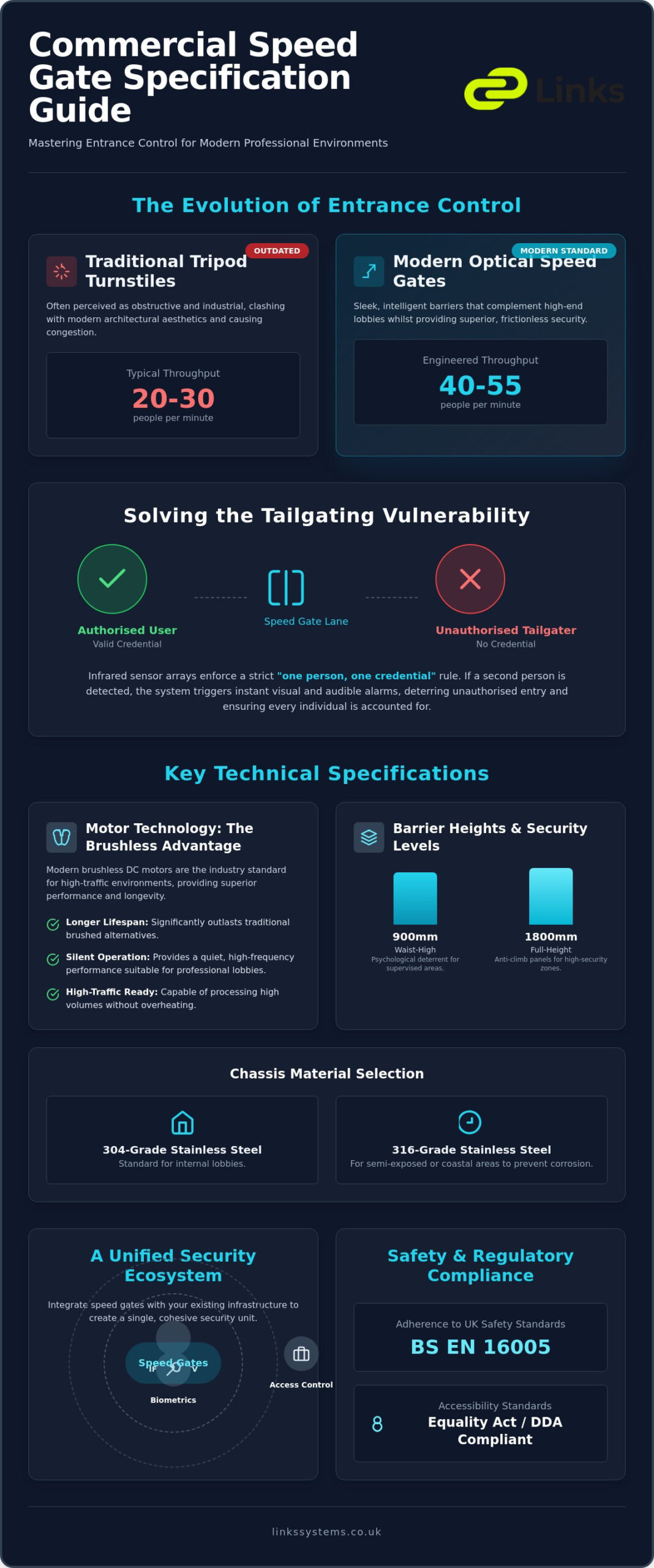
Efficiency is the primary driver for high-occupancy buildings. Whilst a traditional tripod turnstile might process 20 to 30 people per minute, modern commercial speed gates are engineered for a throughput of 40 to 55 pedestrians per minute. This capacity is essential during the morning peaks found in major business hubs. Beyond speed, these systems use sophisticated infrared sensor arrays to distinguish between a single user and someone attempting to follow closely behind. This level of precision allows for a hands-free experience that doesn’t compromise the safety of the perimeter or the comfort of the user. For a detailed breakdown of how these two technologies compare across key performance metrics, our guide to speed gates vs turnstiles provides the comprehensive analysis needed to make an informed procurement decision.
The Problem of Tailgating in Commercial Real Estate
Tailgating remains one of the most persistent security vulnerabilities in commercial properties. It’s not just a minor nuisance; it’s a breach that can void building insurance policies and compromise fire safety protocols. Speed gates enforce a strict “one person, one credential” rule. If the sensor array detects a second person entering the lane without a valid badge swipe, the system can trigger immediate visual and audible alarms. This proactive deterrent ensures that every individual inside the building is accounted for, providing peace of mind for both facility managers and tenants. By automating this process, businesses reduce the pressure on reception staff, allowing them to focus on visitor hospitality rather than gatekeeping.
Key Technical Specifications: Motor Types, Glass Heights, and Security Levels
The physical hardware of commercial speed gates represents the technical execution of a wider security strategy. Choosing the right internal and external components ensures that these systems enhance and automate lobby security without creating mechanical bottlenecks. Precision in the specification phase prevents common operational failures and ensures the system remains fit for purpose throughout its lifecycle.
Industry standards in 2026 favour brushless DC motors or servo motors for high-traffic environments. These units provide silent, high-frequency operation and a significantly longer lifespan than traditional brushed alternatives. They’re capable of processing high volumes of traffic without overheating, which is vital for busy London office blocks. The motor’s responsiveness also dictates the opening speed, which is typically adjustable to suit the specific flow of the building.
Barrier specifications should be tailored to the specific risk profile of the entrance.
- Waist-high panels: Usually measuring approximately 900mm, these offer a psychological deterrent for supervised lobbies where staff are present.
- Full-height anti-climb panels: Extending up to 1800mm, these prevent physical intrusion and are necessary for unmanned areas or high-security zones.
- Chassis materials: 304-grade stainless steel is the standard for internal lobbies, whilst 316-grade is specified for semi-exposed areas or locations near the coast to prevent corrosion.
DDA Compliance and Accessibility Standards
UK law, specifically the Equality Act 2010, requires that building access is inclusive for all users. Standard lanes for commercial speed gates usually measure around 600mm, but at least one wider lane of 900mm or more must be provided for wheelchair users and deliveries. These wider lanes use identical aesthetic finishes to ensure they don’t look out of place amongst the standard array. Modern sensors include anti-crush technology, ensuring the glass panels stop immediately if they detect an obstruction, protecting vulnerable users from accidental contact.
Environmental and Durability Factors
For gates positioned in semi-exposed reception areas or external courtyards, IP (Ingress Protection) ratings are a critical specification to prevent moisture damage. Toughened safety glass is the standard, but the thickness can range from 10mm to 15mm depending on the required impact resistance. Finishes like satin-brushed steel or anti-fingerprint coatings help maintain a premium appearance despite high daily contact. If you’re currently drafting a tender, you can view our technical specifications to see how these components fit into a professional system design.
Configuration also plays a role in throughput. “Normally closed” gates remain shut until a valid credential is presented, whilst “normally open” gates stay open and only close when an unauthorised attempt is detected. The latter configuration can increase pedestrian flow but requires faster motor response times to be effective as a security barrier.
Strategic Integration: Linking Speed Gates with IP CCTV and Access Control
A standalone barrier is only as effective as the data driving it. In professional environments, commercial speed gates act as the physical “handshake” of an integrated security strategy. They serve as the point where digital permissions translate into physical movement. Rather than operating in isolation, these lanes should be fully synchronised with your broader access control infrastructure to ensure that security data flows seamlessly from the server to the pedestal. This level of connectivity is what transforms a simple gate into a sophisticated security asset. For a comprehensive framework covering the full scope of this approach, our guide to access control systems UK provides the strategic detail needed to eliminate fragmented security vulnerabilities.
Modern installations increasingly move away from traditional proximity cards in favour of biometric and mobile-based credentials. Integrating facial recognition or fingerprint scanning directly at the lane provides a high-assurance modern access control solution that eliminates the risk of lost or shared badges. For staff, the use of encrypted mobile credentials on smartphones allows for a truly frictionless entry. As they approach the speed gate, the system identifies the device via Bluetooth or NFC, opening the glass panels without the need for physical contact. We focus on this technical synchronicity, ensuring that hardware from different manufacturers communicates without latency or software conflicts. Organisations looking to eliminate security silos entirely will find that achieving effective physical security integration for commercial buildings is the critical next step toward a truly unified, high-performance security ecosystem.
Visual Verification with IP HD CCTV
Visitor Management and IP Video Intercoms
The visitor journey begins long before they reach the lobby desk. Integrated systems allow for the generation of temporary QR codes, sent directly to a visitor’s email. Upon arrival, the visitor scans the code at the speed gate, which grants access only to the authorised floor. If a visitor encounters an issue, IP video intercoms integrated into the gate pedestal allow for immediate communication with a remote reception team. This automation streamlines the arrival process, ensuring that guests feel welcomed whilst maintaining the integrity of the building’s secure perimeter.
The Installation Journey: Surveying, Fitting, and System Commissioning
Successful deployment of commercial speed gates relies on a structured project workflow that begins long before the hardware arrives on site. It isn’t merely about bolting pedestals to a floor. It’s about ensuring the physical environment and digital infrastructure can support high-frequency mechanical operation over several decades. Precision at this stage prevents future downtime and ensures the system integrates seamlessly with your existing fire safety and building management protocols.
Coordinating with other trades is a vital part of the fit-out process. Electrical contractors, IT teams, and flooring specialists must work in synchronicity to ensure cabling routes are correctly positioned and power supplies are sufficient. For developments that also require broadcast signal distribution, specialists like The TV Man can ensure that satellite and digital TV infrastructure is professionally integrated alongside the security fit-out. We act as a steady hand during this phase, managing the technical requirements to prevent the common delays that occur when hardware and infrastructure aren’t perfectly aligned.
Site Surveys in London and the South East
Navigating the logistical challenges of high-rise installations in the City requires meticulous planning for floor loading. Many modern offices use raised access flooring, which necessitates specific structural reinforcement to ensure the gates remain stable under the torque of rapid motor movements. In older sites across Kent or Surrey, we assess whether existing power and data infrastructure can handle modern IP-based security requirements. A bespoke site survey is the only way to guarantee the structural and electrical compatibility of new speed gates.
The Commissioning Phase Explained
While many contractors offer simple installation, professional commissioning is the most critical step for system reliability. This phase involves the fine-tuning of infrared sensor arrays to match the specific lighting and reflective conditions of your lobby. We configure sensor sensitivity to prevent false alarms whilst maintaining strict security against tailgating. This process ensures the “anti-pinch” safety features are fully operational and compliant with UK standards. We don’t consider a project complete until the hardware and software are in perfect harmony.
We perform rigorous stress-testing during peak flow simulations to verify that the gates can handle the maximum expected throughput without latency. The journey concludes with a comprehensive handover, where your team is trained on emergency override procedures and system management. To ensure your project starts with this level of technical rigour, you can book a professional site survey with our engineering team. This proactive approach ensures your security investment is protected from the first day of operation.
Ensuring Long-Term Reliability: Maintenance and Safety Compliance
Professional commercial speed gates represent a significant capital investment. To protect this asset, facility managers must move away from a reactive repair mindset in favour of a programme of proactive preventative maintenance. High-cycle mechanical components, such as the brushless DC motors mentioned earlier, require periodic inspection to ensure they continue to operate within specified tolerances. Regular servicing doesn’t just prevent downtime. It extends the operational life of the entire entrance system and ensures the optical sensors remain accurately calibrated against tailgating.
A system is only as good as its last service. Whilst the initial commissioning sets the baseline for performance, the stresses of processing thousands of pedestrians daily will lead to mechanical wear if left unmonitored. We provide ongoing technical support to ensure that your security hardware remains as reliable in its tenth year as it was on the first day of operation.
Safety Standards and Legal Obligations
Compliance with BS EN 16005 is a mandatory requirement for power-operated pedestrian doors in the United Kingdom. This standard dictates the safety requirements for the design, installation, and maintenance of commercial speed gates to protect users from potential injury. Building owners have a legal responsibility to ensure their equipment is safe for use by staff and visitors alike. This obligation involves documented force testing and the regular verification of safety edge sensors to prevent accidental impact. In the event of a fire alarm activation, the system must be configured to fail-safe, ensuring the glass panels automatically move to the open position to allow for an unhindered emergency evacuation.
Tailored Maintenance Contracts
Effective maintenance goes beyond simple mechanical checks. Future-proofing your security infrastructure involves regular firmware updates to protect the system against evolving digital threats. Modular hardware designs also allow for the integration of newer biometric technologies as your building requirements change. We provide the steady, experienced hand needed to manage these complex technical cycles. You can secure your premises with professional speed gate maintenance and installation from Links Integrated Systems, ensuring your lobby remains both secure and compliant for years to come.
Securing Your Professional Perimeter for the Future
Specifying the right security entrance is a decision that impacts building safety and staff experience for years. We’ve explored how modern commercial speed gates serve as the vital intersection between physical barriers and digital access control systems. Success depends on precise technical alignment, from selecting high-frequency brushless DC motors to ensuring full integration with IP HD CCTV for real-time visual verification of every entry event.
With over 40 years of industry experience, Links Integrated Systems understands the unique logistical and regulatory challenges of London and the South East. Our team acts as a steady hand for corporate clients, managing the full project lifecycle from initial survey to long-term system health. Our focus remains on specialist commissioning and proactive maintenance to guarantee that your infrastructure meets BS EN 16005 standards consistently. We’re here to help you navigate these complex technical requirements with professional assurance.
Discuss your speed gate requirements with our expert team to ensure a secure, compliant, and frictionless future for your premises.
Frequently Asked Questions
What is the difference between a speed gate and a speed lane?
Speed gates and speed lanes are terms often used interchangeably in the UK security industry, but they have subtle distinctions. A speed gate specifically refers to the entire motorised system including the glass barriers. A speed lane typically describes the optical sensor-controlled path that the user walks through. Most modern commercial speed gates are high-throughput optical systems that combine both elements to manage pedestrian flow efficiently.
Are commercial speed gates DDA compliant for wheelchair users?
Yes, these systems are fully DDA compliant when the installation includes at least one wide-access lane. Whilst standard lanes provide a 600mm width, compliant lanes offer a minimum 900mm clearance to accommodate wheelchair users, pushchairs, and deliveries. This ensures your premises meet the requirements of the Equality Act 2010 whilst maintaining a consistent aesthetic across the entire entrance array.
Can speed gates be integrated with my existing office access control system?
Most professional speed gates are designed with open-platform architecture, allowing them to act as a physical relay for your current access control hardware. They interface directly with existing IP-based controllers, whether you utilise proximity cards, encrypted mobile credentials, or biometric scanners. Our commissioning process focuses on ensuring this digital handshake is seamless and operates without latency.
How many speed gate lanes do I need for my building’s occupancy?
The number of lanes required is determined by your peak throughput during the busiest morning or evening periods. A single lane can process between 40 and 55 pedestrians per minute. For a building with 500 staff arriving within a short 15-minute window, we typically recommend a three-lane array to prevent congestion and ensure a frictionless entry experience for all users.
What happens to the speed gates during a fire alarm or power cut?
In the event of a fire alarm activation or total power failure, the system is configured to fail-safe to an open position. This is a mandatory safety requirement that ensures an unhindered emergency exit route for occupants. The glass panels automatically retract or swing open, powered by either an internal backup battery or a mechanical spring release system, depending on the specific model specified.
Do speed gates require regular safety testing under UK regulations?
Yes, UK regulations under BS EN 16005 require that all power-operated pedestrian doors receive regular safety testing. This includes documented force testing of the barriers and verification of the infrared safety sensors to protect users from injury. Regular maintenance is essential for building owners to demonstrate compliance with health and safety obligations and to ensure insurance policies remain valid.
How long does a typical commercial speed gate installation take?
A standard three-lane installation usually takes between three and five working days to complete once site preparation is finished. This timeframe covers the physical mounting of pedestals, cable termination, and the critical commissioning phase. More complex projects involving structural floor reinforcement or bespoke software integration may require a longer schedule, which we outline during the initial site survey.
Can speed gates be installed in buildings with limited floor depth?
Speed gates can be successfully installed in buildings with limited floor depth by utilising surface-mount plinths or slimline pedestal designs. These solutions allow for secure mounting without the need for deep core drilling into the subfloor or structural slab. If your building has shallow raised access flooring, we can specify hardware that distributes the weight and torque loads safely across the existing surface.
27 Comments
Speed Gate Installation in Essex: Professional Access Control for Commercial Hubs – Links Integrated Systems
11 July 2026[…] environments. For a detailed breakdown of the latest hardware options and technical benchmarks, our professional commercial speed gates specification guide for 2026 provides comprehensive technical clarity on selecting the right system for your […]
Access Control Maintenance Contract: A Guide to Commercial System Reliability – Links Integrated Systems
12 July 2026[…] daily operational stress. Maintenance engineers must focus on testing the alignment and torque of commercial speed gates to prevent mechanical fatigue and ensure pedestrian safety. Optical sensors within these barriers […]
Visitor Management System for Office Buildings: Integrating Security and Efficiency in 2026 – Links Integrated Systems
13 July 2026[…] lobbies often suffer from congestion during morning peaks. By Managing Pedestrian Flow in London Office Buildings, you can separate permanent staff from guests. Speed gates can be programmed to respond differently […]
Automatic Rising Bollards for Commercial Premises: A Professional Specification Guide – Links Integrated Systems
14 July 2026[…] visitor management requires visual and data-driven verification. Linking bollards to IP video intercom systems allows reception staff or remote operators to verify a driver’s identity before lowering the […]
The Complete Guide to Links Integrated Systems: 40 Years of Commercial Security Excellence – Links Integrated Systems
15 July 2026[…] throughout the day. For those looking to refine their facility’s entry points, exploring our commercial speed gates guide offers a technical roadmap for 2026 […]
Commercial Security System Maintenance Plan: Ensuring Operational Reliability in 2026 – Links Integrated Systems
16 July 2026[…] of their hardware. Finally, ensure your provider is authorised to work on your specific brands of commercial speed gates, as uncertified tampering can void warranties and compromise safety […]
Evaluating Access Control Companies: A Guide for UK Commercial Property Managers – Links Integrated Systems
17 July 2026[…] station. For property managers looking to specify the correct hardware for their facility, our Professional Speed Gates & Barriers: A Specification Guide provides detailed technical insights into the latest 2026 […]
Commercial CCTV Maintenance in Hertfordshire: The Professional Reliability Checklist – Links Integrated Systems
18 July 2026[…] Our maintenance programmes often extend beyond cameras to include the seamless operation of commercial speed gates and access control systems. This holistic view ensures that visual verification and physical entry […]
Physical Security Integration for Commercial Buildings: The 2026 Professional Guide – Links Integrated Systems
19 July 2026[…] conflicts during the installation phase. Detailed guidance on this process is available in our Professional Commercial Speed Gates & Barriers: The 2026 Specification Guide. If you are currently drafting a project specification, our team can provide the technical support […]
Business Access Control Systems: A Professional Resource for 2026 – Links Integrated Systems
20 July 2026[…] by security protocols. For project managers, selecting the right hardware involves a detailed Professional Commercial Speed Gates & Barriers specification to match the specific flow requirements of the […]
Commercial CCTV Maintenance London: The Professional Specification Guide for 2026 – Links Integrated Systems
21 July 2026[…] The technical link between CCTV and physical barriers must be tested with the same rigour as the cameras themselves. In a professional setup, CCTV cameras often trigger specific recording events based on speed gate activity or provide visual verification for IP video intercoms. If this link fails, the context of an entry event is lost, rendering the footage less useful for forensic purposes. Regular commercial cctv maintenance london involves verifying these communication paths to ensure every visitor interaction is documented. For a deeper look at the physical hardware involved, see our guide on Professional Commercial Speed Gates & Barriers. […]
High-Rise Building Access Control: A Professional Guide to Vertical Security 2026 – Links Integrated Systems
22 July 2026[…] for pedestrian entrance control. For a detailed breakdown of hardware options, consult our Professional Commercial Speed Gates & Barriers specification […]
Commercial Video Security Systems: The 2026 Professional Explainer – Links Integrated Systems
23 July 2026[…] most significant operational gain comes from synchronising CCTV feeds with commercial speed gates and barriers. This connection enables a visual audit of every individual who passes through a […]
Commercial Video Surveillance Systems: The 2026 Professional Reference Guide – Links Integrated Systems
24 July 2026[…] wider access control strategy. This synergy is particularly effective when cameras are paired with commercial speed gates. Whilst a barrier provides the physical block, the surveillance system provides the visual […]
Cloud Access Control for Business: 2026 Professional Guide – Links Integrated Systems
25 July 2026[…] in the City requires precision. Cloud triggers allow facility managers to adjust the behaviour of professional commercial speed gates & barriers based on real-time data or pre-set schedules. For business parks in Kent or Surrey, this […]
Speed Gates vs Turnstiles: Choosing the Right Access Control Solution for Your Premises – Links Integrated Systems
28 July 2026[…] profile, or sliding panels that retract into the pedestal. Integrating these physical barriers with commercial access control systems and IP intercoms allows for seamless visitor management, where temporary digital credentials can be […]
Integrating CCTV with Access Control Systems: A 2026 Professional Specification Guide – Links Integrated Systems
29 July 2026[…] high-definition imaging with physical barriers. For instance, the strategic placement of cameras at commercial speed gates ensures that every badge swipe is accompanied by a clear, high-contrast facial image. This goes […]
Entrotec vs Comelit Video Intercom: A 2026 Specification Comparison – Links Integrated Systems
31 July 2026[…] proactive approach to System Maintenance & Commissioning is essential for protecting critical security infrastructure. For Entrotec systems, this typically […]
Integrated Security System Installers in London: 2026 Commercial Roundup – Links Integrated Systems
31 July 2026[…] commercial speed gates is a task that combines heavy mechanical engineering with sensitive electronic calibration. […]
Commercial Security System Maintenance London: The 2026 Professional Checklist – Links Integrated Systems
1 August 2026[…] methodology focuses on total system readiness. When configuring commercial speed gates, we don’t just check for movement; we calibrate torque and timing to prevent mechanical fatigue […]
Speed Gate Servicing in Hertfordshire: The Professional Maintenance Checklist 2026 – Links Integrated Systems
4 August 2026[…] gates do not operate in isolation. They must be perfectly synchronised with your wider access control systems to ensure rapid response times. This audit involves testing RFID card readers and QR code scanners […]
Professional Automatic Barrier Maintenance in Essex: Ensuring Security and Compliance – Links Integrated Systems
5 August 2026[…] duty cycle of the hardware. When specifying high-performance systems, we often refer clients to our Professional Commercial Speed Gates & Barriers guide, which outlines how hardware selection influences long-term care […]
Professional Video Intercom System Maintenance in London: The 2026 Guide – Links Integrated Systems
6 August 2026[…] ecosystem. Effective maintenance ensures that the signal from the entry station correctly triggers commercial speed gates and communicates with the central security desk. In high-rise environments, the complexity of IP […]
Office Access Control Solutions in Kent: The 2026 Specification Guide – Links Integrated Systems
7 August 2026[…] Traditional turnstiles often create bottlenecks during peak hours, leading to frustration and entry delays. Speed gates have become the gold standard for modern Kent office lobbies because they offer significantly higher throughput without compromising safety. These systems utilise advanced infrared sensors and anti-tailgating technology to detect unauthorised followers in real time. For a deeper look at specific dimensions, glass heights, and motor types, you can refer to our professional commercial speed gates guide. […]
Professional Business CCTV Installation in Surrey: A 2026 Specification Guide – Links Integrated Systems
8 August 2026[…] as a core component of a larger, unified ecosystem. By linking high-definition video feeds with commercial speed gates and barriers, facilities managers gain immediate visual context for every access event. This integration allows […]
Professional Paxton Net2 Maintenance in London: A Comprehensive Guide – Links Integrated Systems
12 August 2026[…] with sophisticated lobby hardware that requires specialised attention. Our deep-rooted knowledge of commercial speed gates allows us to ensure that the communication between Paxton Net2 software and physical barriers is […]
Office Door Entry Systems UK: The 2026 Professional Specification Guide – Links Integrated Systems
13 August 2026[…] two people attempting to enter together. For those drafting technical requirements, our guide on commercial speed gates provides the specific parameters needed for professional commissioning and long-term […]