

Did you know that whilst 20% of enterprises have now transitioned to mobile authentication, a significant number of UK organisations still rely on legacy technology that is easily compromised by cloning? You likely recognise the frustration of managing disparate entry points across multiple sites, especially when your existing security logs fail to integrate with your CCTV. Relying on an outdated key card entry system for business doesn’t just create administrative friction; it leaves your physical assets and personnel exposed to evolving risks.
At Links Integrated Systems, we understand that true security requires a composed and methodical approach to integration. This guide serves as a professional resource for 2026, offering a comprehensive look at how to specify, commission, and maintain commercial access control that aligns with the latest UK safety standards, including the September 2026 updates to Approved Document B. We’ll explore the shift from traditional credentials to secure RFID and NFC technologies, ensuring your site remains both compliant and highly functional. You’ll gain a clear roadmap for streamlining visitor management and protecting your capital investment through expert system maintenance.
Key Takeaways
- Understand how modern access control has evolved into a sophisticated ecosystem of hardware and software designed for data-driven identity management.
- Learn to specify a secure key card entry system for business by combining encrypted smart cards with mobile HID credentials and biometric authentication.
- Compare the scalability of cloud-based management with the data sovereignty of on-premise infrastructure to find the optimal fit for your organisation’s security profile.
- Gain insights into managing complex vertical flow in London skyscrapers and securing large-scale logistics perimeters through integrated speed gates and barriers.
- Recognise the critical importance of professional commissioning to ensure your access logs, CCTV, and fire systems operate as a single, unified security environment.
The Evolution of Business Access Control Systems in 2026
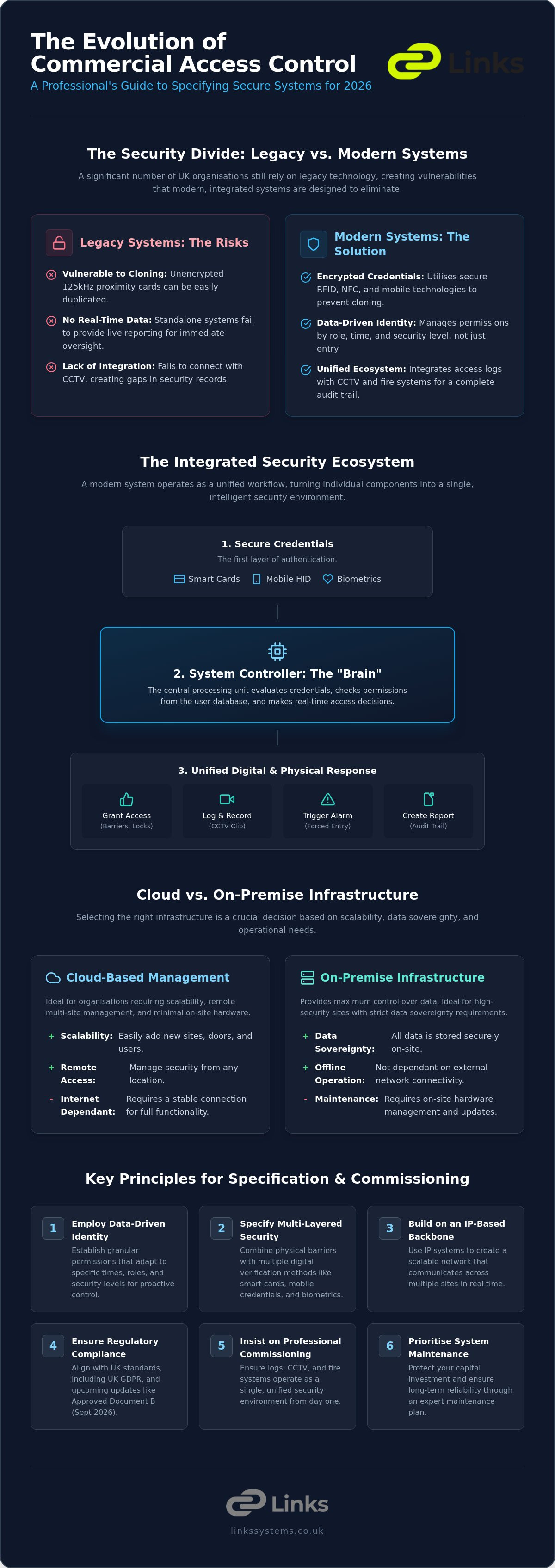
Modern security infrastructure has moved far beyond the mechanical constraints of traditional lock and key sets. In 2026, we view Access Control as a sophisticated, integrated ecosystem where hardware and software converge to manage identity rather than just physical entry. This transition towards data-driven identity management allows organisations to establish granular permissions that adapt to specific times, roles, and security levels. It’s a shift from reactive hardware to a proactive security model.
For professional environments in the UK, a single point of failure is no longer acceptable. High-security sites now require multi-layered entry protocols that combine physical barriers with digital verification. IP-based systems form the backbone of this 2026 security architecture, providing a scalable network that communicates across multiple sites in real time. This connectivity ensures that security managers maintain a steady, authoritative hand over their entire estate from a centralised interface.
Why Traditional Systems are Falling Behind
Standard proximity cards, once the industry benchmark, now present significant risks. These legacy credentials are often unencrypted, making them vulnerable to cloning and unauthorised duplication with inexpensive, readily available tools. A key card entry system for business that lacks modern encryption exposes the organisation to “replay attacks” where a signal is captured and reused by an intruder. The risk is no longer theoretical; it’s a documented vulnerability in older 125kHz systems.
Beyond security flaws, standalone systems fail to provide the real-time reporting required for modern oversight. In high-traffic London offices, the administrative cost of inefficient visitor management is substantial. Without live data, facilities managers can’t accurately track occupancy or respond immediately to security breaches. This lack of transparency leaves the premises reactive and vulnerable to internal and external threats.
The Rise of Integrated Physical Security
Modern access control doesn’t exist in isolation. It links directly with IP HD CCTV and video intercoms to provide a visual record of every entry event. When a credential is presented, the system triggers a timestamped video clip, creating a robust audit trail essential for insurance compliance and health and safety regulations. These logs are vital for meeting UK GDPR requirements and demonstrating a duty of care to employees. Integrated access control is the unification of physical barriers and digital verification into a single, manageable platform. By selecting a modern key card entry system for business, project managers ensure that speed gates, barriers, and readers work in unison to maintain a secure, seamless flow of authorised personnel.
Core Components: Integrating Readers with Physical Barriers
A sophisticated key card entry system for business relies on the seamless coordination between digital intelligence and physical obstacles. The system controllers act as the central processing units, evaluating data from readers before triggering a physical response. These “brains” manage the database of authorised users and ensure that every entry attempt is logged in real time. Without this robust processing layer, the security of the site remains fragmented and vulnerable to bypass.
Effective security requires more than just a digital signal; it necessitates the presence of physical deterrents. In high-traffic corporate environments, electronic readers must be integrated with speed gates, turnstiles, or heavy-duty magnetic locks. This synergy ensures that once a credential is validated, the physical barrier facilitates immediate, authorised passage. For vehicle access, integrating readers with automated barriers and bollards allows for secure management of staff parking and loading bays, extending the security perimeter to the very edge of the property.
Speed Gates and Pedestrian Flow Management
In London’s financial districts, the challenge lies in balancing high-speed throughput with rigorous security checks. Modern speed gates provide a sleek, aesthetic solution that complements corporate lobby design whilst preventing tailgating. These systems are engineered to handle hundreds of users per hour, ensuring that employee productivity isn’t hindered by security protocols. For project managers, selecting the right hardware involves a detailed Professional Commercial Speed Gates & Barriers specification to match the specific flow requirements of the building.
Advanced Credential Technologies
The choice of credential significantly impacts both security and user experience. Whilst encrypted smart cards remain a dependable standard, many organisations are adopting mobile credentials that allow employees to use smartphones for touchless entry. Biometric systems, including facial recognition, offer a higher tier of security for sensitive areas, though they require meticulous UK GDPR compliance regarding the storage of biometric data. For managing remote deliveries and visitor access, IP video intercom systems provide a vital layer of visual verification, allowing security personnel to communicate with and grant access to guests from a centralised control room. A thorough assessment of your site’s physical requirements is the first step towards a resilient access control strategy.
Cloud vs. On-Premise: Selecting the Optimal Infrastructure
Selecting the underlying infrastructure for a key card entry system for business is a foundational decision that influences long-term operational costs and security resilience. While the trend towards cloud adoption is accelerating, with the cloud-based access control systems for business market growing at nearly 18% annually according to MarketsandMarkets (March 2026), the choice between cloud and on-premise deployments depends entirely on your specific sector requirements and risk profile. It’s a balance between ease of management and absolute data sovereignty.
For multi-site UK businesses, cloud-based systems offer unparalleled scalability. Security managers can push instant updates to access privileges across multiple geographic locations from a single operations centre. This setup eliminates the need for extensive on-site server hardware, reducing both the initial capital expenditure and ongoing energy costs. These platforms often integrate seamlessly with wider building management systems (BMS), allowing for automated lighting and climate control based on real-time occupancy data. This synergy doesn’t just improve security; it enhances overall building efficiency.
The Case for Centralised Cloud Management
Cloud infrastructure allows for a proactive service model where software updates and security patches are applied automatically. This ensures that your system is always running the latest version without the need for manual intervention on-site. For organisations with offices in London and logistics hubs in Kent, the ability to manage the entire estate from a single dashboard provides a level of oversight that was previously unattainable with localised systems. It simplifies the administrative burden on facilities teams and ensures a consistent security posture across all locations.
When Localised On-Premise Systems are Essential
Despite the rise of cloud technology, on-premise solutions remain the standard for sensitive sectors where data sovereignty is paramount. High-security environments, such as those in defence or certain financial institutions, often require air-gapped systems that prevent any external interference. These setups ensure that all access logs and credential data remain strictly within the local network, fulfilling rigorous compliance standards. When Evaluating Access Control Companies, it’s vital to choose a partner who understands the nuances of these localised deployments and the technical requirements of UK data protection laws.
A hybrid key card entry system for business provides a failsafe by combining local reliability with cloud convenience. This ensures that even if the internet connection is lost, the doors remain functional and secure. When evaluating the total cost of ownership over a five-year lifecycle, you must account for more than just hardware. Research indicates that software licensing, professional maintenance, and credential replacement can add between 25% and 40% to the initial project quote. A methodical approach to budgeting ensures that your investment remains protected and your site stays secure for years to come.
Specifying Access Control for London and the Home Counties
Specifying a key card entry system for business requires a deep understanding of the local geographic and architectural landscape across the South East. In London, the primary challenge for property managers is managing vertical flow within high-rise skyscrapers. This involves complex lift integration where the access control system communicates directly with destination dispatch elevators. By verifying credentials at the ground floor speed gates, the system automatically assigns a lift to the user’s authorised floor. This reduces lobby congestion and enhances security by ensuring personnel only access the levels permitted by their specific profile. For a detailed examination of these vertical security challenges, our guide to high-rise building access control provides comprehensive specification guidance for multi-storey environments.
Contrast this with the requirements for logistics hubs in Kent and Essex. Here, the focus shifts to securing expansive perimeters and managing heavy vehicle traffic. Integrated systems must coordinate long-range readers with automated barriers and IP HD CCTV to verify haulage contractors before they enter the site. In the business parks of Surrey and Hertfordshire, the requirement is often to maintain an open, campus-like feel whilst ensuring that individual buildings remain strictly secure. This involves a blend of discreet hardware and robust software permissions that protect assets without creating an oppressive environment for employees.
Sector-Specific Security Requirements
In the City, office environments prioritise seamless visitor management. Modern systems allow for the pre-registration of guests, providing them with temporary QR codes or mobile credentials that expire automatically. For industrial and warehouse sites, heavy-duty barriers and vehicle access control are essential to withstand the rigours of 24-hour logistics operations. Retail and leisure sectors, however, require discreet security solutions. The goal is to protect high-value stock and staff areas without creating an intimidating atmosphere for customers or guests.
Local Compliance and Standards
UK insurance providers have rigorous requirements for commercial security installations. Systems must not only be effective but also professionally commissioned to ensure they meet specific risk assessments. Fire safety integration is a critical component of this compliance. Locks must be configured as “fail-safe” on emergency egress routes, ensuring they release during a power failure or fire alarm activation, whereas sensitive internal server rooms may require “fail-secure” setups. Adherence to ‘Secured by Design’ standards is now a necessity for new commercial developments to ensure a baseline of physical security is built into the fabric of the property. For a solution tailored to your specific regional requirements, you can consult with our regional specialists to ensure your site meets all current UK regulations.
The Critical Role of Professional Commissioning and Maintenance
A key card entry system for business is an investment in long-term security infrastructure, not a one-time purchase. While the physical installation of readers and barriers is a significant milestone, the commissioning phase is what determines the system’s ultimate reliability and effectiveness. Professional commissioning is a methodical process that bridges the gap between hardware installation and a fully operational, secure environment. It ensures that every component performs exactly as specified in the original design documents.
At Links Integrated Systems, we view commissioning as a rigorous verification of the entire security ecosystem. This includes testing the critical integration points between access control, IP HD CCTV, and fire safety systems. For example, a fire alarm activation must trigger an immediate, fail-safe release of all emergency egress doors. Simultaneously, the access system should provide a real-time muster report whilst the CCTV cameras move to pre-set positions to monitor the evacuation. These complex interactions require a steady, experienced hand to programme and verify correctly.
What Professional Commissioning Entails
The commissioning process involves a deep-dive into database integrity and user permission levels. Every reader must be tested against different credential types to ensure that authorised personnel have seamless passage whilst unauthorised attempts are correctly logged and blocked. We also conduct stress-testing of physical hardware, such as speed gates and barriers, during simulated peak traffic hours. This ensures that the system can handle the high-throughput demands of a busy London lobby without causing delays. For project managers, following a structured Access Control Installers Checklist is a vital step in ensuring these standards are met before the site goes live.
Planned Preventative Maintenance (PPM)
Regular maintenance is essential for protecting your capital investment and ensuring hardware longevity. Speed gates and vehicle barriers are precision mechanical instruments that require periodic adjustment, lubrication, and alignment to prevent premature wear. Beyond the physical hardware, software firmware updates are a critical component of any maintenance schedule. These updates protect against evolving threats and ensure that your key card entry system for business remains compatible with new mobile credentials or operating system changes.
Engaging a local maintenance partner across London, Kent, Surrey, Hertfordshire, and Essex provides the peace of mind that expert assistance is always within reach. With over 40 years of industry experience, we understand that a proactive maintenance model is far more cost-effective than reactive repairs. It reduces the risk of business disruption and ensures that your security remains a dependable pillar of your daily operations. This commitment to precision and long-term stability is what defines a truly professional security partnership.
Securing the Future of Your Commercial Estate
Modern security requires a methodical approach that balances high-speed pedestrian flow with uncompromising safety standards. We have explored how a robust key card entry system for business now integrates directly with IP CCTV and fire safety protocols to create a unified, data-driven ecosystem. Selecting the correct infrastructure is only the start; the true value of your investment is realised through professional commissioning and planned maintenance that ensures long-term reliability and compliance with current UK regulations.
With over 40 years of industry experience, Links Integrated Systems remains a dependable partner for project managers and stakeholders across London, Kent, Surrey, Hertfordshire, and Essex. We specialise in professional commissioning to guarantee that every integration point is fully verified and resilient against evolving threats. Our local expertise ensures that your installation meets the rigorous standards expected of a modern commercial environment whilst providing a seamless experience for authorised personnel.
Speak to our specialist team about your commercial access control requirements to establish a secure, stable foundation for your business premises. We look forward to helping you protect your capital investment with proven, high-quality solutions.
Frequently Asked Questions
What are the best access control systems for small businesses in the UK?
The most effective systems for UK small businesses are those that offer scalability through cloud-based management. These platforms allow for easy expansion as the organisation grows without requiring significant upfront investment in on-site servers. Selecting a system with open architecture ensures that you don’t become locked into a single hardware provider, allowing for future-proofed security that adapts to changing operational requirements and budget constraints.
How much does a commercial access control system cost per door?
Industry data suggests that the total first-year cost for a professional installation typically ranges between £1,200 and £3,500 per door. This estimate includes the necessary hardware, software licensing, and professional configuration. High-end biometric systems or those requiring extensive cabling in heritage buildings may exceed these averages. It’s essential to consider the total cost of ownership, as software subscriptions and maintenance can add 25% to 40% to the initial project budget.
Can I integrate my existing CCTV with a new key card entry system?
Most modern IP-based systems allow for seamless integration between your CCTV and a new key card entry system for business. This unification enables security teams to view timestamped video footage associated with specific entry events, providing a robust audit trail. By linking these systems, you can automate camera triggers to record whenever an unauthorised credential is presented or a door is forced, significantly enhancing the visual verification capabilities of your site.
What is the difference between a fail-safe and fail-secure lock?
A fail-safe lock releases automatically when power is cut, whilst a fail-secure lock remains locked during a power failure. Fail-safe configurations are typically required on emergency egress routes to ensure life safety and compliance with UK building regulations. Fail-secure locks are reserved for high-security areas, such as server rooms, where protecting assets is the priority. The choice depends entirely on the specific risk assessment and fire safety requirements of each entry point.
Do I need a specific data processing agreement for biometric access control?
Yes, organisations using biometric data must comply with UK GDPR by conducting a Data Protection Impact Assessment (DPIA). Since biometric data is classified as special category data, you must establish a clear legal basis for processing and ensure that data is stored securely, often using encryption or templates rather than raw images. You should also provide a non-biometric alternative, such as a standard key card entry system for business, for employees who choose not to opt-in.
How often should commercial speed gates and barriers be serviced?
Commercial speed gates and vehicle barriers should ideally undergo planned preventative maintenance at least twice a year. High-traffic environments, such as London office lobbies or busy logistics hubs, may require more frequent inspections to ensure mechanical components remain aligned and lubricated. Regular servicing identifies minor wear before it leads to system failure, protecting your capital investment and preventing unauthorised access due to hardware malfunction or mechanical degradation.
Are mobile credentials more secure than traditional key cards?
Mobile credentials often provide superior security compared to traditional proximity cards because they utilise the smartphone’s built-in encryption and multi-factor authentication. Whilst legacy cards are often vulnerable to cloning, mobile access requires the user to unlock their device via PIN or biometrics before entry is granted. This adds a critical layer of identity verification that ensures the person presenting the credential is the authorised user, significantly reducing the risk of lost or stolen credentials.
What is the role of an IP video intercom in modern business security?
An IP video intercom serves as the primary gateway for visitor management and remote delivery verification in modern business environments. It allows security personnel to communicate with guests via high-definition video before granting access through the main entry points or speed gates. These systems integrate directly with the wider access network, enabling remote release functionality and ensuring that every visitor interaction is recorded within the centralised security logs for future audit and compliance purposes.