
A standalone lock is no longer a security strategy; it’s a single point of failure in an increasingly complex regulatory landscape. For facilities managers and contractors, the challenge has shifted from simply granting access to managing a sophisticated, data-driven ecosystem. You likely recognise the daily friction of balancing high foot traffic against the need for rigorous security, especially when trying to bridge the gap between legacy hardware and modern IP video intercoms. Maintaining seamless flow without creating bottlenecks requires more than just hardware. It demands a methodical approach to integration and a deep understanding of current British standards.
This specification guide helps you master the complexities of modern office door entry systems UK for 2026. We’ll outline how to ensure your commercial premises remain secure and compliant with the latest BS 8214:2026 fire door revisions and Building Regulations Part M. You’ll gain a clear understanding of how to integrate high-speed gates with HD CCTV and IP-based intercoms to create a unified security platform. We focus on the full lifecycle of a project, from initial design to professional commissioning, providing the technical clarity needed for long-term reliability in high-end London office environments.
Key Takeaways
- Understand how modern office door entry systems UK have evolved into integrated data ecosystems that prioritise both high-level security and high-volume pedestrian flow.
- Evaluate the technical specifications of IP video intercoms and the growing preference for mobile credentials amongst modern commercial tenants.
- Discover the strategic advantages of speed gates over traditional barriers for managing lobby congestion in professional high-rise environments.
- Master the latest 2026 compliance requirements, including the BS 8214 revisions, to ensure your access control and fire safety systems are legally sound.
- Recognise the critical role of professional commissioning and an integrated project lifecycle in ensuring the long-term reliability of your security infrastructure.
The Evolution of Office Door Entry Systems in the UK
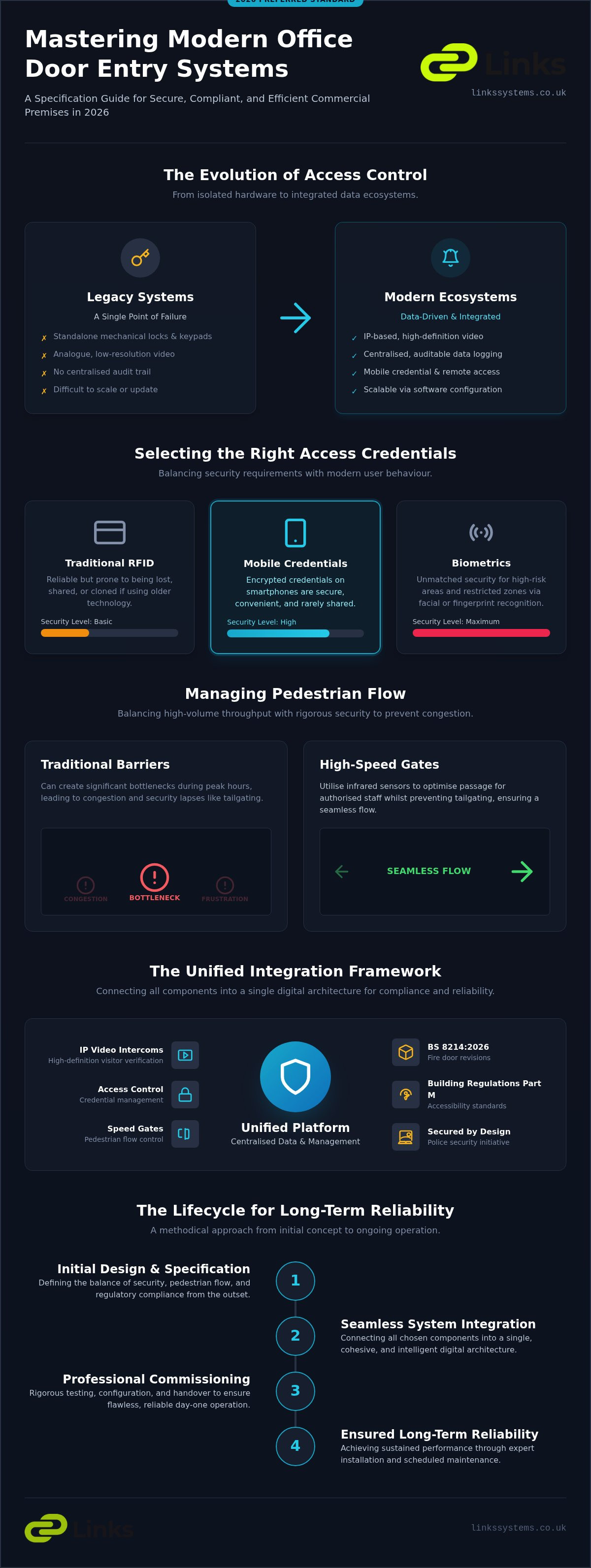
The landscape of office door entry systems UK has transformed from basic mechanical hardware into a sophisticated digital infrastructure. Professional premises no longer rely on a simple keypad; instead, they utilise a network of sensors, readers, and visual verification tools. This shift aligns with fundamental Access control principles where identity verification must be both robust and auditable. Modern stakeholders now demand systems that provide a comprehensive audit trail whilst maintaining a welcoming aesthetic for high-end corporate lobbies. Achieving this balance requires moving beyond standalone components toward a unified ecosystem where every entry point is a data point.
The Shift to IP Video Intercom Systems
Analogue systems are rapidly becoming obsolete in the UK commercial sector. The transition to IP-based video intercoms offers high-definition clarity that ensures visitor identification is undeniable. These systems aren’t just for the front desk. They integrate directly with mobile devices, allowing facility managers to oversee lobby activity remotely. For multi-tenant buildings, the scalability of IP is the favourite choice. Adding new users or departments doesn’t require complex rewiring; it’s a matter of software configuration. This flexibility ensures the hardware remains relevant as building occupancy changes, providing a future-proof solution for growing businesses.
Addressing Modern Pedestrian Flow Challenges
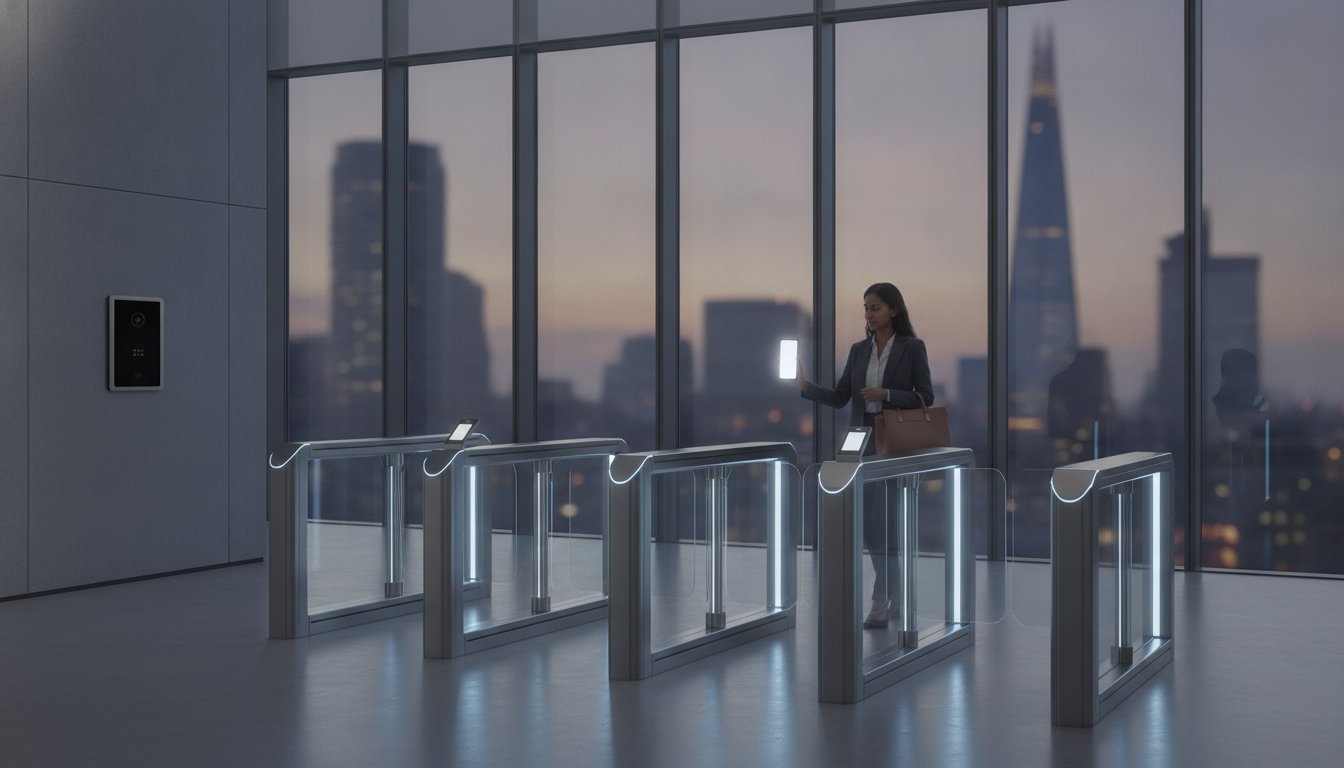
Security isn’t just about keeping people out. It’s about letting the right people in at the right speed. In London’s high-rise environments, the morning rush can create significant bottlenecks if the entry system isn’t optimised for throughput. Pedestrian flow management has become a primary security concern because congestion often leads to security lapses, such as tailgating, where frustrated employees hold doors open for others. Speed gates play a vital role here, utilising infrared sensors to monitor passage and prevent unauthorised entry without slowing down authorised staff. Balancing these rigorous “Secured by Design” standards with a sleek, minimalist aesthetic is now the benchmark for professional installations.
Integrated access control in 2026 is defined as a unified digital architecture where identity verification, physical barriers, and real-time data monitoring work in synchronisation to ensure building safety and operational efficiency.
Specifying IP Video Intercoms and Access Control
Specifying office door entry systems UK for the modern commercial environment requires a shift away from isolated hardware towards unified digital platforms. Professional-grade IP video intercoms now serve as the primary interface for visitor management, particularly in large London business centres where multi-tenant directories must be managed with precision. These systems allow reception staff or individual tenants to verify identities through high-definition visual feeds before granting access. This reduces the reliance on physical security personnel whilst maintaining a high level of scrutiny at the building’s perimeter.
The technical architecture of these systems must align with the UK Government’s Security Policy Framework, which advocates for a holistic approach to physical security. When different components of a security system operate in silos, they create vulnerabilities. A truly integrated ecosystem ensures that every intercom call, credential swipe, and door release is logged within a central database, providing the comprehensive audit trails required for modern compliance and insurance standards.
Selecting the Right Access Credentials
Choosing the correct credential is a balance between security requirements and user behaviour. Traditional RFID fobs and cards remain a staple due to their perceived reliability, yet they are prone to being lost, shared, or cloned if using older, non-encrypted technology. Mobile-based access has become the preferred standard for 2026, driven by the “bring your own device” trend. This allows employees to use encrypted credentials stored on their smartphones, which are far less likely to be shared than a plastic card. For high-security environments or restricted zones within a building, biometric options like facial recognition or fingerprinting are now appropriate, offering a tier of security that cannot be bypassed through lost hardware.
Integrating HD CCTV for Enhanced Security
A standalone intercom is often a vulnerability because it lacks visual context beyond the immediate caller. By integrating cctv with access control systems, facility managers can link video feeds directly to entry events. When a door is opened, the system can automatically flag the corresponding HD CCTV footage, allowing for immediate visual verification of who actually entered. This prevents tailgating and provides undeniable evidence during security audits. Ensuring these systems are professionally commissioned is the only way to guarantee they function as a single, dependable unit. If you are currently designing a lobby environment, you might consult with our technical specialists to ensure your hardware selection meets these rigorous integration standards.
Speed Gates vs. Traditional Barriers: Making the Choice
Selecting the correct physical barrier is a decision that impacts both the security posture and the daily experience of every occupant. In the context of office door entry systems UK, the choice often comes down to the specific requirements of the environment. London skyscrapers and high-density business centres require solutions that can manage rapid pedestrian flow without compromising the building’s aesthetic integrity. Whilst a basic tripod turnstile might suffice for a low-traffic site, it’s rarely appropriate for a professional lobby where throughput and design are paramount. These installations must align with Secured by Design standards to ensure they provide a verifiable deterrent against unauthorised access.
Speed gates have become the preferred choice for these high-specification environments. They offer a sleek, glass-fronted appearance that complements modern architecture whilst housing sophisticated sensor arrays. These sensors are critical for enforcing security protocols, ensuring that only one person passes per valid credential. If an unauthorised individual attempts to follow behind a staff member, the system triggers an immediate alert. This provides a proactive layer of security that manual checks often miss, especially during peak periods when reception staff are occupied with visitors.
The Performance Benefits of Speed Gates
The primary advantage of speed gates lies in their pedestrian throughput. High-performance models can process between 35 and 60 people per minute, per lane, depending on the credential type used. This speed is essential for avoiding lobby congestion during peak morning arrivals. Beyond simple speed, these units incorporate intelligent anti-tailgating sensors that distinguish between a single person with a bag and two people attempting to enter together. For those drafting technical requirements, our guide on commercial speed gates provides the specific parameters needed for professional commissioning and long-term reliability.
When to Use Traditional Barriers and Bollards
Whilst speed gates manage interior flow, traditional barriers and bollards remain essential for external perimeter security. In business parks across Kent and Surrey, heavy-duty vehicle barriers are the standard for controlling access to private car parks and delivery bays. These systems are designed for durability and high-cycle usage, often integrated with long-range RFID readers for seamless vehicle entry. Bollards provide a vital physical deterrent for building frontages. They protect against accidental or intentional vehicle impact, ensuring the structural integrity of the entrance remains uncompromised. Choosing the right combination of these technologies creates a multi-layered security strategy that addresses every potential point of entry.
The Importance of Professional Commissioning and Maintenance
Professional installation of office door entry systems UK is only the first step toward long-term security. The transition from physical installation to a fully operational system requires meticulous commissioning. This phase ensures that every sensor, lock, and data protocol functions as a cohesive unit. Without this rigorous validation, even the highest specification hardware can fail under the pressure of daily commercial use. Reliability is built during the handover process, not just the purchase.
A methodical approach to commissioning bridges the gap between hardware placement and technical performance. It’s during this time that the “integrated” nature of the system is truly tested. If the intercom doesn’t trigger the correct speed gate lane, or if the audit trail fails to log a mobile credential swipe, the system’s integrity is compromised. Our experience shows that professional commissioning prevents 90% of future system failures by identifying and rectifying integration conflicts before the building goes live.
The Commissioning Process: Ensuring System Integrity
Commissioning involves a systematic verification of all hardware components. This includes testing the infrared sensor arrays in speed gates to ensure they accurately detect tailgating and verifying that electronic locks release instantly during a fire alarm trigger. Software configuration is equally vital; it defines user permissions and ensures that data protocols align with the building’s wider network security. This process ensures that the system doesn’t just work on day one but remains resilient throughout its service life, providing peace of mind to stakeholders and project managers alike.
Scheduled Maintenance: Beyond Reactive Repairs
A reactive approach to security maintenance is a significant risk for London landlords and facility managers. For speed gates, quarterly mechanical inspections are essential to check for wear in moving parts and to recalibrate sensors. IP-based systems require regular software updates to patch potential cybersecurity vulnerabilities and ensure compatibility with evolving mobile credentials. Relying on “break-fix” repairs often leads to lobby bottlenecks and security lapses that could have been avoided through a structured maintenance programme.
Compliance with UK health and safety and fire regulations is a legal necessity that maintenance helps satisfy. Under the BS 8214:2026 revision, fire doors and their associated electronic release mechanisms must be inspected at least every six months in commercial buildings to ensure they function correctly in an emergency. For buildings over 11 metres, communal area checks are required quarterly. Neglecting these schedules doesn’t just compromise security; it creates significant legal liabilities for the building owner. You can ensure your premises remain fully compliant and operational by engaging with our system maintenance and commissioning services.
Implementing an Integrated Security Strategy with Links
Managing the installation of office door entry systems UK requires more than technical knowledge; it demands a structured project methodology that covers every phase of the security lifecycle. At Links Integrated Systems, we recognise that a fragmented approach, where hardware, software, and commissioning are handled by separate entities, often leads to operational gaps. By acting as a single partner for design, supply, and installation, we ensure that the integrated element of your security strategy is a reality, not just a label. This end-to-end model provides a clear line of accountability and a consistent standard of quality across the entire project, ensuring that your commercial premises remain secure and compliant with 2026 standards.
Our Approach to Integrated Systems
Our process begins with consultative design. We don’t simply supply hardware; we match technical specifications to the specific behaviour of your building’s occupants. Whether you are managing a multi-tenant lobby or a private corporate headquarters, the alignment of IP video intercoms, access control, and speed gates must be seamless. This involves a logical progression from identifying security risks to selecting hardware that satisfies both aesthetic and functional requirements. For a deeper understanding of how these elements work in unison, you can review our methodology on physical security integration for commercial buildings. This approach ensures that your infrastructure is robust, compliant, and ready for professional commissioning.
Serving the London and Home Counties Business Community
We bring over 40 years of industry heritage to every project, with a specific focus on the requirements of the London and South East business community. Our teams understand the unique logistical and security challenges of London skyscrapers, where high-speed pedestrian throughput is non-negotiable and lobby space is at a premium. Similarly, we provide tailored support for business hubs in Essex, Surrey, and Hertfordshire, where perimeter barriers and vehicle access control often take precedence for out-of-town office parks. This local expertise allows us to navigate regional regulations and site-specific constraints with precision.
A successful security strategy is a long-term commitment. From the initial consultation through to scheduled maintenance programmes, we provide the steady hand needed to manage complex technical requirements. Our proactive service model prioritises reliability and peace of mind, positioning us as a dedicated partner rather than a mere contractor. If you are ready to enhance your building’s security posture, Contact Links Integrated Systems for a professional security consultation to discuss your specific project needs.
Securing the Future of Your Commercial Premises
Mastering the complexities of office door entry systems UK requires a transition from viewing security as a collection of locks to seeing it as a unified, data-driven ecosystem. We’ve explored how the integration of IP video intercoms with high-speed gates doesn’t just enhance security; it fundamentally improves pedestrian flow and tenant experience. Ensuring these systems remain compliant with 2026 standards, such as the BS 8214 fire safety revisions, hinges on the rigour of professional commissioning and a proactive maintenance schedule.
Links Integrated Systems brings over 40 years of specialist security experience to every project. We specialise in high-end IP video and speed gate integration, ensuring that your hardware and software work in perfect synchronisation. Every installation includes comprehensive professional commissioning to guarantee long-term reliability and peace of mind. You don’t have to navigate these technical requirements alone. Discuss your integrated office security requirements with our experts to ensure your building is prepared for the challenges of tomorrow. We look forward to helping you build a safer, more efficient workplace.
Frequently Asked Questions
What are the main benefits of IP video intercom systems for UK offices?
IP video intercoms provide high-definition visual verification and seamless integration with mobile devices. They allow reception teams to manage visitors from any location whilst providing a robust digital audit trail of every entry attempt. These systems are highly scalable, making them the preferred choice for multi-tenant business centres that require flexible, software-driven user management.
How do speed gates improve pedestrian flow in busy London lobbies?
Speed gates utilise sophisticated infrared sensor arrays to process between 35 and 60 people per minute. They distinguish between authorised staff and unauthorised tailgaters without requiring a physical stop for every individual. This high throughput prevents morning bottlenecks in high-density London environments, ensuring that security protocols don’t hinder employee productivity or lobby aesthetics.
Is professional commissioning really necessary for office door entry systems?
Professional commissioning is the most critical phase of any installation because it validates that all components function as a single unit. It involves rigorous testing of sensor calibration, lock release timings, and data protocols. Skipping this stage often leads to integration conflicts, as 90% of future system failures can be prevented by identifying technical issues during handover.
Can I integrate my existing CCTV with a new access control system?
Most modern IP-based office door entry systems UK are designed to integrate with existing HD CCTV infrastructure. Linking video feeds to access events allows facility managers to review footage automatically whenever a specific credential is used. This creates a comprehensive visual audit trail, making it easier to investigate security breaches or unauthorised access attempts.
What maintenance is required for commercial speed gates and barriers?
Commercial speed gates require quarterly mechanical inspections to check for wear in moving parts and to recalibrate safety sensors. Software updates are equally vital for IP-based systems to ensure compatibility with mobile credentials and to patch cybersecurity vulnerabilities. Regular maintenance ensures the system remains reliable and compliant with UK health and safety standards throughout its lifecycle.
How do modern office entry systems comply with UK fire safety regulations?
Compliance requires that all electronic locks include a fail-safe mechanism that releases instantly upon a fire alarm trigger. Under the BS 8214:2026 revision, these mechanisms must be inspected at least every six months in commercial buildings. Systems must also align with BS 9999 standards to ensure that security barriers do not impede emergency egress routes during an evacuation.
What is the difference between a standalone keypad and an integrated system?
A standalone keypad operates in isolation and provides no data regarding who entered or when. An integrated system connects intercoms, speed gates, and CCTV into a unified digital architecture. This provides a centralised management platform for office door entry systems UK, allowing for real-time monitoring, remote access control, and detailed reporting across multiple entry points.
Do you provide office door entry solutions in Kent and Surrey?
Links Integrated Systems provides comprehensive design, installation, and maintenance services across London, Kent, Surrey, and the wider Home Counties. We specialise in tailoring security solutions to the specific needs of each location, from high-rise London lobbies to expansive business parks in the South East. Our local teams ensure that your system meets both regional requirements and national standards.