
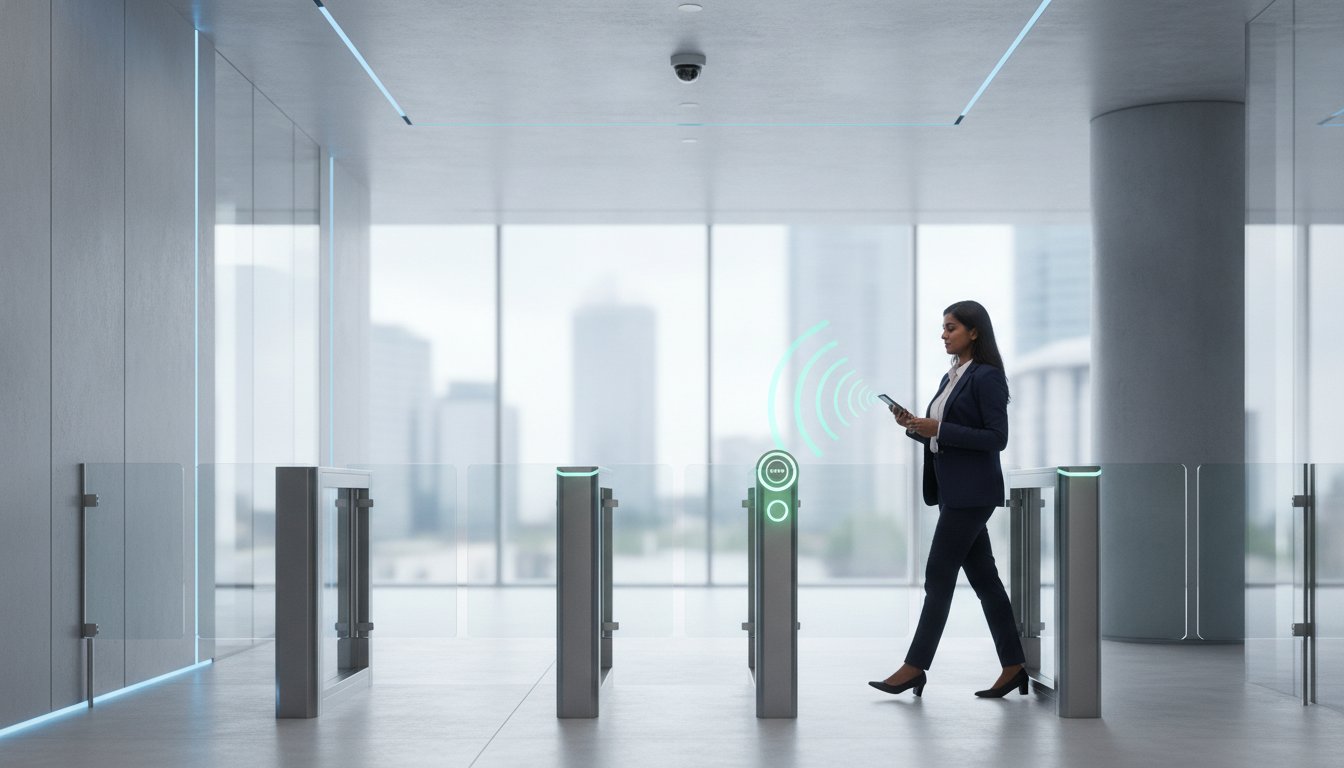
With mobile adoption for hands-free credentials in London commercial buildings now reaching 94%, the traditional plastic key card is no longer the benchmark for high-tier security. Specifying the right access control for office buildings London requires a delicate balance between rigorous perimeter protection and a frictionless lobby experience. You likely understand the operational strain caused by peak-hour congestion and the persistent risk of unauthorised entry, especially when system downtime threatens your building’s integrity. These challenges require a methodical approach to physical security that prioritises reliability over temporary trends.
This guide provides a professional framework for specifying, installing, and maintaining robust hardware, ensuring your systems remain compliant with 2026 standards. We will examine the seamless integration of speed gates, IP video intercoms, and HD CCTV to create a unified security environment. By following this specification guide, you will establish a clear roadmap for achieving a secure, British Standards-compliant entry system that offers peace of mind for stakeholders and a seamless journey for every employee who enters your premises.
Key Takeaways
- Understand the evolving requirements for access control for office buildings London, specifically how to manage high-volume pedestrian flow in multi-tenanted environments.
- Evaluate the technical superiority of IP video intercom systems and speed gates to improve lobby security and operational efficiency.
- Learn how to integrate physical hardware with HD CCTV to provide a robust audit trail and real-time monitoring for facilities managers.
- Navigate the latest 2026 UK security regulations and building standards to ensure your site remains compliant and fully protected.
- Identify why professional system commissioning is essential for the long-term reliability and stability of your commercial security infrastructure.
Securing the London Workplace: Challenges for Modern Office Buildings
Access control has undergone a fundamental transformation over the past four decades. What once amounted to a mortice lock and a reception desk has evolved into a layered architecture of physical barriers, credential verification, and integrated monitoring. For London’s commercial districts, this evolution isn’t optional. The density of high-value tenants, the volume of daily footfall, and the concentration of sensitive business operations create a security environment that demands a rigorous, hardware-first approach.
Software-only solutions address only part of the problem. A digital platform can manage permissions and generate audit logs, but it cannot physically prevent an unauthorised individual from following an employee through an open door. In London’s most prominent business centres, that physical reality is where security succeeds or fails. Robust access control for office buildings London begins at the threshold, with hardware specified to withstand both opportunistic intrusion and sustained pressure.
The Pressure of Peak-Hour Pedestrian Flow
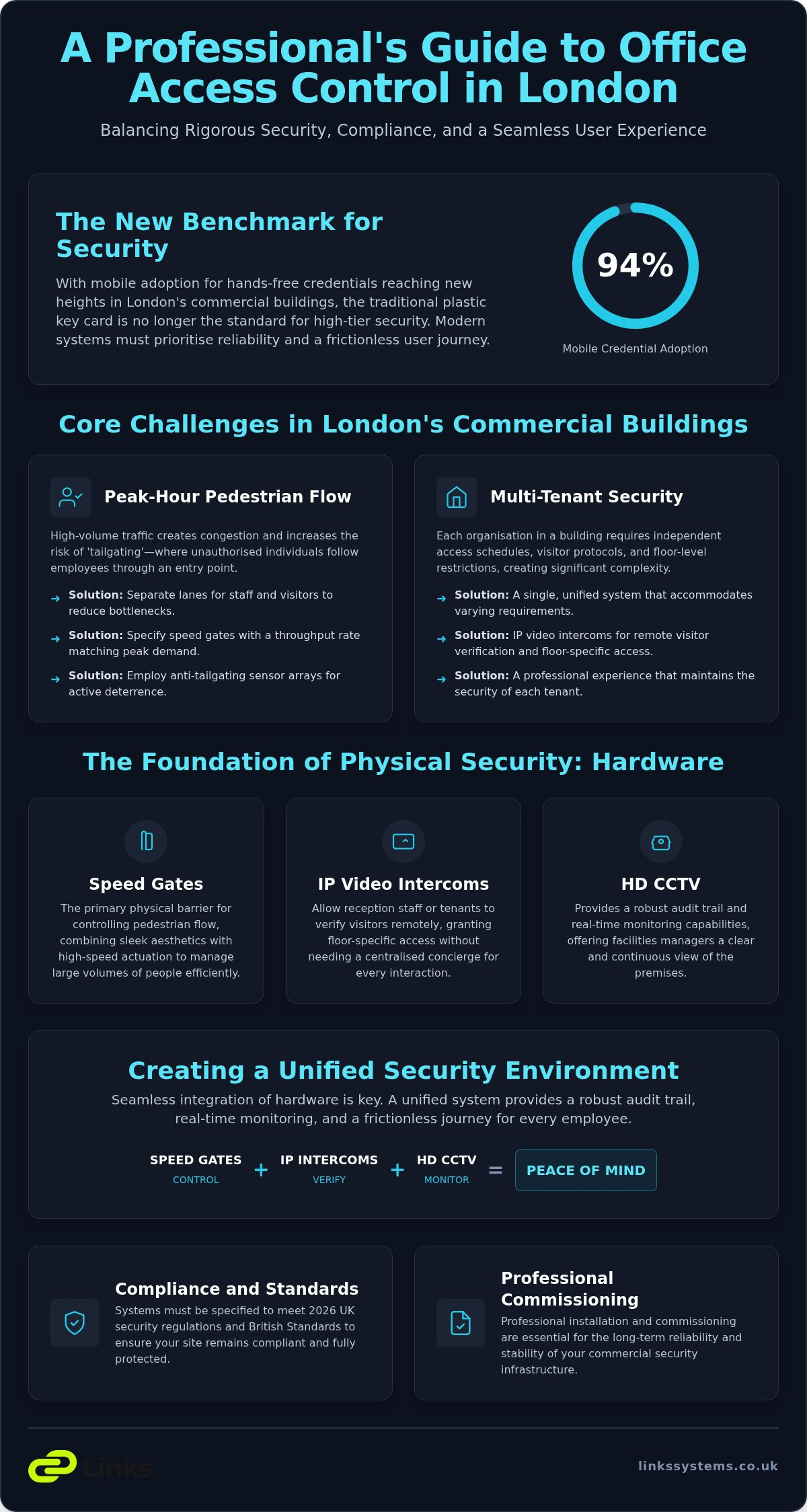
Morning and evening peaks place considerable strain on any entry system. In a large commercial building, hundreds of employees may need to pass through a lobby within a thirty-minute window. Without a properly configured entry arrangement, that pressure produces two distinct problems: congestion that frustrates tenants and creates reputational risk for facilities managers, and the opportunity for tailgating, where an unauthorised individual passes through on the credentials of someone ahead of them.
Addressing both simultaneously requires careful thought about entry point configuration. Key considerations include:
- Lane allocation: Separating high-volume staff lanes from visitor processing points reduces bottlenecks without compromising verification standards.
- Throughput capacity: Speed gates must be specified with a throughput rate that matches realistic peak-hour demand, not average daily figures.
- Anti-tailgating detection: Physical barriers equipped with sensor arrays provide an active deterrent rather than relying solely on staff vigilance.
Multi-Tenant Security Requirements
Managing access across a multi-tenanted building introduces a distinct layer of complexity. Each occupying organisation may require independent access schedules, visitor protocols, and floor-level restrictions. A single unified system must accommodate these varying requirements without creating administrative overhead or compromising the privacy of neighbouring tenants.
IP video intercom systems are particularly well-suited to this environment. They allow reception staff or individual tenant representatives to verify visitors remotely, granting floor-specific access without requiring a centralised concierge to manage every interaction. The result is a professional, welcoming entry experience that doesn’t sacrifice the integrity of each tenant’s secure perimeter.
Physical Security Infrastructure: From Speed Gates to IP Video Intercoms
Effective access control for office buildings London relies on a foundation of high-quality physical hardware. It is the visible manifestation of a building’s security policy, serving as a robust barrier between the public street and the private workspace. While software manages the logic of permissions, physical infrastructure provides the necessary enforcement. Modern installations should align with UK government security standards to ensure that the hardware provides a proportionate response to the specific risks of a London commercial site. Choosing hardware that complements the architectural aesthetic of a professional building ensures that security remains a seamless part of the user experience rather than an intrusive afterthought.
Specifying Speed Gates for High-Rise Lobbies
Speed gates are the primary physical barrier for pedestrian flow control. They combine sleek aesthetics with high-speed actuation to manage large volumes of people without creating a “fortress” atmosphere. Selecting the right model depends on the specific spatial constraints and security requirements of the lobby. Glass wing gates offer a minimalist look suitable for contemporary glass-fronted buildings, whereas sliding or telescopic designs provide a more formidable physical presence for higher-risk environments.
Professional installers can integrate biometric or RFID readers directly into the gate pedestals, creating a streamlined entry process for regular occupants. This visible presence acts as a powerful psychological deterrent, signalling to any unauthorised individual that the premises are actively managed. Ensuring these systems are correctly specified is a vital step in preventing tailgating and maintaining the integrity of the building’s perimeter.
Advanced IP Video Intercom Solutions
The transition from analogue to IP-based intercom systems marks a significant leap in building management capability. Unlike traditional systems that suffer from signal degradation and limited functionality, IP video intercoms deliver high-definition visual verification across existing data networks. This clarity is vital for identifying visitors and contractors before granting access to multi-tenanted floors, reducing the risk of unauthorised entry.
Integration with mobile devices allows facilities managers to monitor entry points and grant access remotely, ensuring building security even when they are away from the reception desk. These systems are inherently scalable and easier to maintain than their legacy counterparts, making them essential for future-proofing London office infrastructure. Implementing advanced access control for office buildings London through IP-based systems requires a partner who understands the nuances of technical commissioning, which is why many developers seek specialist advice on speed gates and barriers during the early planning stages.
Integration Strategy: Unifying Access Control with HD CCTV
Linking physical hardware with real-time HD CCTV monitoring creates a resilient security posture that standalone systems cannot match. While physical barriers provide the necessary enforcement, integrated video provides the visual confirmation required for a complete security picture. This synergy is critical for access control for office buildings London, where high-density occupation makes manual verification of every individual impossible. By triggering CCTV recording based on specific access events, such as a forced door or a tailgating alert, security teams can significantly reduce response times to potential breaches.
Integrated systems ensure that security isn’t just a collection of parts, but a coordinated ecosystem. This approach moves beyond simple entry management to provide a proactive service model that identifies risks before they escalate. It allows facilities managers to maintain a composed, trust-based environment whilst ensuring that every technical requirement of a modern London office is met with precision.
Visual Verification and Audit Trails
High-definition video acts as a digital witness for every transaction at the entry point. When an employee presents a credential, the system can automatically capture a high-resolution image, allowing for immediate visual verification against the stored database profile. This process is a cornerstone of effective Physical Security Measures in modern commercial environments. If an incident occurs, facilities managers have a comprehensive audit trail that pairs timestamped access logs with visual evidence, simplifying post-event investigations and providing clarity for insurance or compliance purposes.
Camera placement is vital for the success of this integration. Optics must be positioned to capture clear facial features without being obscured by the physical structure of speed gates or barriers. This requires a specialist understanding of both the hardware’s range of motion and the lighting conditions of a typical London lobby.
Centralised Security Management
A unified interface allows building staff to manage diverse security streams from a single, manageable workstation. For large-scale facilities across London, Kent, and Surrey, this centralised approach is far more efficient than managing disconnected legacy systems. IP-based integration facilitates this by allowing data to flow seamlessly across existing network infrastructure, providing a scalable solution that grows with the building’s needs. This streamlining reduces operational costs by minimising the need for manual patrols and multiple monitoring stations. For a deeper look at the technical requirements of these setups, see our guide on Integrating CCTV with Access Control Systems: A 2026 Professional Specification Guide.
Compliance and Maintenance Standards for UK Commercial Sites
Compliance within the UK commercial sector requires a thorough understanding of evolving legislative frameworks. In 2026, the Building Safety Regulator (BSR) operates as an independent body overseeing high-risk structures, placing greater accountability on those specifying access control for office buildings London. It’s no longer enough to install hardware; systems must be part of a documented security plan that aligns with Physical Security Integration for Commercial Buildings: The 2026 Professional Guide. This ensures that physical barriers don’t just secure the perimeter but also comply with strict fire safety and emergency egress protocols, alongside Secured by Design standards.
Adhering to British Security Standards
Professional installations must comply with BS EN 50133-1 for access control and the BS EN 62676 series for video surveillance. These aren’t merely suggestions. They’re the benchmarks used by insurers and regulators to verify that a system is fit for purpose. With the enforcement of Martyn’s Law approaching in 2027, buildings in the Enhanced Tier (800+ capacity) are already being audited for their physical security readiness and documented emergency plans.
Links Integrated Systems brings 40 years of industry experience to this process. We focus on the professional commissioning of hardware, ensuring that every gate, barrier, and reader operates within the exact parameters required by UK law. This meticulous approach differentiates a simple equipment fit-out from a fully compliant security infrastructure that protects both the assets and the people within a London workplace.
Preventative Maintenance for Long-Term Reliability
High-traffic environments in the City or Canary Wharf subject physical hardware to significant mechanical stress. Effective access control for office buildings London relies on hardware that is not only robust but also meticulously maintained. Neglecting a scheduled maintenance programme leads to system downtime, which creates immediate security breaches and lobby congestion. Preventative maintenance is the only way to ensure the long-term stability of your investment.
A robust maintenance programme should include:
- Bi-annual mechanical audits: Checking the alignment and actuation of speed gate wings and barrier arms.
- Electrical safety inspections: Ensuring compliance with the Electricity at Work Regulations 1989 and the recommended five-year inspection cycle.
- Software and firmware updates: Protecting IP-based intercoms and CCTV from cyber vulnerabilities whilst ensuring compatibility with new credentials.
Professional maintenance contracts offer peace of mind by identifying potential failures before they disrupt building operations. If you require a steady, experienced hand to manage your site’s safety, explore our system maintenance and commissioning services to ensure your hardware remains reliable for years to come.
Commissioning Your System: Why Professional Installation Matters
Commissioning is the critical final stage that distinguishes a functioning security system from a merely installed one. While installation involves the physical mounting of hardware, commissioning is the rigorous process of testing, calibrating, and verifying that every component operates according to the specific design intent. For access control for office buildings London, this stage ensures that speed gates actuate at the correct speeds, IP intercoms route calls without latency, and fail-safe mechanisms respond instantly during fire drills. Without professional commissioning, even the most expensive hardware remains a collection of isolated parts rather than a unified security infrastructure.
A methodical approach to system handover provides building owners with the assurance that their investment is fully optimised. This process includes the verification of encrypted credentials, the fine-tuning of anti-tailgating sensors, and the final integration of video feeds. It’s this attention to technical detail that prevents the operational friction and security gaps often found in hastily implemented projects. Choosing a partner who prioritises commissioning ensures that your building’s entry points are reliable from the first day of operation.
The Links Integrated Systems Approach
Links Integrated Systems brings 40 years of industry experience to every project, positioning the business as a dependable pillar within the London professional community. We specialise exclusively in high-level commercial requirements, avoiding the distractions of residential or general alarm services. Our end-to-end process begins with a precise specification of physical hardware and continues through to technical commissioning and long-term maintenance. This focus on the full project lifecycle allows us to handle complex technical requirements with a steady, experienced hand.
Our commitment to precision means we don’t just supply equipment; we deliver proven, high-quality solutions tailored to the unique demands of modern workplaces. By maintaining a formal yet collaborative register with project managers and contractors, we ensure that every security installation meets the rigorous standards expected in London’s most prestigious business districts.
Selecting Your Security Partner in London
The stability of your security provider is as important as the stability of the hardware itself. A partner with deep-rooted regional experience understands the logistical challenges of working in London whilst also providing responsive support across Essex, Hertfordshire, Surrey, and Kent. This regional presence is vital for maintaining long-term project continuity and ensuring that maintenance obligations are met promptly. When evaluating a partner for access control for office buildings London, project managers should prioritise firms that demonstrate a proactive service model and a clear understanding of UK regulatory adherence.
Establishing a secure, frictionless entry environment requires meticulous planning and a specialist’s touch. If you are ready to move from initial concepts to a fully commissioned security environment, contact Links Integrated Systems today for a professional security consultation.
Future-Proofing Your London Office Security Infrastructure
Specifying a high-tier security system requires more than just selecting hardware; it demands a strategic alignment of physical barriers and integrated digital oversight. You have seen how speed gates and IP video intercoms serve as the essential first line of defence, whilst HD CCTV provides the visual audit trail necessary for modern compliance. Achieving effective access control for office buildings London depends on this seamless synergy between components and a commitment to rigorous British Standards.
With over 40 years of specialist experience, Links Integrated Systems provides the technical expertise required for complex commercial developments. Our team offers full commissioning and maintenance services across London, Kent, Surrey, and Essex, ensuring your systems remain a reliable pillar of your building’s operations. We prioritise precision and long-term stability in every project we undertake, helping you maintain a secure and professional environment for every occupant.
Discuss your London office security requirements with our specialist team to ensure your premises are protected by industry-leading standards and a steady, experienced hand.
Frequently Asked Questions
What are the best access control systems for high-rise London offices?
The most effective access control for office buildings London in high-rise environments involves a combination of optical speed gates and IP-based credential readers. These systems manage the high-volume pedestrian flow typical of the City whilst maintaining a professional aesthetic. Integrating these with destination-control lift systems ensures that security is maintained from the lobby to specific tenant floors, providing a seamless and secure experience for every employee.
How do speed gates integrate with existing building management systems?
Modern speed gates integrate with building management systems (BMS) through standardised IP communication protocols. This connection allows facilities managers to monitor gate status, occupant counts, and alarm events from a centralised dashboard. Such integration is vital for fire safety, as it ensures that gates automatically open during an emergency evacuation, providing an unobstructed exit path in accordance with UK building regulations and safety standards.
Do I need a maintenance contract for my office speed gates?
A maintenance contract is essential for ensuring the continued reliability and safety of high-traffic speed gates. Regular servicing identifies mechanical wear and sensor misalignment before they cause system failure or lobby congestion. Professional maintenance also ensures that your equipment remains compliant with the Electricity at Work Regulations 1989, protecting your long-term investment and maintaining the security of your London commercial premises.
Can IP video intercoms be managed remotely across multiple London sites?
IP video intercoms are designed for remote management across multiple sites using secure network connections. Authorised personnel can verify visitors and grant access from a single central location or via encrypted mobile applications. This capability is particularly beneficial for managing several London office buildings from a regional headquarters, reducing the need for on-site reception staff at every entry point whilst maintaining high security standards.
What UK safety standards apply to automatic barriers and speed gates?
Automatic barriers and speed gates must comply with BS EN 50133-1 for access control and the BS EN 62676 series for video surveillance. They must also meet the safety requirements of the Machinery Directive to prevent injury during operation. Professional commissioning ensures that every physical barrier is calibrated to stop or reverse if an obstruction is detected, meeting the rigorous safety expectations of the UK commercial sector.
How does HD CCTV integration improve office security?
Integrating HD CCTV with access control for office buildings London provides immediate visual verification for every entry event. When a card is presented, the system captures a high-resolution image of the individual, allowing security teams to confirm that the person using the credential is the authorised holder. This creates a robust audit trail that is invaluable for investigating security incidents and meeting specific insurance requirements.
What is the typical lifespan of commercial access control hardware?
Commercial-grade access control hardware typically has an operational lifespan of 10 to 15 years when supported by a preventative maintenance programme. Whilst the physical structures of speed gates are built for durability, the internal electronic components and sensors may require periodic updates to maintain compatibility with new security protocols. Regular servicing ensures that the hardware continues to perform reliably throughout its entire lifecycle.
How do I choose between speed gates and traditional turnstiles?
Speed gates are generally preferred over traditional turnstiles for modern London offices due to their superior aesthetics and higher throughput rates. Whilst turnstiles provide a physical deterrent, speed gates offer a more welcoming, frictionless experience that suits high-end commercial environments. Speed gates also provide better accessibility for individuals with mobility requirements, ensuring that your building remains inclusive whilst maintaining a high level of perimeter security.