

The most sophisticated security software on the market is ultimately useless if the physical hardware isn’t commissioned by an expert who understands the daily flow of a London office block. You likely recognise that a security breach isn’t the only risk your building faces. Poorly integrated systems often lead to morning lobby congestion and mounting frustration from tenants who just want to get to their desks. It’s exhausting to deal with national access control companies that offer impressive sales pitches but fail to provide the consistent, local maintenance required to keep a commercial facility running smoothly.
You deserve a secure, compliant facility where speed gates and barriers operate with quiet precision. This guide will help you identify the essential criteria for selecting a commercial partner capable of securing your London or Home Counties facility for the next decade. We’ll examine how to evaluate technical expertise, the importance of professional commissioning, and why a focus on the full project lifecycle is the only way to ensure seamless pedestrian flow and long-term reliability.
Key Takeaways
- Learn how to distinguish between national generalists and specialist access control companies that possess the technical proficiency required for complex IP-based security.
- Understand the role of high-performance speed gates and IP video intercoms in maintaining a secure, compliant facility with seamless pedestrian flow.
- Discover the logistical benefits of choosing a provider with deep-rooted experience in central London and the surrounding Home Counties.
- Identify why professional commissioning is the most critical stage of any installation to prevent future hardware failures or database errors.
Essential Selection Criteria for Commercial Access Control Companies
Property managers often face the challenge of filtering through numerous access control companies to find a partner capable of managing complex, high-traffic environments. It isn’t merely about installing a keypad; it’s about integrating a robust digital and physical infrastructure that protects assets whilst facilitating movement. Selecting the right contractor requires a methodical approach that prioritises technical proficiency and a deep understanding of large-scale commercial property requirements. You need a partner who views security as a continuous lifecycle rather than a one-off transaction.
A reliable partner must demonstrate a proven track record in the London and Home Counties region. This local focus ensures they understand the specific logistical constraints of central London sites, from restricted delivery windows to complex building layouts. Beyond installation, your provider should offer transparent maintenance and service level agreements (SLAs) that guarantee long-term system health. These agreements should clearly define response times and preventative maintenance schedules to ensure your facility remains secure and compliant without interruption.
Technical Accreditation and Industry Standards
In the commercial sector, technical accreditations serve as a benchmark for quality and safety. Compliance with NSI (National Security Inspectorate) or equivalent standards is often a non-negotiable requirement for commercial insurance policies. These certifications provide assurance that the systems meet rigorous performance criteria. Access control systems must also adhere to current UK standards, such as BS EN 60839-11-1:2013+AMD1:2020, to ensure they’re fit for purpose. Health and safety compliance is equally vital, especially when working on active construction sites or busy corporate environments where public safety is paramount.
Portfolio and Sector-Specific Expertise
Evaluating a company’s heritage and stability provides insight into their ability to support your facility for decades. Look for contractors who offer specific expertise in managing pedestrian flow and building occupancy. A partner who understands the nuances of high-rise office lobbies will be better equipped to design solutions that prevent bottlenecks during peak hours. Consider these factors during your evaluation:
- Sector Experience: Review case studies involving similar commercial infrastructures to your own.
- Hardware Specialism: Ensure they have deep knowledge of physical hardware, such as speed gates, barriers, and IP video intercoms.
- Full Lifecycle Support: Look for a provider that handles everything from initial design and installation to professional commissioning.
Choosing a specialist with 40 years of industry experience offers a level of stability that newer, national generalists often struggle to match. This long-standing presence signals a commitment to precision and a deep understanding of the evolving security landscape. It’s this combination of technical mastery and local reliability that ensures your property remains a safe, efficient environment for all occupants.
Specialist Contractors vs. National Security Generalists
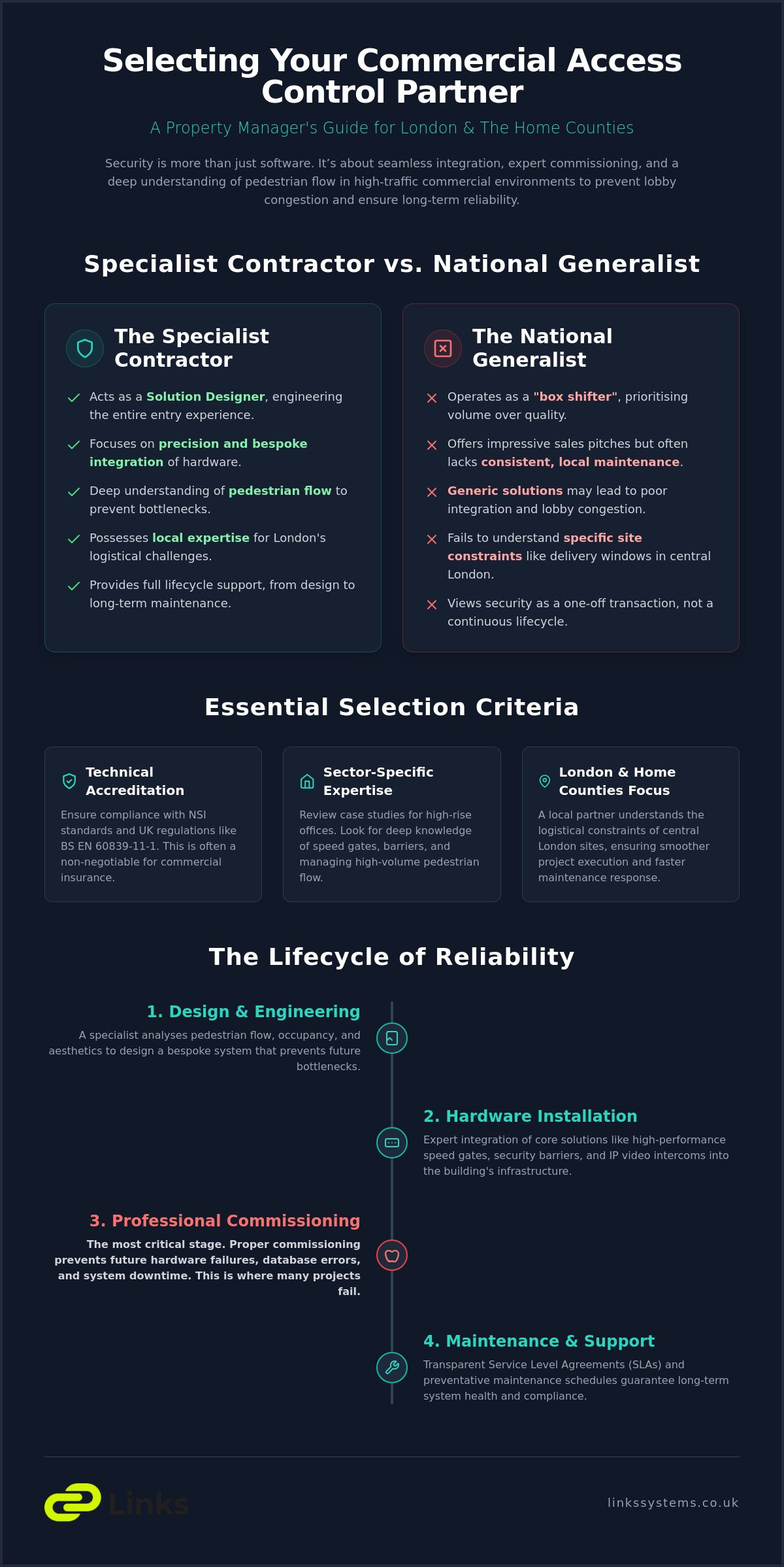
Commercial property managers often choose between large-scale national firms and specialist access control companies. While national providers offer the comfort of a household name, they frequently operate as “box shifters” who prioritise volume over precision. A specialist contractor acts as a solution designer. They don’t just supply a reader; they engineer the entire entry experience. This involves a deep understanding of how physical hardware, such as speed gates and barriers, must be integrated with a building’s network and structural layout. Precision at this stage prevents the lobby congestion that plagues poorly planned installations.
The Role of the Specialist Contractor
Specialists focus on the intricate details of physical security hardware. When installing bespoke security barriers or speed gates, a specialist considers pedestrian flow, peak occupancy, and the specific aesthetic of a London lobby. They manage the complex task of integrating IP video intercoms with existing data networks, ensuring that visitor verification is both secure and high-definition. This technical depth is essential for ensuring compliance with UK Government building regulations, particularly regarding accessibility and safe egress. By focusing on commercial physical security rather than generic residential alarms, these firms provide a level of expertise that national generalists rarely match.
National Providers: Pros and Cons
National providers can be a suitable choice for businesses with hundreds of small, identical sites across the country where a generic approach suffices. However, complex London developments require more than a standard template. The risk with national firms is often found in the maintenance phase. A local specialist in the London and Surrey corridor can often provide faster onsite response times compared to a national provider managing a broad, diluted engineer network. When evaluating costs, the initial savings of a national contract can be quickly eroded by the downtime caused by poorly commissioned systems or slow support. High-rise offices and business parks cannot afford days of lobby bottlenecks while waiting for a national call centre to dispatch a technician.
The presence of a dedicated project manager is perhaps the most significant advantage of a specialist. They oversee the full lifecycle, from the initial site survey to the final commissioning of the database. This ensures that the system isn’t just installed but is fully optimised for your specific operational needs. If you’re looking for a partner that prioritises this level of precision, you can view our approach to system commissioning. Relying on a team with 40 years of heritage provides a level of professional assurance that a transactional national provider simply cannot offer.
Core Hardware Solutions: What Your Provider Should Offer
While many access control companies focus heavily on the software interface, the physical reliability of the hardware remains the most critical factor for high-traffic commercial environments. A professional partner should provide a suite of hardware that includes high-performance speed gates, robust barriers, and integrated IP video intercoms. These components must work in unison to secure the perimeter whilst ensuring that authorised personnel move through the building without delay. Relying on inferior hardware leads to frequent breakdowns and lobby congestion, which undermines the security and professional image of your facility.
A comprehensive hardware solution should also include high-definition IP CCTV systems. These provide the necessary visual audit trail for all access events, allowing property managers to verify identities and monitor building occupancy in real time. For perimeter control, robust physical barriers and turnstiles are essential to prevent unauthorised vehicular or pedestrian entry before visitors even reach the main reception. A specialist contractor with 40 years of heritage understands that these physical elements are the foundation of any secure system. If your organisation is currently evaluating whether an outdated key card entry system for business still meets your security requirements, our 2026 professional resource provides a comprehensive framework for specifying modern credentials and integration standards.
Integrating Physical Barriers and Digital Access
Speed gates are the frontline of lobby management and must communicate instantly with card readers or biometric scanners to maintain fluid movement. It’s vital that your provider understands the technical distinction between “fail-safe” and “fail-secure” configurations. In the event of a power loss or fire alarm, a fail-safe system unlocks to allow immediate egress, whereas a fail-secure system remains locked to protect high-security zones. Organising this flow requires a technical partner who can balance these safety requirements with the need for rigorous security. If your provider cannot explain how their hardware handles these scenarios, they lack the necessary expertise for commercial infrastructure. For facilities operating across multiple floors, understanding the specific demands of high-rise building access control — including elevator integration and tailgating prevention — is essential to achieving a truly secure vertical environment.
IP Video Intercoms and CCTV Synergy
Modern security relies on the synergy between visual verification and digital access logs. High-definition IP CCTV provides a visual record of every entry and exit, which is invaluable for compliance and incident investigation. When combined with advanced IP video intercoms, this allows for effective remote site management. A visitor can be verified via high-definition video at the gate and granted entry from a central management desk or a mobile device. This integration ensures that security staff can manage multiple entry points without leaving their station. For property managers looking to specify the correct hardware for their facility, our Professional Speed Gates & Barriers: A Specification Guide provides detailed technical insights into the latest 2026 standards.
A stable security partner doesn’t just sell equipment; they design a cohesive system where every piece of hardware is selected for its durability and integration capability. This methodical approach ensures your facility remains secure for the next decade, backed by a reliable maintenance partner who understands the full lifecycle of the project.
The Local Advantage: Access Control in London and the Home Counties
Many national access control companies underestimate the sheer logistical complexity of the London market. Operating in the capital requires more than just technical skill; it demands a firm grasp of the city’s unique infrastructure. From navigating the congestion of the City to managing tight delivery windows in Canary Wharf, local presence is a prerequisite for reliability. Property managers in the Home Counties face distinct challenges too. Business parks in Kent or Surrey require rapid onsite support that distant national call centres simply cannot provide. You need a partner who’s already familiar with your postcode’s specific constraints.
This requirement for local, high-quality service applies to all aspects of estate management; for example, many business parks in the South East utilise Sail Shades Direct to install bespoke shading solutions that enhance their outdoor communal areas.
Building long-term relationships with local property management firms allows for a more proactive service model. A contractor based in the South East doesn’t just see a site as a set of coordinates. They understand the local environment, the typical building occupancy patterns, and the regional standards that govern security installations. This familiarity ensures that your facility remains secure and compliant without the friction often caused by providers unfamiliar with the region’s operational pace.
Serving the London Commercial Corridor
Installing security systems in high-rise environments and skyscrapers involves coordination that goes far beyond simple hardware mounting. It requires synchronising with multiple trades on major construction projects where delays are costly. A local specialist understands how to work alongside site managers to ensure that speed gates and IP video intercoms are commissioned exactly when the building’s network is ready. Proximity to the M25 and major arterial roads means that engineers can reach sites in the City or West End without the logistical hurdles faced by firms based outside the South East. This geographical advantage directly translates into higher service reliability and faster incident resolution.
Regional Compliance and Development Standards
Security requirements aren’t uniform across the UK. New developments in Hertfordshire or Essex often have specific regional standards that must be met to satisfy local planning and insurance obligations. A local firm understands the unique security profiles of business hubs in the Home Counties, where the operational needs differ from a central London skyscraper. Having “boots on the ground” in Essex or Surrey allows for more frequent site visits and a more thorough maintenance schedule. It’s about having a partner who can be onsite quickly if a barrier fails or a database needs urgent reconfiguration.
Professional assurance comes from knowing your security partner is just a short drive away. This local focus ensures that your facility remains secure and compliant with minimal downtime. If you’re managing a commercial site in the South East, you can contact our London and Home Counties team for a consultation. Our 40 years of experience in this specific region means we’ve already solved the logistical challenges you’re currently facing.
Commissioning and Maintenance: The Lifecycle of Reliability
Professional commissioning represents the bridge between physical installation and operational reality. It’s a technical necessity. Whilst many access control companies consider their job finished once the hardware is bolted to the floor, a specialist understands that the configuration phase is where the system’s long-term reliability is truly established. A system that hasn’t been properly commissioned is a liability. Poorly configured databases and misaligned hardware sensors are the primary causes of lobby congestion and unauthorised access events. You need the assurance that every component has been tested under real-world conditions before the site goes live.
The risks of neglecting this phase are significant. Without precise calibration, high-performance speed gates can become erratic, leading to mechanical wear or safety risks for pedestrians. A methodical approach to commissioning ensures that the software logic perfectly mirrors your building’s operational requirements. This precision protects your investment and ensures that your security staff aren’t left managing technical glitches instead of monitoring the facility. It’s about creating a stable environment from day one, backed by 40 years of technical heritage.
The Professional Commissioning Process
Testing every gate, reader, and intercom for real-world performance is the core of a successful handover. This process involves more than just checking if a card opens a door; it requires stress-testing the system during simulated peak traffic periods. Every IP video intercom must be verified for clear audio and video transmission across the building’s network. Ensuring seamless handovers to onsite security teams is equally vital, as they must be confident in operating the software and managing visitor credentials. For a detailed breakdown of these technical steps, you can refer to our Access Control Installers: A Professional Checklist. This document outlines the rigorous standards required for a compliant commercial installation.
Developing a Long-Term Maintenance Strategy
Scheduled maintenance is the most effective tool for preventative security. Customising maintenance schedules based on site usage and environment allows you to address wear and tear before it leads to system failure. In high-traffic London offices, physical barriers and gates undergo thousands of cycles every week. Regular servicing by a specialised engineer extends the life of these components and ensures that “fail-safe” mechanisms remain fully operational. This proactive model provides the peace of mind that comes from having a steady, experienced hand overseeing your facility’s security infrastructure. A long-term partnership with a reliable maintenance provider ensures your system remains optimised as your building’s occupancy evolves over the next decade.
Reliability is built through meticulous planning and consistent care. By prioritising professional commissioning and a structured maintenance plan, you ensure that your access control system remains a silent, effective guardian of your commercial property. This lifecycle approach is what distinguishes a master of proven solutions from a simple equipment vendor.
Securing the Future of Your Commercial Infrastructure
Selecting a security partner is a decision that impacts the operational efficiency and safety of your facility for years to come. You’ve seen that the most effective systems rely on a combination of high-performance hardware and meticulous technical integration. By prioritising specialists over generalist access control companies, you ensure that your building’s unique pedestrian flow and security requirements are managed with professional precision. Local expertise remains the most reliable way to navigate the specific logistical demands of London and the Home Counties.
Links Integrated Systems brings 40 years of specialist expertise to every project, focusing exclusively on the complex needs of commercial sites in the South East. Our approach covers the full lifecycle of your security infrastructure, including professional commissioning and long-term maintenance to guarantee system stability. We’re dedicated to providing the technical mastery and traditional business values your property deserves. Discuss your commercial security requirements with Links Integrated Systems today to establish a foundation of reliability for your facility.
Frequently Asked Questions
What services do professional access control companies typically provide?
Professional firms provide a full lifecycle of services including the design, installation, and commissioning of physical security hardware. This includes the supply of speed gates, barriers, IP video intercoms, and HD CCTV systems. They also provide long-term maintenance and system optimisation to ensure ongoing compliance with UK building regulations and insurance standards.
How do I choose between a local and a national access control provider?
Choosing between a local and a national provider depends on the complexity and location of your facility. Local access control companies in the London and Home Counties region offer faster onsite response times and better knowledge of regional logistical constraints. National providers may suit generic needs across multiple distant sites; however, they often lack the bespoke attention required for high-traffic commercial lobbies in central London.
What is the difference between an installer and a commissioning specialist?
An installer focuses on the physical mounting and wiring of hardware, whilst a commissioning specialist ensures the system software and database are correctly configured for operational use. Commissioning is the critical stage where sensors are calibrated and user permissions are established. Without professional commissioning, even high-quality hardware can fail to provide seamless pedestrian flow or accurate access logs.
Why is maintenance so important for commercial speed gates and barriers?
Regular maintenance is essential because commercial speed gates and barriers undergo thousands of mechanical cycles every week. Preventative servicing identifies wear in motors and sensors before they lead to a total system failure or lobby bottleneck. Consistent maintenance also ensures that fail-safe mechanisms remain operational, which is vital for meeting fire safety and health and safety obligations.
Can an access control company integrate my existing CCTV and intercoms?
Most specialist contractors can integrate existing IP-based CCTV and intercom systems into a new access control framework. This creates a unified security environment where visual verification and access events are recorded in a single audit trail. You should verify that your chosen partner has the technical proficiency to manage data integration across different hardware brands and network architectures.
What qualifications should I look for in a security system installer?
You should look for NSI Gold or Silver accreditation as a benchmark for quality and reliability. Installers should also demonstrate compliance with health and safety standards, particularly for active construction sites. Checking for 40 years of industry experience provides assurance that the contractor understands the full lifecycle of complex commercial security projects and can support the system long-term.
How long does a typical commercial access control installation take?
The duration of a commercial installation varies based on the number of entry points and the complexity of the network integration. A single-site lobby upgrade with speed gates typically takes between two to four weeks from initial site preparation to final commissioning. Larger developments or multi-site projects require a more detailed project timeline, which a dedicated project manager should provide during the design phase.
Do access control companies provide ongoing technical support?
Established access control companies provide ongoing technical support through structured maintenance agreements and service level agreements (SLAs). This support includes both remote software troubleshooting and onsite engineer visits for hardware repairs. Having a reliable partner ensures that your system remains optimised as your building occupancy and security requirements change over time.
3 Comments
Business Access Control Systems: A Professional Resource for 2026 – Links Integrated Systems
20 July 2026[…] data remain strictly within the local network, fulfilling rigorous compliance standards. When Evaluating Access Control Companies, it’s vital to choose a partner who understands the nuances of these localised deployments and […]
High-Rise Building Access Control: A Professional Guide to Vertical Security 2026 – Links Integrated Systems
22 July 2026[…] the physical security of the building’s shell and the reliability of its electronic systems. When evaluating access control companies, property managers should look for partners who understand these specific UK standards and the […]
Cloud Access Control for Business: 2026 Professional Guide – Links Integrated Systems
29 July 2026[…] Data residency is a critical factor for any UK-based organisation. When moving to the cloud, you must verify that your security data is stored on servers that comply with current UK GDPR requirements. This ensures that sensitive information regarding employee movements and site access remains within a legally compliant jurisdiction. Look for systems that utilise AES-256 encryption for data at rest and in transit, providing end-to-end protection against intercept. For deeper insights into selecting a compliant partner, read our guide on evaluating access control companies. […]