

What if your security infrastructure could be managed from a single, unified interface, regardless of whether you are overseeing a corporate lobby in London or a distributed facility in Kent? For many organisations, the reality is often far more fragmented, involving separate systems that fail to communicate and the escalating expense of maintaining ageing on-site servers. Transitioning to cloud-based access control systems for business isn’t just about adopting new software; it’s about establishing a resilient foundation that connects digital intelligence with physical hardware.
You likely recognise the administrative burden of manually updating permissions across multiple sites or the risk of a system failure during peak hours. Our 2026 professional guide explores how to streamline these operations by centralising site management and reducing the need for local server maintenance. We will detail the integration of remote-managed security with high-quality physical barriers and speed gates, ensuring your premises benefit from professionally commissioned hardware that is built to last. From initial design to long-term maintenance, this overview provides the technical clarity needed to enhance your commercial security whilst simplifying daily oversight.
Key Takeaways
- Understand how cloud-based access control systems for business transition security management from high-maintenance on-site servers to agile, remote-managed platforms.
- Learn how to integrate cloud intelligence with robust physical hardware, such as speed gates and barriers, to create a unified and high-performance security environment.
- Discover how modern IP-based systems utilise local caching to ensure reliable site access and security even during a temporary internet outage.
- Evaluate the strategic shift from heavy capital expenditure to predictable operational costs whilst improving oversight across multiple commercial sites.
- Recognise why professional commissioning and bespoke system design are vital for achieving a zero-failure handover and long-term reliability.
Understanding Cloud-Based Access Control for Modern Enterprises
The transition to cloud-based access control systems for business represents a fundamental departure from traditional, PC-bound security models. Historically, site security relied on a dedicated on-site server, often a single computer tucked away in a server room, running proprietary software. If that hardware failed or the software became outdated, the entire security perimeter was compromised. Modern cloud architecture moves the management layer to secure, remote servers. This shift allows facility managers to oversee permissions, monitor entry points, and update security protocols from any authorised device, ensuring that physical security remains as agile as the rest of the corporate IT stack.
Adopting these systems also signifies a move away from restrictive, proprietary local wiring. Older systems often used complex serial connections that were difficult to troubleshoot and even harder to scale. By 2026, the industry has largely converged on flexible, IP-based infrastructure. This allows security hardware to sit on standard corporate networks, utilising Power over Ethernet (PoE) to simplify installation. This standardisation ensures that the “brain” of the system, the cloud software, can communicate seamlessly with the “brawn”, such as speed gates and barriers, providing a unified response to security events in real time.
The Core Components of a Cloud-First Security Architecture
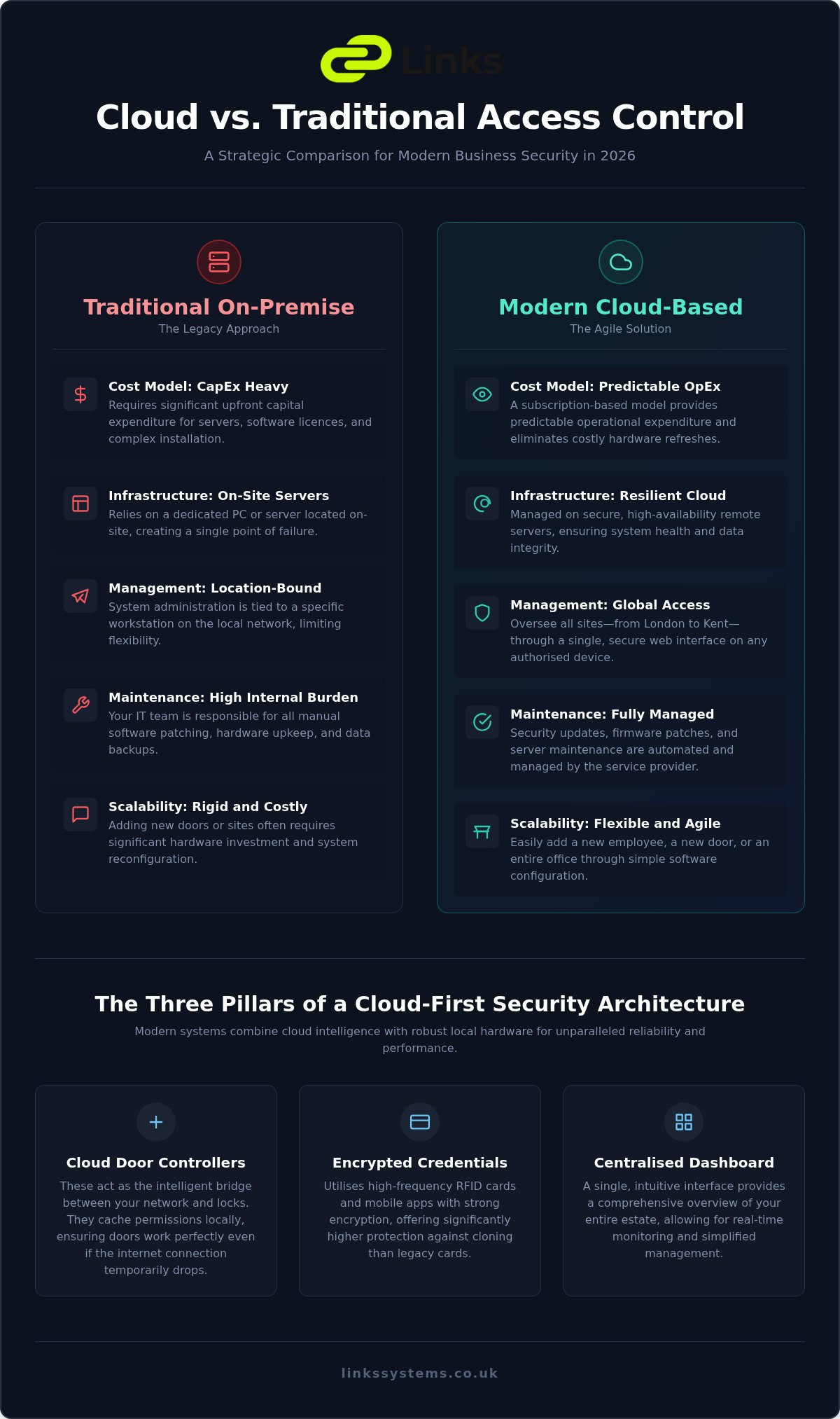
A resilient cloud system is built on three primary pillars. First, cloud door controllers act as the intelligent bridge between your network and the physical locking hardware. These devices cache permissions locally, meaning they continue to function even if the internet connection drops. Second, the system utilises encrypted credentials, such as mobile apps and high-frequency RFID cards, which offer significantly higher protection against cloning than legacy proximity cards. Finally, centralised management dashboards allow stakeholders to view multiple sites, such as offices in London and Kent, through a single interface, providing a comprehensive overview of the entire estate.
Why UK Businesses are Migrating to the Cloud in 2026
The primary driver for migration is the significant reduction in the internal IT burden. Managing on-site security servers requires constant patching, hardware maintenance, and manual backups; cloud systems automate these processes, ensuring the system is always running the latest security firmware. Scalability is another critical factor. As an organisation grows, adding a new door or an entirely new regional office is a matter of configuration rather than a complete system overhaul. This flexibility is supported by enhanced visibility, where real-time audit trails provide the data necessary for strict compliance and health and safety reporting across the South East.
Cloud vs. Traditional On-Premise Systems: A Strategic Comparison
Deciding between on-premise and cloud-based access control systems for business often comes down to how an organisation prefers to allocate its resources. Traditional systems require a significant initial capital expenditure (CapEx) for servers, dedicated workstations, and complex software licensing. Conversely, cloud models shift the financial weight towards operational expenditure (OpEx). This subscription-based approach allows for predictable budgeting whilst ensuring the system remains current without the need for periodic, costly hardware refreshes. It moves the responsibility of system health from your internal IT team to the service provider, ensuring that your security is never limited by ageing local hardware.
A common concern with cloud-reliant security is the potential for internet failure. Modern cloud systems mitigate this risk through local caching. The door controllers store a local database of authorised users, meaning that access remains uninterrupted even if the site loses its external connection. Once the connection is restored, the controller synchronises all event data back to the cloud. This hybrid approach offers the best of both worlds: the agility of the cloud with the fail-safe reliability of local hardware. Unlike legacy systems that might require manual intervention after a crash, cloud systems are designed for high availability and automatic recovery.
Operational Efficiency and Remote Management
Remote management is the ability to oversee global security from a single browser. This capability transforms daily operations for facility managers. A manager based in a London head office can grant temporary access to a contractor at a satellite site in Kent or Essex instantly. There is no need for physical key handovers or on-site attendance. If a security breach is suspected or an employee leaves the company, credentials can be revoked across every site with a single click, maintaining the integrity of the entire perimeter without delay.
Total Cost of Ownership (TCO) and Scalability
Calculating the true cost of ownership involves looking beyond the initial quote. On-premise servers incur hidden expenses such as electricity for 24/7 operation, dedicated cooling systems, and the significant time IT staff spend on manual security updates and patching. Cloud systems automate these maintenance tasks through background updates, ensuring you are always protected against the latest vulnerabilities. For complex environments, such as high-rise building access control, the ability to scale without adding more local server capacity provides immense value. If you are evaluating your current infrastructure, our team can provide a professional system assessment to determine the most cost-effective path forward for your specific site requirements.
Integrating Cloud Software with Physical Security Hardware
Effective security is never a software-only solution. Whilst cloud-based access control systems for business provide the necessary intelligence, they require robust physical hardware to execute security protocols. Think of the cloud software as the brain and the physical entry points as the limbs. High-quality hardware ensures that the digital commands issued by the management dashboard result in immediate, reliable action at the perimeter. This synergy is critical for maintaining site integrity, especially in high-traffic London environments where the speed of operation must match the volume of pedestrian flow.
Open API standards play a vital role here. They allow disparate systems to speak the same language, preventing the fragmentation often found in legacy setups. By utilising open protocols, a business can ensure its security ecosystem is not locked into a single manufacturer. This flexibility allows for the integration of best-in-class hardware whilst maintaining a cohesive aesthetic in a corporate lobby. Security should be a silent, efficient presence that enhances the professional atmosphere rather than detracting from it. When these components are professionally commissioned, they provide a seamless experience for authorised users whilst presenting a formidable barrier to unauthorised entry.
Connecting Speed Gates and Barriers to the Cloud
Managing large volumes of staff during peak morning hours in the City requires precision. Cloud triggers allow facility managers to adjust the behaviour of professional commercial speed gates & barriers based on real-time data or pre-set schedules. For business parks in Kent or Surrey, this integration extends to vehicle perimeters. Cloud-based ANPR (Automatic Number Plate Recognition) can be linked directly to the access database, ensuring authorised vehicles enter without delay whilst maintaining a full digital record of every movement. This centralised oversight reduces the need for manned guarding at every entry point, lowering operational costs.
Synchronising IP CCTV and Video Intercoms
True oversight is achieved when access events are paired with visual verification. By synchronising IP HD CCTV with your access logs, the system creates a complete audit trail where every swipe or mobile credential use is linked to a specific video clip. This eliminates ambiguity during security audits or incident investigations. For a comprehensive technical roadmap on achieving this unified data stream, our guide on integrating CCTV with access control systems provides detailed specification guidance for commercial estates. Additionally, managing visitor entry becomes a centralised task. IP video intercoms allow receptionists or security teams to verify guests visually via the cloud dashboard and grant access remotely. This entire ecosystem relies on a professionally commissioned IP network, ensuring that data flows securely between the hardware and the cloud without latency or interference.
Key Considerations for Specifying a Commercial Access Solution
Specifying cloud-based access control systems for business requires a methodical assessment of your organisation’s specific operational environment. A multi-tenant office in Central London has vastly different requirements compared to a high-security logistics hub in Kent. Whilst the former may prioritise tenant partitioning and sleek speed gate aesthetics, the latter might focus on robust vehicle barriers and long-range credential reading. Identifying these sector-specific nuances early in the design phase prevents the implementation of a system that is either under-specified for security or over-complicated for daily use.
A comprehensive site survey is the cornerstone of a successful installation. It’s impossible to guarantee system performance without physically inspecting the premises to identify potential wireless interference, cabling routes, and the condition of existing door furniture. This technical rigour ensures that the specified hardware is compatible with the building’s infrastructure and meets all relevant fire safety and building regulations. Selecting reliable manufacturers is equally vital; you should prioritise providers with a proven track record of long-term software support and hardware durability to ensure the system remains viable for the next decade.
Data Security, Compliance, and UK GDPR Standards
Data residency is a critical factor for any UK-based organisation. When moving to the cloud, you must verify that your security data is stored on servers that comply with current UK GDPR requirements. This ensures that sensitive information regarding employee movements and site access remains within a legally compliant jurisdiction. Look for systems that utilise AES-256 encryption for data at rest and in transit, providing end-to-end protection against intercept. For deeper insights into selecting a compliant partner, read our guide on evaluating access control companies.
Selecting Hardware for Modern Credentials
The landscape of user credentials has shifted significantly towards “Bring Your Own Credential” (BYOC) models. By 2026, many professionals expect to use their smartphones as their primary access token via Bluetooth or NFC. This approach balances high security with user convenience, reducing the costs associated with lost or damaged physical cards. To future-proof your investment, specify multi-technology readers that support a range of formats, including high-frequency RFID and mobile credentials. If you require assistance with a technical site survey to determine the best hardware for your premises, contact our specialist engineering team to discuss your project requirements.
Professional Installation and Commissioning in London and the South East
The successful deployment of cloud-based access control systems for business depends entirely on the quality of the final handover. Whilst many generalist electrical contractors can pull cable and mount hardware, they often lack the specialised knowledge required to configure complex IP networks and cloud management layers. This technical gap frequently leads to system instability, intermittent connectivity, or security vulnerabilities. We apply over 40 years of industry experience to provide a bespoke design and commissioning service that ensures your security infrastructure is robust from the moment it goes live. A steady, experienced hand is required to manage the intersection of digital software and physical barriers.
Our engineering teams serve the primary commercial hubs across London, Essex, Hertfordshire, Surrey, and Kent. We understand the specific logistical challenges of working in high-density urban environments and distributed business parks alike. By managing the full project lifecycle, from the initial site survey discussed in previous sections to the final sign-off, we ensure that the digital intelligence of the cloud is perfectly synchronised with the physical requirements of your site. This end-to-end oversight is what transforms a collection of hardware into a reliable security solution.
The Importance of Expert System Commissioning
Commissioning is the rigorous process of verifying that every gate, reader, and sensor performs exactly to the design specification. It’s not enough for a door to simply unlock; the system must report events accurately, handle offline caching correctly, and integrate seamlessly with other security layers. Professional commissioning eliminates “day one” glitches that can frustrate staff and compromise site integrity. To ensure your project meets these high standards, we recommend following a professional access control installers checklist during the handover phase.
Long-Term Maintenance and Reliability
The transition from installation to operation marks the beginning of a long-term partnership. Preventative maintenance is essential for protecting your investment in physical security hardware, particularly for mechanical components like speed gates and vehicle barriers that experience high daily usage. A local partner in the South East provides the rapid response and system optimisation necessary to keep your premises secure. Regular servicing ensures that your commercial access control system remains compliant with evolving UK standards and continues to provide the peace of mind that a professionally managed security environment demands.
Securing the Future of Your Commercial Estate
Adopting cloud-based access control systems for business is a strategic investment in the long-term resilience of your premises. By centralising management and integrating intelligent software with robust physical barriers, you eliminate the inefficiencies of fragmented legacy systems. This approach not only reduces the IT burden of on-site server maintenance but also provides the scalable infrastructure necessary to support multi-site growth across the UK. Professional commissioning remains the vital link that ensures these digital and physical components perform to the highest standards from day one.
With 40 years of expertise in integrated systems, we act as a dedicated partner for specialists in London commercial security. Our team provides comprehensive maintenance and commissioning services to ensure your estate remains protected and compliant with evolving regulations. Contact Links Integrated Systems for a Professional Security Consultation to discuss how we can streamline your site management. A professionally designed security environment offers the stability and peace of mind required to focus on your core business objectives.
Frequently Asked Questions
Is cloud-based access control secure for high-security businesses?
Cloud-based access control systems for business are highly secure, often surpassing the protection levels of legacy on-premise systems. They utilise enterprise-grade AES-256 encryption for data at rest and in transit, ensuring that communication between readers, controllers, and the cloud remains private. Because security patches are deployed automatically by the provider, the system is protected against the latest vulnerabilities without requiring manual intervention from your internal staff.
What happens to my office security if the internet goes down?
Your site remains secure because modern door controllers utilise local caching to store a database of authorised users. Access decisions are made at the door level rather than waiting for a response from the cloud, so staff can still enter and exit during a network outage. Once the internet connection is restored, the controller automatically synchronises all event logs and audit trails back to the central management dashboard.
Can I integrate cloud access control with my existing speed gates?
Integration with existing physical hardware is often possible provided the equipment uses standard interfaces or open API protocols. We specialise in linking cloud software with the physical “brawn” of speed gates and vehicle barriers to create a unified security perimeter. A professional site survey is necessary to confirm compatibility and determine if any interface modules are required to ensure a zero-failure handover.
How much does a cloud-based access control system cost for a UK business?
The total cost of a system is determined by several factors, including the number of entry points, the complexity of the physical hardware, and the specific security requirements of your sector. Transitioning to the cloud typically involves a shift from high initial capital expenditure to a more predictable operational expenditure model. This subscription-based approach covers ongoing software updates and remote management, providing better long-term value than maintaining ageing on-site servers.
Is cloud-based access control GDPR compliant in the UK?
Yes, these systems are designed to meet strict UK GDPR standards, provided the data is stored on servers within a compliant jurisdiction. We ensure that the cloud providers we specify maintain UK data residency, keeping your employee and visitor information within the legal framework required for commercial operations. This compliance is a core part of our design and commissioning process for all integrated security systems.
Do I need to replace all my existing door locks to move to the cloud?
You don’t always need to replace your entire physical locking infrastructure to upgrade to a cloud-based model. Many systems can be retrofitted by replacing the controllers and readers whilst keeping the existing high-quality locks or handle sets. We assess your current hardware during an initial consultation to determine which components are suitable for integration and which require modernisation to support new encrypted credentials.
How many users can a cloud-based system manage?
Cloud-based systems are virtually unlimited in their capacity to manage users, making them ideal for both small offices and large-scale commercial estates. Unlike traditional on-premise software that may be limited by local server memory or processing power, cloud architecture scales effortlessly as your business grows. You can manage thousands of users across multiple sites in London and the South East from a single, centralised interface.
What are the benefits of using mobile credentials over traditional key cards?
Mobile credentials offer superior security and convenience by turning an employee’s smartphone into a secure access token via Bluetooth or NFC. Smartphones are much harder to clone than legacy RFID cards and are less likely to be shared amongst staff or lost. Additionally, facility managers can issue or revoke mobile credentials instantly from a remote dashboard, significantly reducing the administrative burden and costs associated with physical card management.
1 Comment
Professional Security Turnstile Installers in Essex: The 2026 Procurement Guide – Links Integrated Systems
10 August 2026[…] where every entry event is recorded, verified, and stored. By linking physical hardware with cloud-based access control systems for business, facility managers gain the ability to manage permissions across multiple sites from a single […]