

The era of the physical security fob is rapidly coming to an end. For years, facility managers have battled the persistent headaches of lost credentials, shared passes, and the inevitable morning bottleneck at the lobby speed gates. Implementing facial recognition access control for offices isn’t just about adopting a modern aesthetic; it’s about establishing a high-throughput identity management layer that works as hard as your team does. You likely agree that security shouldn’t be a hurdle that slows down your staff’s morning momentum or creates a mountain of administrative paperwork.
This guide explores how facial recognition technology is revolutionising office security by ensuring seamless pedestrian flow and robust biometric protection for UK businesses. We’ll show you how to achieve a touchless, secure entry system that integrates perfectly with your existing speed gates and CCTV infrastructure. You’ll discover how to navigate the latest 2026 ICO guidance and UK GDPR requirements to ensure your data storage is as secure as your front door. From professional commissioning to long-term maintenance, we’ll outline the path to a more reliable and efficient workplace.
Key Takeaways
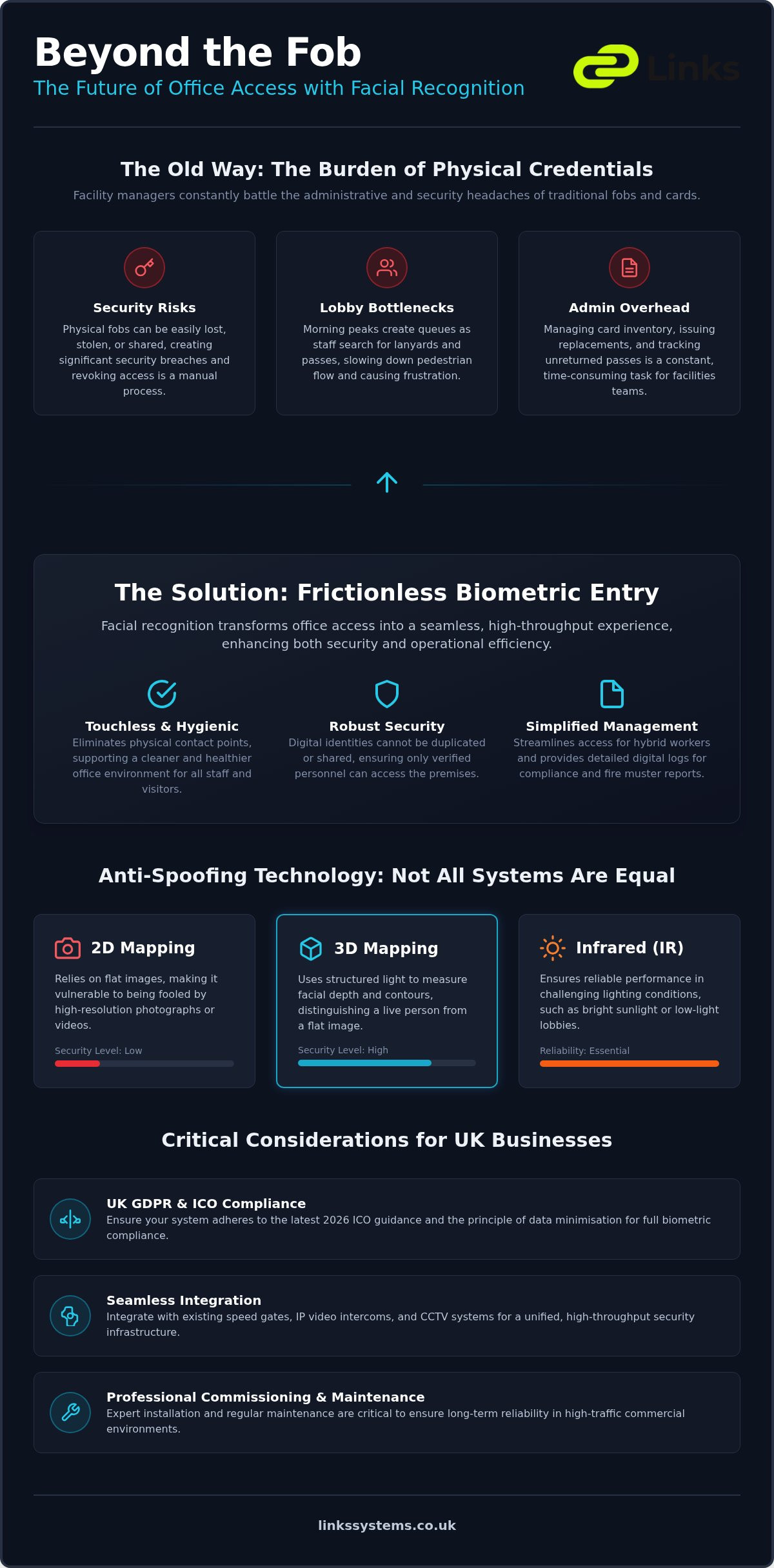
- Learn why touchless authentication is becoming the operational standard for London offices to eliminate the administrative burden of managing physical credentials.
- Understand the technical differences between 2D, 3D, and Infrared mapping to ensure your facial recognition access control for offices remains secure against sophisticated spoofing attempts.
- Gain clarity on 2026 ICO guidance and the principle of data minimisation to ensure your biometric system remains fully compliant with UK GDPR.
- Discover how to integrate advanced biometric terminals with existing speed gates and IP video intercom systems for a cohesive, high-throughput security infrastructure.
- Recognise the critical role of professional commissioning and regular maintenance in ensuring long-term reliability for high-traffic commercial environments.
Understanding Facial Recognition Access Control in Modern Office Environments
A Facial recognition system provides a sophisticated method of biometric authentication by mapping unique facial features to verify a person’s identity. In a professional setting, this technology serves as the primary gatekeeper, replacing the need for traditional keys or plastic credentials. Whilst older systems relied on proximity cards, modern facial recognition access control for offices uses high-resolution sensors to grant entry in less than a second. This shift represents a move towards more secure, identity-based protection that can’t be easily shared or duplicated.
In London’s professional centres, the demand for touchless entry has increased significantly. High-profile corporate environments require a balance between robust security and an inviting atmosphere. It’s no longer enough to have a secure door; the entry process must be elegant and efficient. We differentiate between consumer-grade smart locks, often found in residential settings, and commercial-grade integrated systems. A commercial system is built for the rigours of a high-traffic lobby, designed to communicate directly with speed gates and building management software.
The Core Advantages for Office Facilities Managers
The transition to biometrics solves several persistent operational challenges for facilities teams. Managing a fleet of physical fobs is a significant administrative drain, often involving constant replacements and the security risk of unreturned passes. By moving to a digital identity model, managers can focus on higher-level tasks rather than card inventory.
- Security Integrity: Digital identities can’t be lost, stolen, or lent to unauthorised individuals, ensuring only verified personnel enter the premises.
- Client Experience: High-value clients and visitors are greeted by a modern, professional entrance that reflects the brand’s commitment to precision and technology.
- Audit Compliance: Detailed digital logs provide precise data for health and safety requirements and automated fire muster reports.
Addressing the ‘Frictionless’ Entry Requirement
Speed is a critical factor in lobby management. Morning peaks can create significant queues if the authentication process is slow. Facial recognition supports rapid pedestrian flow, allowing staff to pass through speed gates without breaking their stride or searching for a lanyard.
- Hybrid Working: Biometrics simplify access for staff who only visit the office occasionally, as there’s no need to issue or collect temporary cards.
- Hygiene Standards: Eliminating physical contact points at entry gates supports a cleaner, more hygienic office environment for all occupants.
- Seamless Integration: These systems work alongside existing security measures to create a unified, responsive perimeter that adapts to the building’s specific occupancy patterns.
The Technology Behind Biometric Authentication: Accuracy and Anti-Spoofing
The effectiveness of facial recognition access control for offices relies on the sophistication of its underlying hardware and software. Unlike basic consumer devices, professional-grade systems don’t just take a flat picture. They create a complex mathematical map of the user’s face. This process ensures that identity verification is both instant and highly resistant to manipulation. For a system to be reliable in a high-traffic commercial environment, it must balance speed with an extremely low margin for error.
2D vs 3D vs Thermal Imaging: What Do You Need?
Traditional 2D mapping is increasingly insufficient for high-security London offices. Because 2D systems rely on flat images, they’re more susceptible to spoofing and often struggle with changes in lighting or facial hair. In contrast, 3D mapping uses structured light or multiple sensors to measure the depth and contours of a face. This adds a critical layer of security that distinguishes a living person from a high-resolution photograph or video screen.
Infrared (IR) illumination is another essential component for reliability. Many London lobbies feature glass-fronted designs that create challenging backlight and glare. IR sensors allow the matching engine to “see” clearly in pitch-black conditions or direct sunlight, ensuring 24/7 performance without requiring staff to stand in specific, brightly lit spots. This technical stability is what allows for a truly frictionless entry experience.
Liveness detection serves as the primary defence against spoofing. By analysing micro-behaviours such as eye movement, skin texture, or pulse detection, the system confirms that the subject is a living individual. This prevents unauthorised entry attempts using masks or digital displays, maintaining the integrity of the building’s perimeter.
Accuracy Standards and False Acceptance Rates (FAR)
In the security industry, we measure performance through the False Acceptance Rate (FAR) and the False Rejection Rate (FRR). A high-quality system targets a FAR of less than 0.0001 percent, meaning the chance of an unauthorised person being granted access is virtually non-existent. According to the NIST study on facial recognition accuracy, the quality of the algorithm is paramount in achieving these results across diverse populations. Algorithmic bias refers to systematic errors in software that can lead to varying accuracy across different demographic groups, a challenge that modern enterprise systems mitigate through diverse training datasets and refined mathematical models.
The speed of these calculations depends on the matching engine. Whilst cloud-based systems offer scalability, many of our clients prefer local database storage to ensure the fastest possible response times and enhanced data privacy. To maintain these high standards of precision, professional system commissioning is required to calibrate the sensors and software to the unique environmental conditions of your specific office lobby.
Navigating Privacy, GDPR, and Biometric Compliance in the UK
Deploying facial recognition access control for offices requires a rigorous approach to data privacy. In the UK, the processing of biometric data is strictly governed by the UK General Data Protection Regulation (UK GDPR) and the Data Protection Act 2018. Because biometric data used for identification is classified as special category data, businesses must establish a specific lawful basis for its processing. This usually involves obtaining explicit, freely given consent from every employee. It’s a common mistake to assume that biometric entry can be mandated; instead, a viable alternative, such as a traditional proximity card, must be provided for those who choose not to opt in.
A Data Protection Impact Assessment (DPIA) is a mandatory prerequisite before any hardware is installed. This document identifies and mitigates the risks associated with processing sensitive biometric information. Transparency is equally vital, requiring clear signage at all entry points to inform users that biometric systems are in operation. These steps ensure that your security policy is legally robust and that your organisation remains a dependable steward of staff data.
Storing Templates vs Storing Images
Professional security systems don’t store actual photographs of staff members. Instead, they follow the principle of data minimisation by converting facial features into a mathematical hash, often called a biometric template. This template is a one-way string of data that cannot be reverse-engineered to recreate the person’s image. Adopting this approach significantly reduces the impact of a potential data breach, as the stored hashes are useless to unauthorised parties.
Data must be protected with high-level encryption both whilst at rest on the local server and during transit across the network. Efficient data management also includes clear protocols for employee offboarding. When a staff member leaves the company, their biometric hash should be permanently deleted as part of a standard, methodical workflow to ensure continued compliance with data retention limits.
The Role of the Information Commissioner’s Office (ICO)
The ICO provides the definitive framework for the commercial use of biometrics in the UK. Their guidance published on 5 March 2024 clarifies that biometric data becomes special category data from the moment of collection if the intention is to identify an individual. Convenience or general security improvements aren’t always sufficient justifications; there must be a documented, necessary reason for the deployment.
Legal standards also emphasise the need for meaningful human intervention. If a system fails to grant access to an authorised user, a security officer or facility manager must be available to resolve the situation. By adhering to these methodical standards, London businesses can implement advanced facial recognition access control for offices whilst maintaining the highest levels of regulatory adherence and peace of mind.
Integrating Facial Recognition with Existing Security Infrastructure
Successful deployment of facial recognition access control for offices depends on how well it communicates with your building’s wider security architecture. It isn’t a standalone solution but a critical component of a layered defence. We prioritise the Open Supervised Device Protocol (OSDP) over the legacy Wiegand standard. Wiegand has been the industry staple for decades, but its lack of encryption makes it vulnerable to “man-in-the-middle” attacks. OSDP v2.2, the 2026 standard, solves this by using AES-128 encryption. When we design a system for a high-security London office, this protocol is our default choice for all biometric-to-controller links.
Speed Gates and Turnstiles: The Ultimate Lobby Combination
The most effective application of this technology is found at the building’s primary entrance. By integrating biometric terminals with commercial speed gates, facilities managers create a high-speed “walk-through” experience. Staff don’t need to pause or search for fobs; the gates retract as they approach, maintaining momentum during morning peaks. For visitors, the system can manage temporary access via QR codes, working in parallel with permanent staff biometrics. Our commissioning process ensures terminals are positioned at the precise height and angle to accommodate various heights and postures, preventing unnecessary bottlenecks.
The Unified Security Platform
A centralised platform simplifies the management of facial recognition access control for offices, allowing for remote updates and instant credential revocation across an entire property portfolio. This synergy allows for integrating CCTV with access control to provide visual verification of every entry event. Combining these systems creates a searchable database; security teams can track specific individuals across the entire site’s camera network based on the initial biometric “hit” at the front door. This drastically reduces the time required for forensic investigations.
If the system detects “tailgating” where an unauthorised person follows a staff member through a gate, it can trigger an immediate alert via your IP video intercom systems or HD cameras. This unified approach future-proofs the building by allowing for mobile-credential fallback options. It ensures the system remains flexible as workplace policies and tenant requirements evolve over time. To ensure your lobby infrastructure is fully synchronised and secure, you can consult with our experts regarding our comprehensive access control systems.
Professional Specification and Maintenance for London and Home Counties Offices
Specifying facial recognition access control for offices requires a methodical approach that extends far beyond hardware selection. For high-traffic commercial hubs in London and the Home Counties, the success of a biometric deployment rests on professional commissioning. This process involves calibrating sensors to account for the unique environmental variables of a lobby, such as varying light levels or floor-to-ceiling glazing. Without this precise setup, even the most advanced systems can suffer from increased false rejection rates, leading to staff frustration and lobby congestion.
The requirements for a single-occupier headquarters in Surrey often differ significantly from those of a multi-tenanted building in the City. In a shared environment, the system must manage complex partitioning of data whilst providing a unified experience at the primary speed gates. Links Integrated Systems brings 40 years of industry experience to these projects, serving as a seasoned guide for businesses across Kent, Hertfordshire, and Essex. We ensure that the transition from physical credentials to biometric identity is handled with the precision that stakeholders expect.
Selecting the Right Installation Partner
Choosing a contractor with deep-rooted stability is essential for the long-term health of your security infrastructure. You should evaluate a partner’s expertise in physical security integration to ensure that your biometric terminals communicate seamlessly with gates, barriers, and fire alarm systems. A dedicated partner doesn’t simply walk away after the final door is commissioned; they provide the necessary post-installation support and critical firmware updates that keep the system secure against evolving threats.
Adherence to ‘Secured by Design’ principles is a key indicator of a professional installer. This ensures that the hardware placement and software configuration meet the highest industry standards for crime prevention. In a professional landscape where security is paramount, working with a specialist who understands the expectations of project managers ensures peace of mind throughout the project lifecycle.
Ongoing Maintenance and System Health
High-traffic London environments demand a proactive maintenance schedule to maintain peak performance. Optical sensors must be cleaned regularly to prevent dust or smudges from degrading the accuracy of the matching engine. We recommend a structured maintenance plan that includes reviewing system performance metrics and audit logs to identify any emerging patterns or anomalies before they impact pedestrian flow.
As UK data laws continue to evolve, your maintenance partner should also assist in ensuring long-term compliance. This includes updating privacy policies and data retention protocols in line with the latest ICO guidance. By prioritising regular system health checks, facilities managers can reduce the administrative burden of credential management whilst maintaining a robust, touchless perimeter that stands the test of time.
Future-Proofing Your Commercial Property with Biometric Identity
The transition to facial recognition access control for offices represents a significant step forward in lobby management and building security. By moving away from physical credentials and embracing biometric identity, facilities managers can eliminate the administrative burden of lost fobs whilst enhancing the daily experience for staff and visitors alike. We’ve seen how professional commissioning and the latest 3D mapping technology ensure that these systems remain both accurate and compliant with current UK data regulations. A well-integrated system doesn’t just secure a door; it creates a seamless, identity-based perimeter that supports the modern hybrid workplace.
Achieving this level of technical precision requires a partner with deep industry knowledge and a commitment to reliability. Links Integrated Systems brings 40 years of expertise in integrated systems to every project, providing a comprehensive maintenance and commissioning service that ensures long-term performance. As specialist installers for London, Surrey, and Kent, we understand the unique requirements of high-traffic commercial environments and multi-tenanted buildings. You can contact Links Integrated Systems for a professional security consultation to begin designing a tailored solution for your premises. We look forward to helping you create a more secure and efficient workplace.
Frequently Asked Questions
Is facial recognition legal for UK offices under GDPR?
Facial recognition is legal in UK offices provided you adhere to the UK GDPR and Data Protection Act 2018. You must establish a lawful basis for processing special category data, which typically requires explicit consent from each employee. A Data Protection Impact Assessment (DPIA) must be completed before deployment. It’s also essential to provide a non-biometric alternative, such as a traditional proximity card, for those who don’t wish to opt in.
Can the system be fooled by a photograph or a video?
Commercial-grade systems are highly resistant to spoofing attempts. Professional hardware uses 3D mapping and infrared sensors to perform “liveness detection,” which distinguishes between a living person and a flat image or video screen. These sensors detect depth and skin texture, ensuring that a high-resolution photograph or digital display cannot trick the system. This level of security is vital for maintaining the integrity of a professional office perimeter.
What happens if the facial recognition system fails to recognise an employee?
If a system fails to recognise an authorised user, there should be a secondary authentication method available. This often involves a manual override by security personnel or the use of a backup credential like a mobile pass. UK regulations require “meaningful human intervention” for biometric systems; this means a staff member must be able to resolve any access issues promptly to ensure that authorised individuals aren’t unfairly excluded from the premises.
Does the system store actual photos of my staff’s faces?
No, professional systems don’t store actual photographs of faces. Instead, the facial recognition access control for offices converts facial features into a mathematical hash or template. This data is a one-way string of numbers that cannot be reverse-engineered to recreate an image of the person. This approach adheres to the principle of data minimisation, ensuring that sensitive biometric data remains secure and encrypted within the system’s database.
How many people can a facial recognition speed gate process per minute?
A well-commissioned facial recognition speed gate can typically process between 30 and 45 people per minute. The matching engine usually identifies a user in less than one second, allowing them to walk through the gates without stopping. This high throughput is particularly beneficial during morning peaks in busy London lobbies. The actual speed often depends more on the mechanical operation of the physical gates than the biometric processing time itself.
Is facial recognition better than fingerprint or iris scanning for offices?
Facial recognition is often superior for office environments because it’s completely touchless and faster than fingerprint scanning. Whilst iris scanning is highly accurate, it can be more intrusive and slower to align. Facial recognition provides the best balance of hygiene, convenience, and speed for high-traffic lobbies. It allows for a frictionless entry experience that feels modern and professional, which is why it’s becoming the standard for 2026 office specifications.
Can facial recognition work with people wearing masks or glasses?
Modern algorithms are designed to recognise individuals even when they’re wearing glasses, hats, or medical masks. The software focuses on the unique features of the upper face and the area around the eyes. During the initial commissioning of facial recognition access control for offices, we ensure the sensors are calibrated to handle these variations. Accuracy remains consistently high, ensuring that staff can enter the building without removing their standard daily accessories.
What is the typical ROI for switching from fobs to facial recognition?
The return on investment for biometric systems is primarily found in reduced operational costs and improved security. By eliminating the need to purchase, issue, and replace physical fobs, businesses save significant sums on hardware and administrative labour. Additionally, the reduction in security risks associated with shared or lost credentials provides long-term value. Facilities managers also benefit from automated audit trails, which simplify compliance and health and safety reporting across the building.