
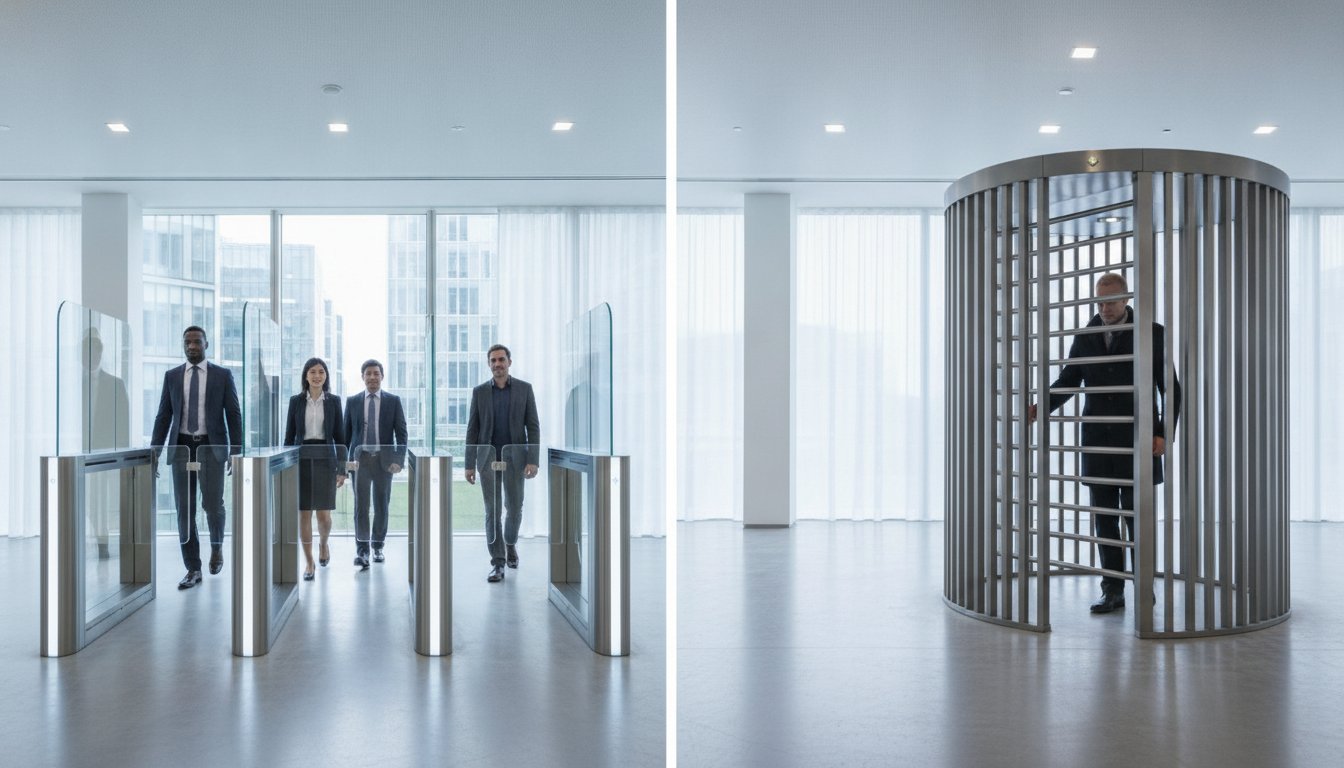
Your entrance is the first point of contact for every visitor, yet many facilities managers find themselves forced to choose between a welcoming aesthetic and robust security. It’s a common challenge to maintain a high-prestige lobby whilst ensuring that unauthorised access is strictly prevented. When evaluating speed gates vs turnstiles, the decision often hinges on more than just the initial cost or physical footprint; it requires a deep understanding of operational flow and technical reliability.
We recognise the importance of creating a secure environment that doesn’t compromise the professional atmosphere of your premises. This guide provides a comprehensive comparison to help you select an access control solution that balances rigorous security with seamless movement. Drawing on four decades of industry experience, we’ll examine the critical factors that define a successful installation. We will cover everything from the high-throughput capabilities of modern speed gates to the dependable physical containment of traditional turnstiles, ensuring your chosen system offers long-term stability and effortless integration with your existing IP infrastructure.
Key Takeaways
- Understand why motorised glass barriers provide the necessary throughput for high-traffic lobbies whilst maintaining a prestige aesthetic.
- Compare the advanced sensor technology used to detect tailgating in modern gates against the robust physical security of mechanical turnstiles.
- Identify how to select slimline hardware that minimises floor space requirements and integrates seamlessly with existing IP access control systems.
- Use our decision framework to determine the best fit for speed gates vs turnstiles based on your unique risk profile and user demographics.
- Discover why professional commissioning is vital for ensuring long-term system reliability and reducing potential maintenance costs.
Understanding Speed Gates and Turnstiles: The Fundamentals of Access Control
Selecting the correct pedestrian entry system is a fundamental requirement for modern facility management. Speed gates are motorised barriers, usually constructed from glass or acrylic, designed to facilitate rapid movement in prestige environments. Turnstiles are more traditional physical obstacles, such as tripod arms or full-height steel cages, built for robust containment. When evaluating speed gates vs turnstiles, the distinction begins with their physical presence and operational intent.
The choice of system impacts more than just aesthetics. It’s a critical component of building compliance and insurance. Insurers often require specific pedestrian control measures to validate public liability and property protection policies. A well-specified entrance reduces the risk of tailgating and unauthorised entry, which are key metrics for security audits. Professional commissioning ensures these systems meet safety standards, protecting both the assets and the people within the building.
The Anatomy of a Modern Speed Gate
Speed gates, frequently referred to as Optical turnstiles, rely on sophisticated infrared sensor arrays and safety beams. These sensors detect tailgating by monitoring the space between users, triggering an alarm if a second person attempts to follow without a valid credential. Safety beams prevent entrapment by ensuring the glass panels don’t close whilst a person is in the path. You can choose between swinging panels, which offer a slim profile, or sliding panels that retract into the pedestal. Integrating these physical barriers with commercial access control systems and IP intercoms allows for seamless visitor management, where temporary digital credentials can be issued and verified instantly.
Traditional Turnstiles: From Tripods to Full-Height
Tripod turnstiles remain the workhorse for environments like gyms and transport hubs. They’re mechanical or motorised systems that allow one person to pass per rotation. Whilst they lack the visual prestige of speed gates, they’re durable and cost-effective. For high-risk sites, full-height turnstiles provide a floor-to-ceiling physical perimeter that’s virtually impossible to climb over. The choice between mechanical and motorised operation often comes down to the required lifecycle. Motorised versions offer a smoother user experience and reduced wear on internal components, whereas mechanical units are prized for their simplicity and independence from power for basic operation. Understanding the nuances of speed gates vs turnstiles helps project managers select a solution that aligns with their specific security risk profile.
Security Levels and Operational Mechanisms: How the Solutions Differ
The security efficacy of an entrance depends on its ability to manage the three pillars of access control: deterrence, detection, and delay. When comparing speed gates vs turnstiles, the mechanism for achieving these goals differs significantly. Speed gates utilise sophisticated infrared (IR) sensor arrays to detect tailgating or ‘piggybacking’ in real-time. This technology identifies if two people attempt to pass on a single credential, immediately alerting security or locking the barriers. In contrast, mechanical turnstiles provide a physical block that naturally limits passage to one person at a time, making them a robust choice for unmonitored areas.
Detecting and Preventing Unauthorised Access
Advanced IR sensors in speed gate lanes monitor the precise volume and speed of objects passing through. This level of granularity allows the system to distinguish between a single person with a suitcase and two people walking closely together. To enhance this security layer, we often link these barriers to IP HD CCTV systems. This integration ensures that every unauthorised attempt triggers a high-definition visual record, providing clear evidence for incident reporting. Whilst speed gates offer an elegant deterrent, the cage-like structure of a full-height turnstile provides a much stronger psychological and physical barrier for high-risk perimeters where containment is the priority.
Operational Speed and User Experience
Throughput is a decisive factor for high-density London office lobbies. Speed gates are designed for efficiency, with some models capable of handling 3,000 to 4,000 cycles per hour. This far exceeds the capacity of swing gates, which typically manage 800 to 1,200 cycles. This ‘frictionless’ experience is why motorised gates are the favourite for corporate headquarters where staff expect rapid movement during peak morning flows. Beyond speed, noise levels play a role in the building’s atmosphere. Motorised speed gates operate with a near-silent glide, whereas mechanical tripod turnstiles often produce a distinct metallic click that can be disruptive in quiet reception areas.
Operational reliability is equally vital. We specify equipment based on expected cycle counts to ensure 24/7 durability. During a fire alarm or power failure, these systems must behave predictably. Most speed gates are configured as ‘fail-safe’, meaning the barriers automatically open to allow clear egress. Turnstiles can be set to ‘fail-safe’ or ‘fail-secure’ depending on the specific risk assessment of the site. If you’re unsure which configuration suits your building’s safety requirements, our team can provide expert guidance through our system commissioning services.
Aesthetic Integration and Throughput Efficiency in Commercial Environments
Modern commercial architecture demands that security infrastructure complements rather than contradicts the building’s aesthetic. When choosing between speed gates vs turnstiles, facilities managers must consider how the hardware integrates with the lobby’s interior design. High-end speed gates often feature tempered glass and brushed stainless steel, materials that align with the clean lines of contemporary offices. Custom finishes, such as powder-coated colours or bespoke veneers, allow these units to blend into reception desks, maintaining a professional and cohesive appearance. This focus on design isn’t merely for show; it contributes significantly to the ROI of Security Entrances by ensuring the system remains a long-term asset that enhances the building’s value.
Space management is a priority in urban centres where floor area is at a premium. Slimline speed gates typically have a smaller footprint than traditional tripod turnstiles, which require wider pedestals to house their mechanical components. Furthermore, user behaviour is influenced by the physical nature of the barrier. The ‘open feel’ of glass speed gates reduces the psychological barrier for staff, improving daily employee satisfaction whilst maintaining a secure perimeter. Compliance with the Equality Act 2010 (formerly DDA) is also a non-negotiable factor. We specify lane widths of at least 900mm for accessible routes, ensuring that your entrance remains inclusive without compromising on security standards.
Designing for the London Office Lobby
In the City of London, skyscrapers prioritise high-glass speed gates to create a clear boundary without causing visual obstruction. This approach balances a ‘Secured by Design’ philosophy with the need for a welcoming reception area. By utilising transparent materials, we help facilities managers define secure zones whilst keeping the lobby’s sightlines clear. This is particularly effective in prestige buildings where the architecture itself is a brand statement, allowing security to function as a silent, efficient guardian.
Throughput Analysis: Managing the Morning Rush
Multi-lane configurations are essential for busy Essex business hubs and Kent commercial centres to prevent bottlenecks. During the morning rush, the throughput difference between speed gates vs turnstiles is recognisable. Motorised speed gates allow for a continuous walking pace, whereas tripod turnstiles require a physical push and a momentary pause. Integrating biometrics or mobile credentials further accelerates this process, as users don’t need to stop and search for physical cards. This seamless passage reduces wait times and ensures that high-density buildings can handle peak pedestrian flows with ease.
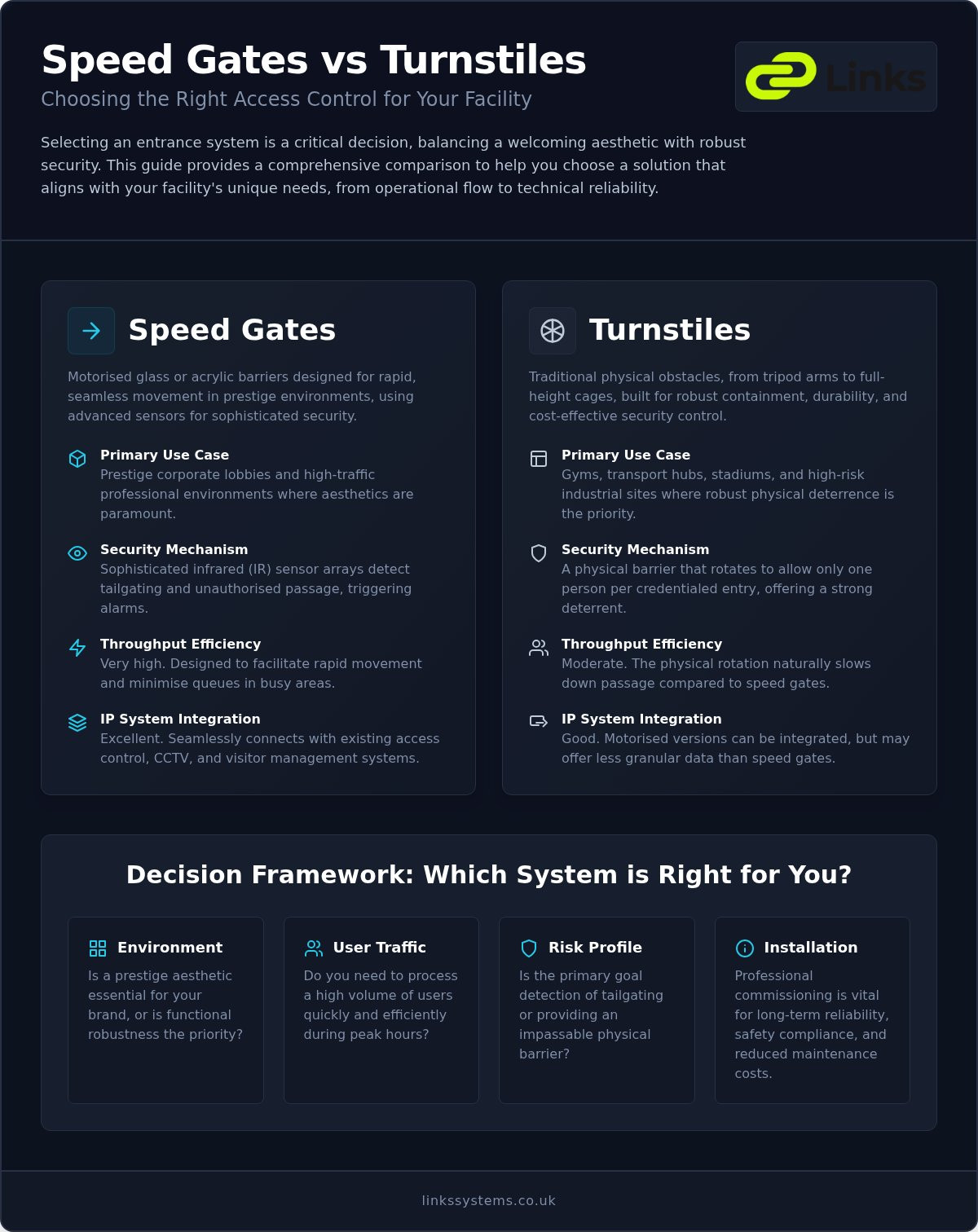
Selecting Your Access Control Solution: A Decision Framework
Determining the ideal entry point requires a structured assessment of your building’s operational reality. Choosing between speed gates vs turnstiles isn’t a matter of one being superior to the other; it’s about matching the hardware to the specific risk profile and user demographic of your site. We begin by defining the primary security objective. If the goal is to deter and detect unauthorised access in a monitored environment, speed gates are the logical choice. However, if the requirement is to physically prevent entry at an unmanned perimeter, the robust containment of a full-height turnstile is more appropriate.
The environment and user demographic dictate the necessary durability and interface. In an indoor prestige lobby, the focus remains on throughput and aesthetics. For outdoor industrial perimeters or construction sites, the equipment must withstand harsh weather conditions and heavy-duty use. Budgetary considerations should also extend beyond the initial capital expenditure. Whilst motorised systems often represent a higher initial investment, they frequently offer better long-term value through reduced mechanical wear and lower maintenance requirements compared to purely mechanical alternatives. Engaging with experienced access control installers at the design phase ensures that the chosen solution is fully compatible with your floor loading, power supply, and network infrastructure.
When to Choose Speed Gates
Speed gates are the standard for high-end corporate offices, data centres, and government buildings where visual appeal is as vital as security. These environments typically utilise biometrics or high-speed RFID as the primary credential, requiring a barrier that can react instantly. If your facility needs to maintain a welcoming, ‘open’ atmosphere whilst strictly managing high-density pedestrian flow, motorised glass gates provide the most effective balance. They allow for a frictionless user experience that aligns with the expectations of modern professionals.
When to Choose Turnstiles
Turnstiles are the preferred solution for stadiums, industrial yards, and construction sites where maximum physical containment is the priority. Tripod models are excellent for budget-conscious projects with lower aesthetic requirements, such as staff entrances in warehouses or public leisure centres. When an entrance must remain unmanned, a full-height turnstile provides a formidable barrier that cannot be vaulted or crawled under. These systems prioritising physical blocking over electronic detection, making them a dependable pillar for perimeter security. If you’re ready to specify a solution for your premises, you can contact our technical team for a detailed site assessment.
Professional Installation and Commissioning: Ensuring Long-Term Reliability
Professional commissioning represents the final, most critical stage of any access control project. Without it, even the highest-specification hardware remains a collection of parts rather than a cohesive security solution. When evaluating speed gates vs turnstiles, the complexity of the commissioning process varies according to the technology involved. For motorised systems, precise calibration is essential to ensure compliance with UK safety standards, specifically BS EN 16005. This regulation governs the safety of power-operated pedestrian doorsets; adherence is mandatory for protecting users and reducing the liability of facilities managers.
Integrating these physical barriers with commercial access control systems requires a deep understanding of IP network protocols and signal timing. Our approach focuses on creating a unified security ecosystem where the physical barrier, the credential reader, and the central management software operate in perfect synchronisation. This level of precision ensures that authorised staff experience no delay, whilst the system maintains a rigorous check against unauthorised entry. A steady, experienced hand during this phase prevents the system from becoming a constant nuisance of false alarms or mechanical stutters.
The Commissioning Process
A thorough commissioning phase involves calibrating sensor sensitivity to eliminate ‘blind spots’ where tailgating might go undetected. We test every safety beam to prevent accidental closure on pedestrians, ensuring the system is both secure and safe. Testing the integration with fire alarm systems is equally vital. Barriers must automatically trigger a fail-safe opening during an emergency to allow unimpeded egress. We also verify the communication link with the central security desk, ensuring that any breach or system fault is reported instantly to the on-site team, providing peace of mind for high-level stakeholders.
Ongoing Maintenance and Support
London’s high-traffic environments place immense strain on motorised components and sensor alignments. Regular preventative maintenance is the only way to avoid the high costs of system failure and emergency repairs. A scheduled speed gate installation in a commercial hub requires periodic servicing to check for mechanical wear and to update software firmware. Our local expertise across Surrey, Hertfordshire, and Essex allows us to provide rapid response support, ensuring your premises remain secure without interruption. By prioritising the full lifecycle of the project, from initial design to long-term maintenance, we help clients navigate the choice of speed gates vs turnstiles with the confidence that their investment is protected for years to come.
Securing Your Building’s Future
Selecting the right entrance solution requires a precise balance of security, operational flow, and architectural harmony. We’ve explored how speed gates deliver the high throughput and aesthetic prestige required for modern lobbies, whilst turnstiles provide the uncompromising physical containment needed for high-risk or unmanned perimeters. The decision between speed gates vs turnstiles ultimately rests on your site’s specific risk profile and the expectations of your users.
At Links Integrated Systems, we bring 40 years of expertise in integrated security to every project. Our team specialises in the professional commissioning of complex systems for London skyscrapers, ensuring every sensor and barrier operates with absolute precision. We also provide comprehensive maintenance services for businesses across Kent and Surrey, protecting the long-term reliability of your investment. This end-to-end approach guarantees that your access control system remains a dependable asset rather than an operational burden.
If you’re ready to enhance your premises with a robust and reliable entry point, our technical experts are here to guide you through the specification process. Request a professional consultation for your speed gate or turnstile installation today. We look forward to helping you create a secure, welcoming entrance that stands the test of time.
Frequently Asked Questions
What is the main difference between a speed gate and a turnstile?
The primary distinction lies in the method of control and the physical barrier used. Speed gates utilise motorised glass or acrylic panels combined with infrared sensors to manage high-density pedestrian flow in prestige environments. Turnstiles, whether tripod or full-height, rely on mechanical or motorised rotating arms to provide a more robust physical block. They often prioritise containment over aesthetic appeal, making them suitable for different operational requirements.
Are speed gates as secure as full-height turnstiles for commercial buildings?
Security levels depend on your specific objectives. Full-height turnstiles offer superior physical containment because they provide a floor-to-ceiling barrier that prevents climbing or vaulting. Speed gates are designed for monitored environments where sensor-based detection and rapid throughput are prioritised. They’re highly effective at alerting security to unauthorised attempts without creating an intimidating atmosphere in a corporate lobby, ensuring a professional and welcoming entrance.
Can speed gates be integrated with my existing access control software?
Modern speed gates and turnstiles are fully compatible with most enterprise-level IP access control systems. They use standard communication protocols to link with your central management platform, allowing for seamless credential verification via RFID, biometrics, or mobile applications. This integration ensures that every entry event is logged and monitored in real-time by your security team, providing a comprehensive data trail for audit and compliance purposes.
How much space is required for a standard speed gate lane installation?
A standard pedestrian lane typically requires a width of 600mm to 660mm. However, you must also account for the width of the pedestals themselves, which can vary between 120mm and 300mm depending on the model. When planning your lobby layout, it’s essential to include at least one wider lane to ensure your entrance remains accessible to all users and complies with current building regulations.
What happens to speed gates and turnstiles during a power failure?
Most speed gates are designed to be ‘fail-safe’, meaning the motorised barriers will automatically retract or remain open during a power loss to allow unimpeded egress. Turnstiles can be configured as ‘fail-safe’ or ‘fail-secure’ based on your site’s risk assessment. We test these configurations during the commissioning phase to ensure the system behaves exactly as required by your fire safety strategy and local building codes.
How often should commercial speed gates be serviced to ensure reliability?
We recommend a professional maintenance visit at least twice a year for high-traffic commercial premises. High-density buildings in London and the Home Counties place significant strain on motorised components and sensor arrays. Regular servicing allows us to recalibrate sensors and inspect mechanical parts, preventing the high costs associated with unexpected system failure and ensuring the long-term stability of your security infrastructure.
Are speed gates compliant with DDA regulations for wheelchair access?
Speed gates are an excellent solution for meeting Equality Act requirements. By specifying wider lane widths of 900mm or more, you provide a motorised, touchless entry point that’s easy for wheelchair users to navigate. These wider lanes ensure your building remains inclusive whilst maintaining the same level of sensor-based security across all entry points, creating a seamless and dignified experience for every visitor and employee.
Do speed gates prevent tailgating more effectively than tripod turnstiles?
Speed gates offer superior detection capabilities when comparing speed gates vs turnstiles in high-traffic areas. Whilst tripod turnstiles provide a physical barrier, they lack the sophisticated infrared sensor arrays used in speed gates to identify ‘piggybacking’. Advanced gates can detect a second person attempting to follow an authorised user and trigger an immediate alarm, providing a higher level of electronic surveillance and peace of mind.
2 Comments
Access Control Systems UK: The Professional Guide to Commercial Security in 2026 – Links Integrated Systems
28 July 2026[…] an open gate. When evaluating your entrance solution, understanding the key differences in a speed gates vs turnstiles comparison can help determine which physical barrier best suits your lobby’s operational flow and […]
Professional Commercial Speed Gates & Barriers: The 2026 Specification Guide – Links Integrated Systems
28 July 2026[…] breakdown of how these two technologies compare across key performance metrics, our guide to speed gates vs turnstiles provides the comprehensive analysis needed to make an informed procurement […]