
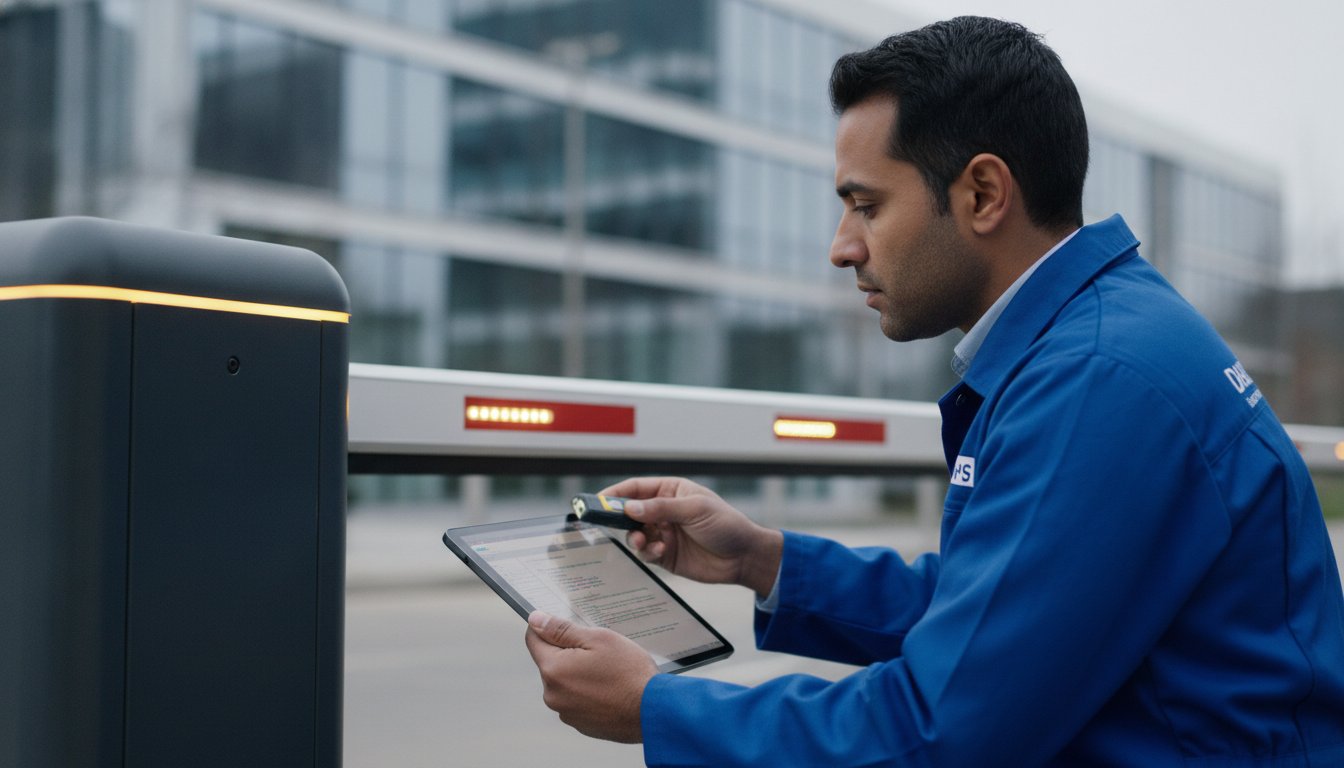
Could the very system designed to protect your premises actually be your most significant legal and operational liability? For many commercial site managers, the reality of a failing entrance system often only hits home when a motor burns out during peak traffic or a compliance audit reveals a failure to meet the latest safety standards. Professional automatic barrier maintenance in Essex is no longer just a task for the facilities checklist; it’s a fundamental requirement for ensuring site safety and operational continuity.
You likely recognise that reactive repairs are far more costly than planned inspections, yet finding a partner who balances technical expertise with deep regulatory knowledge can be challenging. This guide explains how structured maintenance for automatic barriers in Essex protects your commercial assets, ensures full compliance with the Provision and Use of Work Equipment Regulations 1998, and prevents the hidden costs of unexpected downtime. We’ll examine the specific requirements of the DHF TS 013:2025 code of practice and detail how a proactive service model extends the lifespan of your physical security infrastructure.
Key Takeaways
- Understand the legal framework governing perimeter security, including compliance with PUWER and the latest DHF codes of practice to mitigate corporate liability.
- Learn why scheduled automatic barrier maintenance in Essex is a critical investment for preventing operational downtime in busy distribution centres and office parks.
- Discover the technical components of a professional inspection, ranging from mechanical lubrication to the rigorous testing of advanced safety sensors and induction loops.
- Identify the long-term financial benefits of a proactive maintenance strategy compared to the significant costs of reactive emergency repairs and premature hardware replacement.
- Explore how a structured service plan ensures the continued integration of your barriers with IP-based access control and CCTV systems for a unified security profile.
The Necessity of Automatic Barrier Maintenance in Essex Commercial Sites
Professional automatic barrier maintenance in Essex is best defined as a proactive engineering discipline rather than a reactive fix. For commercial sites, these systems represent the primary point of control for vehicle flow and site security. At Links Integrated Systems, we view this through the lens of our 40-year industry presence; reliability isn’t accidental, it’s the result of methodical planning and technical precision. These systems are the first line of defence for your commercial infrastructure, requiring a steady, experienced hand to manage their complex technical needs.
From the coastal industrial zones in Southend to the bustling corporate centres of Chelmsford, Essex business hubs depend on consistent perimeter control. The failure of automatic bar gates at a logistics depot or a high-specification office park doesn’t just cause a minor delay. It compromises the entire security perimeter and creates a bottleneck that impacts professional reputation. We provide the stability needed to ensure these barriers function correctly under heavy use.
Statutory Compliance and HSE Requirements
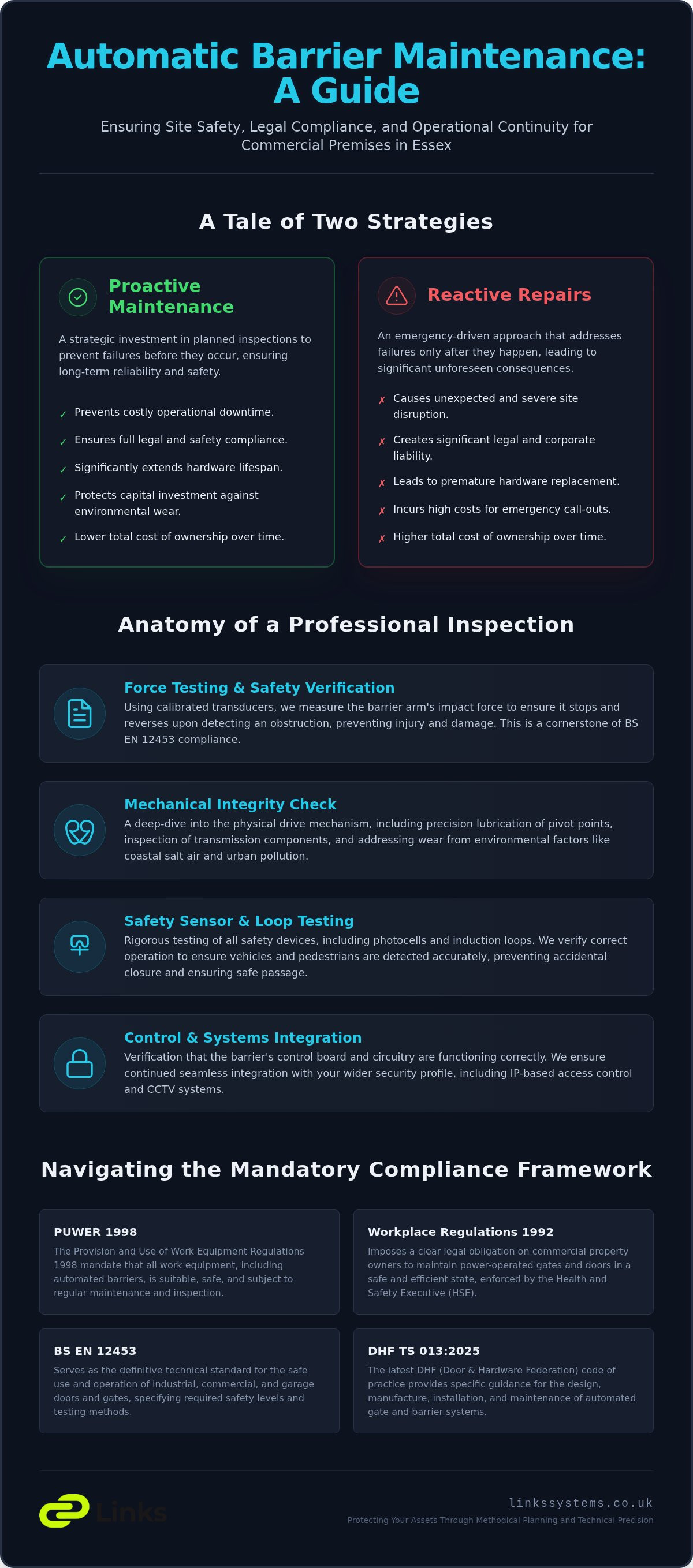
Owners of commercial premises have a clear legal obligation to maintain power-operated gates under the Workplace (Health, Safety and Welfare) Regulations 1992. This isn’t a suggestion; it’s a statutory requirement. The Health and Safety Executive (HSE) enforces barrier safety strictly, as poorly maintained systems can pose significant risks of entrapment or impact injuries. If an incident occurs, the absence of a documented maintenance log can lead to severe liability and legal repercussions. The BS EN 12453 standard serves as the definitive benchmark for the safe operation of all power-operated gates and barriers.
Protecting Your Infrastructure Investment
The Essex landscape presents unique challenges to mechanical hardware. Sites near the Thames Estuary or the coast face corrosive salt air that can accelerate the degradation of internal components and finishes. Similarly, urban centres deal with higher levels of particulate pollution that can foul moving parts. Planned automatic barrier maintenance in Essex addresses these environmental stressors before they cause systemic failure.
By implementing a structured service programme, you don’t just prevent breakdowns; you significantly extend the operational lifecycle of expensive hardware. This approach also preserves the professional aesthetics of your site. It ensures your entrance remains a clean, functional representation of your corporate values whilst protecting the long-term capital investment of the installation.
Technical Breakdown: What a Professional Maintenance Inspection Covers
A standard visual inspection might confirm that a barrier arm moves, but it fails to verify if that movement is safe, compliant, or sustainable. Professional automatic barrier maintenance in Essex involves a methodical technical audit that goes far beyond surface-level checks. We employ industry-specific diagnostic tools to assess the health of every component, from the structural housing to the intricate circuitry of the control board. This process ensures that your hardware adheres to professional commissioning standards, providing a verifiable trail of safety and reliability.
The difference between a cursory glance and a comprehensive audit lies in the data. Our engineers don’t just look for wear; they measure performance against original specifications. This level of detail is essential for maintaining accurate service logs, which are often a prerequisite for insurance validity and statutory health and safety compliance. It provides the peace of mind that your site’s entrance isn’t just functional, but legally robust.
Mechanical Integrity and Force Testing
Force testing is the cornerstone of any professional maintenance visit. We use calibrated force transducers to measure the impact levels of the barrier arm, ensuring it stops and reverses immediately upon detecting an obstruction. This prevents crushing injuries and vehicle damage, keeping your site compliant with BS EN 12453. Beyond safety tests, we conduct a deep-dive into the physical drive mechanisms. This includes the precision lubrication of pivot points to reduce friction and the inspection of the gearbox for signs of oil leakage or gear fatigue. We also adjust counterbalance spring tensions; a poorly balanced arm puts unnecessary strain on the motor, leading to premature failure and increased operational costs.
Control Systems and Safety Sensor Calibration
The reliability of an automated entrance depends on its “senses”. We rigorously test photocells, safety edges, and induction loops to ensure they trigger the correct system response every time. In high-specification environments, these components are often integrated with IP-based control boards. We inspect these boards for wiring integrity and signs of environmental ingress. Our engineers also verify that firmware is up to date. Updating the internal software ensures your system remains compatible with modern security protocols and continues to function seamlessly within your wider infrastructure. Our comprehensive system maintenance and commissioning services ensure that every technical detail is addressed, from the smallest sensor to the main control unit.
The Operational and Legal Risks of Neglecting Barrier Servicing
A common misconception amongst facility managers is that maintenance is a discretionary cost. However, the financial reality of a failed system often reveals that reactive repairs are significantly more expensive than planned care. When you neglect automatic barrier maintenance in Essex, you’re essentially gambling with your site’s operational efficiency. A failed motor or a snapped spring doesn’t just stop a barrier; it stops your business. We view professional maintenance as a “security of mind” investment that ensures your hardware remains a functional asset rather than a growing liability.
For property managers in major Essex commercial zones, from the logistics hubs near the M25 to the business parks in Basildon, a reliable entrance is a baseline requirement. Our 40-year heritage has shown that the most stable environments are those that prioritise regular technical audits. This proactive approach provides the stability that high-specification sites demand, preventing the sudden, hidden costs associated with system neglect.
Public Liability and Regulatory Penalties
The legal ramifications of a barrier malfunction can be severe. If a non-compliant system causes property damage or, worse, personal injury, the site owner is held directly responsible. Regulatory bodies and the HSE will scrutinise maintenance records immediately following an incident. A lack of documented service history often leads to significant penalties and can completely invalidate commercial insurance policies. Insurance providers require proof that equipment has been maintained to current standards to honour a claim; without this, you’re left to cover the costs of litigation and damages alone. Ignorance of safety standards is not a legal defence for site owners.
Avoiding Costly Operational Downtime
Operational downtime creates a damaging bottleneck effect that ripples through a business day. Imagine a barrier failing during the peak morning commute in a busy Chelmsford office district. Traffic quickly backs up onto public highways, causing frustration for tenants, staff, and visitors alike. This doesn’t just disrupt productivity; it causes lasting reputational damage. A broken barrier is often the first thing a client sees, and it projects an image of poor site management and technical stagnation.
Neglect also leads to catastrophic hardware failure that could have been easily avoided. A small, inexpensive component like a worn bearing or an unlubricated pivot point can place excessive strain on the drive motor. If these issues aren’t identified during regular automatic barrier maintenance in Essex, the motor will eventually burn out under the load. Replacing a commercial-grade motor is a major capital expense that far exceeds the cost of several years of planned servicing. Proactive care ensures these “emergency” costs are avoided, keeping your entrance professional and your budget predictable.
Structured Maintenance for High-Traffic Essex Environments
Essex commercial landscapes are diverse. A quiet corporate head office in Epping doesn’t face the same mechanical stress as a 24-hour distribution hub in Purfleet. Effective automatic barrier maintenance in Essex requires a bespoke approach that accounts for these variables. A one-size-fits-all service plan is insufficient for professional environments where the cost of failure is high. Instead, we recommend a tiered maintenance structure based on the duty cycle of the hardware. When specifying high-performance systems, we often refer clients to our Professional Commercial Speed Gates & Barriers guide, which outlines how hardware selection influences long-term care requirements.
Our 40-year industry presence has taught us that the most reliable sites are those that align their service intervals with actual usage patterns. This methodical approach provides the stability needed for complex Essex sites, from retail parks to secure corporate offices. By identifying the specific stressors on your infrastructure, we can transition your site from reactive repairs to a model of sustained reliability.
Tailoring Service Intervals to Traffic Volume
For low-use private car parks, a bi-annual inspection is often sufficient to maintain safety and compliance. However, high-frequency commercial entrances tell a different story. If your site processes over 500 vehicle movements per day, quarterly technical audits are the professional standard. High-traffic urban centres in Essex, such as Colchester or Romford, create a relentless rhythm for barrier motors and safety sensors. Frequent cycling accelerates the wear on springs and drive belts; regular technical intervention is essential to prevent sudden fatigue before it leads to a total system failure.
Integrating Maintenance with Access Control and CCTV
Modern security isn’t siloed. A physical barrier is only as effective as the logic that controls it. We specialise in Integrating CCTV with Access Control Systems to create a unified security profile. If a barrier fails, it doesn’t just block a road; it can create blind spots in your IP security network or cause errors in your vehicle tracking data. This creates a ripple effect across your entire site management infrastructure.
Using a single partner to manage both the physical barrier and the digital access logic provides significant advantages. It ensures that firmware updates for the barrier control board don’t conflict with your CCTV integration or ANPR cameras. This holistic management approach provides the deep-rooted stability that high-specification Essex sites require. To ensure your site remains both secure and compliant, explore our comprehensive system maintenance and commissioning packages tailored to your specific traffic requirements.
The Links Integrated Systems Approach to Professional Commissioning
Links Integrated Systems operates as an authoritative expert in the field of master-planned security solutions. With 40 years of industry experience, we provide a level of stability and technical competence that is essential for high-specification projects. Our approach is defined by a collaborative register; we don’t just act as a corporate contractor, but as a dedicated service partner for Essex facility managers and project developers. This ensures that every technical requirement is met with precision and a long-term view of hardware health. We understand that the most successful security outcomes are the result of meticulous planning and a deep understanding of the local commercial landscape.
Our Methodology: From Commissioning to Contract
The lifecycle of a reliable entrance system begins long before the first service visit. Our rigorous commissioning process ensures that every barrier is “born” compliant, meeting all safety standards and performance benchmarks from the moment of activation. This professional commissioning serves as the essential foundation for our long-term automatic barrier maintenance in Essex. We design our maintenance plans to cover the full lifecycle of the hardware, ensuring that mechanical and digital components remain synchronised as the system ages. For a total perimeter solution, we often integrate barriers with high-definition IP video intercom systems. This allows for secure, verified access that is managed through a single, stable interface, reducing the complexity for site operators and enhancing the overall security profile.
Supporting Essex Commercial Infrastructure
Our commitment to Essex business communities is built on a proactive service model. We don’t wait for a system to fail; our engineers use their expertise to identify potential points of wear or calibration drift before they escalate into operational downtime. This methodology provides the deep-rooted stability required by complex commercial sites, from industrial hubs to corporate headquarters. By choosing a partner with a 40-year heritage in integrated security, you’re investing in a relationship based on precision and proven results. We invite you to secure your commercial infrastructure with a steady, experienced hand that understands the unique demands of automatic barrier maintenance in Essex. Our goal is to provide the peace of mind that comes from knowing your site’s first line of defence is managed by specialists who value long-term reliability over rapid, transactional interactions.
Securing Your Site’s Operational Future
A reliable perimeter is the foundation of any professional commercial environment. As we’ve explored, structured maintenance is a statutory necessity that ensures your site remains fully compliant with HSE guidelines and British Standards. By prioritising regular automatic barrier maintenance in Essex, you protect your business from the significant financial and legal risks associated with equipment failure. This proactive strategy prevents operational bottlenecks and extends the lifespan of your physical security infrastructure, ensuring a consistent first impression for visitors and tenants alike.
Links Integrated Systems brings 40 years of engineering expertise to every project, acting as a specialist partner in integrated IP security. Our methodical approach provides the deep-rooted stability that complex Essex sites require to function without interruption. We invite you to enquire about a professional maintenance contract for your Essex site to safeguard your capital investment. Let us provide the technical precision and industry-leading standards your commercial property deserves. We look forward to establishing a long-term partnership that keeps your premises secure and efficient.
Frequently Asked Questions
How often should automatic barriers be serviced in a commercial setting?
Commercial barriers should typically be serviced bi-annually as a minimum standard to ensure mechanical reliability and safety. High-traffic sites, such as those with over 500 movements per day, require quarterly technical audits to manage the accelerated wear on drive motors and counterbalance springs. This frequency ensures that safety devices remain within their operational parameters, preventing the sudden failures that disrupt site productivity.
What are the legal requirements for automatic barrier safety in the UK?
The primary legal requirement falls under the Provision and Use of Work Equipment Regulations 1998 (PUWER), which mandates that all work equipment is maintained in an efficient state and in good repair. Additionally, the Workplace (Health, Safety and Welfare) Regulations 1992 require that power-operated gates and barriers are maintained in a safe condition. Failure to comply can result in Health and Safety Executive (HSE) intervention and significant corporate liability.
Does my automatic barrier need a force test every year?
Yes, force testing should be conducted at least once per year, though bi-annual testing is recommended for busy commercial environments. This technical check verifies that the barrier arm stops and reverses correctly upon impact, adhering to the BS EN 12453 safety standard. It’s a critical component of professional automatic barrier maintenance in Essex, providing documented proof of safety for your insurance records.
What is the difference between reactive repair and planned preventative maintenance?
Reactive repair occurs after a system has already failed, often leading to emergency call-out fees and significant operational downtime. Planned preventative maintenance involves scheduled technical audits designed to identify and resolve minor issues, such as worn bearings or sensor drift, before they cause a total breakdown. This proactive model offers greater cost-predictability and ensures the long-term stability of your physical security hardware.
Can you maintain barriers that were installed by another company?
We can maintain and commission barrier systems installed by third parties, provided the hardware meets current safety standards. Our engineers conduct an initial technical audit to assess the system’s condition and compliance levels. Following this assessment, we can integrate the hardware into a structured maintenance contract, applying our 40 years of engineering expertise to ensure its continued reliability and performance.
What documentation should I receive after a barrier maintenance visit?
Following a professional visit, you should receive a detailed service report and a force test certificate. This documentation must include a record of all safety checks, any technical adjustments made, and a clear statement regarding the system’s compliance with BS EN 12453. These records are essential for demonstrating your adherence to HSE guidelines and are often required to maintain the validity of commercial insurance policies.
What happens if my automatic barrier fails a safety inspection?
If a barrier fails a safety inspection, it must be isolated from use until the necessary repairs or adjustments are made to ensure it is safe. Our engineers provide a clear breakdown of the failure points and a formal proposal for remediation. Once the issues are resolved, the system is re-tested to ensure full compliance before being returned to active service, protecting your site from legal and operational risks.
How does coastal air in Essex affect barrier maintenance needs?
Coastal air contains high levels of salt and moisture, which significantly accelerates the corrosion of metal housings and internal drive mechanisms. Sites in Essex coastal areas require more frequent lubrication of pivot points and the application of protective coatings to prevent rust and mechanical seizure. Regular automatic barrier maintenance in Essex addresses these environmental stressors, ensuring that the hardware doesn’t suffer from premature structural or mechanical degradation.