
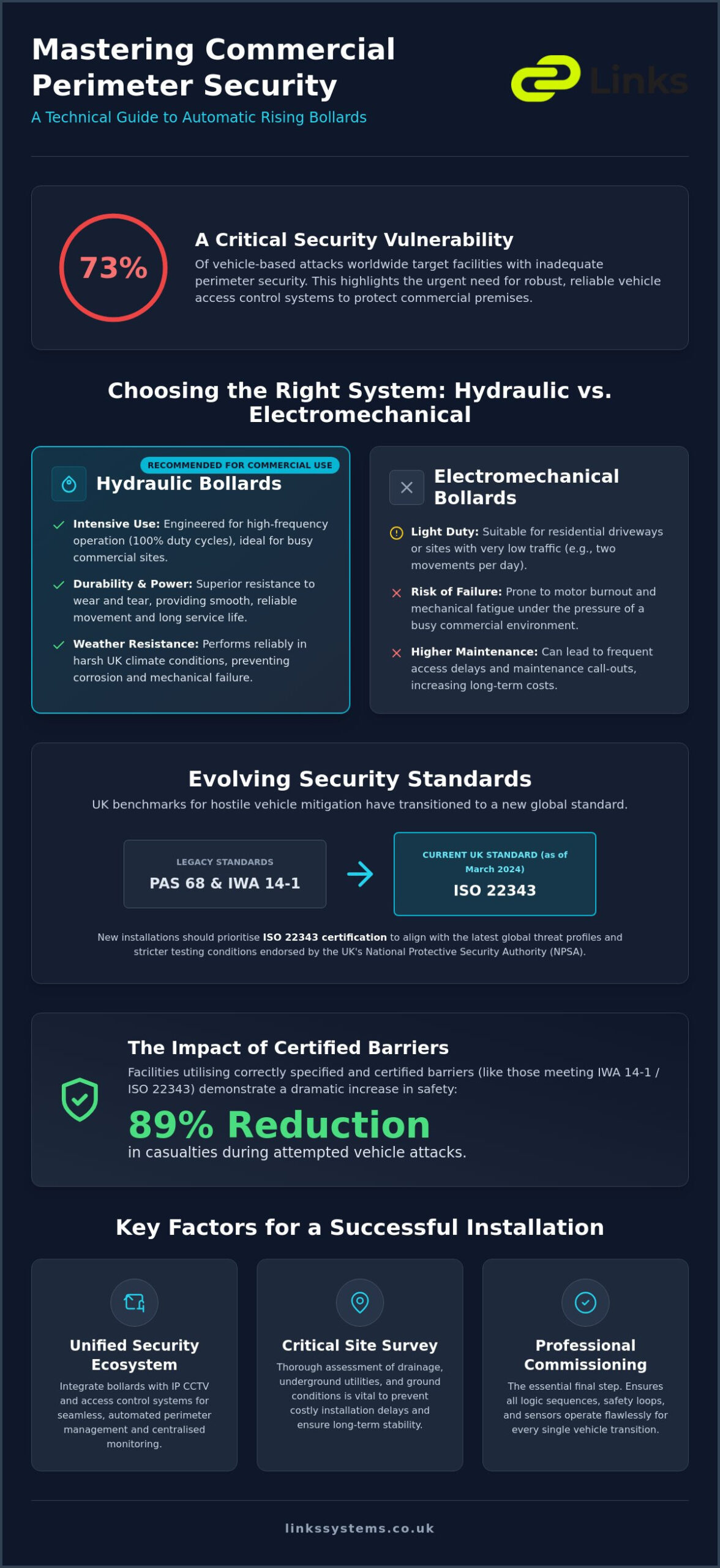
Did you know that 73% of vehicle-based attacks worldwide target facilities with inadequate perimeter security? For estate managers across London and the South East, the challenge isn’t just installing a physical barrier; it’s ensuring that barrier performs reliably without causing operational gridlock. You likely recognise the frustration of hardware that fails during peak hours or the complexity of trying to force a standalone unit to communicate with your existing IP CCTV and access control systems. A security system is only as effective as its weakest integration point, and for many commercial sites, the perimeter remains a source of constant maintenance anxiety.
This professional guide will help you master the technical requirements and integration strategies for automatic rising bollards for commercial premises to secure your site effectively. We’ll examine the transition to the new ISO 22343 impact testing standard and explain why professional commissioning is the essential bridge between hardware and a functional security ecosystem. You’ll gain a clear understanding of how to select reliable hardware, synchronise it with your data infrastructure, and establish a maintenance schedule that ensures long-term compliance and peace of mind across all your locations.
Key Takeaways
- Understand the necessity of specifying intensive-use hydraulic systems over residential-grade electrics to ensure long-term reliability on high-traffic commercial sites.
- Navigate the transition from PAS 68 to the new ISO 22343 standards to ensure your automatic rising bollards for commercial premises meet current UK security benchmarks.
- Learn how to unify physical barriers with IP-based access control and HD CCTV systems to create a seamless, automated perimeter management ecosystem.
- Identify the critical site survey requirements for London and South East locations, focusing on drainage and utility management to prevent installation delays.
- Discover why professional commissioning is the essential final step in ensuring logic sequences and safety sensors operate flawlessly for every vehicle transition.
The Role of Automatic Rising Bollards in Modern Commercial Security
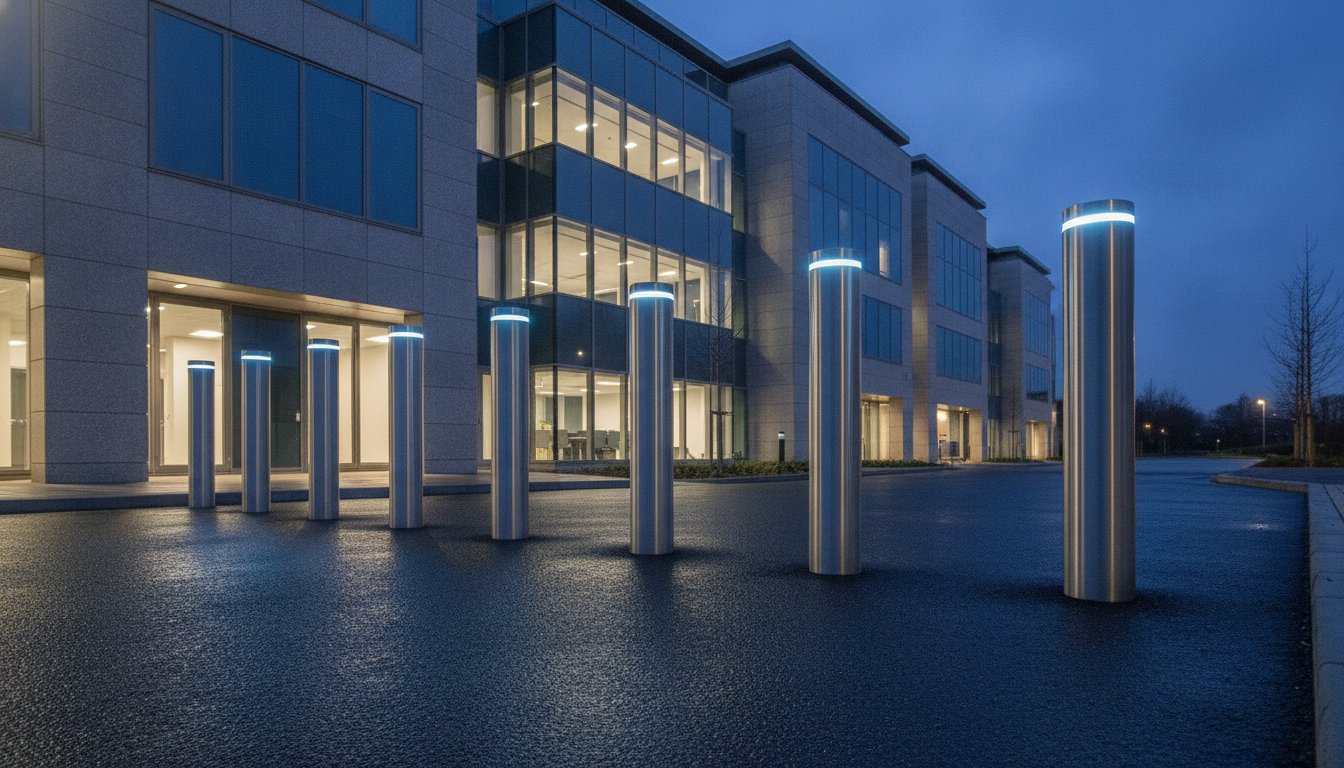
A traffic bollard in a professional context is no longer a simple static post. In modern security design, these units have evolved into dynamic physical barriers that provide a sophisticated layer of vehicle management. For many businesses, automatic rising bollards for commercial premises represent a strategic transition from passive perimeter protection to active, remote-controlled access management. They allow facility managers to maintain a hard perimeter whilst ensuring that authorised vehicles can move freely without the aesthetic or operational drawbacks of large gates or manual barriers.
The distinction between commercial-grade hardware and residential alternatives is critical for site reliability. Whilst residential electric bollards might suffice for a private driveway with two movements a day, they often fail under the pressure of a busy office park or retail centre. Commercial environments demand intensive-use hydraulics. These systems are engineered to handle high-frequency operation, ensuring that site access remains fluid during peak morning and evening rushes without the risk of motor burnout or mechanical fatigue. This level of reliability is what provides stakeholders with the peace of mind that their premises remain secure and accessible 24 hours a day.
Key Applications for Commercial Sites
Security requirements vary significantly across the South East, and the application of automatic rising bollards for commercial premises must reflect the specific risk profile of the location. In central London, bollards are frequently deployed to secure office building forecourts and executive parking areas where space is at a premium and a high-quality finish is required. In Essex, they are a staple for managing delivery access at retail parks and distribution centres, ensuring only authorised logistics vehicles enter restricted zones. For pedestrianised zones amongst high-footfall commercial hubs, these barriers protect the public from vehicle incursions whilst allowing emergency services to pass through via secure overrides.
Hydraulic vs. Electromechanical Systems
Hydraulic bollards remain the industry favourite for intensive commercial applications due to their inherent durability and power. Unlike electromechanical alternatives, hydraulic units use pressurised fluid to drive the piston, which offers a smoother movement and significantly higher resistance to wear. When specifying a system, it’s vital to assess the duty cycle. A system that cannot handle 100% duty cycles will eventually lead to access delays and frequent maintenance call-outs. Furthermore, the UK climate necessitates the use of high-grade stainless steel or weather-resistant finishes to prevent corrosion and ensure the hardware remains functional through decades of exposure to the elements.
Technical Specifications: Impact Ratings and Safety Standards
Specifying automatic rising bollards for commercial premises requires a granular understanding of impact testing and safety compliance. For decades, PAS 68 and IWA 14-1 were the UK’s primary benchmarks for hostile vehicle mitigation. However, as of March 2024, the National Protective Security Authority (NPSA) has transitioned its focus to ISO 22343. This current international standard introduces stricter fail conditions and more precise vehicle classifications. Whilst legacy products tested under the older standards remain valid, new installations should prioritise ISO 22343 certification to ensure alignment with the latest global threat profiles.
Choosing the right rating depends entirely on a site-specific risk assessment. A 2023 report from the U.S. Department of Homeland Security noted that 73% of vehicle-based attacks target facilities with inadequate perimeter security. Conversely, facilities utilising IWA 14-1 certified barriers (the predecessor to ISO 22343) showed an 89% reduction in casualties during attempted vehicle attacks. For high-risk South East locations, such as government infrastructure or major data centres, anti-ram bollards are essential. For standard commercial forecourts, traffic management bollards may suffice, focusing on movement control rather than stopping a multi-tonne vehicle at speed.
Impact Rating Breakdown for Facilities Managers
- Traffic management bollards: These units are designed for high duty cycles and controlling vehicle flow. They do not carry a crash rating and are intended to deter unauthorised parking rather than stop a hostile vehicle.
- High-security bollards: These are certified to halt vehicles of specific weights, such as 7.5 tonnes, at specific speeds. They are the standard choice for protecting critical infrastructure.
- ISO vs K-Ratings: Modern ISO 22343 standards provide a more comprehensive analysis of vehicle penetration distance compared to the older US K-ratings, which are increasingly being phased out in British specifications.
Safety and Emergency Protocols
Safety is as vital as security. All automated systems must comply with the Machinery Directive to prevent injury during movement. Obstacle detection sensors and integrated LED lighting are non-negotiable for public-facing areas amongst busy urban centres. You must also decide between fail-safe and fail-secure configurations. Fail-safe bollards automatically lower during a power loss to allow emergency access, whilst fail-secure units remain raised to maintain the perimeter. Integrating these units with your fire alarm ensures the bollards descend immediately during an evacuation. For reliable long-term performance, professional system maintenance and commissioning ensures these safety logic sequences are tested and verified for flawless operation.
Induction loops are another critical safety component. They detect the presence of a vehicle directly over the bollard, preventing the unit from rising whilst a car is still in the transition zone. This protects both the hardware and the vehicle from accidental damage. When these technical elements are organised correctly, the result is a secure, compliant, and safe perimeter that meets all UK regulatory guidelines.
Integrating Bollards with Advanced Access Control and IP CCTV
Traditional security often treats physical barriers as isolated components. However, for automatic rising bollards for commercial premises, the true value lies in their integration with the wider site network. Relying on hand-held remotes is inefficient for modern facilities management; instead, IP-based control allows for precise, software-driven management. This enables an estate manager in a central London HQ to oversee vehicle access across multiple sites in Kent or Surrey from a single interface. By centralising these controls, you ensure that security protocols remain consistent regardless of the specific location, providing a unified approach to perimeter protection.
The transition to IP-based systems means that bollards no longer operate in a vacuum. They become data points within your security infrastructure. When a vehicle approaches, the system can use IP HD CCTV for visual verification, ensuring that the driver and vehicle match the expected profile before any physical movement occurs. This proactive model replaces the reactive “button-pushing” of the past with a methodical, verified process that enhances both security and site safety.
Seamless Visitor Management
Effective visitor management requires visual and data-driven verification. Linking bollards to IP video intercom systems allows reception staff or remote operators to verify a driver’s identity before lowering the barrier. This process can be further automated through ANPR (Automatic Number Plate Recognition). When an authorised vehicle approaches, the system cross-references the plate against a whitelist and triggers the bollard descent automatically. This creates a detailed audit trail, recording exactly when every vehicle entered and exited the premises, which is invaluable for security reviews amongst high-traffic commercial hubs.
The Value of Integrated Physical Security
A holistic approach to perimeter protection involves creating a “ring of steel” by synchronising bollards with other physical measures. This is often achieved by linking them with commercial speed gates or barriers to provide multi-layered defence. For example, a high-security site might use speed gates for primary traffic flow whilst keeping automatic bollards as a secondary, crash-rated line of defence. When the system detects a breach or tampering event, it can automatically trigger IP HD CCTV cameras to begin high-definition recording. This level of automation significantly reduces the reliance on on-site security personnel, allowing technology to handle the routine tasks of verification and deterrence with precision.
Planning and Installation for South East Commercial Premises
Installing automatic rising bollards for commercial premises in the South East presents unique logistical challenges. From the narrow streets of central London to the busy business parks of Kent and Surrey, successful deployment hinges on meticulous pre-installation planning. A thorough site survey is the first line of defence against project delays. This process involves mapping underground utilities to avoid damaging existing power or data lines and assessing ground conditions to ensure the structural base can support the required impact ratings. Without this initial rigour, even the highest-specification hardware can fail due to poor foundational support.
Navigating local planning requirements is another vital consideration for estate managers. Whilst installing bollards on private land often does not require planning permission, the Department for Transport provides specific guidelines that must be followed to ensure public safety. Permission is almost certainly required if your premises are in a conservation area, involve a listed building, or if the installation affects a public highway. To minimise disruption to your daily operations, groundworks should be organised in phases. This approach ensures that site access remains functional whilst the heavy civil works are completed, preventing the operational gridlock that often follows poorly managed security upgrades.
Site Preparation and Civil Works
Effective drainage is the single most important factor in the longevity of a hydraulic system. Without proper soakaways or pumped drainage, standing water can lead to hydraulic failure and electrical shorts. Excavation must also account for the complex web of underground services common in urban centres like London. Once the bollard casings are positioned, ensuring correct concrete curing times is essential for structural integrity. Rushing this stage can compromise the crash rating of the entire system, rendering the security investment ineffective against vehicle-borne threats.
Local Maintenance and Support
Proximity is a critical factor when selecting a security partner for sites in London, Essex, and Hertfordshire. Rapid response times for on-site support ensure that any hardware issues don’t lead to prolonged security vulnerabilities. Scheduled maintenance is the most effective way to prevent downtime, involving regular checks of hydraulic fluid levels, seal integrity, and safety sensor calibration. Modern systems now utilise remote diagnostics, allowing technicians to identify and often resolve software-based logic issues without a physical site visit. For comprehensive protection, investing in professional System Maintenance & Commissioning ensures your perimeter remains reliable and compliant throughout its entire lifecycle.
Professional Commissioning: The Links Integrated Systems Advantage
For many contractors, the project ends when the concrete sets and the hardware is powered on. However, for automatic rising bollards for commercial premises, the physical installation is only the first phase. Professional commissioning is a distinct and critical process that bridges the gap between hardware placement and a fully operational security system. It is the stage where technical expertise ensures that the bollards don’t just move, but move correctly, safely, and in perfect synchronisation with your site’s wider security protocols. Without this rigorous final verification, a site remains vulnerable to logic failures or safety sensor malfunctions that can lead to costly downtime.
Our approach to commissioning is built on 40 years of industry experience, focusing on the precision required for complex South East commercial environments. We move beyond basic functionality to verify that the bollards are fully integrated into your IP security infrastructure. This includes testing the communication between the bollard controllers and your IP Video Intercom Systems or access control software. A successful handover also requires comprehensive staff training. We ensure your on-site team understands the manual override procedures, emergency protocols, and software interfaces, transforming a complex technical installation into a manageable, user-friendly security asset.
Rigorous System Testing
The testing phase involves a methodical checklist designed to simulate real-world scenarios. We verify fail-safe operations to ensure bollards descend correctly during power losses or fire alarms, whilst also checking that fail-secure settings maintain the perimeter when required. Induction loops and pressure sensors are calibrated with high precision to prevent accidental vehicle damage. Commissioning is the final verification of system design and safety, ensuring that every mechanical movement and software command aligns with the project’s specific security requirements. This meticulous attention to detail ensures that the logic sequences governing vehicle transitions are flawless from day one.
Long-term Reliability and Warranty
Professional commissioning is often a prerequisite for maintaining manufacturer hardware warranties. When a system is commissioned by specialists, it ensures the equipment is operating within its designed parameters, which significantly reduces mechanical wear and long-term maintenance costs. An expertly configured system is less likely to suffer from the intermittent faults that plague poorly setup hardware. By investing in this final technical stage, you protect your capital investment and ensure the peace of mind that comes with a reliable, professionally verified perimeter. Enquire about professional commissioning for your South East premises to ensure your security infrastructure is built for long-term stability.
Securing Your Perimeter for the Long Term
Effective vehicle management requires more than just high-grade hardware; it demands a unified approach where physical barriers and digital infrastructure work in harmony. You’ve seen how the transition to ISO 22343 standards and the integration of IP-based access control can transform a static perimeter into a proactive security asset. By prioritising intensive-use hydraulic systems and professional commissioning, you ensure that your investment remains reliable under the pressures of high-traffic urban environments.
Successfully managing automatic rising bollards for commercial premises involves technical precision from the initial site survey through to long-term maintenance. With over 40 years of expertise, our team provides specialist installation and full system commissioning across London and the Home Counties. We focus on creating a seamless security ecosystem that protects your assets whilst maintaining operational efficiency and safety compliance.
If you’re ready to enhance your site’s security with a professionally integrated solution, Request a Professional Specification Consultation today. We’re here to help you build a resilient, compliant perimeter that provides lasting peace of mind.
Frequently Asked Questions
Do I need planning permission for automatic rising bollards on my commercial site?
Planning permission is generally not required for bollards installed on private commercial land, provided they don’t exceed height restrictions or affect public highways. However, you must consult your local planning authority if the premises are in a conservation area or involve a listed building. Adhering to Department for Transport guidelines ensures public safety and avoids potential enforcement actions from local councils.
How much maintenance do automatic hydraulic bollards require?
Automatic hydraulic bollards require bi-annual or annual professional maintenance to ensure long-term reliability. This process involves checking hydraulic fluid levels, inspecting seals for leaks, and calibrating safety sensors. Regular servicing prevents unexpected site access delays and ensures the hardware operates within its designed duty cycle, especially in demanding environments across the South East.
Can automatic bollards be integrated with my existing access control system?
Yes, automatic rising bollards for commercial premises are designed for seamless integration with existing access control systems. They can be linked via standard I/O connections or IP-based controllers to work alongside speed gates, barriers, and intercoms. This allows for centralised management and ensures that a single credential or command can trigger multiple security components simultaneously.
What happens to the bollards during a power cut or emergency?
You can specify bollards to be either fail-safe or fail-secure during a power loss. Fail-safe units automatically descend to allow emergency vehicle access, whilst fail-secure units remain raised to maintain the perimeter. Most commercial systems also feature an emergency override, often integrated with the building’s fire alarm, to ensure the site can be cleared or accessed rapidly during a crisis.
Are automatic bollards suitable for high-traffic environments in London?
High-traffic environments in London demand intensive-use hydraulic bollards capable of 100% duty cycles. Unlike residential electric models, these commercial-grade units are engineered to handle the constant movement of vehicles in busy delivery bays or office forecourts. Selecting hardware with a high frequency of operation rating is essential to prevent mechanical fatigue and site congestion during peak hours.
What is the typical lifespan of a professionally commissioned commercial bollard?
A professionally commissioned commercial bollard typically has a lifespan of 10 to 15 years, depending on the frequency of use and the quality of the maintenance regime. Using high-grade stainless steel and ensuring effective drainage during the installation phase significantly extends this longevity. Regular servicing by a specialist partner helps identify wear early, protecting the initial capital investment.
How do PAS 68 bollards differ from standard traffic management bollards?
PAS 68 bollards are crash-rated barriers tested to stop vehicles of specific weights at high speeds, providing hostile vehicle mitigation. Standard traffic management bollards are intended for flow control and deterrence only; they don’t carry an impact certification. Choosing between them depends on your site’s risk profile and whether the primary goal is security or simple access regulation.
Can I control my commercial bollards via a smartphone app or remote IP system?
Modern automatic rising bollards for commercial premises can be controlled via smartphone apps or remote IP systems when integrated with a network-based controller. This allows security managers to monitor status and trigger movement from any location with internet access. Using an IP-based management platform provides real-time feedback on bollard positions and any system alerts, enhancing operational oversight across multiple sites.