
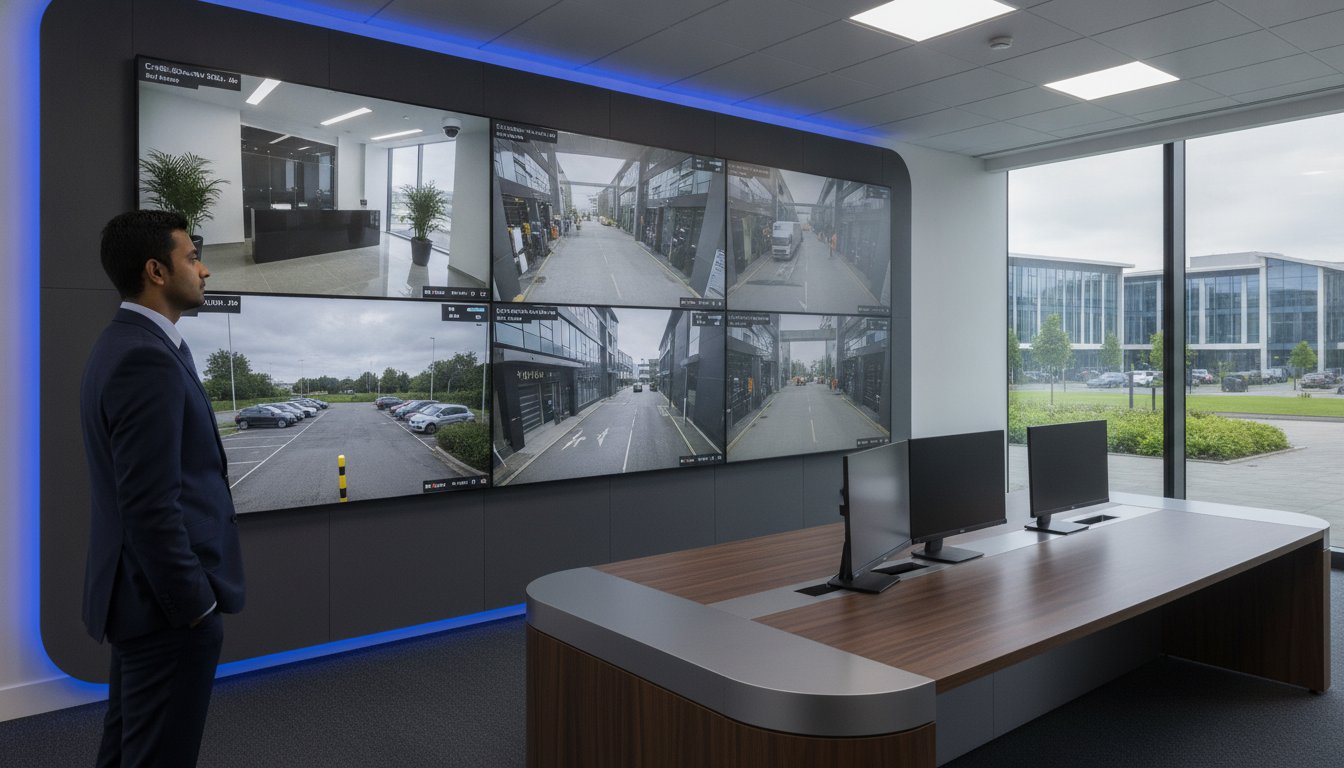
With business robberies in England and Wales increasing by 50 per cent in the year ending March 2025, relying on legacy security hardware is no longer a viable strategy for Surrey firms. If your current system produces grainy, low-resolution footage that fails to provide clear evidence, you’re likely paying for a sense of security rather than the reality of it. Even the most diligent commercial CCTV maintenance Surrey can only do so much for outdated analogue hardware; eventually, the cost of upkeep outweighs the benefits of a modern upgrade.
We understand that the prospect of overhauling your entire security infrastructure feels daunting, especially when you need to maintain daily operations. This guide explains how to transition seamlessly to a high-definition IP CCTV system that delivers 4K clarity and remote mobile viewing without the typical disruption. We’ll explore the technical requirements of modernising your site, from integrating access control to ensuring full compliance with the latest requirements of the Data (Use and Access) Act 2025. By moving to a networked solution, you can secure your premises with a future-proof system designed for long-term reliability.
Key Takeaways
- Learn why transitioning from legacy analogue hardware to IP is critical for maintaining high-definition evidence and site security in 2026.
- Discover how a professional site audit identifies blind spots and determines whether to use IP encoders or full camera replacements.
- Understand the role of Power over Ethernet (PoE) and bandwidth management in ensuring your security system runs without impacting your business network.
- Ensure long-term reliability and UK GDPR compliance through expert commissioning and proactive commercial CCTV maintenance Surrey.
- Explore the operational advantages of integrating your IP CCTV with speed gates and access control for a unified security infrastructure.
Transitioning from Analogue to IP CCTV Systems in Surrey
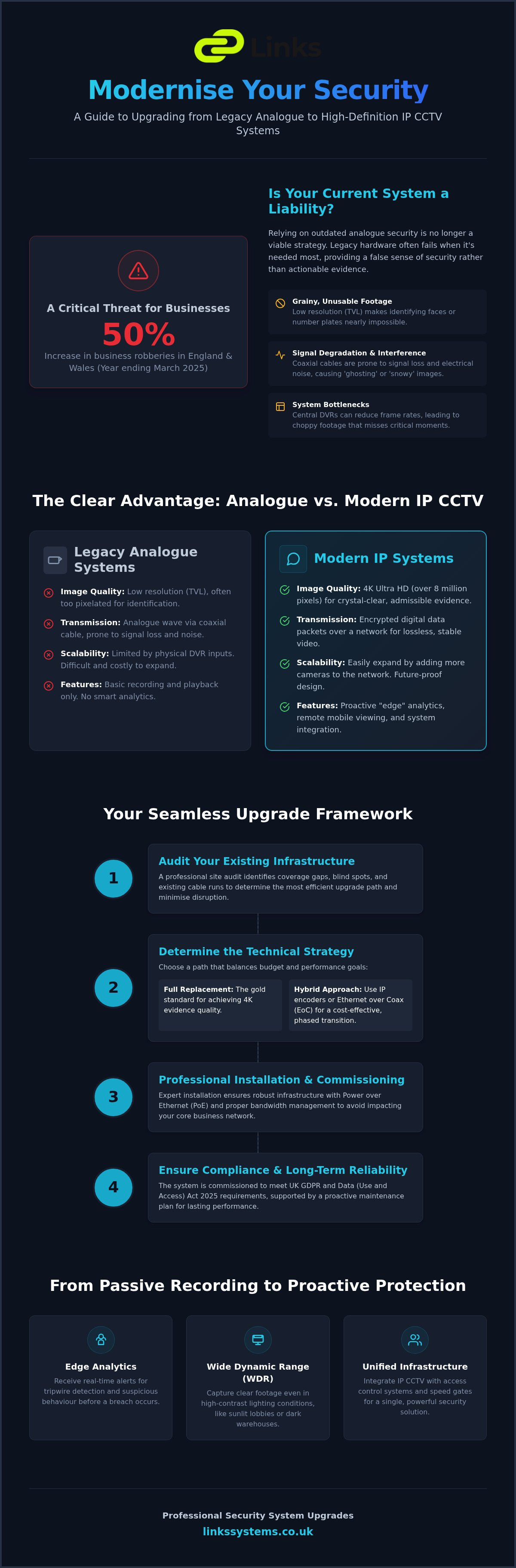
The evolution of Closed-circuit television (CCTV) systems has reached a decisive moment for Surrey businesses. Traditional analogue setups transmit video as a continuous electrical wave through coaxial cabling. Whilst this served as the industry standard for decades, it’s inherently limited by physical signal degradation and interference. In contrast, modern IP systems convert video into encrypted data packets at the source. This allows for lossless transmission over local networks, providing a level of stability and signal integrity that analogue hardware simply cannot match.
By 2026, the transition to IP has become a necessity for high-level site protection. Legacy hardware is struggling to keep pace with modern security requirements and evolving regulatory standards. Older systems measured resolution in Television Lines (TVL), often producing images that were too pixelated to identify individuals or vehicle registrations accurately. Modern 4K ultra-high-definition cameras offer over 8 million pixels per frame. This massive increase in data allows Surrey managers to utilise digital zoom without losing critical detail, turning a vague shape into clear, admissible evidence.
Reliability is the cornerstone of an integrated security strategy. Ongoing commercial CCTV maintenance Surrey is vital for system longevity, but even the most thorough servicing cannot compensate for the fundamental weaknesses of ageing coaxial infrastructure. Finding replacement parts for legacy DVRs is becoming increasingly difficult as manufacturers shift their focus entirely to networked solutions. A professional approach to commercial CCTV maintenance Surrey now involves assessing how to transition these legacy components into a more robust, future-proof digital environment that supports remote accessibility from any location.
The Limitations of Legacy Coaxial Systems
Analogue systems are prone to signal loss over long cable runs, often resulting in “ghosting” or snowy images that are useless during an investigation. These systems rely on a central Digital Video Recorder (DVR) which acts as a significant bottleneck for the entire site. If the DVR’s processing power is insufficient, it may reduce frame rates across all cameras to cope with the storage load. This leads to choppy footage where critical seconds of an incident might be missed entirely. Coaxial cables are also susceptible to electrical noise from nearby power lines, which can compromise the integrity of your security feed at the worst possible time.
Key Benefits of High-Definition IP Video Surveillance
IP cameras offer sophisticated features that were previously impossible with traditional wiring. Wide Dynamic Range (WDR) allows cameras to capture clear footage in office lobbies with heavy glass and challenging backlighting. Beyond mere recording, “edge” analytics process data directly on the camera itself. Features like tripwire detection and heat mapping provide proactive alerts, allowing security teams to respond to suspicious behaviour before a breach occurs. This approach transforms your CCTV from a passive recording tool into an active participant in your site’s protection, integrating seamlessly with other building management systems.
How to Organise Your IP CCTV System Upgrade: A Step-by-Step Framework
Upgrading a commercial security system requires more than just replacing cameras. It demands a methodical framework that ensures zero downtime whilst transitioning between technologies. A successful project begins with a granular site audit, identifying exactly where current coverage fails and where infrastructure can be salvaged. This phase is critical because it dictates the budget and the technical complexity of the installation.
For many Surrey businesses, a total “rip and replace” isn’t always the most efficient path. We often evaluate the feasibility of using IP encoders. These devices allow legacy analogue cameras to communicate on a modern network, providing a cost-effective bridge whilst you phase in high-definition hardware. However, to achieve the 4K evidence quality required for modern legal standards, full camera replacement remains the gold standard for site protection.
Step 1: Auditing Your Existing Security Infrastructure
The first stage involves mapping existing cable runs. If your site has extensive coaxial cabling, we can often utilise Ethernet over Coax (EoC) technology to transmit digital signals without the need for invasive re-wiring. This reduces labour costs and minimises site disruption. We also assess power requirements at each junction. Modern IP cameras typically rely on Power over Ethernet (PoE), so ensuring your network switches can handle the increased wattage is essential for system stability. Adhering to the Surveillance Camera Code of Practice during this audit ensures that your new layout remains compliant with UK privacy regulations from the outset.
Step 2: Selecting the Right NVR and Camera Specification
Selecting a Network Video Recorder (NVR) is about more than just current needs. It’s about scalability. Your NVR must have sufficient processing power and drive bays to handle the high bitrates of 4K video whilst allowing for future business growth. Storage calculations must account for the ICO’s general 30-day retention position. When choosing camera hardware, we consider the specific geography of your Surrey premises. Bullet cameras offer a visible deterrent for perimeters, whilst discreet domes are better suited for office interiors. Ensuring all hardware is ONVIF compliant is a non-negotiable requirement. This allows for interoperability amongst different manufacturers and prevents restrictive vendor lock-in.
A phased transition plan is the final piece of the framework. By upgrading your system in zones, we maintain active surveillance across the site at all times. This methodical approach is a core part of our commercial CCTV maintenance Surrey services, ensuring that your security never lapses during the modernisation process. If you are planning a site upgrade, our team can help you design a robust integrated security infrastructure tailored to your specific operational risks.
Essential Infrastructure for a Robust Commercial IP Upgrade
The physical backbone of an IP system is just as critical as the cameras themselves. Whilst analogue systems rely on dedicated coaxial paths, IP video shares the digital environment of your business. This requires a structured approach to network design to ensure that high-definition video streams do not compromise your daily office operations. A well-designed infrastructure facilitates more efficient commercial CCTV maintenance Surrey, as it allows for remote diagnostics and centralised power management.
To prevent network congestion, we implement Virtual LANs (VLANs). By segregating security traffic from your primary data network, we ensure that large 4K video packets don’t slow down your internet or internal file sharing. This logical separation also adds a layer of cyber security, isolating the surveillance hardware from other networked devices. When selecting hardware for this infrastructure, adhering to ONVIF interoperability standards is essential to ensure that switches, recorders, and cameras from different manufacturers communicate without protocol errors.
Network Stability and PoE Requirements
High-quality Cat6 cabling serves as the gold standard for modern IP CCTV upgrades. It provides the necessary bandwidth for multiple 4K streams whilst delivering reliable power over longer distances. We utilise managed PoE (Power over Ethernet) switches as a central hub for the system. These devices are vital for proactive commercial CCTV maintenance Surrey, as they allow our engineers to cycle power to individual cameras remotely if a software hang occurs. For cameras located in remote site corners where a dedicated switch isn’t viable, PoE injectors provide a stable power solution without the need for additional electrical outlets.
Storage Requirements for 4K and AI-Enhanced Video
Recording in 4K resolution with AI analytics generates vast amounts of data. Estimating storage requirements involves calculating the bitrate of every camera against your required retention period, typically 30 days. We employ H.265+ high-efficiency compression to reduce storage costs and bandwidth usage by up to 70 per cent compared to older standards, all whilst maintaining crystal-clear evidence quality. For mission-critical sites, we configure storage using RAID 5 or RAID 10 arrays. This ensures that if a single hard drive fails, your footage remains intact and the system continues to record without interruption. This level of redundancy provides the peace of mind that evidence will be available when it is most needed.
Planning Your Surrey Site Survey and Compliance
A professional site survey serves as the technical foundation for any IP CCTV modernisation project. It’s far more than a simple counting of cameras. Our engineers conduct a methodical assessment of environmental factors, such as the specific lighting conditions found across Surrey commercial parks. We evaluate whether your site requires additional external infrared or white-light illumination to ensure 4K clarity at night. For businesses operating out of listed buildings or modern glass-fronted offices, we select discreet mounting solutions that preserve the architectural integrity of the site whilst providing optimal viewing angles.
This planning phase also ensures that your system design facilitates easier commercial CCTV maintenance Surrey in the future. By identifying accessible mounting points and protected cable routes during the survey, we reduce the complexity of subsequent inspections. Our team also considers the integration of your video surveillance with existing hardware, such as access control systems and speed gates, to create a unified security perimeter.
Identifying Critical Coverage Gaps in Commercial Premises
Strategic camera placement is essential for capturing actionable evidence. We focus on high-traffic entry and exit points, ensuring that resolution and frame rates are sufficient for facial recognition and number plate identification. Perimeter protection must extend beyond the building itself to cover loading bays and car parks effectively. Inside the premises, we prioritise the monitoring of high-value internal assets and office centres, eliminating blind spots that legacy systems often overlook. This comprehensive approach ensures that every square metre of your site is accounted for in the final design.
Navigating Local Compliance and Data Protection
Operating a commercial surveillance system in the UK carries significant legal responsibilities. Under the Data Protection Act 2018 and the UK GDPR, businesses must conduct a Privacy Impact Assessment (PIA) before deployment. We assist in implementing privacy masking to protect neighbouring residential properties in Surrey, ensuring your cameras only record what is legally permissible. As of June 2026, a mandatory complaints-handling duty is in force for data controllers. We help you establish clear policies for data access and footage requests, ensuring your business remains fully compliant with ICO regulations. To ensure your site meets these rigorous standards, book a professional site survey with our experienced engineering team.
Professional Commissioning and Maintenance with Links Integrated Systems
The final stage of an IP CCTV upgrade is often the most critical, yet it’s frequently overlooked by generalist contractors. There is a fundamental distinction between simply fitting a camera to a wall and the professional commissioning of a complex security network. Commissioning is the methodical process of verifying that every component operates at its peak performance and integrates perfectly with your existing infrastructure. This technical validation ensures that your investment delivers the reliability required for 24-hour commercial protection.
Security in the digital age requires a focus on both physical and cyber vulnerabilities. We ensure network integrity through rigorous firmware hardening and the implementation of secure, encrypted password protocols. This prevents your security hardware from becoming an entry point for unauthorised network access. Beyond the initial setup, proactive commercial CCTV maintenance Surrey is essential for business continuity. Regular inspections allow us to identify and rectify minor hardware issues or storage errors before they result in a total system failure at a critical moment.
Why Expert Commissioning is Vital for System Reliability
Our engineers fine-tune every camera to optimise focus, field of view, and bitrate settings based on the specific environmental conditions of your site. We also conduct thorough testing of failover protocols. This ensures that if a network switch loses power, the system automatically redirects data or utilises on-camera storage to prevent any loss of footage. Professional commissioning eliminates the common issues of ghosting or lag in live feeds, providing a fluid and responsive monitoring experience for your security team. This level of precision is what separates a high-level corporate installation from a basic domestic setup.
Integrating IP CCTV with Access Control for Total Security
Modern site management is most effective when security layers work in unison. By connecting your video surveillance with commercial access control systems, you create a powerful audit trail. This integration allows for the automatic linking of video events to specific alerts, such as a door being forced or an unauthorised entry attempt at a speed gate. Using integrated systems provides immediate visual verification of every access event, allowing facility managers to confirm identities in real time.
The process of integrating CCTV with access control systems significantly simplifies daily operations for Surrey facility managers. Instead of managing disparate platforms, you can oversee your entire security perimeter from a single, unified interface. This holistic approach is at the heart of our commercial CCTV maintenance Surrey service, where we look at the health of the entire integrated ecosystem rather than just individual cameras. This strategy ensures that your security infrastructure remains a dependable pillar of your business operations for years to come.
Securing the Future of Your Surrey Business
Transitioning to a high-definition IP CCTV system is a strategic investment in your site’s long-term protection. By replacing legacy analogue hardware with 4K networked solutions, you gain the clarity required for modern legal standards and the operational flexibility of remote monitoring. This modernisation isn’t merely about new cameras; it’s about building a robust, integrated infrastructure that supports your business growth whilst remaining fully compliant with UK data regulations.
Reliability depends on more than just hardware. Ongoing commercial CCTV maintenance Surrey ensures these sophisticated systems remain operational and secure against evolving threats. With 40 years of security expertise, our local Surrey-based support team provides professional commissioning as standard for every project. We take pride in being a dependable partner for stakeholders who value precision and industry-leading standards.
Take the first step towards a more resilient security posture. Request a professional Surrey site survey for your IP CCTV upgrade and ensure your premises are protected by a system built for the requirements of 2026 and beyond.
Frequently Asked Questions
How much does an IP CCTV system upgrade cost for a Surrey business?
The total investment for an IP upgrade depends on the number of cameras, the required storage duration, and whether your existing cabling can be salvaged. High-resolution 4K systems require more robust storage and processing power, which influences the final specification. We provide bespoke designs based on a thorough site survey to ensure the solution meets your specific security and budget requirements without unnecessary expenditure.
Can I use my existing coaxial cables for a new IP CCTV system?
Yes, we can often utilise your existing coaxial infrastructure by installing Ethernet over Coax (EoC) converters. This approach allows digital data to travel over old analogue wiring, significantly reducing the labour costs and site disruption associated with a full re-cable. It’s a practical way to manage the transition to IP whilst maintaining a regular schedule for commercial CCTV maintenance Surrey.
What is the difference between an NVR and a DVR?
A Digital Video Recorder (DVR) is used for analogue systems and encodes video data at the recorder itself. A Network Video Recorder (NVR) is used for IP systems, where the video is encoded at the camera and then streamed to the NVR as data. This shift allows for much higher resolutions, advanced edge analytics, and more flexible network-based installations that aren’t limited by physical cable lengths.
How long does a commercial CCTV upgrade typically take to install?
A typical commercial upgrade for a medium-sized Surrey office usually takes between three and five working days. We follow a phased installation plan to ensure your site remains protected throughout the process. The exact duration depends on the complexity of the network configuration and whether we are installing new Cat6 cabling or using converters to utilise existing infrastructure.
Do I need to inform my staff if I upgrade to higher-resolution cameras?
Yes, businesses must comply with the Data Protection Act 2018 and UK GDPR by updating their staff and visitors about surveillance changes. You should update your CCTV signage to reflect the identity of the data controller and ensure your Privacy Impact Assessment (PIA) accounts for the increased detail captured by 4K hardware. This ensures your upgrade remains legally compliant and maintains the trust of your employees.
Is it possible to view my Surrey office CCTV cameras on my smartphone?
Modern IP HD CCTV systems allow for seamless remote viewing via secure applications on your smartphone, tablet, or desktop. This capability provides Surrey facility managers with real-time site oversight from any location with an internet connection. We configure secure encrypted portals during the commissioning stage to ensure your video feeds remain private and protected from unauthorised access at all times.
What happens to my CCTV recording if the internet goes down?
Recording will continue uninterrupted even if your internet connection fails, as the cameras transmit data directly to the local NVR. The only feature affected by an internet outage is remote viewing. For mission-critical sites, we can also configure edge storage where individual cameras record to internal SD cards as a secondary failover during local network interruptions.
Can IP CCTV systems be integrated with my existing office access control?
IP systems are designed for high-level integration, allowing your cameras to work in unison with access control systems and speed gates. This integration enables visual verification of every access event, such as a camera automatically recording a high-resolution clip when a specific door is opened. This unified approach is a core focus of our commercial CCTV maintenance Surrey, ensuring all security layers operate as a single, cohesive ecosystem.