
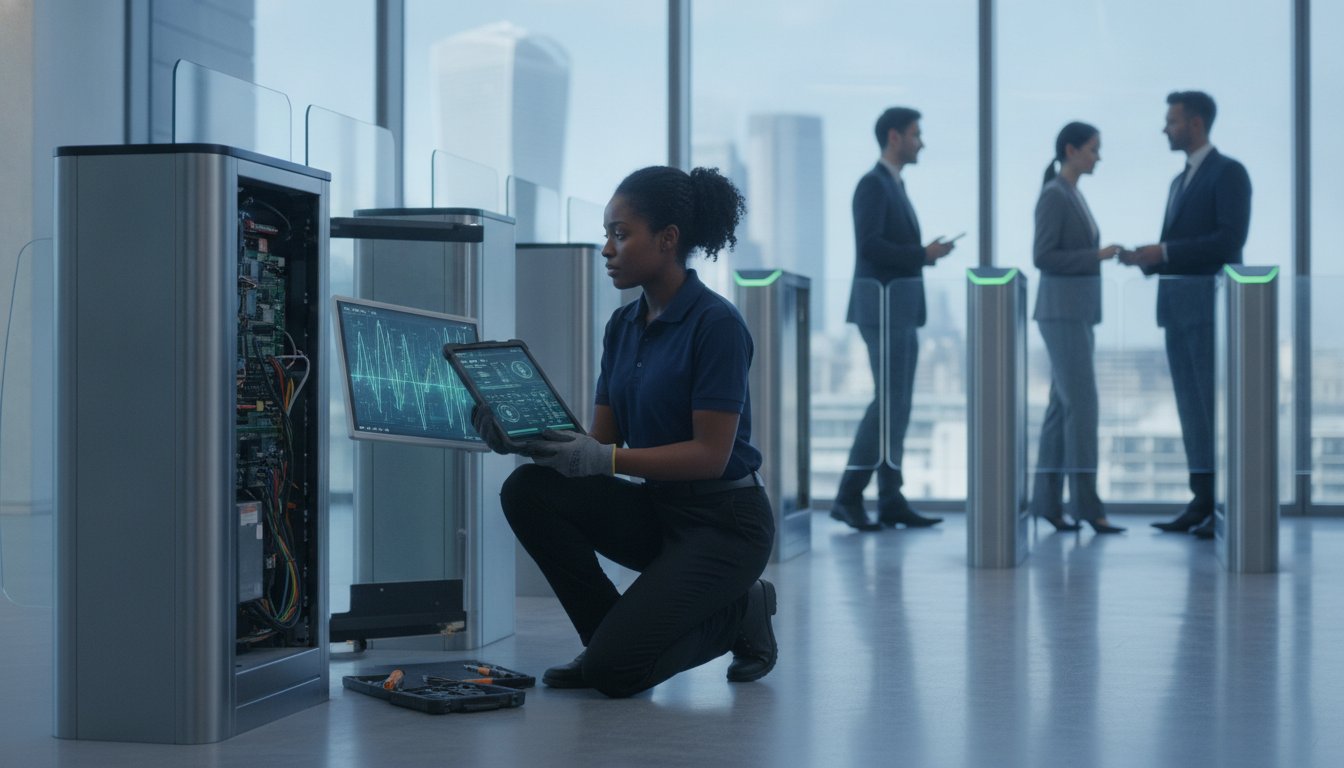
Imagine the operational friction when a critical speed gate fails during the morning rush, or the legal vulnerability discovered during a surprise fire safety audit. For facility managers across London and the Home Counties, these aren’t just inconveniences; they represent a breakdown in the professional standards your stakeholders expect. You recognise that a security system is only as effective as its last successful test. Securing a comprehensive access control maintenance contract is the most reliable method to move from reactive repairs to proactive asset management.
This guide demonstrates how a structured service agreement safeguards your commercial infrastructure, ensures strict regulatory compliance, and maximises the return on your technical investments. We will outline the essential elements of professional commissioning, the importance of clear documentation for insurance purposes, and how specialist support keeps your integrated IP security systems functioning at peak performance for years to come.
Key Takeaways
- Understand why a proactive access control maintenance contract is more cost-effective than a reactive “break-fix” model, ensuring both physical and digital assets remain secure.
- Learn the essential components of a professional service agreement, from physical hardware checks on speed gates to complex software database optimisation.
- Discover the mandatory regulatory requirements for security systems, specifically regarding fire alarm integration and “fail-safe” evacuation protocols.
- Identify how to evaluate Service Level Agreements (SLAs) to ensure your site receives the appropriate balance of remote support and on-site engineer attendance.
- Gain insights into how 40 years of industry expertise provides a stable foundation for managing the full lifecycle of your integrated security infrastructure.
The Strategic Importance of an Access Control Maintenance Contract
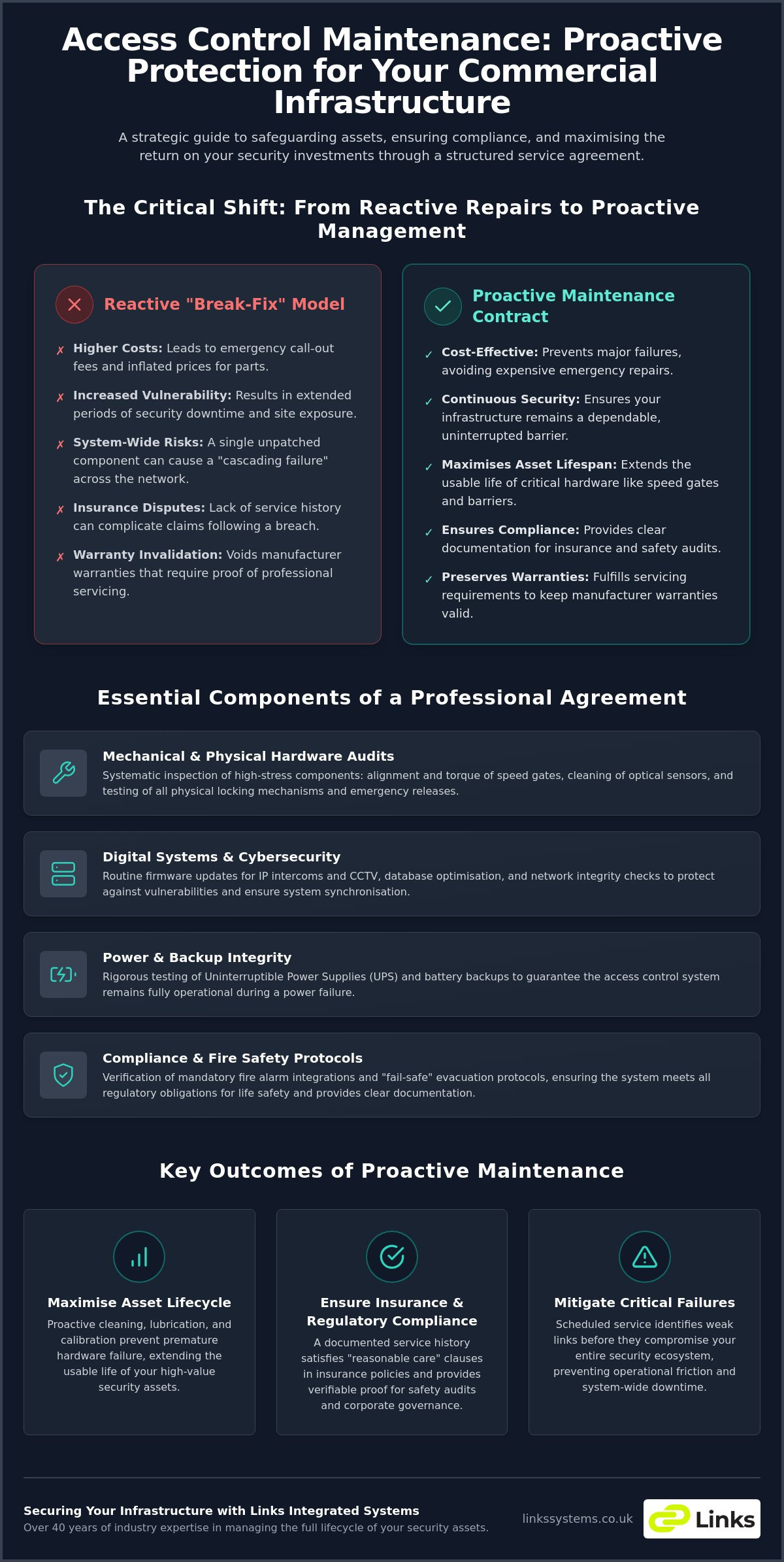
An access control maintenance contract is a proactive service agreement designed to protect both the physical and digital assets of a commercial enterprise. Many businesses mistakenly rely on a “break-fix” model, only calling for assistance when a door fails to lock or a speed gate jams. This reactive approach is inherently more expensive. It often leads to emergency call-out fees, inflated parts costs, and extended periods of site vulnerability. By contrast, a structured agreement ensures that your Access control infrastructure remains a dependable barrier rather than a point of failure.
Regular maintenance is also a prerequisite for preserving manufacturer warranties on high-end hardware. Most vendors require proof of professional servicing to honour hardware claims. In integrated IP security systems, a single neglected component can trigger a “cascading failure.” For example, an unpatched firmware vulnerability in an IP intercom might compromise the entire network’s integrity. Routine audits identify these weak links before they impact the wider ecosystem, ensuring that hardware and software remain in perfect synchronisation.
Beyond Repair: Proactive Lifecycle Management
Scheduled visits allow engineers to identify early signs of wear in mechanical components, such as the motors and hinges of speed gates. These heavy-duty assets undergo significant stress in high-traffic environments. Similarly, IP-based video intercoms and IP HD CCTV systems require consistent firmware updates to maintain cybersecurity standards and functional compatibility. In London and the South East, urban pollution and fluctuating weather conditions can accelerate the degradation of outdoor barriers. Proactive cleaning and lubrication are essential to prevent premature hardware failure. It’s about extending the usable life of your assets, not just fixing what’s broken.
Asset Protection and Insurance Compliance
A formal access control maintenance contract often satisfies the “reasonable care” clauses found in commercial insurance policies. Without a documented service history, insurers may dispute claims following a security breach or a fire incident. Preventative maintenance is the systematic inspection, detection, and correction of incipient failures before they occur or develop into major defects. Maintaining these records provides high-level stakeholders with the clear documentation required for safety audits and corporate governance. It gives project managers peace of mind, knowing their site’s security protocols are backed by a verifiable history of expert care.
Essential Components of a Professional Maintenance Agreement
A professional access control maintenance contract must be more than a superficial walkthrough of the premises. It requires a methodical approach that addresses both the tangible hardware and the underlying digital architecture. Reliability is built on a foundation of rigorous testing, ensuring that every reader, controller, and software interface functions exactly as intended. High-level institutional protocols, such as those found in the University Electronic Security Standards, highlight that maintenance is as much about documentation and standards as it is about physical repairs.
A comprehensive agreement should include a detailed checklist of services that go beyond basic troubleshooting. This includes testing Uninterruptible Power Supplies (UPS) and battery backups to ensure the system remains operational during a power cut. It also involves “system commissioning” as an ongoing cycle. This process verifies that the system still meets its original design intent after months of heavy use. If your current provider lacks this level of detail, it may be time to review your maintenance requirements with a specialist.
Mechanical and Physical Hardware Audits
Physical components bear the brunt of daily operational stress. Maintenance engineers must focus on testing the alignment and torque of commercial speed gates to prevent mechanical fatigue and ensure pedestrian safety. Optical sensors within these barriers require careful cleaning and calibration; dust build-up often leads to false alarms or “tailgating” errors. Furthermore, engineers should inspect all physical locking mechanisms and emergency release buttons, confirming they operate smoothly without sticking or delay.
Database and Software Integrity Checks
The digital side of an access control maintenance contract is often overlooked but equally vital. Software database optimisation involves organising user records to remove defunct credentials, which improves system response times and reduces security risks. Engineers must verify the integration between the core access software and IP video intercoms to ensure seamless communication. This audit also confirms that CCTV triggers are correctly synchronised with access events. When a door is forced or held open, the system must automatically flag the corresponding HD footage for immediate review.
A structured maintenance visit concludes with a formal report. This document provides the clear evidence needed for safety audits and insurance compliance, proving that your security infrastructure is managed with professional precision.
Compliance, Fire Safety, and Regulatory Obligations
Compliance within a commercial environment is a continuous obligation rather than a static achievement. For any organisation, the legal and safety requirements surrounding building entry points are stringent. A professional access control maintenance contract ensures that these systems remain in strict accordance with British Standards, such as BS EN 60839. These standards dictate the performance and reliability of electronic security, ensuring that technical failures don’t lead to safety breaches. Regular audits verify that every component, from the card reader to the central controller, operates within these regulated parameters.
A primary focus of these audits is the distinction between “fail-safe” and “fail-secure” configurations. Fail-safe locks release automatically when power is removed or a fire signal is received, making them essential for designated emergency exit routes. Conversely, fail-secure locks remain locked during a power failure to protect high-value assets. Professional maintenance ensures these settings haven’t been altered during software updates or hardware repairs. Misconfiguration in this area doesn’t just compromise security; it creates a significant risk to life during an evacuation.
The Fire Alarm Interface Audit
The mandatory interface between access control systems and fire alarms is perhaps the most critical safety link in a building. During a fire drill or a genuine emergency, every speed gate and electronic door must release instantly to allow for an unobstructed exit. A comprehensive access control maintenance contract includes “cause and effect” testing to verify this link. Facilities managers hold a legal liability for the safety of occupants. If an integrated system fails to release due to a faulty relay or a software glitch, the consequences for the organisation can be severe, ranging from heavy fines to criminal negligence charges.
GDPR and Data Security in Access Control
Modern security systems generate vast amounts of data, including entry logs and IP HD CCTV footage. This information is classified as personal data under UK GDPR. Maintenance visits must therefore include a review of how this data is stored and managed. It’s vital to ensure that access databases are secure and that only authorised personnel can review sensitive logs. Additionally, regular software patching is required to protect encrypted IP streams from cybersecurity threats. To complement physical maintenance, CyberOne provides Managed MXDR services UK to ensure that the underlying digital infrastructure remains resilient against sophisticated remote interference, which could otherwise compromise the integrity of the entire security infrastructure.
Evaluating Service Level Agreements (SLAs) for Commercial Sites
Selecting the right Service Level Agreement (SLA) is a strategic decision that dictates how quickly your business recovers from a security failure. An access control maintenance contract is only as effective as the response times it guarantees. When evaluating these agreements, you must match the level of service to the operational criticality of your site. A high-traffic corporate headquarters in the City of London requires a far more stringent response than a small regional satellite office. A well-structured SLA provides clear expectations for both parties, moving the relationship from a simple transaction to a collaborative partnership.
Effective agreements often combine remote support with on-site engineer attendance. For modern IP-based systems, many software glitches or credential issues can be diagnosed and resolved remotely, often within minutes. However, physical hardware failures, such as a damaged barrier arm or a faulty locking relay, require a physical presence. Contract holders benefit from prioritised scheduling, ensuring they are at the front of the queue whilst non-maintained sites wait for available slots. This prioritisation is a key component of maintaining 100% system uptime in demanding commercial environments.
Stability is further enhanced by having a dedicated account manager. This specialist understands the specific topography of your site, including the location of every controller and the nuances of your network infrastructure. This internal knowledge reduces the time spent on-site and ensures that maintenance visits are as efficient as possible. To ensure your site is protected by an appropriate response framework, you can review our maintenance service levels to find a fit for your specific requirements.
Defining Response Times and Priorities
A professional SLA clearly defines what constitutes a “critical” fault versus a “non-critical” issue. A critical fault might involve a total system failure that prevents staff from entering the building or leaves a main entrance unsecured. Non-critical issues might include a single card reader failure in a low-traffic area. Remote diagnostics play a vital role here; engineers can often log in to the IP system to identify the fault whilst an engineer is still en route. This allows the attending technician to arrive with the correct components, significantly increasing the first-time fix rate.
Geographic Considerations for London and the South East
The geography of your maintenance provider is a practical factor in response reliability. Choosing a partner with a strong presence in Kent, Surrey, Essex, and Hertfordshire ensures that engineers aren’t delayed by long-distance travel. For sites within the capital, a contractor familiar with London skyscraper security protocols is invaluable. Navigating loading bay requirements, lift access permissions, and strict out-of-hours working windows requires a level of local expertise that national providers often lack. This local knowledge ensures that site visits are conducted with minimal disruption to your daily operations.
Securing Your Infrastructure with Links Integrated Systems
Links Integrated Systems stands as a premier partner for commercial security across London and the Home Counties. With 40 years of industry experience, we provide a level of professional assurance that only comes from decades of managing complex technical requirements. Our approach to an access control maintenance contract is rooted in stability and precision. We don’t just react to faults; we manage the entire lifecycle of your security assets. From the initial commissioning of a site to the long-term support of integrated IP systems, our team acts as a steady hand for facilities managers and high-level stakeholders.
Our expertise is particularly focused on specialist hardware that requires technical mastery. This includes the maintenance and calibration of speed gates, barriers, and sophisticated IP-integrated infrastructure. We understand that these assets are critical to your site’s operational flow. By positioning maintenance as a natural extension of our professional commissioning service, we ensure that the high standards established at installation are preserved throughout the system’s life. This methodical approach provides the peace of mind that comes from working with a seasoned guide in the security sector.
A Legacy of Professional Assurance
Our extensive history with major London developments informs every maintenance standard we set. We’ve seen how urban environments and high-traffic volumes impact the longevity of pedestrian barriers and electronic locks. This experience allows us to anticipate issues before they cause downtime. We favour clear, declarative communication and follow highly structured project workflows. When you partner with us, you aren’t just hiring a contractor; you’re engaging a specialist who understands the deep-rooted relationship between hardware reliability and corporate security.
Tailored Contracts for Diverse Commercial Estates
Every commercial site has a unique topography and operational demand. We customise each access control maintenance contract to suit the specific needs of the estate, whether it’s a single-site office in Surrey or a multi-region business park spanning Kent and Essex. This flexibility ensures that your security investment is protected by a plan that makes sense for your budget and risk profile. A stable, long-standing partner provides the continuity needed for effective long-term planning. To begin the process of securing your infrastructure, the next step is a comprehensive site audit to evaluate your current access control health and regulatory compliance.
Ensuring Long-Term Technical Reliability
Maintaining the integrity of a commercial security infrastructure requires a shift from reactive repairs to a structured lifecycle management strategy. This guide has detailed how a professional access control maintenance contract provides the documented evidence needed for insurance compliance whilst ensuring critical fire safety interfaces function exactly as intended. By addressing both the mechanical wear of speed gates and the cybersecurity of IP-based networks, you protect your technical investment and the safety of your occupants.
Links Integrated Systems brings over 40 years of specialist experience to every site we manage. Our expertise in commissioning and maintaining complex security systems across London, Kent, Surrey, and the wider South East ensures your facility remains secure and compliant. We provide the stable, expert-led support required for high-rise and commercial sectors, offering a level of precision that national providers often overlook. A reliable security system is the foundation of a safe, efficient workplace. We look forward to helping you achieve total peace of mind.
Request a Professional Site Audit and Maintenance Proposal to secure your infrastructure with a partner you can trust.
Frequently Asked Questions
Do I legally need a maintenance contract for my access control system?
Legally, you are responsible for ensuring that all fire safety systems, including doors integrated with access control, function correctly during an evacuation. Under the Regulatory Reform (Fire Safety) Order 2005, failure to maintain these systems can lead to prosecution. A formal contract provides the documented evidence needed to prove compliance during a local authority inspection and ensures you meet your duty of care to occupants.
How often should a commercial access control system be serviced?
Most commercial systems require a professional service at least twice per year to ensure mechanical and digital reliability. High-traffic environments, especially those utilising speed gates or external barriers, may require quarterly inspections to mitigate wear and tear. Regular intervals allow engineers to identify potential failures before they disrupt your site’s operational flow or compromise the security of your premises.
What is the difference between preventative and reactive maintenance?
Preventative maintenance involves scheduled inspections designed to identify and resolve issues before they cause system downtime. Reactive maintenance is a “break-fix” approach where repairs are only requested after a component has already failed. Adopting a proactive access control maintenance contract is generally more cost-effective as it prevents expensive emergency call-out fees and significantly extends the lifecycle of your hardware.
Does a maintenance contract include software and firmware updates?
Yes, professional maintenance agreements typically include essential firmware updates and software patches for your security infrastructure. These updates are critical for maintaining cybersecurity standards and ensuring compatibility between integrated IP systems. Keeping your software current prevents vulnerabilities that could otherwise allow unauthorised digital access to your physical security network; it’s a vital part of modern system health.
Will my fire alarm integration be tested during a maintenance visit?
Testing the fire alarm interface is a mandatory component of every maintenance visit we conduct. Our engineers perform “cause and effect” testing to verify that all electronically locked doors and speed gates release instantly upon receiving a fire signal. This ensures your building remains compliant with life safety regulations and that occupants can evacuate the building without obstruction during an emergency.
Can you maintain an access control system installed by another company?
We can maintain most professional-grade access control systems, regardless of the original installer. Our engineers possess the expertise to commission and support a wide range of industry-standard hardware and IP-based platforms. We begin this process with a comprehensive site audit to evaluate the current state of your infrastructure and identify any immediate requirements for optimisation or hardware repairs.
How does a maintenance contract affect my building insurance premiums?
While a contract might not always lead to a direct premium discount, it is often a condition of “reasonable care” clauses within commercial insurance policies. Having a documented service history proves that you have taken proactive steps to secure the premises. Without a valid access control maintenance contract, insurers may have grounds to reduce or reject a claim following a security breach or technical failure.
What happens if my speed gates fail outside of normal business hours?
The response to an out-of-hours failure is determined by the specific Service Level Agreement (SLA) chosen for your site. Contract holders receive prioritised scheduling and access to support protocols that are unavailable to non-maintained sites. This ensures that critical failures, such as a main entrance barrier becoming stuck, are addressed within a guaranteed timeframe to maintain the security and accessibility of your building.