

What if your security infrastructure did more than just record events, but actively verified the identity of every individual entering your building through a unified data stream? For many estate managers across London and the South East, the reality is often far less cohesive. You likely find yourself frustrated by siloed systems where video footage and access logs remain separate, making it difficult to identify individuals quickly during an alarm event. Integrating cctv with access control systems is no longer a luxury for commercial assets; it’s a fundamental requirement for a commissioned, high-functioning security ecosystem.
We understand that navigating technical complexities, such as the latest ONVIF Profile V cloud standards or Genetec Security Center 5.14 updates, can be challenging whilst maintaining strict UK GDPR and ICO compliance. This 2026 professional specification guide provides a clear roadmap for unifying your physical security. You’ll discover how to create a single-pane-of-glass management interface that automates video evidence for every access event. We will examine the latest industry standards and practical steps to future-proof your infrastructure, ensuring your site remains secure, compliant, and easy to manage.
Key Takeaways
- Learn why moving away from siloed security platforms to a unified management interface is essential for modern commercial asset protection.
- Understand the technical requirements for integrating cctv with access control systems using Video Management Software and robust APIs to ensure seamless communication.
- Discover how to strategically link high-definition cameras with speed gates to automate visual verification and reduce tailgating risks.
- Identify the critical difference between basic installation and professional commissioning to ensure full compliance with UK GDPR and British Standards.
- Gain insights into how a single audit trail for video and access events significantly improves the speed and accuracy of security incident investigations.
The Case for Unified Security: Why Integrating CCTV with Access Control is Essential
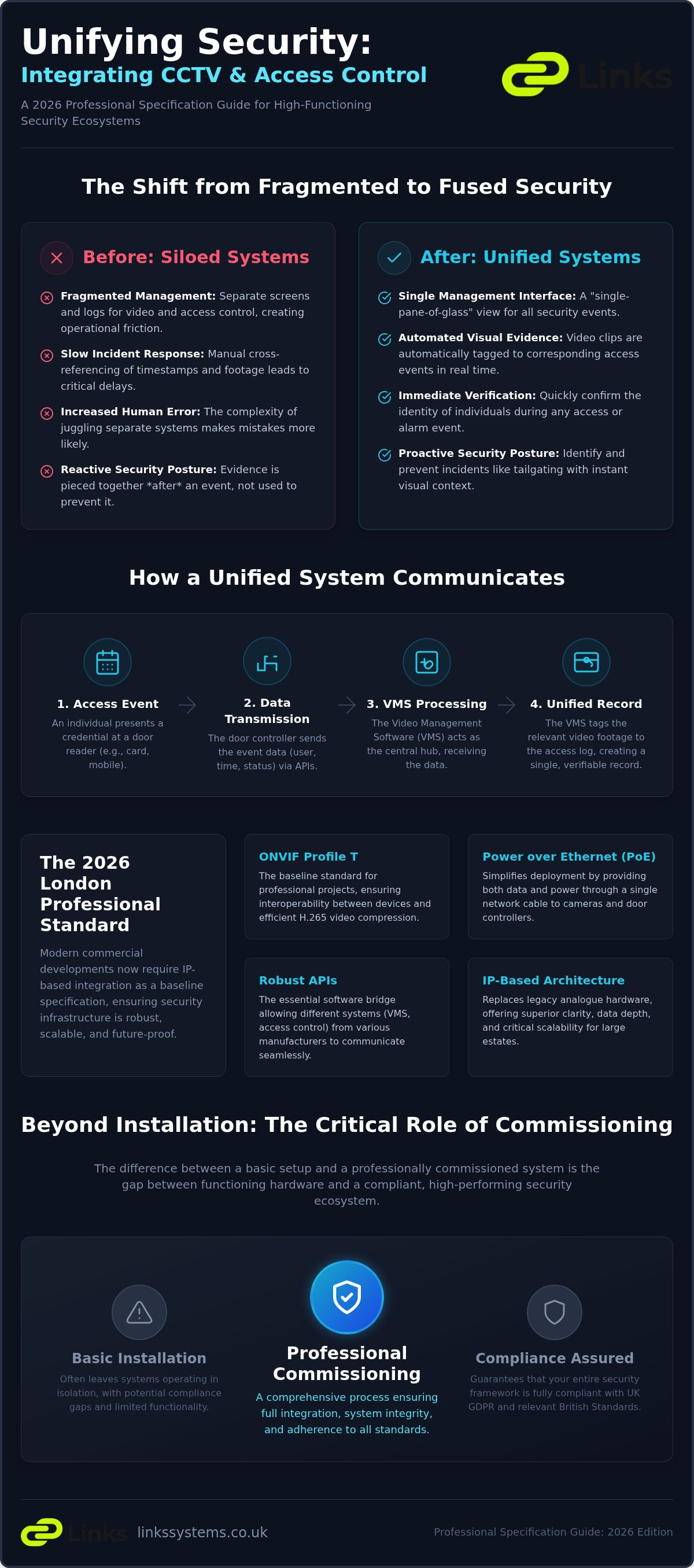
Integrated security represents the technical convergence of video surveillance and access authorisation into a single, cohesive framework. It creates a proactive environment where data from different sources validates a single event in real time. Traditionally, security managers operated with siloed systems that functioned in isolation. One screen displayed door logs whilst another showed live video feeds. This fragmented approach often led to significant delays and oversight during critical incidents.
By integrating cctv with access control systems, your security team gains a unified management interface that drastically reduces human error. Instead of manually searching through hours of footage to find a specific door entry, the system automatically tags the relevant video clip to the corresponding access event. In this setup, commercial video security systems provide the necessary visual context, acting as the eyes for every authorisation, denial, or alarm event recorded at the door.
The Limitations of Standalone Security Systems
Standalone systems create operational friction that compromises the safety of commercial assets. When an unauthorised entry alarm triggers, a guard must cross-reference time-stamped logs with a separate video recorder. This process is slow and prone to mistakes. It increases response times during forced entry attempts or tailgating incidents where seconds matter.
Maintaining disparate hardware also drives up long-term costs. Each system requires its own software updates, dedicated server space, and separate maintenance schedules. A broader strategy for Physical security suggests that layered protection is only effective if those layers communicate. Without integration, your security posture remains reactive. You’re left piecing together evidence after an event rather than preventing it through immediate visual verification.
The 2026 Standard for London Professional Environments
Modern office developments in London and Kent now require IP-based integration as a baseline specification. The 2026 standard moves away from legacy analogue hardware in favour of networked solutions that offer superior clarity and data depth. These systems rely on Power over Ethernet (PoE) to simplify multi-system deployments. PoE allows a single network cable to provide both data and power to cameras and door controllers, which reduces the complexity of the initial infrastructure and lowers installation hurdles.
This networked approach supports essential future scalability for large-scale commercial estates. Whether you manage a single site in the City or a sprawling corporate campus across the Home Counties, an integrated IP system allows for easy expansion. It ensures that your security infrastructure remains robust and adaptable as your operational requirements evolve over the coming decade.
Technical Architecture: How IP Video and Access Systems Communicate
The foundation of a modern security ecosystem lies in the seamless exchange of data between disparate hardware components. Video Management Software (VMS) serves as the central intelligence hub for this operation. It receives real-time data from door controllers and matches it with high-definition visual feeds. This communication relies on Application Programming Interfaces (APIs), which function as the bridge between software platforms from different manufacturers. Without robust APIs, systems remain isolated, forcing security teams to toggle between different applications to verify a single event.
Modern commercial video surveillance systems have transitioned fully to networked IP protocols. This shift allows for more sophisticated integrating cctv with access control systems using open standards such as ONVIF. As of July 2026, ONVIF Profile T has become the baseline for professional projects, ensuring that H.265 video compression is used to manage high-resolution data without overwhelming the corporate network. A stable, high-speed data network is essential to handle these 4K streams whilst maintaining the near-instantaneous response times required for door authorisation.
VMS vs. Access Control Software: Which Should Lead?
Deciding which software platform acts as the “primary” interface depends on your specific operational requirements. Managing access through a VMS is often the preferred choice for active security rooms. It allows guards to view live video directly alongside door event logs, providing immediate visual context for every person entering the building. This Overview of Access Control Systems highlights how dedicated access head-ends are better suited for complex credential management and high-volume user databases. For many London firms, a hybrid approach where video overlays appear within the access software provides the most efficient workflow.
Bandwidth and Storage Considerations for Integrated Data
High-resolution video integrated with access data places significant demands on local infrastructure. To prevent latency between a card swipe and a door release, network traffic must be prioritised using Quality of Service (QoS) settings. We recommend a hybrid storage model for most commercial sites. This involves using local Network Video Recorders (NVRs) for high-speed retrieval of recent footage, combined with cloud-based redundancy for long-term audit trails. Ensuring your network is correctly configured is a vital part of system maintenance and commissioning, as it prevents bottlenecks that could compromise site safety.
Properly designed architecture ensures that as your estate grows, your security infrastructure can scale without requiring a complete hardware replacement. This logical progression from hardware to software creates a reliable environment where every entry is accounted for and visually documented.
Hardware Synergy: Linking HD Cameras with Speed Gates and Barriers
Whilst software provides the intelligence, the physical hardware serves as the primary point of contact for every visitor and employee. True synergy occurs when you align high-definition imaging with physical barriers. For instance, the strategic placement of cameras at commercial speed gates ensures that every badge swipe is accompanied by a clear, high-contrast facial image. This goes beyond simple recording. It creates a verifiable audit trail that links a digital identity to a physical person in real time.
CCTV provides the essential visual verification needed for tailgating alarms at turnstiles. When a sensor detects two people passing through on a single authorisation, the integrated system can immediately pop up the relevant video feed on the security desk. This level of physical security integration acts as a powerful deterrent. When individuals see visible, integrated cameras that clearly monitor the entry process, the likelihood of unauthorised entry attempts or “piggybacking” drops significantly.
Reducing Tailgating through Video Analytics
Modern AI-driven cameras can now detect multiple people entering on a single badge swipe with high precision. These analytics operate at the edge, meaning the camera itself identifies the breach and sends a signal to the access software. By integrating cctv with access control systems, you can automate alerts to security personnel only when a visual confirmation of tailgating occurs. This reduces “alarm fatigue” caused by false sensor triggers and ensures that your team focuses on genuine security breaches. The psychological impact of visible, high-end cameras at lobby entry points cannot be overstated, as it signals a high-quality, managed environment.
Vehicle Access Control and Barrier Integration
For industrial sites across Kent and Surrey, managing vehicle entry is as critical as pedestrian access. Integrating IP CCTV with perimeter barriers allows for the use of Automatic Number Plate Recognition (ANPR) to automate entry for authorised fleet vehicles. This relies heavily on robust API Integrations to ensure the ANPR data triggers the barrier relay without delay.
Low-light performance is a non-negotiable requirement for 24/7 vehicle monitoring. Cameras must be capable of capturing clear plates and driver images in varied weather conditions and at night. In remote gate scenarios, intercom-linked cameras allow security teams to visually vet visitors before granting access, ensuring that the perimeter remains secure even when the gatehouse is unmanned. This methodical approach to hardware pairing ensures that every entry point, whether for a person or a vehicle, is fully accounted for.
Professional Commissioning and Compliance: Ensuring System Integrity
Professional commissioning is the final, critical stage where a security system is rigorously tested against its original design specification. It’s the bridge between a collection of hardware and a functional security ecosystem. Many providers offer basic “fitting,” where cameras are simply mounted and powered. However, a commissioned commercial cctv installation involves a methodical validation of every technical link. This ensures that when integrating cctv with access control systems, the data exchange is instantaneous and reliable under stress.
In London, Essex, and Hertfordshire, professional installers must deliver systems that don’t just work, but comply with strict industry standards. For corporate stakeholders requiring high-definition IP video security that integrates seamlessly with access control, a thorough commercial cctv installation London specification is essential to ensure clarity and legal compliance from the outset. Regular maintenance follows commissioning to ensure long-term reliability. Without this ongoing oversight, hardware drift or network changes can quietly degrade system performance, leaving your assets vulnerable. A steady, experienced hand is required to manage these technical requirements, ensuring that your investment provides peace of mind for years to come.
The Commissioning Checklist for Integrated Systems
The commissioning process follows a strict protocol to ensure system integrity. First, we verify IP address stability to prevent network conflicts that could drop video feeds during a security event. We then perform live testing of trigger-based events. For example, if a door is forced, does the integrated camera immediately switch to a high-frame-rate recording mode? The final stage involves focus calibration for specific lighting conditions and a storage verification to ensure the system is correctly overwriting data according to the agreed schedule before client handover.
GDPR and ICO Compliance for Commercial Monitoring
UK GDPR and ICO regulations place a heavy burden of responsibility on commercial property managers. Integrating cctv with access control systems means you’re handling sensitive personal data, from facial images to movement logs. A Privacy Impact Assessment (PIA) is essential for any integrated surveillance project. This document outlines why the data is being collected and how it’s protected. You must also implement data retention policies that balance security needs with legal requirements, typically ensuring footage is only held for a justifiable period, whilst satisfying the needs of your insurance provider.
Ensuring your system remains both operational and compliant requires expert oversight. Our team provides comprehensive system maintenance and commissioning to keep your commercial property secure and legally sound.
The Operational Advantages of a Commissioned Security Ecosystem
The transition from separate security components to a commissioned ecosystem provides more than just technical convenience. It fundamentally changes how security teams interact with their environment. By integrating cctv with access control systems, the speed and accuracy of incident investigations improve significantly. Instead of correlating separate logs, operators work from a single audit trail. This unified data stream provides immediate video evidence for every access event. Such clarity is essential for resolving disputes or investigating breaches in high-traffic commercial settings. Safety is the priority.
Professional, commissioned installations also offer financial advantages. Many UK insurers recognise the reduced risk profile of a site where video surveillance and access control are technically unified. This can lead to more favourable insurance premiums, as the system provides a higher level of accountability and evidence-gathering capability. Links Integrated Systems acts as a steady, experienced hand for these complex projects. We draw on 40 years of industry experience to ensure every integration is bespoke, reliable, and tailored to the specific needs of the estate.
Streamlining Incident Response for Security Teams
Incident response times are drastically reduced through automated pop-up video alerts. When an alarm triggers, such as a “door held open” or “unauthorised entry,” the management software automatically displays the live feed from the nearest camera. This allows for immediate visual verification without the need for manual searching. Facilities managers also benefit from remote monitoring capabilities via secure mobile apps. They can vet visitors or clear alarms from anywhere on the estate. This efficiency ensures that security personnel focus on genuine threats rather than administrative searching. It’s a proactive model.
Future-Proofing Commercial Assets for 2026 and Beyond
The security landscape is moving rapidly towards smart building integration and IoT compatibility. Investing in a high-quality IP infrastructure today prevents the need for costly retrofits as technology evolves. A commissioned system ensures that your data network is ready for future enhancements, such as advanced AI analytics or cloud-based redundancy. Integrating cctv with access control systems using open protocols allows for easier expansion as your business grows. Professional integration is a long-term investment in building resilience and occupant safety. By choosing a partner who understands the full lifecycle of a project, you ensure your commercial asset remains secure and compliant for the next decade.
Securing Your Commercial Assets for the Next Decade
Establishing a resilient security infrastructure requires more than just high-end hardware; it demands a unified approach to data management. By integrating cctv with access control systems, you transform passive recording into an active, verifiable audit trail that protects both your physical assets and your personnel. This transition ensures that every entry is visually documented and that your security team can respond to incidents with absolute precision.
A commissioned system is a long-term investment in building stability. It moves your estate away from fragmented, siloed operations toward a single-pane-of-glass interface that simplifies compliance and improves operational efficiency. With 40 years of security expertise, we specialise in delivering these complex technical solutions across London, Kent, and the Home Counties. Our bespoke approach includes full system commissioning and ongoing maintenance to ensure your infrastructure remains robust as standards evolve.
Take the first step toward a more secure, unified environment for your business. Request a Professional Site Survey from Links Integrated Systems today to discuss your specific requirements. We look forward to helping you future-proof your commercial property with confidence.
Frequently Asked Questions
Do I need a specific licence to integrate CCTV with access control in the UK?
Installers must hold valid SIA (Security Industry Authority) licences for the specific category of work they perform on your premises. Additionally, your organisation must be registered with the Information Commissioner’s Office (ICO) as a data controller. This ensures that the collection, storage, and processing of video and access data comply with the Data Protection Act 2018.
Can I link my existing analogue cameras to a new IP access control system?
You can link legacy analogue cameras to modern systems using video encoders or hybrid recording hardware. Whilst this allows for a phased upgrade of your infrastructure, it often lacks the advanced metadata and AI-driven analytics found in native IP solutions. For high-security zones, transitioning to HD IP cameras is the recommended path to ensure superior visual evidence during an incident.
How does integrating CCTV with speed gates help prevent tailgating?
Integration allows the system to cross-reference physical sensor data with live video streams in real time. If a speed gate sensor detects two individuals passing through on a single authorisation, the system can immediately flag the event for review. Integrating cctv with access control systems in this way provides the visual proof needed to challenge tailgating and enforce site safety policies effectively.
What are the GDPR implications of using facial recognition with access control?
Using facial recognition involves processing “special category” biometric data, which carries significant legal requirements under UK GDPR. You must conduct a thorough Data Protection Impact Assessment (DPIA) to demonstrate that the use of such technology is necessary and proportionate. Explicit consent from individuals or a robust legal basis is required before this technology can be deployed in a professional environment.
How often should an integrated security system be professionally maintained?
We recommend professional maintenance at least twice a year for integrated commercial systems. These bi-annual inspections involve checking hardware integrity, updating software firmware, and verifying that all integration triggers are functioning correctly. Regular oversight prevents minor network issues from becoming significant security vulnerabilities, ensuring the long-term stability of your commissioned ecosystem.
What is the difference between simple installation and professional commissioning?
Simple installation refers to the physical mounting and wiring of devices, whilst commissioning is the rigorous testing of the system against its original design specification. Commissioning involves resolving IP conflicts, calibrating camera fields of view, and ensuring that every door event correctly triggers the associated video recording. It’s the difference between a collection of parts and a reliable, high-functioning security ecosystem.
Can integrated systems be monitored remotely by my security team in London?
Yes, your security team can monitor integrated systems from any location in London or beyond via secure network protocols. Modern Video Management Software (VMS) provides encrypted remote access through mobile apps or browser-based interfaces. This allows managers to vet visitors, review access logs, and respond to alarms in real time, regardless of their physical presence on the estate.
Is it possible to integrate ANPR cameras with commercial vehicle barriers?
Integrating ANPR cameras with vehicle barriers is a standard method for automating perimeter security at industrial and commercial sites. The camera identifies the number plate and sends a signal to the barrier controller to grant entry to authorised vehicles automatically. This process streamlines traffic flow whilst maintaining a complete digital and visual record of every vehicle that enters the premises.
12 Comments
Commercial Video Surveillance Systems: The 2026 Professional Reference Guide – Links Integrated Systems
29 July 2026[…] resource. For a comprehensive technical overview of how these systems communicate, our guide on integrating CCTV with access control systems provides a detailed specification roadmap for creating a unified security […]
Cloud Access Control for Business: 2026 Professional Guide – Links Integrated Systems
29 July 2026[…] For a comprehensive technical roadmap on achieving this unified data stream, our guide on integrating CCTV with access control systems provides detailed specification guidance for commercial estates. Additionally, managing visitor […]
Commercial CCTV Installation London: Professional IP Video Security – Links Integrated Systems
30 July 2026[…] This integration allows for automated security responses that move beyond passive recording. Systems can be programmed to trigger specific actions based on real-time events. For instance, if a camera with built-in analytics detects a vehicle at a perimeter barrier outside of standard operating hours, the system can automatically prioritise that video feed on the security monitor. This proactive model ensures that security personnel have the immediate visual context required to manage a potential incident before it escalates. For a detailed technical overview of these requirements, refer to our Integrating CCTV with Access Control Systems: A 2026 Professional Specification Guide. […]
Access Control System Maintenance Kent: The 2026 Professional Guide – Links Integrated Systems
2 August 2026[…] as network latency can lead to security gaps at the perimeter. For those managing complex sites, Integrating CCTV with Access Control Systems: A 2026 Professional Specification Guide provides a deeper look at how these technologies should be synchronised. If you require a site […]
IP CCTV System Upgrade Surrey: A Professional Guide to Modernising Commercial Security – Links Integrated Systems
3 August 2026[…] process of integrating CCTV with access control systems significantly simplifies daily operations for Surrey facility managers. Instead of managing […]
Speed Gate Servicing in Hertfordshire: The Professional Maintenance Checklist 2026 – Links Integrated Systems
4 August 2026[…] real-time monitoring and event logging. A specialist service partner will also assess the role of integrated CCTV in verifying speed gate events, ensuring that every authorised entry is visually […]
Professional Automatic Barrier Maintenance in Essex: Ensuring Security and Compliance – Links Integrated Systems
5 August 2026[…] siloed. A physical barrier is only as effective as the logic that controls it. We specialise in Integrating CCTV with Access Control Systems to create a unified security profile. If a barrier fails, it doesn’t just block a road; it can […]
Professional Video Intercom System Maintenance in London: The 2026 Guide – Links Integrated Systems
6 August 2026[…] intercoms can often be upgraded modularly. This preserves manufacturer warranties and ensures your integrated systems remain compatible with evolving network protocols. By budgeting for incremental software updates […]
Professional Business CCTV Installation in Surrey: A 2026 Specification Guide – Links Integrated Systems
8 August 2026[…] remains one of the most persistent security challenges for commercial buildings in Surrey. By integrating CCTV with access control systems, businesses can automate alerts when physical sensors detect multiple people passing through a gate […]
Professional Security Turnstile Installers in Essex: The 2026 Procurement Guide – Links Integrated Systems
10 August 2026[…] turnstile alarm is only as useful as the information it provides. By integrating cctv with access control systems, you ensure that every ‘unauthorised entry’ or ‘tailgating’ alert is […]
London Office Access Control: 2026 Specification Guide – Links Integrated Systems
11 August 2026[…] A unified interface allows building staff to manage diverse security streams from a single, manageable workstation. For large-scale facilities across London, Kent, and Surrey, this centralised approach is far more efficient than managing disconnected legacy systems. IP-based integration facilitates this by allowing data to flow seamlessly across existing network infrastructure, providing a scalable solution that grows with the building’s needs. This streamlining reduces operational costs by minimising the need for manual patrols and multiple monitoring stations. For a deeper look at the technical requirements of these setups, see our guide on Integrating CCTV with Access Control Systems: A 2026 Professional Specification Guide. […]
Office Door Entry Systems UK: The 2026 Professional Specification Guide – Links Integrated Systems
13 August 2026[…] intercom is often a vulnerability because it lacks visual context beyond the immediate caller. By integrating cctv with access control systems, facility managers can link video feeds directly to entry events. When a door is opened, the system […]