
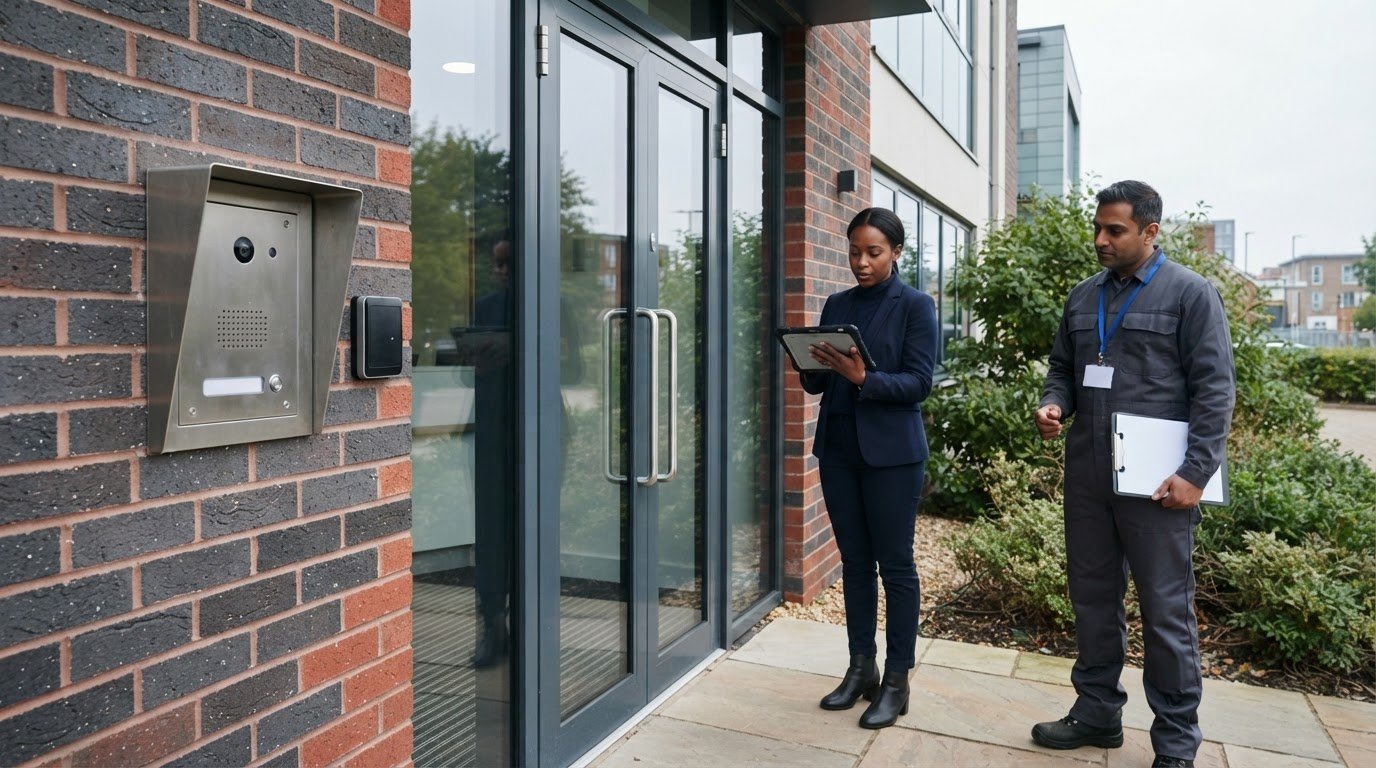
The intercom faceplate is only one part of the security specification. A unit may resist deliberate damage, yet still leave an entrance vulnerable if its mounting, cabling or position is poorly planned. For organisations assessing vandal-proof intercom systems Essex, that distinction matters: resilience depends on how the complete entrance is designed, installed and maintained.
It’s understandable to focus first on a robust external unit, particularly where equipment is exposed to weather, impact or tampering. But choosing the right system also means matching its durability and ingress protection to the site, then confirming how it will work with access control and existing security arrangements. This guide explains the risks and features to assess, the installation questions to raise with a contractor, and why commissioning and ongoing maintenance belong in the specification from the outset. Links Integrated Systems supplies, installs, commissions and maintains commercial IP video intercom and access-control systems across Essex. Read on to make a more informed decision about the equipment and project support your entrance requires.
Key Takeaways
- Assess how exposed and heavily used each entrance is before deciding what level of vandal resistance it needs.
- Compare enclosure design and fixings, and distinguish impact resistance from protection against dust and water.
- Map the visitor journey so calls, identity checks and door release work with your access-control arrangements.
- Use documented site conditions and operational needs to assess proposals for vandal-proof intercom systems Essex.
- Ask installers about commissioning, staff handover, planned maintenance and fault reporting.
When does a commercial site in Essex need a vandal-resistant intercom?
Assess each entrance’s exposure and use before choosing a unit simply because it looks tougher. A publicly accessible reception door, a loading area used by visiting drivers and an unattended side entrance can present different risks, even on the same site. The right specification reflects what happens at each entrance, where equipment will be mounted and how it will be used.
Consider three types of exposure separately. Accidental knocks may come from bags, trolleys or deliveries passing close to the unit. Deliberate tampering could involve pressing, striking or trying to remove exposed components. Weather, dust and dirt present environmental challenges rather than impact risks. These factors can overlap, but one rating or robust-looking faceplate shouldn’t be assumed to address them all.
Which entrance conditions increase the risk of damage?
Consider how freely people can approach the equipment, whether it’s clearly visible, and how closely staff can monitor the entrance during operating hours. A unit beside a busy loading route may face repeated accidental contact; one at a remote access point may receive less supervision. Record likely impact, attempted removal, dirt and weather exposure at the proposed mounting position.
Ask facilities staff about previous damage, recurring faults and visitor communication problems. Their experience can reveal practical issues that aren’t obvious during a brief site visit.
What should a vandal-resistant intercom achieve?
It should support clear visitor communication and controlled entry, while reducing the likelihood that foreseeable damage will disrupt those functions. A vandal-resistant intercom is a risk-reduction specification, not a claim that equipment is impossible to damage. Confirm how the proposed unit’s construction and mounting address the risks identified at the entrance.
For context, a typical video intercom system links outdoor visitor equipment with an indoor answering unit. In a commercial setting, it lets staff communicate with a visitor and make an entry decision. The arrangement should suit the site’s operating pattern, not just the equipment’s appearance.
Keep tamper resistance distinct from protection against water and dust. These address different conditions, so check the relevant impact and ingress information against the actual mounting environment. Don’t assume that a product described as vandal-resistant is automatically suited to every exposed Essex entrance, or that every property faces the same threat. A considered assessment helps buyers specify vandal-proof intercom systems Essex according to site conditions, rather than choosing unnecessary or unsuitable protection.
Which intercom features and ratings should you specify?
Turn the entrance assessment into a written specification. Look beyond a metal faceplate: enclosure material, panel design, concealed or protected fixings and the position of exposed components all affect how the equipment may withstand site conditions. Ask the supplier to explain how each selection addresses the risks recorded at the entrance, and to provide evidence for any ratings or compatibility claims.
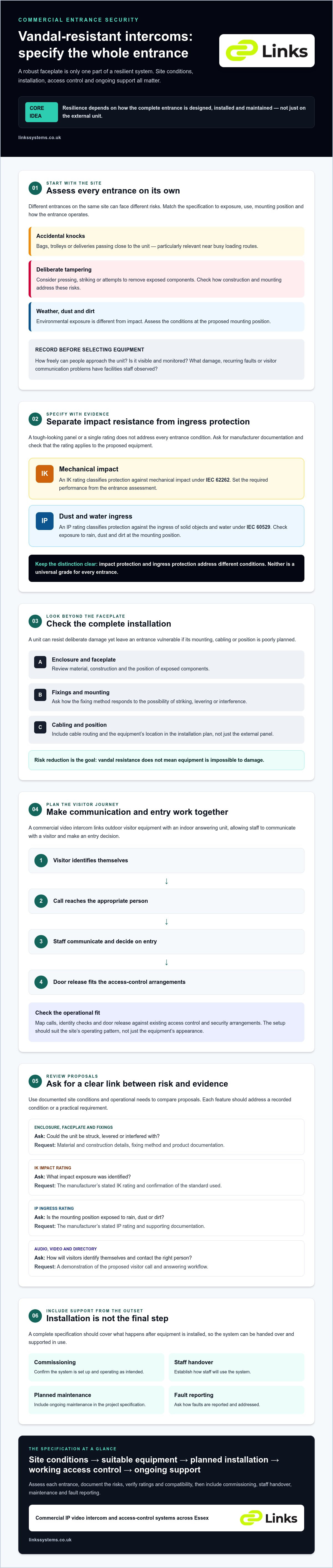
Impact and ingress protection are separate considerations. An IK rating classifies protection against mechanical impact under IEC 62262; an IP rating classifies protection against the ingress of solid objects and water under IEC 60529. Neither is a universal grade for every entrance. Set the required performance from the site assessment, then check that the manufacturer’s documentation identifies the relevant standard and applies to the proposed equipment.
Compare the specification against the entrance
Use an evidence-based comparison when reviewing proposals for vandal-proof intercom systems Essex. The supplier should connect each feature to an operational need or documented site condition.
| Feature | Site question | Evidence to request |
|---|---|---|
| Enclosure, faceplate and fixings | Could the unit be struck, levered or interfered with? | Material and construction details, fixing method and product documentation. |
| IK impact rating | What level of impact exposure was identified? | Manufacturer’s stated IK rating and confirmation of the standard used. |
| IP ingress rating | Will the mounting position be exposed to rain, dust or dirt? | Manufacturer’s stated IP rating and supporting documentation. |
| Audio, video and directory | How will visitors identify themselves and contact the right person? | Demonstration of the proposed visitor call and answering workflow. |
| Access-control compatibility | How will staff authorise entry using existing or proposed equipment? | Written confirmation of the intended interface and any limitations. |
Match communication features to daily use
Choose audio or video according to how staff need to identify and assist visitors. Check the button layout, display readability, directory requirements and ease of operation for the people expected to use the entrance. More features aren’t automatically better if they complicate routine visitor handling. Confirm compatibility with the access-control system and existing equipment before procurement, rather than assuming IP systems will integrate without configuration or additional work.
Product performance evidence and contractor credentials are separate checks. For information about the private security industry regulator, consult the Security Industry Authority (SIA). This is not certification of a particular intercom or rating. For a project-specific discussion of commercial IP video intercom and access-control systems, ask the supplier to confirm the proposed equipment, integration and installation requirements in writing.
How should vandal-proof intercom systems integrate with access control?
An intercom should form part of a clear entry process, not operate as an isolated device. Map the visitor journey from arrival to entry: the visitor uses the call button or directory, staff receive and assess the call, and an authorised person decides whether to release the door. Specify who answers, what happens if a call is missed and how access is granted. This makes system behaviour easier to agree before equipment is ordered.
Give door release particular attention. Confirm which staff members can operate it and whether release is controlled through the access-control system or another agreed method. The process should match site procedures and avoid leaving visitors uncertain about what to do next. CCTV may also be relevant where the project requires it, but don’t assume it needs to be linked to the intercom or access control.
What should buyers check before integrating an intercom?
Give the installer an accurate picture of the existing system and how the entrance is managed. Record the access-control equipment, entry points, user groups and operating procedures. Ask the installer to confirm compatibility, identify dependencies and explain what additional equipment or configuration may be needed.
Agree who is responsible for configuring and testing each connection, including any existing equipment, and what will be demonstrated during handover. If CCTV is part of the project, define its purpose and whether a connection to the entry process is required. A clearly scoped approach helps prevent gaps between the intercom, access control and day-to-day operation.
How can the entrance design protect the complete installation?
Include mounting position, fixings and cable routes in the design. Even a robust intercom may leave exposed cables or adjacent components accessible, so review the whole entrance and consider whether door-release equipment creates a weak point in the process. Request a site-specific drawing or written scope showing equipment locations, cable routes and system connections.
For broader design context, buyers can consult the commercial guidance in the Secured by Design design guides. Use relevant guidance to inform questions, then confirm the proposed equipment’s ratings, compatibility and installation details for the specific site. The right specification for vandal-proof intercom systems Essex connects identified risks to a workable visitor process.
Links Integrated Systems supplies, installs, commissions and maintains commercial IP video intercom and access-control systems, with integration considered where the site requires controlled entry. Ask for responsibilities, testing and handover to be set out clearly, so the finished installation can be checked against the agreed scope.
How can you assess an Essex intercom installation proposal?
A sound proposal should show how the project moves from site assessment to a tested, usable system. Review the sequence: define the risks and operating requirements, survey the entrance, agree the specification, install the equipment, commission the system and review its performance after handover. Each stage should have a clear scope, so you can see how the chosen equipment responds to the documented conditions.
Compare proposals on more than the headline device or its stated ratings. Check what’s included for access-control integration, cabling, configuration, commissioning, staff handover and planned maintenance. Ask suppliers to explain why they selected each component and how it supports the site’s visitor process. For connected projects, consider how the intercom fits within the wider physical security design, rather than assessing each system in isolation.
What should an intercom site survey record?
The survey should capture how the entrance operates, not simply where a unit might be mounted. Ask for relevant dimensions, mounting surfaces, cable routes, and power and network requirements to be recorded for verification. The assessment should also note environmental exposure and existing equipment that could affect system selection or integration.
Operational details matter just as much. Record visitor volumes, opening hours, who answers calls, and the access-control requirements for each entry point. This gives the supplier a basis for recommending equipment and explains how the system should behave during normal use.
What should the installation and commissioning scope include?
Request a written breakdown of the equipment, mounting, cabling, configuration and interfaces included. Clarify any dependencies on existing systems and identify work or equipment outside the quoted scope. A clear document reduces uncertainty about who is responsible for each part of the installation.
Commissioning should be described in practical terms. Ask how testing will confirm that visitor calls reach the intended staff, communication is clear, authorised door release works as agreed and relevant failure scenarios are considered. The handover should specify what system documentation, user guidance and maintenance recommendations will be provided.
For vandal-proof intercom systems Essex, these details help distinguish a complete, site-led proposal from one focused mainly on the external unit. Links Integrated Systems supplies, installs, commissions and maintains commercial IP video intercom and access-control systems in Essex. Discuss your intercom installation requirements with the team and clarify the project-specific scope and support arrangements.
Choosing an Essex contractor for intercom installation and ongoing support
The contractor’s project process matters as much as the equipment recommendation. Look for relevant experience with commercial IP video intercoms and access control, a clear written scope, and a defined approach to installation, commissioning and ongoing support. For vandal-proof intercom systems Essex, the proposal should explain how the chosen equipment and installation respond to the specific entrance conditions, rather than relying on general claims about durability.
Which questions should you ask a prospective installer?
Establish who will survey the site, confirm compatibility with existing systems and take responsibility for the final design. Ask for examples of relevant commercial work, without assuming those examples took place in Essex. Before agreeing a scope, clarify how commissioning checks will be carried out, what user handover includes, and which maintenance arrangements are available for the proposed system.
- Who is responsible for coordinating the intercom and access-control elements?
- What tests will confirm that the agreed functions work as intended?
- How are faults reported, and what response arrangements apply?
- What maintenance tasks are recommended, and who will undertake them?
Clear answers help you compare contractors on delivery and support, rather than equipment descriptions alone. Ask for responsibilities and any project-specific conditions to be recorded in writing.
What should happen after the system is commissioned?
Handover should leave the organisation able to operate and manage its system. Confirm that staff receive suitable operating guidance and that you’ll receive a record of the installed configuration, including relevant equipment and agreed system connections. Ask the contractor to explain maintenance recommendations and how they relate to the equipment, entrance conditions and patterns of use.
Agree who will arrange planned inspections, what the maintenance covers and how faults should be reported. Keep this information with the system documentation so facilities staff can refer to it when responsibilities change or the entrance is altered. Commissioning and maintenance are part of the system lifecycle, not optional details to leave until a problem occurs.
Links Integrated Systems supplies, installs, commissions and maintains commercial IP video intercom and access-control systems across London, Kent, Surrey, Hertfordshire and Essex. Organisations planning an entrance upgrade can discuss site-specific requirements with Links, including how intercom and access control should work together and what installation and ongoing support arrangements need to be confirmed.
Specify an entrance system built for your site
Choosing vandal-proof intercom systems Essex starts with the entrance, not a tougher-looking faceplate. Assess exposure and day-to-day use, then match enclosure, impact and ingress protection to the conditions recorded on site. Just as importantly, define how visitors will contact staff and how an authorised door release will work with access control.
A clear proposal should connect equipment choices to site requirements and set out installation, integration, commissioning, handover and planned maintenance. This gives you a practical basis for comparing contractors and helps ensure the system is considered beyond the initial installation.
Links Integrated Systems supplies and installs commercial IP video intercom and access-control systems, with commissioning and scheduled maintenance. The company serves London, Kent, Surrey, Hertfordshire and Essex. Discuss your commercial intercom requirements with Links Integrated Systems and outline the entrance conditions, existing equipment and support you need.
With a site-led specification and a clear plan for ongoing support, you can make a considered choice and move forward with confidence.
Frequently Asked Questions
What makes an intercom system vandal-resistant?
A vandal-resistant intercom combines construction and secure installation suited to the entrance’s risks. Its enclosure and faceplate should be selected for expected impact, while secure mounting and protected cable routes can reduce opportunities for tampering. This doesn’t make equipment impossible to damage. Assess public access, weather and likely use at the actual location, then ask the supplier for manufacturer evidence supporting any stated impact or ingress ratings.
What is the difference between an IK rating and an IP rating?
An IK rating describes protection against mechanical impact, whilst an IP rating addresses protection against the ingress of solid objects and water. They measure different properties, so one can’t be used as a substitute for the other. Ask the system designer to confirm the applicable standards, such as IEC 62262 for IK and IEC 60529 for IP, and specify ratings according to the entrance conditions.
Can an IP video intercom work with an existing access-control system?
It may be possible, but compatibility depends on the intercom, access-control controller, entry hardware and required operating sequence. Before ordering, ask the installer to check interfaces, identify dependencies and clarify who is responsible for configuration and testing. The agreed design should explain how staff answer calls, make entry decisions and operate the door release, so the completed system can be checked against the intended process.
Do commercial intercom systems need CCTV integration?
No, CCTV integration isn’t necessary for every commercial intercom installation. The decision should reflect entrance risks, visitor-handling procedures, operational policy and equipment already in place. If a connection is proposed, ask what it contributes, how the devices will communicate and who will configure and test the integration. Don’t assume that adding a camera alone guarantees suitable coverage or enables staff to identify every visitor clearly.
How do I choose a vandal-resistant intercom for an Essex business?
Start by assessing the entrance’s exposure, expected users, operating hours and existing security equipment. For vandal-proof intercom systems Essex, compare construction, manufacturer-verified ratings, communication features, access-control compatibility and the installation scope. Ask a contractor serving Essex to document how the recommendation suits the site, including commissioning and maintenance arrangements. Don’t choose solely by appearance or rely on an impact or ingress rating without supporting evidence.
What should be included in an intercom installation proposal?
A clear proposal should describe the site survey, equipment, mounting, cabling, configuration, system interfaces and commissioning checks. It should also explain what user guidance and system documentation will be handed over, and whether planned maintenance options are available. Ask suppliers to identify exclusions and dependencies in writing, especially where the intercom must work with existing access control or other entrance equipment. This makes the full scope easier to assess.
How often should a commercial intercom system be maintained?
There’s no single maintenance interval that suits every commercial site. The appropriate schedule depends on the equipment, how frequently it’s used, its environment, manufacturer guidance and the importance of the entrance. Ask the installer to recommend planned maintenance, explain which checks it covers and clarify how faults should be reported. Record agreed tasks and responsibilities in the service documentation, then review the schedule if site conditions or use change.