

Tearing out existing cabling infrastructure is rarely the smartest way to modernise commercial security. When managing an active corporate estate, the requirement to upgrade analogue CCTV to IP London facilities often stalls behind a familiar dilemma: the disruption of invasive building work, tenant complaints, and vulnerable blind spots across critical access points. You already recognise that grainy, low-resolution footage fails to satisfy insurers or identify intruders effectively, but halting daily operations for a complete rip-and-replace isn’t an acceptable compromise.
You don’t have to choose between visual clarity and business continuity. This guide outlines how to transition legacy surveillance to high-definition IP video seamlessly across complex commercial sites without operational downtime. We examine practical engineering strategies, from repurposing existing coaxial lines with media converters to structured, phased migrations. You will also discover how modern network video delivers multi-site visibility while maintaining rigorous compliance with BS EN 62676 and UK Data Protection laws.
Key Takeaways
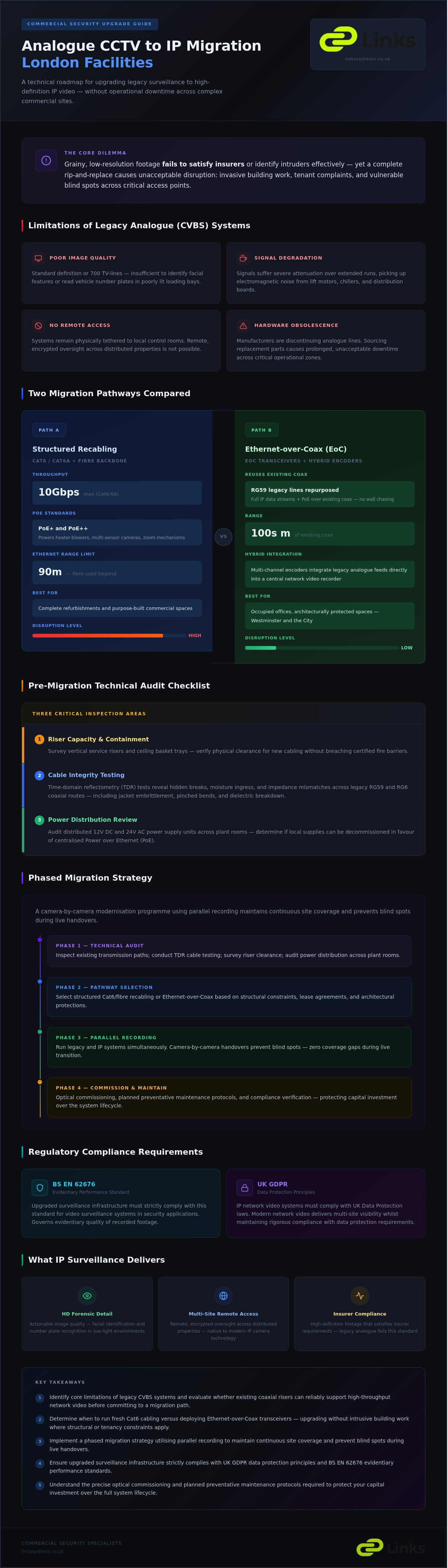
- Identify the core limitations of legacy CVBS systems and evaluate whether existing coaxial risers can reliably support high-throughput network video.
- Determine when to run fresh Cat6 cabling versus deploying Ethernet-over-Coax transceivers to upgrade analogue CCTV to IP London premises without intrusive building work.
- Implement a phased migration strategy that utilises parallel recording to maintain continuous site coverage and prevent blind spots during live handovers.
- Ensure your upgraded surveillance infrastructure strictly complies with UK GDPR data protection principles and BS EN 62676 evidentiary performance standards.
- Understand the precise optical commissioning and planned preventative maintenance protocols required to protect your capital investment over the system lifecycle.
Evaluating Legacy Analogue CCTV Systems Across London Facilities
London commercial facilities often rely on legacy Composite Video Blanking and Sync (CVBS) architecture that strains under modern security expectations. Deciding to upgrade analogue CCTV to IP London properties requires an objective assessment of both the visible hardware and the concealed infrastructure behind service risers. A proper technical audit establishes whether a property supports a phased hardware transition or requires complete infrastructural replacement.
The Operational Limitations of Ageing Analogue Surveillance
Analogue cameras operating at standard definition or 700 TV-lines fail to capture actionable forensic detail. Identifying an intruder’s facial features or reading vehicle number plates in poorly lit loading bays is virtually impossible with legacy sensors. Facilities teams require remote, encrypted oversight across distributed properties; this capability is native to modern IP camera technology, whereas analogue systems remain physically tethered to local control rooms. Signals pushed across extended runs in commercial buildings suffer severe attenuation and pick up electromagnetic noise from lift motors, chillers, and distribution boards. As manufacturers discontinue analogue lines, sourcing replacement hardware causes prolonged, unacceptable downtime across critical operational zones.
Auditing Cable Health and Structural Containment Pathways
Before selecting new hardware, engineers must inspect the existing transmission paths. Legacy RG59 and RG6 coaxial runs in commercial properties frequently suffer from jacket embrittlement, pinched bends, and dielectric breakdown that degrade signal impedance:
- Riser capacity and containment: Survey vertical service risers and ceiling basket trays to verify physical clearance for new cabling without breaching certified fire barriers.
- Cable integrity testing: Time-domain reflectometry tests reveal hidden breaks, moisture ingress, and impedance mismatches across legacy coaxial routes.
- Power distribution: Audit distributed 12V DC and 24V AC power supply units across plant rooms to determine if local supplies can be decommissioned in favour of centralised Power over Ethernet (PoE).
Conducting this diagnostic groundwork clarifies whether existing cable pathways can be repurposed or if the building demands structured data containment.
Selecting the Technical Migration Pathway: Full Recabling vs EoC
Deciding how to upgrade analogue CCTV to IP London facilities hinges on balancing infrastructural disruption against long-term building lifecycle goals. Modernising surveillance to digital video yields substantial operational benefits. However, central London commercial estates often contend with structural constraints, listed architectural protections, or tenant lease agreements that prohibit intrusive containment works. Selecting the right transmission method dictates both project delivery time and overall system capability.
Structured Network Cabling: Cat6 and Fibre Backbone Deployments
A structured recable serves as the standard for complete refurbishments and purpose-built commercial spaces. Running dedicated Cat6 or Cat6A data cabling provides throughput up to 10Gbps and supports advanced Power over Ethernet (PoE+ and PoE++) standards. This infrastructure supplies adequate wattage directly from local comms cabinets to power heater-blowers, multi-sensor cameras, and optical zoom mechanisms over a single network lead. For campus estates or high-rise risers exceeding the 90-metre Ethernet boundary, single-mode or multi-mode fibre optic backbones link distributed switches back to the central server room, preventing data bottlenecks and ground-loop noise.
Ethernet-over-Coax (EoC) and Hybrid Encoders for Heritage Assets
Total recabling is frequently impractical in occupied offices or architecturally protected spaces across Westminster and the City. Ethernet-over-Coax (EoC) transceivers overcome this challenge by repurposing healthy legacy RG59 lines. Single-port and multi-channel rackmount EoC devices transmit full IP data streams alongside PoE over several hundred metres of existing coax, eliminating the need to chase walls, open ceiling rafts, or install disruptive surface trunking. Multi-channel rackmount encoders also allow legacy analogue feeds to integrate directly into a central network video recorder. This approach supports a controlled, camera-by-camera modernisation programme aligned with the operational standards in the Surveillance Camera Code of Practice.
Every commercial site presents unique physical constraints. Balancing Power over Ethernet requirements, riser congestion, and building fabric restrictions requires careful technical calculation. Arranging an engineering review for IP HD CCTV systems ensures your migration pathway delivers high-throughput surveillance without unnecessary capital expenditure or tenant disruption.
Analogue-to-IP Migration Without Site Disruption
Upgrading security in occupied commercial offices demands rigorous coordination. When you upgrade analogue CCTV to IP London facilities cannot simply switch off security cameras and leave blind spots across reception foyers, lift lobbies, or loading docks. A structured five-stage deployment eliminates downtime by running critical visual streams in parallel throughout the transition.
Phase 1 to 3: Site Survey, Network Provisioning, and Pre-Staging
Preparation completed off-site prevents delays on the facility floor. The migration process follows three initial engineering steps before any legacy hardware is taken down:
- Targeted optical surveys: Engineers map exact fields of view, lux levels across fluctuating daylight, and mounting elevations to confirm sensor specifications for each location.
- Network segregation: Technicians configure isolated surveillance VLANs, managed core switches, and static subnets within client comms cabinets, ensuring video streams remain strictly compartmentalised from corporate traffic.
- Bench testing and pre-staging: Every camera is unboxed, assigned static network parameters, and flashed with hardened firmware inside a controlled workshop. Pre-addressing devices prevents IP clashes during site deployment.
Phase 4 and 5: Systematic Hardware Cutover and Storage Integration
Physical changeovers happen systematically zone by zone, typically during out-of-hours windows to avoid disrupting building occupants. Technicians establish temporary parallel recording by introducing the IP head-end before retiring the analogue recorder. This operational overlap ensures high-risk zones, such as vehicle barriers and pedestrian speed gates, maintain continuous video coverage while engineers mount and focus the new cameras.
Varifocal optics are calibrated on-site to match the target operational requirement, whether observing general movement or capturing forensic detail. New camera streams route to enterprise Network Video Recorders protected by fault-tolerant RAID storage arrays. During this phase, aligning the video platform with physical door controllers follows proven engineering protocols for integrating cctv with access control systems, tying visual bookmarks directly to credential events.
Executing an upgrade analogue CCTV to IP London project through structured milestones guarantees full data integrity from sensor lens to storage disk without exposing the property to security lapses.
Regulatory Compliance, Data Privacy, and Network Security in London
Deploying digital surveillance across corporate premises introduces strict legal and infrastructural responsibilities. Moving to network-attached cameras shifts video data into the scope of data protection legislation and IT governance. When commercial property managers decide to upgrade analogue CCTV to IP London facilities must satisfy both statutory privacy obligations and enterprise-level network protection.
UK Statutory Compliance and BS EN 62676 Standards
Operating an enterprise surveillance system requires alignment with the UK General Data Protection Regulation (UK GDPR) and the Data Protection Act 2018. The Information Commissioner’s Office (ICO) treats commercial CCTV as a high-risk processing activity. Facilities teams must conduct a Data Protection Impact Assessment (DPIA) before activating high-resolution sensors covering public footpaths or multi-tenant reception halls.
To avoid dispute during criminal investigations or insurance claims, optical designs must adhere to British Standard BS EN 62676. This standard categorises camera views into four discrete performance tiers: monitor, detect, recognise, and identify. An entrance camera designed to identify unknown individuals requires a minimum target resolution of 250 pixels per metre across the target plane. Property managers must also display compliant signage stating the scheme operator, legitimate purpose, and procedures for Subject Access Requests (SARs). These requests require prompt video redaction and delivery within one calendar month, typically backed by a standard 31-day data retention schedule. Review our comprehensive guide on physical security integration for commercial buildings for broader estate compliance strategies.
Securing the Physical Security Network Against Cyber Vulnerabilities
Physical security devices represent network endpoints that require proactive cyber-hygiene. Leaving factory configurations in place invites severe security vulnerabilities into corporate estates:
- Protocol hardening: Deactivate unsecured protocols including Telnet, HTTP, and Universal Plug and Play (UPnP), mandating HTTPS encrypted connections for all web interfaces.
- Port authentication: Configure 802.1X Network Access Control (NAC) on managed switch ports. This step prevents rogue laptops from accessing the surveillance subnet if an external camera cable is severed or unplugged.
- Cryptographic protection: Enforce TLS encryption for video transport between edge cameras and servers, paired with AES-256 encryption for media storage arrays.
Meeting these statutory benchmarks while safeguarding IP architecture requires seasoned technical guidance. To safeguard your estate against regulatory and network risks, speak with our technical engineering team to design a compliant commercial infrastructure.
Commissioning, Lifecycle Maintenance, and Selecting an Enterprise Partner
Commissioning is the dividing line between a resilient security asset and an unverified network liability. Delivering a successful project to upgrade analogue CCTV to IP London commercial sites requires far more than physical bracket mounting. It demands structured validation of data throughput, optical calibration, and seamless integration with existing building infrastructure.
Rigorous Commissioning and Handover Documentation
Professional commissioning confirms that every sensor captures the precise operational field of view agreed during early surveys. Engineers conduct lux-level assessments and nighttime infrared illumination checks across exterior perimeters to ensure wide dynamic range (WDR) sensors balance harsh vehicle headlights or dark loading bays without clipping highlights. Handover documentation must be meticulous, providing estates teams with:
- As-fitted schematics: Complete CAD layouts detailing camera locations, lens focal lengths, and cable routes.
- Network port schedules: Granular mapping of switch ports, PoE wattage allocations, MAC addresses, and static subnet assignments.
- Operational training: Practical staff instruction covering user privilege management, audit logging, and rapid video export workflows.
Long-Term System Maintenance and Engineering Partnership
Commercial surveillance hardware demands proactive preventative maintenance to avoid silent drive failures or compromised optical clarity. Scheduled servicing visits include inspecting weatherproof dome seals, cleaning external lenses, checking power supply voltages, and stress-testing RAID storage arrays. Regular maintenance preserves manufacturer warranties and ensures systems capture usable evidence when incidents occur.
Modern network video achieves its greatest utility when unified with perimeter hardware. Connecting high-definition surveillance with reception speed gates, perimeter barriers, and IP video intercoms creates an integrated access barrier that manages visitors smoothly while logging entry events visually. When looking to upgrade analogue CCTV to IP London building owners need a dedicated service partner capable of managing complex lifecycle requirements. Backed by four decades of specialist commercial security contracting heritage since 1984, contact Links Integrated Systems to schedule a technical infrastructure survey for your London premises.
Securing the Future of Your London Estate
Transitioning from low-resolution analogue equipment to enterprise digital surveillance doesn’t require disruptive building work or operational blind spots. Evaluating transmission routes, deploying Ethernet-over-Coax where appropriate, and executing phased parallel cutovers allows property managers to modernise site security with zero downtime. High-definition network video sharpens visual evidence, simplifies multi-site management, and satisfies stringent UK GDPR and BS EN 62676 compliance standards.
Choosing an experienced engineering partner ensures your hardware investment performs reliably across its full operational lifecycle. Backed by over 40 years of continuous commercial physical security contracting experience since 1984, our specialist engineering teams serve commercial estates throughout London, Surrey, Kent, Hertfordshire, and Essex. We deliver end-to-end technical design, cabling, and multi-discipline commissioning, seamlessly uniting IP CCTV with access control platforms and speed gates. When you are ready to upgrade analogue CCTV to IP London commercial estates demand proven, methodical engineering. Consult Links Integrated Systems to plan your commercial IP CCTV upgrade today.
Frequently Asked Questions
Can I upgrade to IP cameras while keeping my existing coaxial cables?
Yes, you can retain existing coaxial cabling by deploying Ethernet-over-Coax (EoC) transceivers. These media converters transmit high-bandwidth IP network signals and PoE power over legacy RG59 or RG6 cables across hundreds of metres. This strategy allows facilities teams to upgrade analogue CCTV to IP London premises without tearing through decorative ceilings, vertical risers, or listed interior finishes, providing a reliable migration route with minimal structural disruption.
What is the practical difference between analogue HD and a true IP surveillance system?
Analogue HD transmits an uncompressed electrical signal directly to a recorder, whereas IP systems process, digitise, and encrypt video at the camera sensor itself. This architectural distinction gives IP cameras independent processing intelligence, higher resolving power beyond basic sensor limits, and native cryptographic security. IP systems also support distributed multi-site management across corporate networks without suffering signal degradation or ground-loop electrical noise over long cable runs.
Will our commercial building operations need to shut down during the camera upgrade?
No, commercial operations remain uninterrupted when using a phased migration plan with parallel recording. Engineering teams pre-configure and address network cameras off-site before arrival. Physical cutovers then proceed zone by zone during scheduled out-of-hours windows. By operating the legacy and replacement recording systems concurrently, entrances, turnstiles, and loading bays maintain continuous visual surveillance throughout the entire transition.
How long can digital video footage be legally retained under UK GDPR guidelines?
There is no fixed statutory retention limit, but standard UK practice aligns with a 31-day retention cycle under the Data Protection Act 2018. Storing visual data beyond 31 days requires justifiable legal cause, such as an ongoing police enquiry or formal insurance claim. System storage arrays should be provisioned with automated overwrite routines to purge obsolete recordings, ensuring your property complies with Information Commissioner’s Office storage limitation principles.
Why is Power over Ethernet (PoE) preferred over local power supplies for commercial CCTV?
Power over Ethernet eliminates the need for separate fused spurs or distributed step-down transformers near camera locations. Supplying power and network data across a single Cat6 line centralises power management within secure comms rooms. Backing up central PoE network switches with uninterruptible power supplies (UPS) guarantees that cameras stay operational during mains electrical failures, while enabling technicians to reboot devices remotely via managed network ports.
What network bandwidth does an enterprise commercial IP CCTV system require?
Modern commercial IP cameras typically consume between 2 Mbps and 6 Mbps per stream using efficient H.265 compression. Exact requirements depend on frame rate, sensor resolution, and scene complexity. Isolating surveillance traffic onto dedicated Virtual Local Area Networks (VLANs) with managed gigabit switching prevents video streams from competing with day-to-day corporate IT traffic, guaranteeing smooth playback and frame integrity across your London facility.
How does an IP CCTV system integrate with our commercial access control and speed gates?
Network video systems integrate with access platforms through open API protocols and ONVIF standards at the network switch level. When someone scans an authorised credential at a reception speed gate or intercom station, the system automatically bookmarks corresponding video frames. This unified approach gives security teams real-time visual verification of access events, streamlines incident reporting, and strengthens building security when you upgrade analogue CCTV to IP London facilities.