
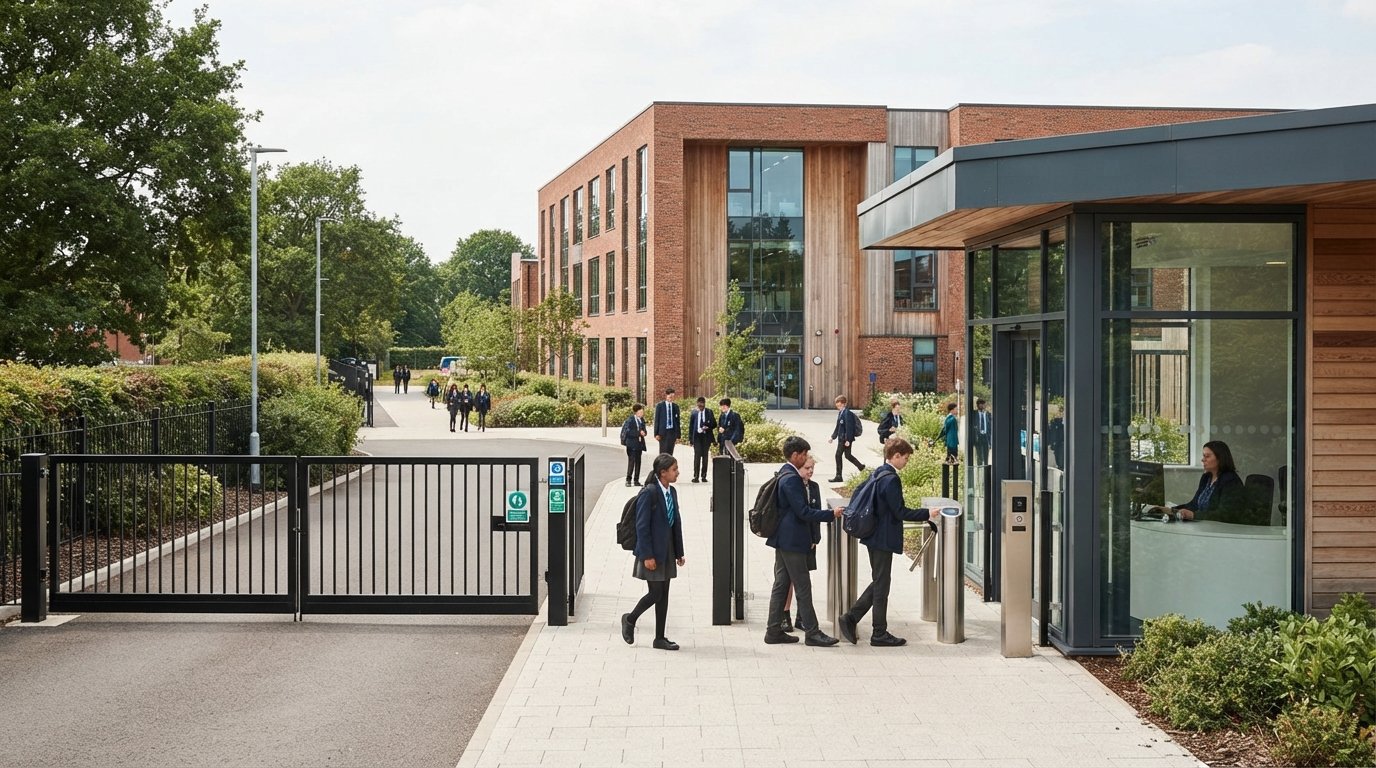
A school perimeter is only as dependable as its ability to release instantly during an emergency evacuation. For estate managers and trust leadership, specifying access control for schools in Kent means resolving this exact operational tension every day. Sprawling grounds across Swale, Medway, and rural Kent demand strict safeguarding boundaries, yet front-desk teams still battle morning congestion and visitor tailgating whilst balancing stringent Department for Education guidelines.
You already know that protecting pupils and staff under updated Keeping Children Safe in Education standards shouldn’t disrupt daily school routines or exhaust capital budgets. This 2026 guide explains how to specify, procure, and maintain fully compliant access control systems tailored to the structural realities of Kent schools and multi-academy trusts. We explore how to combine automated gates, turnstiles, and IP video intercoms with instantaneous fire release mechanisms, giving you a clear blueprint for verified single-point entry across your campus.
Key Takeaways
- Align perimeter zoning with statutory DfE and KCSIE guidelines to establish verified single points of entry without causing reception bottlenecks.
- Discover how specifying robust access control for schools in Kent pairs commercial-grade automated gates and turnstiles with IP video intercoms to endure heavy term-time traffic.
- Resolve the critical balance between physical site lockdown and emergency evacuation by ensuring all electrified access hardware complies with BS EN 179 and BS EN 1125.
- Identify the essential contractor vetting criteria, from mandatory Enhanced DBS staff clearance to verified gate safety accreditations.
- Protect school capital investment by establishing structured commissioning protocols and scheduled preventative maintenance programmes for long-term operational reliability.
Safeguarding and Access Control: Statutory Demands for Kent Schools
Unmonitored school boundaries introduce unacceptable safeguarding vulnerabilities. During an Ofsted inspection, inspectors scrutinise site boundary management and visitor protocols to verify that unauthorised individuals cannot bypass reception. Establishing engineered access control for schools in Kent transitions an estate from passive observation to active perimeter containment, creating a verifiable single point of entry that logs every movement.
Meeting DfE and KCSIE Safeguarding Compliance
Under statutory Keeping Children Safe in Education (KCSIE) standards and Department for Education (DfE) protective security guidelines, governing bodies carry a legal duty to control site access. Modern physical security hardware enforces this mandate through electrified gates and credentialed barriers. These installations generate digital audit trails that record exactly when staff, contractors, and visitors enter the premises. Applying established access control principles ensures that visitor verification happens at the outer boundary rather than after someone has already reached reception.
For primary academies, perimeter automation provides an essential safety net. Electrified pedestrian gates fitted with magnetic locks prevent unsupervised pupils from absconding during busy morning arrivals or afternoon dismissals. This operational control reassures both safeguarding leads and parents that children remain securely on campus throughout the school day.
Managing Varied Campus Layouts Across Kent
Estate architecture varies sharply across the county. Historic grammar schools in Tonbridge, Canterbury, and Rochester often occupy heritage, multi-building grounds intersected by public footpaths. In these settings, continuous external fencing is often impractical. Site security depends on securing internal building thresholds with card or fob credentials, restricting unauthorised movements between academic wings.
Conversely, secondary academies and modern comprehensive campuses in Medway, Swale, and Dartford present expansive open-plan layouts. Effective perimeter access control for schools in Kent requires flexible physical zoning to manage these large facilities. Automated turnstiles and fast-acting speed gates enable schools to isolate community sports centres, evening lettings, and performing arts venues from teaching corridors. As a result, public revenue-generating events can run smoothly without exposing sensitive educational blocks or compromising pupil safeguarding.
Key Hardware Configurations: Specifying School Access Control Systems
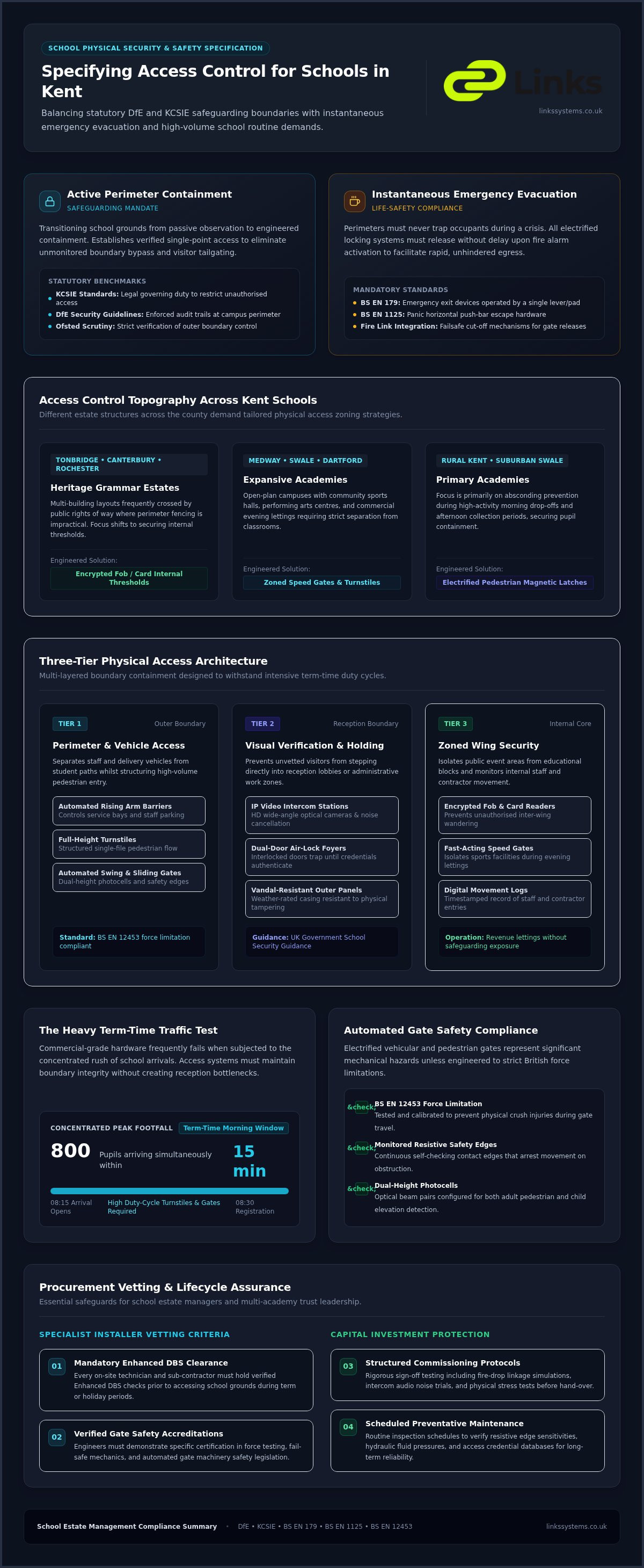
Specifying access control for schools in Kent requires hardware engineered for intensive duty cycles. Standard commercial devices frequently fail when subjected to the concentrated footfall of eight hundred pupils arriving within a fifteen-minute window. To maintain boundary integrity, educational settings require an integrated physical architecture combining automated perimeter lines, visual verification, and encrypted internal locking.
Vehicle Barriers, Automated Gates, and Perimeter Controls
Automated rising arm barriers separate staff parking and service delivery bays from student pedestrian paths. For perimeter footpaths, full-height external turnstiles provide structured, single-file access during peak morning periods. Estate teams evaluating high-volume boundary containment can consult our commercial speed gates guide for detailed drive mechanism comparisons. Every automated swing or sliding gate must incorporate monitored resistive safety edges and dual-height photocells to guarantee strict compliance with BS EN 12453 force limitation standards.
Visitor Management Intercoms and Reception Air-Locks
Perimeter access must not rely on unmonitored release buttons. High-definition IP video intercom stations featuring wide-angle optical cameras and noise-cancelling audio allow reception teams to positively identify visitors before unlatching external gates. Vandal-resistant, weather-rated panels withstand physical tampering and harsh weather. Inside the main foyer, dual-door interlocked air-locks ensure visitors remain in a secure holding area until front-office staff authenticate their credentials and issue visitor passes in accordance with UK Government School Security Guidance.
Internal Door Security: Smart Cards, Fobs, and Wireless Locks
Internal access architecture protects sensitive zones without disrupting regular timetable movements. Estate teams should consider three essential hardware practices:
- Encrypted Credentials: Transition from legacy 125kHz proximity cards to MIFARE DESFire smart credentials, which utilise cryptographic protection against cloning.
- Specialised Compartmentation: Deploy wireless smart lock handles on science laboratories, IT server suites, and medical rooms to provide auditable access without running complex network cabling through finished surfaces.
- Centralised Provisioning: Utilise cloud-managed controllers across multi-academy trusts to permit instant bulk credential revocation and enrolment during September term intakes.
If your trust is reviewing campus infrastructure to upgrade access control for schools in Kent, our engineering team can provide comprehensive technical surveys; explore how we support regional estates at linkssystems.co.uk.
Crucial Integration Requirements: Emergency Lockdown and Fire Safety
Lockdown protocols must never compromise the immediate preservation of life during a fire emergency. Resolving this operational conflict represents the central engineering challenge when designing access control for schools in Kent. Security teams must ensure that an electrified physical barrier designed to secure perimeter gates against external threats yields instantly when an evacuation trigger sounds. Our commercial security integration guide examines how to architect multi-system building infrastructure without creating conflicting automated commands.
Dynamic Lockdown Protocols for Critical Incidents
Critical incidents require swift, tiered containment. Modern controllers execute dynamic lockdown sequences triggered via reception panic buttons, administrative computer shortcuts, or silent staff fobs. A robust lockdown setup operates across two discrete levels:
- External Perimeter Isolation: External automated gates and perimeter speed gates lock immediately against ingress whilst maintaining emergency free-egress for escaping occupants.
- Internal Compartmentalisation: Magnetic hold-open devices release fire doors throughout educational corridors, creating secure physical zones that contain an intruder within a single sector and protect adjacent classrooms.
Harmonising Electronic Access with Fire Evacuation Egress
Life safety legislation supersedes asset security. All electrified egress hardware must comply stringently with British and European standards: BS EN 179 for non-public emergency exits operated by trained staff, and BS EN 1125 for panic bars fitted along main student escape routes.
Primary evacuation doors rely on fail-safe magnetic locks wired directly through dedicated fire alarm relays. The moment the fire alarm system trips, the primary low-voltage power circuit cuts out, dropping magnetic locks without delay. To protect against controller freeze or circuit board failure, secondary protection requires double-pole green break-glass call points wired in series with the power feed right beside the door. Estate teams must test these hardware releases systematically during weekly fire bell checks.
Synchronising Access Control with IP HD CCTV Infrastructure
Unifying entry hardware with visual surveillance eliminates blind spots across school grounds. When an individual attempts access, the system places a digital bookmark on the IP HD CCTV footage for straightforward auditing. External pan-tilt-zoom (PTZ) cameras can be configured to pivot toward an entry gate the moment a visitor triggers the IP video intercom. Read our dedicated manual on integrating CCTV with access control systems to discover how to align hardware protocols across your estate.
How Kent School Estate Managers Should Evaluate Specialist Installers
Selecting an integration partner demands thorough scrutiny beyond basic trade credentials. When tendering access control for schools in Kent, estate managers and trust operations directors must evaluate contractors across technical, legal, and operational benchmarks to protect both capital investment and pupil welfare.
A structured evaluation framework should follow five core stages:
- Step 1: Statutory Safeguarding Verification: Demand evidence of Enhanced Disclosure and Barring Service (DBS) vetting for every field technician assigned to your grounds.
- Step 2: Technical and Machinery Safety Accreditations: Verify certifications demonstrating compliance with the Supply of Machinery (Safety) Regulations and powered boundary standards.
- Step 3: Education Sector Track Record: Require verified references from multi-academy trusts or secondary colleges within the South East.
- Step 4: Phased Logistics Mapping: Ensure project scopes accommodate the restrictive flow of the academic timetable.
- Step 5: Rigorous Service Level Agreements (SLAs): Scrutinise contractual response times for hardware faults during term time.
Mandatory Installer Vetting and Safeguarding Accreditations
School sites permit no compromises regarding child safeguarding. Unvetted subcontractors must never gain unchaperoned access to educational facilities. Reputable providers maintain current Enhanced DBS disclosures across their engineering personnel, logging certificate details directly into your Single Central Record (SCR) before commencement.
Powered perimeter gates are classified as industrial machinery under UK law. Consequently, engineering leads should possess verifiable credentials from recognised safety organisations such as the Door & Hardware Federation (DHF) or Gate Safe. These qualifications confirm an installer’s ability to calculate mechanical impact forces, fit category-tested pressure edges, and issue formal UKCA or CE declarations of conformity upon completion.
Planning Installations Around the Academic Calendar
Effective security integrators shape project milestones around term breaks. Intrusive ground excavation, road ducting for vehicle barriers, and structural containment trenching must occur during summer, Easter, or half-term closures. This scheduling avoids vehicle gridlock, pedestrian diversions, and noise disruptions during teaching hours.
When term-time installations prove unavoidable, a competent contractor establishes segregated working compounds protected by anti-climb safety hoardings. If external gates require temporary decommission during hardware changeovers, the installation plan must define interim security procedures, ensuring boundary control remains fully active ahead of morning registration.
With over 40 years of commercial physical security engineering expertise across the South East, Links Integrated Systems delivers fully accredited boundary solutions; contact our engineering team to discuss your school estate requirements.
System Commissioning, Maintenance, and Lifecycle Assurance
Commissioning marks the critical transition from mechanical installation to daily operational readiness. Access control for schools in Kent requires formal verification to confirm that every barrier, lock, and intercom station responds safely under real-world operating conditions. Maintaining detailed digital asset logbooks and complete handover files protects estate directors against liability during Health and Safety Executive (HSE) reviews.
Comprehensive Commissioning and Handover Protocols
Handover protocols begin with calibrated force-testing on all automated gates and vehicular barriers using dynamic impact transducers. This physical testing ensures closing forces comply with statutory health and safety limits. Commissioning engineers then configure system databases, validating credential groups and testing anti-passback rules at perimeter turnstiles. Premises staff, bursars, and administrative personnel receive structured, hands-on training alongside detailed Operations and Maintenance (O&M) manuals, as-built wiring schematics, and equipment test certificates.
Preventative Planned Maintenance and Statutory Testing
High footfall subjects perimeter hardware to continuous mechanical fatigue. Structured preventative planned maintenance contracts guarantee long-term operational uptime and satisfy education insurance covenants. Bi-annual engineering service visits include:
- Mechanical Servicing: Inspecting structural hinges, guide rollers, hydraulic drive pressures, and magnetic shear alignment.
- Power Integrity Audits: Testing backup battery health under simulated load to confirm automated locks release correctly during power disruptions.
- System Firmware Updates: Deploying validated firmware patches across networked controllers and IP intercoms to preserve system stability.
Selecting Links Integrated Systems as Your Kent Security Partner
Delivering dependable access control for schools in Kent demands an engineering partner with established technical accountability. With over 40 years of commercial physical security engineering expertise, Links Integrated Systems provides comprehensive lifecycle support for education providers across Kent, London, and the South East. Our team manages the complete project scope, from early feasibility surveys and system integration to structured planned maintenance. Discuss your campus requirements by contacting Links Integrated Systems to plan your upcoming security works.
Building a Safer Campus Environment for 2026 and Beyond
Effective safeguarding demands a calculated balance between robust perimeter containment and instantaneous emergency fire egress. Specifying the right access control for schools in Kent ensures that high-volume pupil arrivals, verified visitor vetting, and complex campus zoning operate in harmony without compromising daily learning routines or capital budgets.
Achieving long-term security requires commercial-grade hardware engineered to endure demanding term-time footfall, paired with scheduled maintenance that satisfies statutory safety standards. Backed by over 40 years of commercial physical security engineering expertise, Links Integrated Systems delivers bespoke commissioning and dedicated regional support across Kent, London, and the South East. Taking a structured approach today protects both your estate investment and your wider school community. Request a professional school security audit from Links Integrated Systems to strengthen your campus boundaries with lasting confidence.
Frequently Asked Questions
How does access control support a school’s safeguarding and Ofsted rating?
Access control directly supports Ofsted evaluations by proving the school maintains active perimeter containment and supervised visitor protocols. Digital logs establish a clear audit trail of everyone entering the grounds, satisfying Keeping Children Safe in Education criteria. By channelling all unvetted arrivals through a single, controlled reception point, schools prevent unauthorised site access and demonstrate effective leadership oversight of physical pupil safeguarding.
Can our existing gates and entrance doors be retrofitted with electronic access control?
Yes, existing timber doors, aluminium entrance sets, and manual metal swing gates can usually be retrofitted with commercial locking hardware. An engineering survey evaluates hinge load capacities, frame stability, and cabling routes. Installing magnetic shear locks, electric strikes, or post-mounted gate automation allows schools to upgrade their boundary containment without the expense of completely replacing established structural gateways.
What occurs to school access doors during a power cut or fire alarm activation?
Primary escape doors must immediately fail safe to permit unimpeded evacuation. When the fire alarm triggers or mains electricity cuts out, power to electromagnetic locks drops instantly via dedicated interface relays, releasing the doors. Secondary manual green break-glass units provide an emergency mechanical override right at the door threshold, ensuring full compliance with BS EN 179 and BS EN 1125 life safety standards.
Why is biometric access control scrutinized under UK GDPR in educational environments?
Biometric data, such as fingerprints or facial geometry, constitutes special category personal data under UK GDPR. Schools must conduct a rigorous Data Protection Impact Assessment (DPIA) and obtain explicit, verifiable parental consent before enrolling pupils. Because of these legal and regulatory administrative hurdles, most Kent educational trusts prefer encrypted smart cards or MIFARE fobs for day-to-day identity and boundary verification.
How do schools manage delivery drivers and unexpected visitors securely?
Unexpected visitors and couriers are directed to an external IP video intercom station positioned at the vehicular barrier or pedestrian gate. Reception personnel visually verify the caller’s identity and delivery credentials over wide-angle video before remotely granting entry. Once through the gate, visitors enter an interlocked reception lobby air-lock, ensuring they remain isolated from teaching corridors until properly registered and badged.
Can our Kent school install access control hardware during term time?
Specialist contractors routinely install access control for schools in Kent during term time by segmenting work into safe operational phases. Internal door controllers, wire pulls, and low-voltage commissioning can take place outside teaching hours or behind protective screening hoardings. Disruptive civil groundworks and roadway trenching for perimeter gates are usually reserved for half-terms or holiday closures to avoid vehicle congestion.
What maintenance is legally required for automated school entrance gates?
Automated school gates are regulated as machinery under the Workplace (Health, Safety and Welfare) Regulations 1992. Estate teams must arrange regular maintenance inspections, typically carried out bi-annually by accredited engineers. These visits include calibrated force testing, safety edge validation, hinge structural checks, and drive operator servicing. All outcomes must be logged in the site’s permanent machinery safety logbook for HSE compliance.
Can access control integrate with our school management information system?
Modern access control for schools in Kent can synchronise directly with leading management information systems (MIS) such as SIMS, Bromcom, or Arbor. This integration automates user profile updates, instantly activating access credentials for new staff and deactivating departing personnel. The synchronised data also streamlines roll-call logging during critical emergency evacuations and facilitates automated attendance tracking across secondary campuses.