

Could the most obvious security upgrade leave your biggest vulnerability untouched? A search for commercial speed gate installation London may start with a busy entrance, but the right physical controls depend on risks across the whole premises. Any entrance system also needs to work with staff routines, visitor flows and building operations.
It can be difficult to decide which weaknesses to address first or how to turn a risk review into a practical system specification. A clear assessment connects each threat to a site vulnerability and its potential consequences. This helps you prioritise improvements proportionately instead of choosing equipment in isolation.
This checklist will help you review entry points, movement around the site, existing controls and operational needs. Use your findings to prepare a shortlist of physical security measures and a concise brief for specialist installers. The brief can cover how access control, IP CCTV and speed gates or barriers may work together, as well as design, commissioning and ongoing maintenance. Whether your premises are in London, Kent, Surrey, Hertfordshire or Essex, the aim is to make a considered security decision that supports both protection and day-to-day operations.
Key Takeaways
- Set clear boundaries for your review, including entrances, shared areas, operating hours, occupants, visitors and important assets.
- Assess assets, threats, vulnerabilities and potential consequences in a consistent order. Treat risk scores as a guide, not a certainty.
- Compare possible physical controls against each documented risk, including their operational effects and system dependencies.
- Use your priorities to prepare a practical brief for commercial speed gate installation London, including how access control and CCTV may support site operations.
- Agree project scope, acceptance criteria, handover information and review arrangements with a specialist before implementation begins.
Security risk assessment for London business premises: define the site and its priorities
Before considering a gate or access control system, establish what the assessment needs to protect and where its boundaries lie. A security risk assessment is a structured review of threats, vulnerabilities, potential consequences and existing safeguards. It gives decision-makers a reasoned basis for comparing risks and controls, rather than starting with a preferred product. Security management principles offer an overview of how asset identification and risk review fit into wider protection planning.
Agree the scope with facilities, operations, property management and relevant security stakeholders. Map the premises, entrances, shared areas and access routes between occupiers. Record operating hours, who uses each space, and which people, property, information or processes need protection. Include business continuity. For example, consider how restricting access to a loading area could affect deliveries or essential operations.
What should a commercial premises assessment cover?
Consider risks to people, physical assets, business continuity, information exposure and critical processes. Separate external threats, internal risks and accidental events, as each may call for a different response. An unsecured entrance, unauthorised visitor access and a door left open by mistake are distinct scenarios, even if they involve the same access point.
Document existing safeguards, such as access procedures and installed security systems, and note known incidents or near misses. Past events can help identify weaknesses, but they do not predict every future scenario. Record assumptions and information gaps so the review is transparent and can be revisited when operations or occupancy change.
Which London site conditions should shape the review?
Look beyond the main entrance. Map public-facing doors, shared lobbies, loading areas and routes between separate occupiers. Consider local footfall, neighbouring uses and nearby transport links only where they affect how people approach, enter or move through the specific site. A busy public frontage may create different access control needs from a building with a managed reception and shared facilities.
Check available building plans, landlord requirements and site-specific planning or security guidance before defining possible changes. These may affect where equipment can be installed and how access routes need to operate. Confirm relevant legal duties and seek specialist advice where the site, proposed controls or potential consequences require it. This checklist supports decisions but does not replace a formal assessment or legal guidance.
Once you have documented the site and its priorities, use the findings to compare proportionate controls against specific entry-point risks. That context makes a brief for commercial speed gate installation London more practical, with the specification shaped by actual users, routes and operating requirements rather than assumptions.
How to assess threats, vulnerabilities and consequences systematically
Use the same sequence for each concern so findings can be compared and reviewed consistently: identify the asset, consider a credible threat, locate the vulnerability, estimate the consequences, then record the controls already in place. A concise definition helps keep the review focused: risk is the relationship between a threat, the site’s exposure to it and the potential consequences.
Keep likelihood and impact separate. Likelihood concerns how plausible a scenario is in the conditions observed; impact describes what could happen if it occurred. If you use a scoring scale, define what each level means before applying it and explain the evidence behind each rating. A score helps prioritise discussion, but it is not a prediction or a precise measure of certainty.
How do you identify credible site-specific threats?
Use available incident logs, access records, staff observations and information about operational changes. Ask facilities, reception, operations and other site stakeholders where procedures are difficult to follow, visibility is limited or access patterns seem unusual. Their observations can help distinguish a real exposure from a theoretical concern.
Consider scenarios such as unauthorised entry, tailgating, misuse of credentials or disruption, but do not assume they apply simply because they are possible. For each scenario, note where and when it might occur, who or what could be affected, and what information supports the assessment.
How should vulnerabilities and consequences be documented?
Describe each weakness precisely. For example, a shared entrance may rely on staff recognising every visitor, or movement between areas may not be consistently controlled. Record dependencies too. A weakness at a lobby could affect access to several occupiers, while a change to an entrance procedure could affect deliveries or visitor reception.
State consequences in plain language, covering possible effects on people, operations, assets and continuity. Separate confirmed observations from assumptions, and mark missing evidence for follow-up. A useful record includes the scenario, evidence source, current safeguards, likelihood and impact rationale, action owner and review date. This helps another stakeholder understand how the finding was reached and what needs checking next.
Compare existing or proposed controls with the specific exposure rather than selecting equipment by default. ProtectUK’s physical security measures checklist can help prompt consideration of relevant physical measures. Where the review identifies an entry-point risk, the findings can inform a considered specification for commercial speed gate installation London, including how access control should support actual user workflows. To explore systems for that discussion, see commercial speed gates and access control systems.
Compare physical security controls for commercial speed gate installation London and other risks at your site
Use the documented findings to compare controls against specific risks, not to select equipment in isolation. A control that addresses unauthorised pedestrian entry may affect visitor queues, accessible routes and staff procedures. Record operational effects and dependencies alongside the potential benefit, then consider whether the measure can be maintained and managed in practice.
| Documented risk or need | Controls to evaluate | Operational effects and dependencies |
|---|---|---|
| Entry permissions need clearer definition or oversight | Access control systems | Check credential arrangements, permission management, entry workflows and who will administer the system. |
| Managed pedestrian entry is required | Speed gates alongside access control | Assess people flow, accessible routes, visitor handling and procedures for exceptions or assistance. |
| Vehicle access needs to be managed | Barriers | Consider vehicle movements, delivery processes, site layout and how authorised access will be controlled. |
| A defined monitoring or incident-review need exists | IP HD CCTV | Check camera sightlines, privacy and data handling, system integration, and who is responsible for using and managing footage. |
| Staff need to manage visitor requests remotely | IP video intercom systems | Confirm who responds, how requests fit reception workflows and whether the system works with other proposed controls. |
Treat each option as something to evaluate, not a guaranteed remedy. A speed gate may be worth assessing where pedestrian access needs managing, but its suitability depends on the site layout, user needs, throughput and procedures. A barrier addresses vehicle access, not pedestrian permissions. Dependencies matter too: a gate may need to work with access control and established visitor processes.
Match controls to the access requirement
Consider access control where defined permissions or auditable entry decisions address a recorded need. Evaluate speed gates for managed pedestrian entry, taking account of accessible routes and day-to-day operations. Consider barriers where vehicle access management is a documented requirement. For commercial speed gate installation London, use the assessment findings to shape a specification around actual entry risks and user flows, rather than assuming one arrangement suits every building.
Check monitoring, privacy and project requirements
IP CCTV may be relevant where the assessment identifies a need for monitoring, oversight or incident review. An IP video intercom may help staff handle remote visitor requests. Before specifying either, check sightlines, privacy and data handling, integration dependencies and operational ownership. Confirm that proposed systems can be maintained within the site’s arrangements.
Finally, verify relevant legal duties and standards against the specific project and current authoritative guidance. Requirements can depend on the equipment and installation context, so do not treat a general reference as confirmation that a design is suitable or compliant.
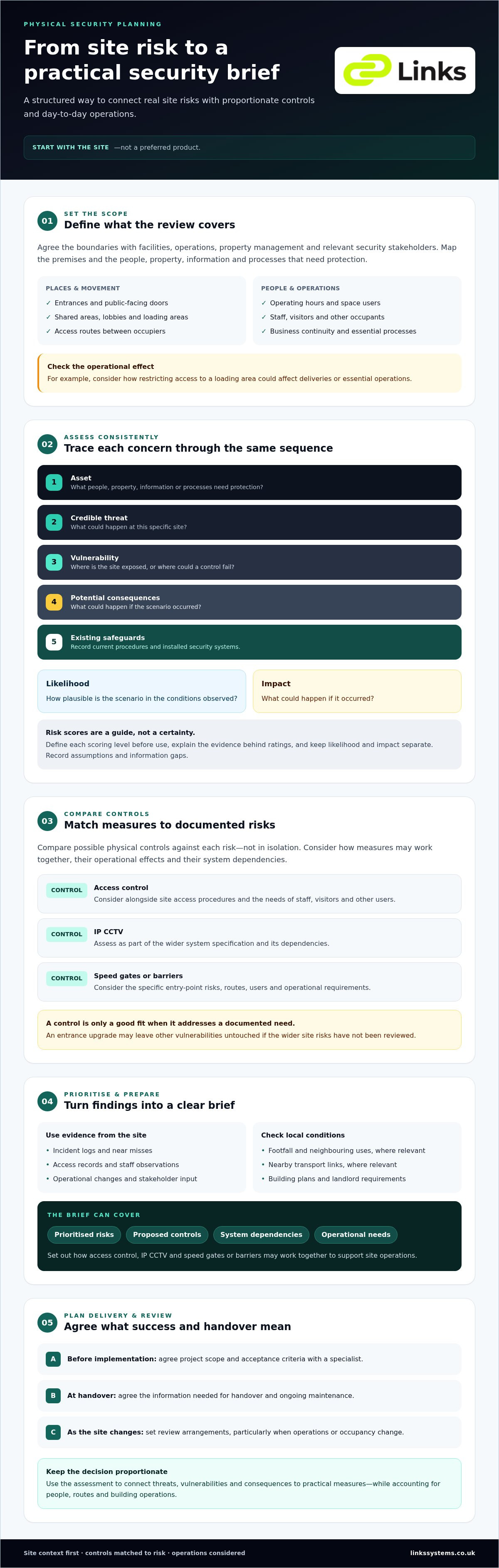
Use this London premises checklist to prioritise actions and prepare a brief
A useful checklist turns assessment findings into owned actions. Prioritise them using criteria agreed by the relevant stakeholders, such as potential harm, operational impact, exposure and gaps in current controls. Record the reasoning behind each priority so the order of work is clear, especially where a proposed security improvement could affect daily operations.
What should the assessment checklist record?
For each finding, capture enough detail for another stakeholder to understand the issue and decide what happens next:
- Location and scenario: identify the entrance, route or area, and describe what could happen.
- People or assets affected: note relevant user groups, property, information or operational processes.
- Existing controls and evidence: record safeguards, observations and available supporting records. Mark assumptions or missing evidence clearly.
- Priority and rationale: explain the risk rating using your agreed criteria, rather than presenting a score without context.
- Action and ownership: state the next step, responsible owner, evidence needed and target review date.
Separate urgent follow-up from further investigation and longer-term system improvements. An unverified concern, for example, may need a site check before a control is specified, while a confirmed gap can be assigned for action. Note constraints that may affect delivery, including occupied areas, accessible routes, landlord approvals and planned building works.
How do you turn findings into an installer brief?
Give prospective specialists a practical picture of how the site operates. Describe entrances, typical user groups, operating hours, entrance volumes where known, and the required workflows for staff, visitors and deliveries. Include available drawings, details of existing systems and constraints on access or installation. Label unknowns instead of presenting estimates as confirmed facts.
Ask suppliers to explain how their proposals address the recorded risks and fit site operations. Compare suitability, integration with existing systems, commissioning, handover documentation and maintenance arrangements. For a speed gate, clarify how the proposal accounts for pedestrian flow, accessible routes and visitor procedures. These requirements help shape a considered brief for commercial speed gate installation London, without assuming a gate is the right answer for every entrance.
For entry-control options, review professional commercial speed gates and barriers and use your prioritised findings to frame a discussion about specification, installation, commissioning and ongoing maintenance.
Plan implementation, commissioning and review with a security systems specialist
Once the assessment and brief are agreed, use a defined delivery sequence: scope, site survey, design, installation, commissioning, handover and planned review. Each stage should carry forward the decisions made earlier. A documented entry-control need, for example, should translate into an agreed design and clear tests, rather than remain a general project objective.
Before work begins, confirm who is responsible for decisions and approvals, how site access and working arrangements will be managed, and which dependencies need coordination. These may include occupied areas, existing access control or video systems, landlord approvals and planned building works. Clear responsibilities help prevent installation assumptions from conflicting with site operations.
What should decision-makers expect during system delivery?
Agree acceptance criteria against the project brief. Specify the intended functions, user workflows and integration requirements, then ask how the installed system will be configured, tested and demonstrated. A practical test should reflect real use, such as how authorised staff enter or how reception handles a visitor request, not just whether the equipment powers on.
At handover, request relevant operating information and records for the people who will manage the site. Confirm what documentation will be provided, who will receive it and how users will be shown the agreed processes. For commercial speed gate installation London, commissioning should verify the specified operation against the agreed requirements, with any outstanding issues recorded for resolution.
How should security controls be reviewed after installation?
Installation is not the end of the assessment. Check that controls continue to suit actual pedestrian flows, access permissions and site procedures. A system designed around an assumed visitor route may need review if the entrance layout or reception process changes. Assign someone to oversee this review and keep relevant records current.
Agree maintenance ownership and fault-reporting responsibilities with the appointed service provider. Establish how scheduled maintenance will be arranged and how faults or operational concerns should be raised. Review documented risks when occupancy, layout, threats or business processes materially change, and after incidents that reveal a possible control gap.
Where assessment findings span access control and video, consider how the systems should work together and who will operate them. Links Integrated Systems supplies, installs, commissions and maintains commercial security systems, including access control, IP HD CCTV and IP video intercom systems. A clear brief and agreed handover provide a basis for discussing system design, commissioning and ongoing maintenance with a specialist.
Turn your assessment into a practical next step
A useful premises review gives your team more than a list of concerns. It clarifies which risks need attention, why they matter and what evidence or approval is needed before action. Prioritise controls that address documented vulnerabilities while fitting the way people use and manage the building.
With that groundwork in place, you can discuss commercial speed gate installation London in the context of actual entry requirements, visitor flows and site operations. Links Integrated Systems supplies and installs commercial speed gates, barriers and access control, alongside IP HD CCTV and IP video intercom systems. System commissioning and scheduled maintenance can also be part of the project discussion.
Frequently Asked Questions
Is a security risk assessment a legal requirement for business premises in the UK?
There is not one universal legal requirement for every business to complete a standalone physical security risk assessment. However, duties may apply depending on your premises, activities and the risks involved. Health and safety requirements are separate, and some premises may fall within the Terrorism (Protection of Premises) Act 2025 as its provisions come into force. Check current official guidance and seek competent advice about which requirements apply to your site.
How do you carry out a security risk assessment for business premises?
Start by defining the premises, operating arrangements, people and assets in scope. Identify credible threats, then examine vulnerabilities, existing safeguards and possible consequences. Assess likelihood and impact separately, explaining the evidence and method behind any rating instead of treating a score as certain. Record assumptions, information gaps, action owners and review dates. Involve facilities, operations and property stakeholders so findings reflect how the premises are actually used.
What should a commercial premises security checklist include?
Include entrances, shared areas, loading points, operating hours, user groups and important assets or processes. For each concern, record its location, scenario, people or assets affected, current controls and supporting evidence. Add a reasoned priority, proposed next step, responsible owner and review point. Note building constraints, landlord approvals and existing systems. Mark unverified concerns for investigation rather than recording assumptions as confirmed vulnerabilities.
How often should a business premises security risk assessment be reviewed?
Set a review schedule that reflects the site’s risks and operating conditions, then revisit the assessment sooner if circumstances change. Triggers may include a change in occupancy, layout, access procedures or business processes, as well as an incident that reveals a possible control gap. Record when the review took place, who contributed and what changed. Check applicable legal or sector-specific guidance for any review requirements relevant to your premises.
Can a security risk assessment help choose speed gates or access control?
Yes. It can show whether a documented entry risk calls for defined access permissions, managed pedestrian flow or another response. Consider the people using the entrance, accessible routes, visitor procedures and how the system would be administered. These findings can inform a brief for commercial speed gate installation London, but a gate is not automatically suitable for every site. Compare options against the risk and operational needs before specifying equipment.
Should CCTV be included in a business premises security assessment?
Include CCTV as an option to assess where there is a defined need for monitoring, oversight or incident review. Check camera coverage and sightlines alongside who will manage footage and how it will be used. Recording identifiable people engages data protection considerations, including the UK GDPR and Data Protection Act 2018. Establish a lawful basis, clear signage, appropriate retention arrangements and controlled access to recordings, using current Information Commissioner’s Office guidance.
What information should I give a commercial security installer?
Share the assessment findings, site plans, entrance locations, operating hours, user groups, known access workflows and typical visitor or delivery arrangements. Include details of existing access control or video systems, occupied areas, landlord requirements and planned building works. Label unknowns clearly. Explain the functions you need and ask how the proposal will address them, including integration, commissioning, handover documentation and maintenance arrangements. This gives a specialist a practical basis for discussing design and installation.
Discuss your commercial security requirements with Links Integrated Systems, using your assessment findings to explore a suitable approach to specification, installation, commissioning and maintenance.