
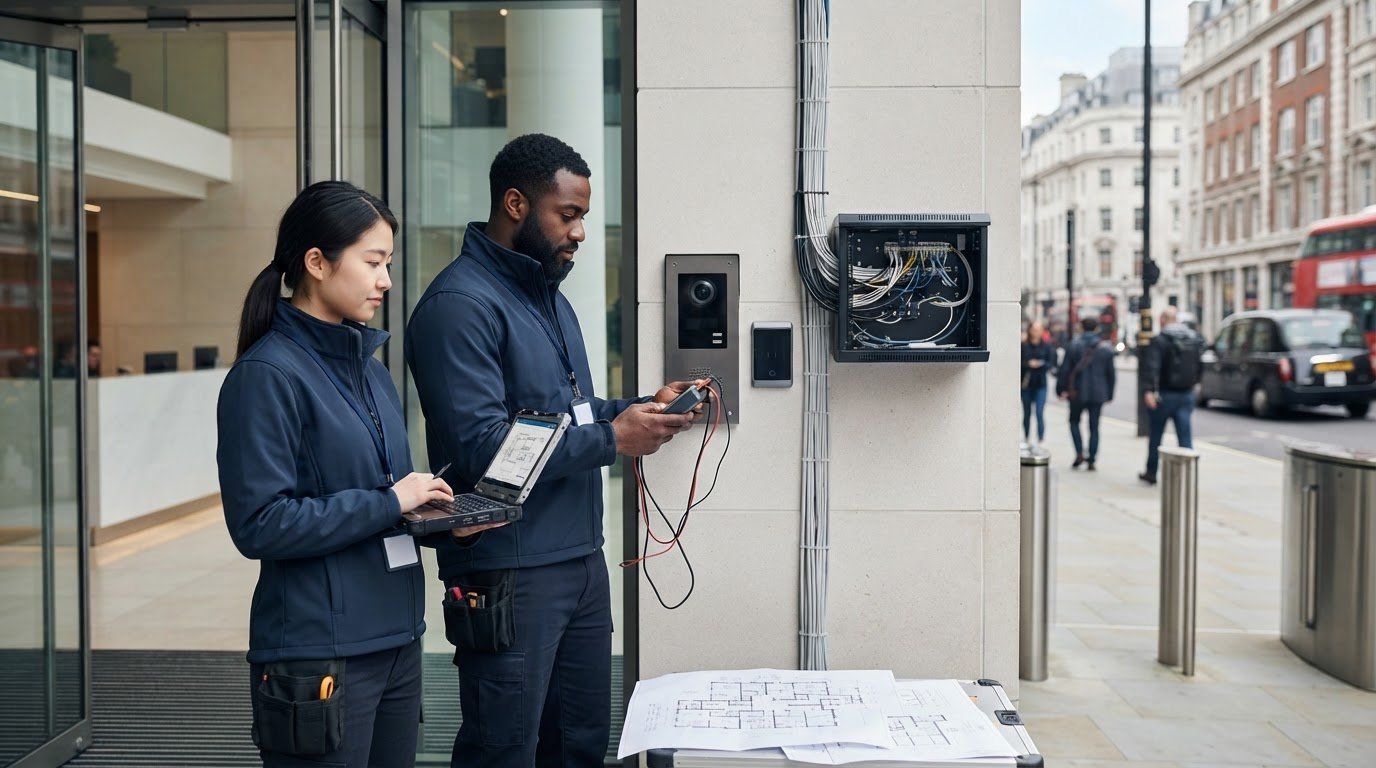
The closest contractor isn’t automatically the right choice for a commercial intercom project. A search for “Comelit installer London” should lead to a partner whose experience with your specific equipment can be checked, not assumed. Existing access-control arrangements and network infrastructure may also affect the design, installation and commissioning plan.
Before appointing an installer, ask which Comelit models they can support, what experience they have with comparable projects, and what happens after installation. Links Integrated Systems provides commercial IP video intercom installation, commissioning and maintenance, alongside access control. Confirm Comelit model compatibility and any manufacturer status for your project.
This guide explains what to ask before choosing an installer and what a well-planned project can involve, from the initial site survey to testing, handover and maintenance planning. It also covers points to review when an intercom needs to work with existing access-control or network systems, so you can assess a London partner on verified capability and support throughout the project.
Key Takeaways
- Define whether your project involves a new system, replacement, extension or fault investigation before comparing proposals.
- Ask a Comelit installer London to confirm support for the specific equipment and provide evidence of relevant project experience.
- Use the site survey to clarify device positions, cabling routes, power and network requirements alongside existing infrastructure.
- Check that the proposed workflow covers design confirmation, installation, testing and a clear handover.
- Agree what commissioning and scheduled maintenance will include, and verify any manufacturer authorisation separately from technical capability.
Comelit Installer London: Define the Commercial Project Before You Appoint
A search for a Comelit installer London may reflect very different needs: a new IP video intercom installation, a replacement for existing equipment, an extension to serve additional entrances, or an investigation into a fault. Identify which applies before requesting proposals. The scope affects what information an installer needs and what should be assessed during a site survey.
This guide focuses on commercial and professional environments. A project might involve one office entrance, several access points in a building, or connected sites with different reception arrangements. Note how visitors arrive, who needs to answer calls and whether the intercom must work alongside existing access control. Confirm Comelit model compatibility, relevant installation experience and any manufacturer authorisation or training directly. A general intercom capability does not establish these details.
What kind of Comelit intercom project do you need?
For a new installation, describe the entrances and reception points the system needs to serve. For an upgrade or replacement, gather details of the equipment already in place and explain what you want to change. If you’re reporting a fault, record what isn’t working and when the issue occurs, without presuming the cause. In every case, clarify visitor-management requirements and whether the work covers one building, multiple entrances or connected sites.
An installer’s role is to help define the system scope, plan the work, install the agreed equipment and complete commissioning and handover. Ask how the proposal addresses your requirements and what information or decisions you’ll need to provide.
What should a London commercial project brief include?
A concise brief helps an installer assess the project and identify questions for the survey. Include the building location, site type, approximate user numbers, entrances, operating hours, access constraints and a project contact. Add your preferred timing and flag whether the premises must remain operational during installation.
Where available, share building drawings, equipment schedules and details of existing intercom or access-control systems. Note reception arrangements and any site rules that affect access to work areas. These details don’t replace a site survey, but they help the installer understand the building before confirming the scope.
- Project type: new installation, replacement, extension or fault investigation.
- Site requirements: building type, entrances, user numbers and visitor arrangements.
- Existing infrastructure: equipment details, drawings and access-control information.
- Coordination: operating hours, access restrictions, contacts and preferred timing.
Use this brief to ask a prospective Comelit installer London to confirm support for the specific equipment under consideration. Request evidence of relevant project experience and clarify manufacturer status separately. Links Integrated Systems works on commercial IP video intercom systems, commissioning and maintenance. Confirm Comelit model support and manufacturer status for your enquiry.
What a Professional Comelit Intercom Installation Should Cover
A commercial intercom proposal should set out more than the equipment to be fitted. The scope depends on the selected Comelit equipment, the building and its existing infrastructure. Before agreeing to work, establish what the installer has assessed, what remains subject to confirmation and how the finished system will be tested and handed over.
For an IP system, integration depends on the specifications of the intercom equipment and any connected systems. Don’t assume that an existing door-release arrangement, access-control system or network can be connected without review. Ask the proposed Comelit installer London to confirm compatibility for the specific models and interfaces in scope, and to record any assumptions in writing.
How site conditions affect system design
A site survey should consider where entrance panels and internal devices can be positioned, how visitors reach reception and which cable routes are practical. The installer should also review the proposed equipment’s power and network requirements against the building’s existing provision.
Ask for existing door-release hardware and access-control interfaces to be recorded for a compatibility review. If access to a route or area hasn’t been confirmed, or a system specification is still needed, list it as an open item rather than treating it as settled. Clear assumptions help both parties understand what the proposal includes.
What commissioning and handover should include
Agree the acceptance checks before installation begins. Depending on the equipment and project scope, these may include confirming that devices operate, audio and video functions work, door release behaves as agreed, and specified interfaces function with the relevant systems. Ask who will perform each check and how defects or outstanding work will be recorded.
Handover should give authorised building staff usable operating guidance and relevant system documentation. Confirm what information will be provided, who will receive it and how staff familiarisation will be handled. Also agree when maintenance responsibilities begin and what scheduled maintenance is proposed, rather than leaving aftercare undefined.
- Design: device positions, cabling routes, power and network assumptions.
- Integration: compatibility checks for existing door-release equipment and access-control interfaces.
- Testing: agreed checks for devices, audio, video and specified system functions.
- Handover: operating guidance, documentation and a record of outstanding items.
If a provider refers to Security Industry Authority status, ask what the claim relates to and check the relevant information with the Security Industry Authority. Treat this as separate from whether the installer can support your Comelit equipment. For commercial IP video intercom, commissioning and maintenance requirements, you can also discuss system requirements with Links Integrated Systems, confirming model compatibility and manufacturer status for your enquiry.
How to Compare Comelit Installers in London
A useful comparison goes beyond the equipment list. Consider three questions: has the installer delivered similar commercial projects, can they support the Comelit equipment specified, and will they take responsibility for commissioning and maintenance? These capabilities are related, but evidence for one doesn’t automatically prove the others.
| Area to assess | What to ask for | What to look for |
|---|---|---|
| Commercial project experience | Can you provide examples or references for comparable sites? | Experience relevant to your building type, number of entrances and existing systems. |
| Comelit capability | Which product families and configurations have you worked with? | Specific, verifiable answers about the equipment in your proposed scope. |
| Commissioning and handover | What will be tested, documented and handed over? | Agreed checks, named responsibilities and clear operating guidance. |
| Maintenance | What maintenance arrangements can you provide? | A written outline of planned tasks, responsibilities and records. |
Questions to ask about Comelit experience and authorisation
Ask which Comelit product families and system configurations the installer has worked with, and whether that experience relates to projects like yours. Request evidence for any claimed manufacturer training, approval or warranty-related status. Authorisation is not the same as general technical competence, so check each claim separately. Confirm who will handle technical questions during installation and commissioning, including any specialist support the project may require.
References are most useful when they relate to comparable commercial sites. A general intercom reference may not show experience with a multi-entrance building, reception workflow or existing access-control interfaces. Ask what the installer was responsible for and whether the reference covers commissioning and ongoing maintenance as well as installation.
Assess the proposal beyond the equipment list
Before appointment, request a written scope that records survey findings, proposed interfaces, testing, handover and maintenance arrangements. It should name the responsibilities of the installer and client, state design assumptions, and identify exclusions or items awaiting confirmation. This makes proposals easier to compare and reduces the risk of different expectations emerging during delivery.
Links Integrated Systems provides commercial IP video intercom installation, commissioning and maintenance. Comelit-specific model support and manufacturer status must be verified for your project rather than assumed. To review your commercial intercom requirements, discuss your project with Links Integrated Systems.
From Site Survey to Commissioning: The London Installation Process
A structured installation process gives building managers clear decision points and helps coordinate work around people using the site. Duration and disruption depend on the confirmed scope, equipment, access arrangements and site conditions. Ask your proposed Comelit installer London to explain dependencies and outstanding decisions before agreeing a schedule.
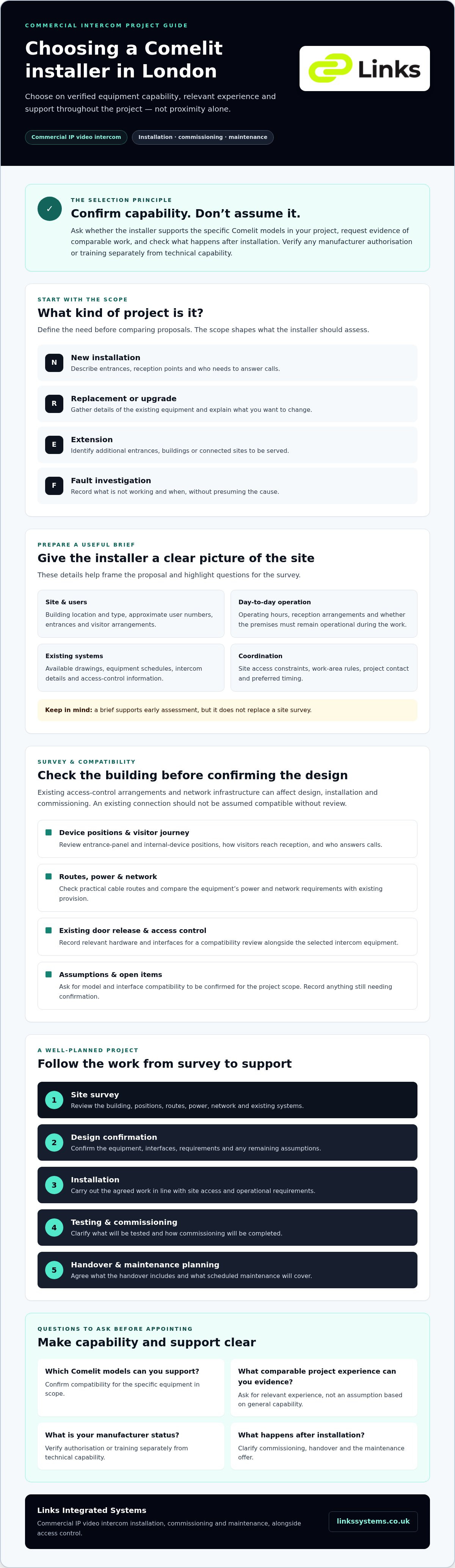
- Brief: Confirm the project objective, entrances, users, existing equipment and operational constraints.
- Survey: Review device positions, cable routes, power, network requirements and relevant interfaces on site.
- Design confirmation: Agree the equipment and system scope, document assumptions, and resolve compatibility questions before work begins.
- Installation: Complete the agreed work in line with site access arrangements and coordination requirements.
- Testing: Check devices and agreed functions, including audio, video, door release and relevant system interfaces.
- Handover: Record commissioning results, provide operating information and identify any outstanding work.
Preparing the building and coordinating access
Before installation, name the site contact and agree permitted working hours, induction requirements, access arrangements and any areas that need an escort or approval. In a multi-tenant building, work may need to be coordinated around reception activity, deliveries or staff schedules. Decide who will tell building users about planned interruptions or changes, and how updates will be shared if arrangements need to change.
Confirm whether the premises must remain operational throughout the work and identify activities that could affect entry or visitor handling. Clear coordination helps the project team plan responsibly, but site-specific arrangements still need to be confirmed with the building operator.
Testing, handover and ongoing system care
Agree acceptance checks before work starts, including who performs them and who records the results. At handover, designated staff should receive relevant operating information and know whom to contact for support. Confirm how defects or incomplete items will be documented, assigned and followed up.
For video systems, establish which organisation is responsible for relevant privacy and data-protection decisions, then check current guidance from the Information Commissioner’s Office (ICO). Don’t assume those responsibilities are covered simply because equipment has been installed. Separately, agree scheduled maintenance expectations and how future changes to equipment, entrances or interfaces will be assessed.
Links Integrated Systems provides commercial commissioning and scheduled system maintenance alongside IP video intercom installation. To discuss project coordination, commissioning or ongoing system care, contact Links Integrated Systems about your project. Confirm Comelit model compatibility and any manufacturer status as part of that discussion.
Discuss a Commercial Comelit Installation with Links Integrated Systems
Links Integrated Systems works with commercial and professional environments on IP video intercom systems, access control, IP HD CCTV, commissioning and scheduled system maintenance. Where a project requires it, intercom planning can be considered alongside access-control requirements, so the proposed scope reflects the building’s existing arrangements as well as its intended use.
Establish Comelit support specifically for your enquiry. Links’ Comelit model compatibility, product experience and manufacturer status aren’t confirmed as standard claims. Ask whether the equipment you’re considering can be supported, what relevant project experience can be evidenced, and whether any manufacturer authorisation or training applies. These checks help define the technical next steps before a system is specified.
Where Links may support the wider project
An intercom installation may form part of a broader commercial security project, particularly where entrance communication needs to align with existing access control. The systems and interfaces involved must be assessed against the actual equipment and site conditions. Links’ confirmed services include commissioning and scheduled maintenance, so these requirements can be discussed alongside installation rather than left until handover.
Links serves London and surrounding counties, including Kent, Surrey, Hertfordshire and Essex. Local coverage alone doesn’t establish suitability for a particular Comelit project, so confirm model support and relevant experience directly.
What to provide when requesting a project discussion
A concise enquiry gives the project team a useful starting point. Include the property type and location, the number of entrances, the outcome you need and any known constraints on site access or timing. Add available drawings and details of existing intercom, access-control or other relevant equipment.
- Site: building type, location and number of entrances.
- Existing systems: equipment details and known interface requirements.
- Project scope: new installation, replacement, extension or another requirement.
- Planning information: drawings, access constraints and desired timescale.
With this information, you can establish whether the project aligns with Links’ commercial IP video intercom and related system capabilities, then clarify the survey, compatibility checks and commissioning scope. For a measured discussion of your requirements, discuss your commercial security project with Links Integrated Systems.
Take the Next Step with a Clear Project Scope
Choosing a Comelit installer London means looking beyond the equipment list. Define whether the work is a new installation, replacement, extension or fault investigation, then assess the proposed partner’s relevant commercial experience, confirmed product capability and approach to commissioning. A site survey should clarify how existing equipment, access arrangements and network requirements affect the plan.
Before appointing anyone, get the scope, responsibilities, testing, handover and maintenance arrangements in writing. Confirm Comelit model compatibility and any manufacturer authorisation directly. These checks help you compare proposals on evidence and understand what will happen from initial survey through to ongoing system care.
Links Integrated Systems provides commercial IP video intercom installation, commissioning and scheduled maintenance, serving London and surrounding counties. Comelit-specific support and manufacturer status must be confirmed for each enquiry. Share your site details, existing equipment and project aims to establish the appropriate technical checks.
Discuss your commercial security project with Links Integrated Systems and take the next step towards a well-defined installation plan.
Frequently Asked Questions
Does a Comelit system need to be installed by an approved installer?
Not necessarily. Whether approval is required can depend on the equipment and applicable manufacturer or warranty terms. Check the requirements for the specific Comelit system with the manufacturer or supplier before appointing an installer. Ask separately for evidence of manufacturer authorisation, relevant product training and practical experience. These are distinct from general technical competence. Links Integrated Systems’ Comelit authorisation and model-specific experience aren’t confirmed, so verify them directly.
Can a Comelit intercom be installed in an existing London building?
An existing commercial building may be suitable, subject to a site survey and equipment compatibility checks. The installer should assess entrance locations, practical cable routes, power and network provision, and any existing door-release or access-control equipment. Older buildings may have constraints that affect the design or installation plan. Links Integrated Systems serves commercial clients in London and surrounding counties, including Kent, Surrey, Hertfordshire and Essex.
How much does a Comelit installation cost in London?
There isn’t enough information to give a reliable price without knowing the project scope. Costs depend on the selected equipment, number of entrances, site conditions, cabling requirements and any interfaces with existing systems. Request a written, itemised proposal based on a survey, with assumptions and exclusions made clear. This helps you compare like-for-like scopes rather than relying on a general estimate that may not reflect your building.
What should a commercial Comelit intercom installation include?
A commercial installation should cover the agreed system scope, site survey, device positions, cabling and infrastructure requirements, installation, testing and handover. Confirm that the proposal specifies checks for relevant audio and video functions, door release and agreed interfaces. Ask what operating guidance and documentation will be provided, who will record commissioning results, and what maintenance arrangements are included. Confirm that the installer supports the specific Comelit equipment proposed.
Can a Comelit video intercom integrate with an existing access-control system?
It may be possible, but compatibility depends on the specific Comelit equipment, access-control system and interfaces at the site. Ask the installer to review the existing hardware and system specifications, then confirm the intended functions in writing before work begins. For example, clarify whether the intercom is expected to operate an existing door release and how that function will be tested. Don’t assume systems will integrate simply because both are IP-based.
How long does a commercial Comelit installation take?
The duration depends on the verified scope and site conditions, so a reliable timescale should follow a survey and design confirmation. A project involving several entrances, existing equipment or restricted access may need different coordination from a straightforward installation. Ask for the proposed sequence, dependencies and any expected interruptions in writing. Building access, staff or tenant schedules, and site rules can all affect planning and the installation programme.