
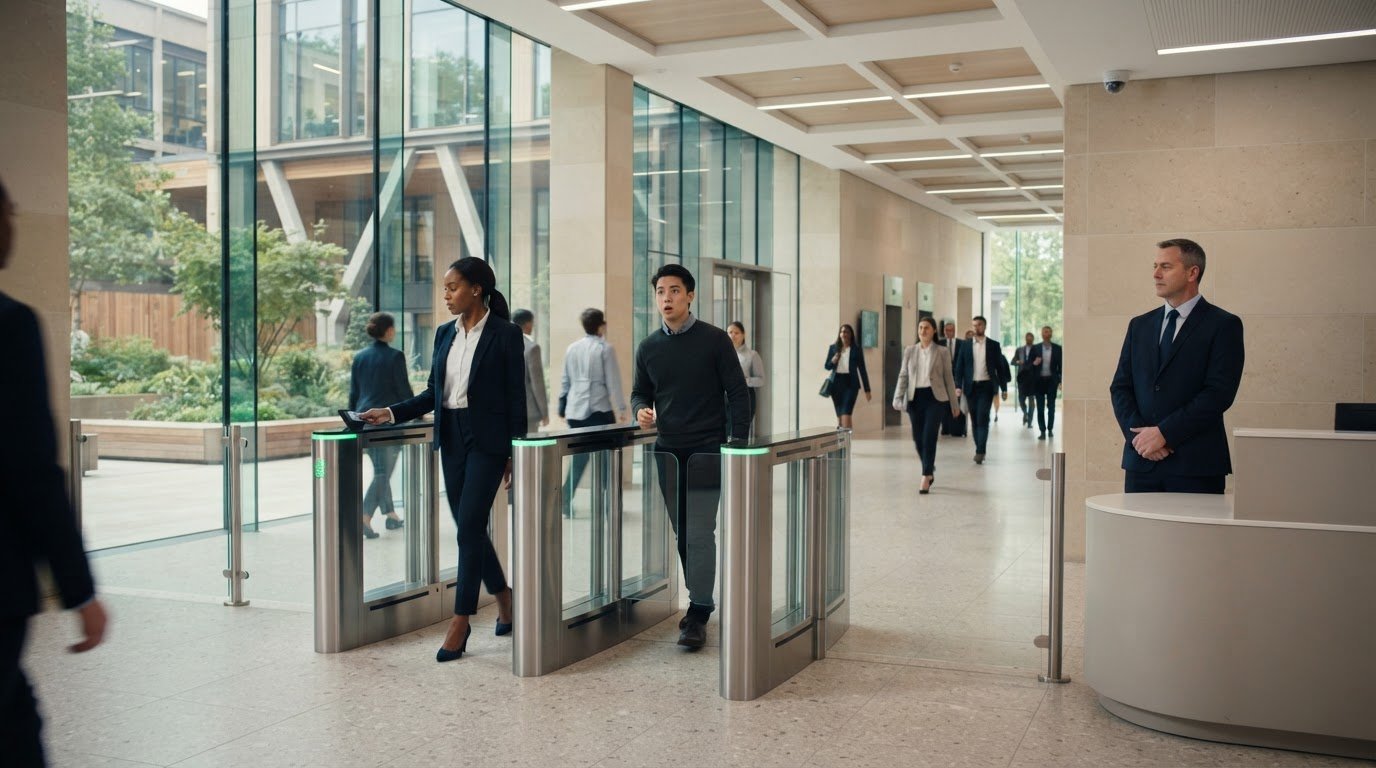
A secure door can still let in someone who isn’t authorised. Tailgating, sometimes called piggybacking, happens when an unauthorised person follows an authorised person through a controlled entrance. Preventing tailgating in office buildings in Hertfordshire means combining effective entry controls with alert staff and clear procedures.
It’s easy to overlook this risk: staff may hold a door for someone they assume belongs there, while contractors may leave an entrance open during work. These everyday actions can undermine otherwise well-managed access arrangements, particularly in buildings shared by different organisations.
This article explains how to identify entrances vulnerable to tailgating and how door controls, trained personnel and electronic systems can work together to reduce the risk. It compares the roles of speed gates, turnstiles, CCTV and access control, helping you assess which measures may suit your building and how to respond if someone unauthorised gets through.
Key Takeaways
- Identify entrances where doors are held open, fail to close properly or are shared by staff, visitors and contractors.
- Pair clear entry procedures and attentive personnel with electronic access controls, rather than relying on a single measure.
- Choose controls to suit the site: turnstiles, speed gates and security portals manage pedestrian access in different ways.
- Use CCTV and access records to support incident awareness and help staff respond consistently to suspicious entry.
- Match the system to the building’s layout, footfall and security priorities before deciding what changes to make.
Door closure and access-control measures
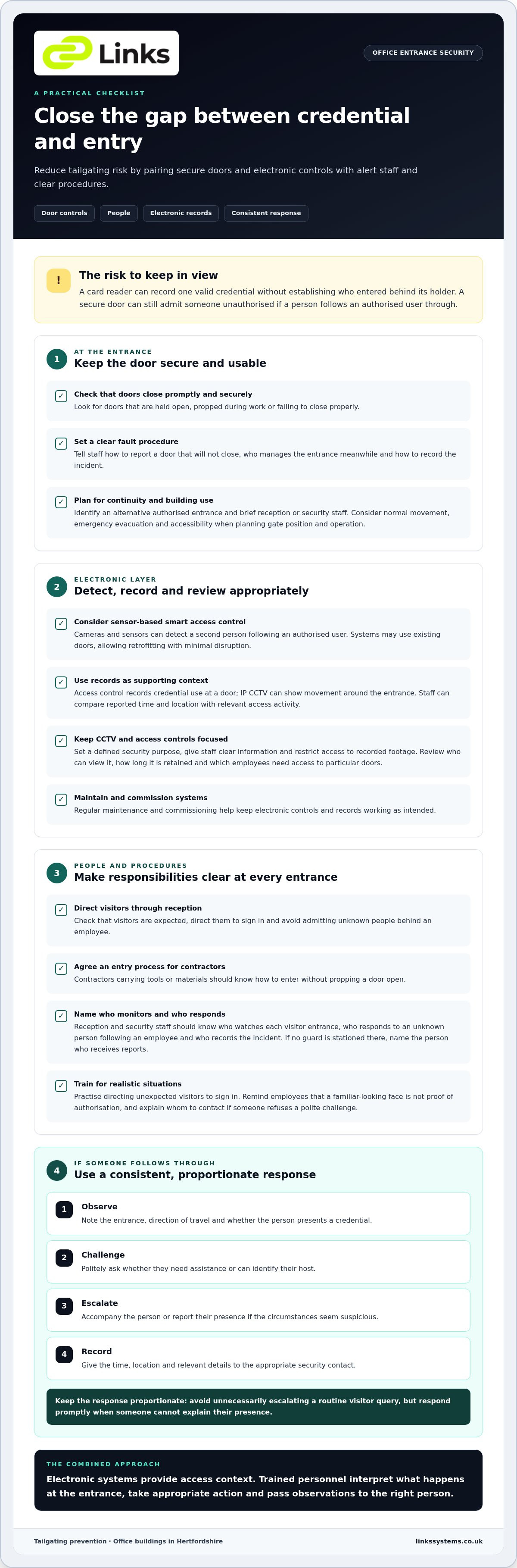
Tailgating can happen when a door is held open, propped during work or fails to close. Effective controls combine reliable door closure, clear staff procedures and access permissions suited to each entrance.
Sensor-based smart access control
Sensor-based smart access control uses cameras and sensors to detect a second person following an authorised user through an entrance. Modern solutions, such as those highlighted on digital-vision.ai, utilise AI-powered surveillance and access monitoring to help identify multiple entrants in real time. It matters where a card reader alone records one valid credential but cannot establish who entered behind its holder. Systems can use existing doors, which may allow retrofitting with minimal disruption. Staff should still report doors that fail to shut and avoid holding controlled entrances open for others.
Workplace CCTV and access control requirements
For UK workplaces, CCTV and access controls should have a defined security purpose, clear information for staff and restricted access to recorded footage. Review who can view footage, how long it is retained and which employees need access to particular doors. These measures help keep monitoring focused on office security and avoid collecting unnecessary information.
Access procedures also depend on people. Train employees to direct visitors to reception, check that visitors are expected and avoid admitting unknown people behind them. Contractors carrying tools or materials should follow an agreed entry process rather than prop a door open. Staff should report suspicious individuals to on-site security or the appropriate personnel, and follow a clear procedure if someone enters without authorisation.
Balancing prevention with evacuation and continuity
Security gates and access controls need to work alongside emergency evacuation and the building’s day-to-day use. According to Hertfordshire Building Control, Building Regulations cover fire safety and accessibility, among other areas. Discuss the gate’s position and operation with those responsible for the building work, so entry controls do not undermine these design considerations. Plan how staff and visitors will move through the building during normal operations.
A door should close promptly and securely, but faults need a defined response. Tell staff how to report a door that will not close, who should manage the entrance meanwhile and how to record the incident. For business continuity, identify an alternative authorised entrance and brief reception or security personnel on the procedure. Training should also cover what to do if an access-control system or door is unavailable.
Building-control support is separate from planning enforcement. Hertfordshire Building Control checks building plans and carries out site inspections to help demonstrate compliance with Building Regulations. East Herts District Council may take planning enforcement action if development proceeds without permission, approved plans or required conditions are not followed. These processes concern building work and planning; they do not replace an assessment of everyday tailgating risks at office entrances.
Combining security personnel with electronic systems
Electronic controls record access, while trained personnel interpret what happens at the entrance. In an office reception, a card event may show one authorised credential, but a guard can notice someone following the cardholder through. Together, these measures help staff identify unusual entry, assess it and follow the building’s reporting procedure.
Give reception teams and security staff clear responsibilities for each controlled entrance. They should know who monitors the visitor entrance, who responds when an unknown person follows an employee and who records the incident. If no guard is stationed there, name the appropriate person to receive reports. A defined handover helps ensure observations reach the right person, from reception to building management.
Electronic systems can provide useful context. Access control records credential use at a door, while IP CCTV can show movement around the entrance. Staff can compare the time and location of a reported event with relevant access activity, then pass the details to the person responsible for security. The systems support an investigation; personnel decide what action to take.
Use a consistent response when someone appears to follow through a controlled access point:
- Observe: note the entrance, direction of travel and whether the person presents a credential.
- Challenge: politely ask whether they need assistance or can identify their host.
- Escalate: accompany the person or report their presence if the circumstances seem suspicious.
- Record: give the time, location and relevant details to the appropriate security contact.
Training should cover realistic situations, not just remind people to keep doors secure. Receptionists can practise directing unexpected visitors to the sign-in point, while employees learn not to treat a familiar-looking face as proof of authorisation. Contractors should understand how to enter without leaving access points unsecured. Briefings can also explain whom to contact if someone refuses a polite challenge.
Keep the response proportionate. Personnel should avoid unnecessarily escalating a routine visitor query, while responding promptly when someone cannot explain their presence. Building management can review reported incidents alongside access records and CCTV, then adjust staff briefings or entry procedures if patterns emerge. Regular system maintenance and commissioning help keep electronic records and controls working as intended.
For offices reviewing how staff procedures connect with electronic entry controls, access control systems can form part of a coordinated approach alongside IP CCTV and trained personnel.
Initial assessment and investigation priorities
Start by mapping how people actually enter the building, not just how the access plan says they should. In a Hertfordshire office with multiple tenants, employees, visitors and contractors may use different entrances, reception points and shared corridors. Record each route, who uses it and where one person could follow another. This gives you a practical picture of potential exposure before changing any controls.
Walk the site during typical arrival and departure periods. Note whether staff queue at a reader, whether reception can see the entrance and whether deliveries create situations where doors are left open. For example, contractors moving equipment through a loading entrance may need a managed route that keeps the door secure. Check side doors and shared access points as well as the main reception entrance.
Prioritise locations by considering access, visibility and potential consequences. A door leading directly to a sensitive office or records area deserves closer attention than an entrance into a staffed reception space. In a multi-tenant building, establish which organisation controls each door and receives incident reports. Shared responsibility can leave a gap: a tenant may assume the building manager monitors an entrance, while the manager expects tenants to supervise their visitors.
For each location, assess the following:
- Access pattern: identify staff, visitor and contractor routes, including delivery entrances.
- Physical condition: note doors that close slowly, fail to latch or are routinely held open.
- Observation: check whether reception, security staff or CCTV can see the approach and doorway.
- Impact: consider what areas become accessible if an unauthorised person passes through.
- Ownership: name the person or organisation responsible for the entrance and incident response.
Establish what happened before choosing a remedy. If someone reports a person entering behind an employee, record the entrance, direction of travel, approximate time and any witness account. The building manager can compare the description with access-control activity and relevant CCTV footage. This helps distinguish an expected visitor using the wrong route from an access incident that needs further investigation.
Look for recurring circumstances rather than treating every report in isolation. Several observations at a shared lobby may point to unclear visitor arrangements, while reports at a service entrance may show that contractor procedures need review. Keep incident records consistent and limited to relevant details, then use the findings to adjust staff instructions or entrance controls. Reviewing reported locations can help building managers focus on the routes most exposed to risk.
Reassess after a significant change, such as a tenant moving floors, reception being relocated or a new contractor route being introduced. These changes can affect who approaches a door and who can see it. For Hertfordshire offices with shared access, involving the relevant tenants and building manager in the same review helps clarify responsibilities and investigation priorities.
Biometrics, photo-sensors and turnstiles
Different entry controls address different risks, including identity checks, one-person passage and tailgating detection. The right choice depends on the entrance, pedestrian flow and level of control required.
Biometrics and photo-sensors
Biometric access checks a person’s identity using a physical characteristic, while photo-sensors detect movement or presence around an entrance. These measures can help where a card alone cannot show whether its authorised holder entered alone. Used alongside smart cards and CCTV, they can provide additional identity or passage information for staff reviewing an access event. Choose measures to suit the entrance’s purpose and the response staff can provide.
Biometrics can link entry to an individual rather than relying only on a credential that someone else could present. Photo-sensors can help detect movement through a controlled point. In either case, consider how the system fits the entrance layout and normal pedestrian flow. A busy reception needs a workable visitor route, while a restricted internal area may require tighter identity checks.
Turnstile, speed gate and mantrap comparisons
Turnstiles control pedestrian passage, speed gates manage lane entry and can detect certain tailgating events, while security portals can ensure a user is alone. These systems serve different purposes, so the right choice depends on the site’s access-control needs. They are often used at site perimeters alongside CCTV.
Speed gates suit locations where people need to move through controlled lanes. Security revolving doors and portals offer a higher level of anti-tailgating detection by controlling entry so the user is alone. These options are not interchangeable. Compare the security objective, available space, pedestrian flow and need for staff involvement before choosing a control. A perimeter entrance may need a different arrangement from an office lobby.
Detecting and responding to tailgating
Office access systems can detect tailgating by combining credential checks with sensors or cameras that monitor passage. Speed gates can identify someone without a valid ID card entering a lane behind an authorised user, then sound an alarm and close the gate. This can help staff distinguish a potential unauthorised entry from ordinary credential use and focus on the relevant access point.
Every detection event needs a defined response. Staff should know where an alert appears, who assesses it and how to report a person who has already entered. CCTV can help personnel review the entrance, while access records show the related credential activity. Treat an alert as a prompt to assess the situation, not as proof of identity or intent.
Match the response to the device. A full-height turnstile can restrict passage to one pedestrian at a time, but staff still need another way to identify tailgating. A speed gate’s alarm and closure provide a direct response to detected passage. A portal designed to ensure the user is alone offers a different level of control. Regular commissioning and maintenance help keep equipment and responses aligned with building procedures.
How do anti-tailgating turnstiles, speed gates and mantrap doors compare?
These entrance controls differ in how they manage pedestrian movement and identify unauthorised passage. For a Hertfordshire office, compare the required level of control, available space and expected pedestrian flow before choosing a system.
Full-height turnstiles restrict pedestrian passage through a controlled point, generally allowing one person through at a time. They can provide access without staffed security and are often used at site perimeters alongside CCTV. However, a full-height turnstile does not detect tailgating. It physically controls passage, but should not be treated as a system that identifies or alerts staff to every unauthorised following attempt.
Speed gates use lanes to manage pedestrian flow and can detect tailgating. If a person without a valid ID card enters behind an authorised user, the gate can raise an alarm and close. This makes speed gates relevant to busy office entrances where controlling movement and identifying a possible second entrant are both priorities. Their operation depends on users presenting valid credentials and following the lane’s entry process.
Mantrap doors and security portals control access by ensuring the user is alone before entry proceeds. Security revolving doors and portals can provide a high level of anti-tailgating detection. This differs from an open lane or turnstile, because the entrance itself checks for individual passage. Such controls may suit areas with stricter access requirements, but the arrangement must fit the building layout and normal visitor movement.
Use the intended outcome to compare options:
- Control pedestrian passage: consider a full-height turnstile, while recognising that it does not detect tailgating.
- Manage busy lanes and detect following: consider speed gates that can alarm and close when an unauthorised person follows.
- Check that each entrant is alone: consider a security portal or revolving door designed for individual passage.
Assess the entrance’s location, too. A perimeter point may need a different arrangement from a reception lobby serving staff, visitors and several tenants. Consider how people approach the control, whether reception or security personnel can respond to an alarm and how the system fits established entry procedures. These factors help determine whether the priority is controlled passage, detection or both.
For a project assessing pedestrian flow and entry control, review speed gate options as part of the site’s security planning.
Links Integrated Systems: Speed Gates & Barriers
Links Integrated Systems can help turn an office’s tailgating assessment into a practical entry system. Its Speed Gates & Barriers and Access Control Systems can support controlled pedestrian movement, while IP HD CCTV and IP Video Intercom Systems can contribute to entry monitoring and visitor communication. The right combination depends on the building’s entrances, layout, pedestrian flow and security priorities.
For a Hertfordshire office planning a new entrance or reviewing existing controls, Links Integrated Systems can supply and install systems suited to the site. Discuss your entry requirements and the controls you’re considering with Links Integrated Systems.
Make your next security review practical
A practical plan for preventing tailgating in Hertfordshire office buildings starts with deciding which entrance to review first and who is responsible. Assigning responsibility gives building managers and tenants a clear route from observations to action. Revisit the decision when occupancy, visitor arrangements or building use changes, so entry controls stay aligned with how the premises operate.
If a review points to changes in pedestrian entry, Links Integrated Systems can help assess options including Speed Gates & Barriers, Access Control Systems and IP Video Intercom Systems. The right combination depends on the building’s access points and security priorities. Discussing your requirements can help shape a considered system plan.
Contact Links Integrated Systems to discuss your office entry requirements. Taking a clear, planned approach is a constructive step towards better-managed access.
Frequently Asked Questions
So, what are ‘Tailgating’ and ‘piggybacking’ in the physical environment?
Tailgating is when an unauthorised person follows someone with permission through a controlled entrance. “Piggybacking” is often used to describe the same physical security breach. For example, an employee uses a credential to enter, and another person follows without presenting their own. The key question for office staff is whether each person entering has individual authorisation, whatever term the site uses.
What are the risks?
An unauthorised person inside an office may reach areas beyond reception, including staff workspaces, internal networks or rooms holding confidential data. Because physical breaches can quickly translate into digital compromise, companies frequently pair on-site access controls with broader cyber protections from providers such as ManagePoint to safeguard sensitive business systems. Tailgating can contribute to financial loss and reputational damage. It can also make it harder to account for who is on site during an incident. In a shared Hertfordshire building, unclear tenant responsibilities may delay reporting or leave an access concern without a clear owner.
What can you do to prevent tailgating?
Make expected behaviour clear to employees, visitors and contractors. Tell staff, for example, to direct an unregistered visitor to reception rather than let them follow through a secure entrance. Provide a simple way to report suspicious entry, such as a named building contact or reception point. Review reports for recurring locations or circumstances, then update instructions if staff are unsure how to respond.
What solutions prevent this security breach?
Choose a combination suited to the entrance rather than expecting one device to address every risk. A credential-controlled door governs permission; CCTV can help personnel review activity; and speed gates can detect and respond to certain following events. A staffed reception can help manage visitors and investigate alerts. Consider how each measure works with the others, including who receives an alert and what they do next.
What is tailgating in office building access control?
In office access control, tailgating occurs when someone enters a restricted area behind an authorised user without passing the access check themselves. For instance, a valid card opens a door, but a second person enters before it closes. The credential record may show the authorised user’s access, so building procedures should also cover how staff notice, report and assess possible additional entry.
What are the most effective ways to prevent tailgating at office entrances?
Effective prevention means matching controls to the entrance and supporting them with consistent staff behaviour. A busy lobby may need controlled lanes and a clear visitor route, while a restricted internal doorway may require tighter access permissions. Make sure employees know how to respond to someone without a visible credential. Review incidents and adjust entrance procedures if the same issue recurs.
How should a Hertfordshire office assess tailgating risks and choose suitable measures?
To prevent tailgating in office buildings in Hertfordshire, start by mapping staff, visitor and contractor routes, including shared entrances. Note where people queue, where reception has limited visibility and which doors lead to sensitive areas. Then identify who manages each access point and handles reports. Compare those findings with the required level of control, pedestrian flow and available space before choosing measures.