
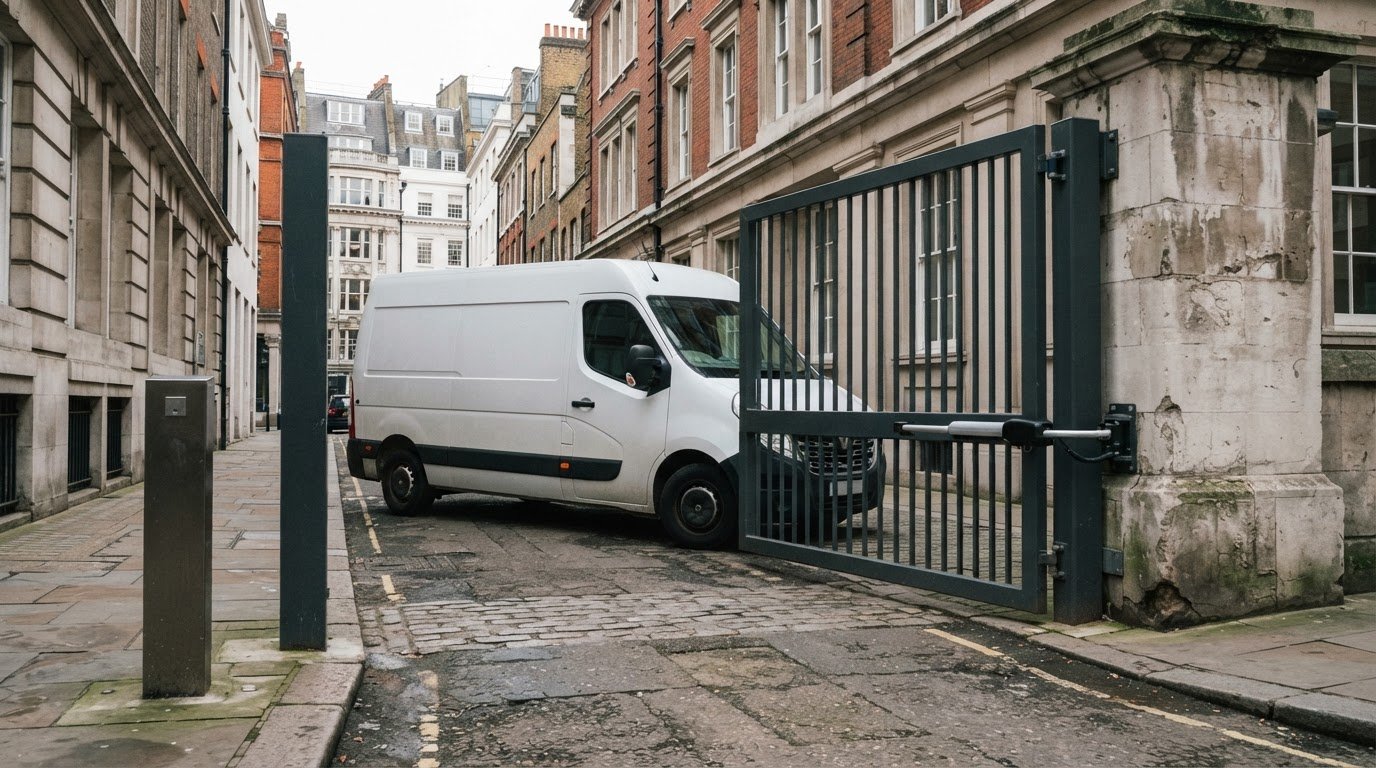
London’s bridge barriers have made one point clear: protective measures must work alongside the movement of people and vehicles. For security barrier installation in the City of London, a straightforward single-arm barrier or swing gate fitted to existing posts usually takes a day or two on site. The entrance layout, traffic movements and barrier type all shape the installation.
Choosing a barrier is only part of the decision. The system must also suit the way the building operates, with commissioning and maintenance considered from the outset. This guide explains how barrier types and site conditions shape security barrier installation in the City of London, what happens during installation and commissioning, and how ongoing maintenance supports reliable operation.
Key Takeaways
- Understand how entrance geometry, vehicle movements and site operations shape the choice and positioning of an automated barrier.
- See why installation planning should account for system testing and ongoing maintenance, not just the physical fit.
- Compare the roles of rising arm barriers, gates, bollards and road blockers when assessing different access points.
- Learn how access control, intercom and CCTV systems can support a coordinated approach to building security.
Building barriers – a new normal for London?
Barriers are one way to manage vehicle access, not a standard solution for every entrance. London Bridge installations show how security measures can be planned around busy routes and pedestrian movement.
Automated Barrier Installation
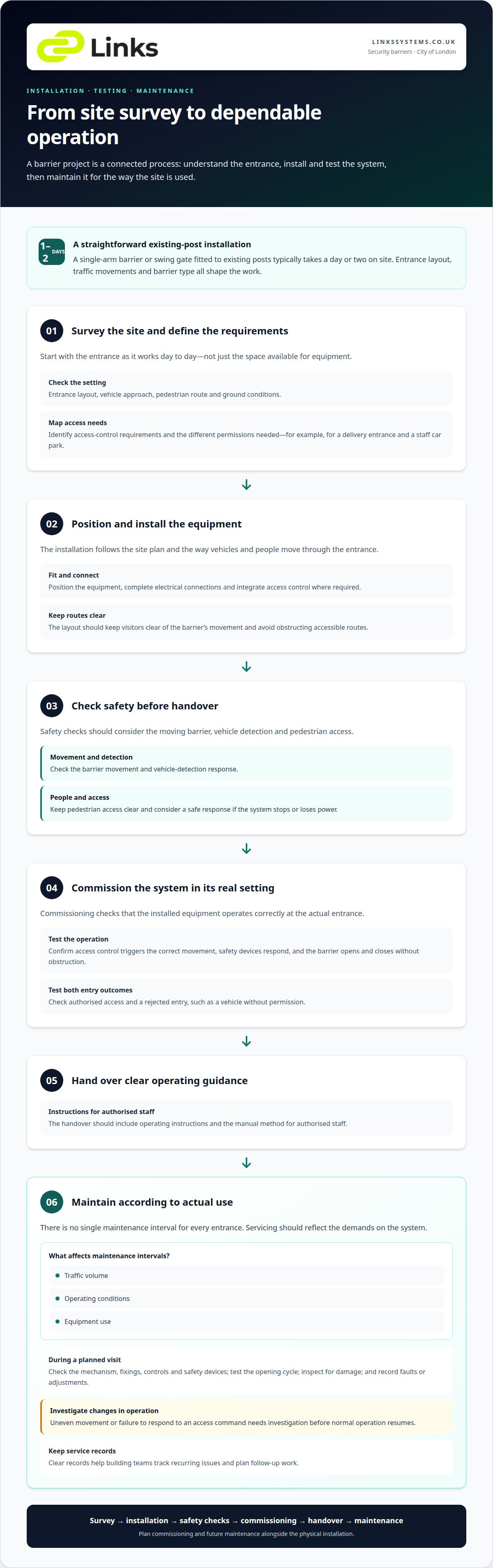
For City of London sites, automated barrier installation starts with the entrance layout, vehicle movements and access-control requirements. An automated gate may suit an entrance where a rising arm would obstruct the route, while manual operation can provide an alternative. An existing-post installation for a single arm barrier or swing gate typically takes a day or two on site. Planning should also cover commissioning and future maintenance.
Planning and Corporation Approval
Planning permission and building regulations depend on the site and proposed works, so there is no single approval route for every private entrance. Barriers on streets or public land involve the relevant landowner or road authority; City of London Corporation approval applies where it controls the affected land or route. Automated gate design should account for the Supply of Machinery (Safety) Regulations. CPNI guidance covers protecting crowded public places.
Installation Prices and Lead Times
Installation costs and lead times depend on the barrier type, entrance dimensions, ground conditions, power supply and access-control requirements. Using existing posts can make a straightforward installation simpler than a project requiring new foundations or changes to vehicle circulation. An existing-post installation for a single arm barrier or swing gate typically takes a day or two on site. The overall programme also depends on site access and coordination with other works.
City of London Installers
Commercial security-system installers carry out this work, including the design and installation of automated barriers and access control. For security barrier installation in the City of London, look for expertise in coordinating the barrier with the entrance, pedestrian route and vehicle approach. The project scope should cover commissioning and servicing as well as installation, so the system is considered throughout its lifecycle. For public land, the approval route depends on who controls the site.
Installation, testing and maintenance
Installation starts with a site survey covering the entrance, vehicle approach, pedestrian route and ground conditions. The installer then positions the equipment, completes electrical connections and integrates the barrier with access control where required. For example, a delivery entrance may need different access permissions from a staff car park. These details shape commissioning and future maintenance.
Safety checks should cover the moving barrier, vehicle detection and pedestrian access. The layout must keep visitors clear of the barrier’s movement and avoid obstructing accessible routes. The design should also account for a safe response if the system stops or loses power.
Commissioning and maintenance
Commissioning tests the installed system in its actual setting. The installer checks that access control triggers the correct movement, safety devices respond, and the barrier opens and closes without obstruction. Tests should cover both authorised access and a rejected entry, such as a vehicle without permission. The handover should include operating instructions and the manual method for authorised staff.
Ongoing maintenance
Maintenance intervals depend on traffic volume, operating conditions and equipment use. A busy commercial entrance may experience more movement than a staff-only access point, so servicing should reflect the demands on the system. Planned visits can check the mechanism, fixings, controls and safety devices before wear affects normal operation.
During each visit, a technician can test the opening cycle, inspect for damage and record faults or adjustments. For example, a gate that moves unevenly or fails to respond to an access command needs investigation before normal operation resumes. Clear service records help building teams track recurring issues and plan follow-up work.
Protective barriers were installed at Westminster Bridge from the night of 4 June. This illustrates how barrier work can form part of site planning, while maintenance still needs to reflect the equipment and its setting. Building teams can keep the visit record alongside commissioning notes and details of faults or adjustments. Reviewing those records helps identify recurring issues and plan follow-up work, while avoiding assumptions that every gate or location has identical servicing needs.
Security gates, rising arm barriers, bollards and road blockers
The barrier type should match the entrance’s security needs and daily traffic. A rising arm barrier controls vehicle entry at a car park or service entrance, while a gate can secure a wider opening. Bollards and road blockers provide other forms of protection. The right arrangement depends on the site layout and how vehicles and pedestrians use the approach.
Fixed bollards can define a boundary where routine vehicle access is not required. At a building frontage, they can separate pedestrian space from vehicle routes while keeping designated access points clear. Removable or retractable designs allow authorised access where occasional vehicle entry is needed, and specialist UK suppliers such as bollardsecure.co.uk offer a variety of security bollards and parking posts to suit these configurations. Positioning matters: bollards must protect the intended area without narrowing pedestrian routes or obstructing building access.
Rising bollards provide controlled vehicle access at an entrance where a continuous arm would not suit the layout. Road blockers are designed for vehicle stopping duties and require careful consideration of the approach, foundations and operating arrangements. PAS 68-compliant road blockers can stop a fully loaded 7,500kg lorry travelling at up to 50mph. That performance relates to the specified road blocker, not to every barrier or bollard.
London Bridge, Westminster Bridge, Lambeth Bridge and Waterloo Bridge had barriers designed specifically for hostile vehicle mitigation. These examples illustrate why a public-facing site may need a different solution from a staff car park. A rising arm manages routine entry, bollards establish a physical boundary, and a road blocker addresses a more demanding vehicle threat. Each option also needs a clear plan for authorised access and pedestrian movement.
For a commercial entrance, the assessment should consider vehicle types, traffic frequency, available space and the required level of protection. A narrow opening with frequent deliveries may call for a different layout from a broad perimeter with limited vehicle access. The barrier should fit the site’s operating pattern rather than forcing car parks, pedestrians and deliveries into conflicting routes.
Concrete and steel barriers were placed on several bridges in central London to separate vehicles from pedestrians after a terrorist incident. Their placement created physical separation between vehicle routes and pedestrian space at those crossings.
How professionals choose a security barrier to suit entrance layout and traffic
A professional assessment starts with the entrance’s purpose and daily traffic. A staff entrance with scheduled vehicle arrivals has different needs from a loading bay serving regular deliveries. The installer maps vehicle paths, pedestrian routes and waiting areas, then identifies where a barrier can control entry without disrupting normal movement. This helps match the equipment to the site’s actual use.
Available space shapes the design. At a narrow entrance, a rising arm may leave less room for vehicles to turn than a gate positioned along the boundary. A wide opening may need a different arrangement to manage the full vehicle route. The assessment also considers the surface, ground, nearby walls, drainage and existing access points. These details inform equipment positioning and installation requirements.
Traffic patterns help determine how the system should operate. The installer considers who needs access, how permissions are issued and how visitors are handled. For example, an office entrance may need staff credentials and a clear process for guests. Intercoms can let reception speak with visitors before granting access, while delivery entrances may need a separate operating procedure.
Professionals also consider how the barrier fits the wider security arrangement. Access control can govern authorised entry, while the barrier provides the physical point of control. The operating plan should account for permitted vehicles, pedestrian movement and delivery procedures. For security barrier installation in the City of London, these decisions help align the entrance design with the building’s daily operations.
Share a site plan, entrance photographs and an outline of vehicle movements to support an informed assessment. Arrange a barrier installation assessment to discuss the entrance layout and operating requirements.
Links Integrated Systems: Speed Gates & Barriers
Links Integrated Systems can turn an entrance assessment into a coordinated barrier and access-control installation. Its Speed Gates & Barriers and Access Control Systems support controlled vehicle entry, while IP Video Intercom Systems help staff manage visitor access. IP HD CCTV Systems can complement the wider site security arrangement.
Turn to Links Integrated Systems when a City of London building needs barrier equipment selected to suit its entrance layout, traffic and operating requirements. Installation can be coordinated with commissioning and ongoing system maintenance, keeping the project focused on how the system will operate after fitting as well as on the equipment itself.
Contact Links Integrated Systems to discuss your building’s entrance and security requirements.
Plan the next stage of your entrance project
Set the project up for a clear decision by aligning security objectives with the building’s operating needs. For security barrier installation in the City of London, start by defining how vehicle access, visitor handling and day-to-day building operations should work together. This shared brief gives the installation design a practical foundation.
Links Integrated Systems supplies and installs Speed Gates & Barriers, Access Control Systems and IP Video Intercom Systems. These can form part of a coordinated approach to managing vehicle and visitor access, with commissioning and maintenance included in the wider project lifecycle.
Discuss your requirements and planned entrance arrangements with Contact Links Integrated Systems. A considered project brief can help move your building towards a suitable, well-integrated security arrangement.
Frequently Asked Questions
What types of security barriers are available for commercial and residential properties in the City of London?
Options include speed gates, automated gates, rising arm barriers, bollards and road blockers. A commercial office might use a controlled vehicle entrance, while a shared residential development could manage access to its communal car park. The choice depends on whether the priority is regulating vehicle entry, defining a boundary or protecting a particular approach. These are physical access measures, not residential burglar alarms.
How do bollards, rising arm barriers, gates and road blockers compare for security and access control?
Each type suits a different access pattern. Bollards can define a boundary, while rising arms manage routine vehicle entry where traffic follows a clear approach. Gates can secure an opening, and road blockers are designed to stop vehicles. For example, a building with scheduled deliveries may prioritise controlled entry, while a site requiring stronger vehicle protection may assess the role of a road blocker.
What is the process for surveying, installing and commissioning a security barrier?
The process moves from understanding the site’s needs to designing, supplying, installing and commissioning the system. A building representative can provide entrance plans, access requirements and details of how staff, visitors and deliveries use the site. The installer uses this information to shape the system, then commissions it for operation. Maintenance can support the system after handover.