
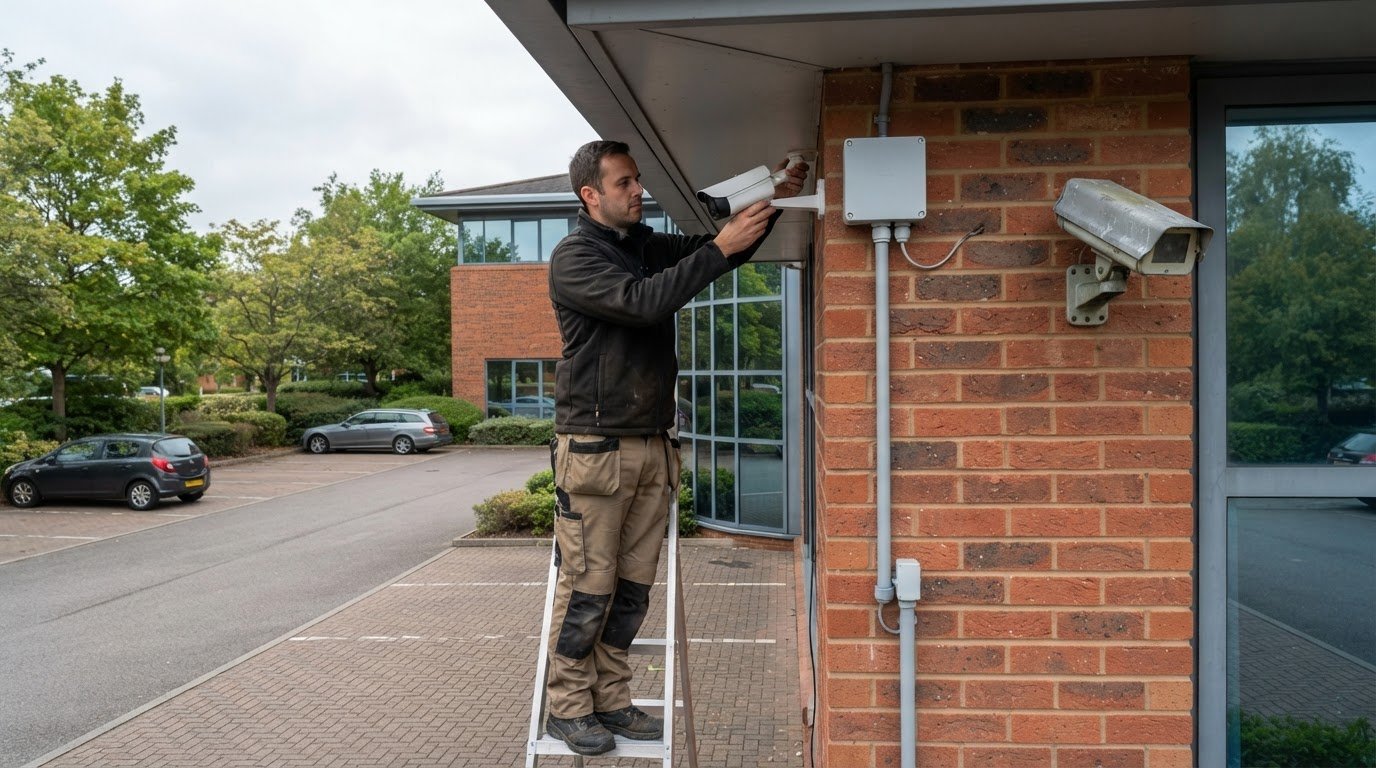
More cameras do not automatically mean better coverage. A CCTV system upgrade in Woking should focus on the areas that need clear, usable footage, rather than a standard camera count. The right number depends on the site layout, blind spots and the level of detail needed in each area.
If your existing system has faults or leaves parts of the site uncovered, first consider whether every component needs replacing. The key is identifying which equipment can still deliver the coverage you need and which parts are limiting the system.
This article explains how to assess camera numbers and coverage for drives, grounds and car parks, and what a professional checks when fault-finding or upgrading a system. It also explains how existing cameras and recording equipment might fit into an upgrade, helping you decide what work your site needs.
Key Takeaways
- Set camera positions around the areas that need clear footage, taking lighting and monitoring needs into account.
- Assess drives, grounds and car parks by identifying coverage gaps and the views each location requires.
- Fault-finding can help distinguish a camera problem from an issue with cabling, connectivity or recording equipment.
- Review existing cameras and system components before replacing them; suitable equipment may be reusable as part of an upgrade.
How professionals assess CCTV needs in Woking
A professional assessment starts with the areas to cover and the footage each camera needs to capture. Camera placement, lighting, monitoring arrangements and existing equipment all shape the upgrade plan.
Camera positioning and lighting needs
Planning maps each camera to a specific view, such as an entrance, vehicle access point or industrial loading area. Position and angle should capture useful detail while limiting blind spots and unwanted views. At night, nearby lighting and glare affect image quality, so placement needs to account for changing light conditions.
Planning permission depends on the site and proposed works. Installing cameras into a listed building’s fabric may require listed building consent. For homes recording beyond the property boundary, the Information Commissioner’s Office says data protection law applies and people must be informed with a sign. Businesses should usually respond to a recorded person’s request for footage within a month.
IP, analogue and wireless cameras
IP cameras send digital video over a network, while analogue cameras use a different recording connection. Existing cabling and recording equipment help determine which option suits the site. Wireless cameras can be easier to install and move; wired systems are generally more reliable and secure. Some systems can retain footage locally without a network connection, while remote viewing may depend on connectivity.
Viewing footage on a phone depends on network access and system configuration. During an assessment, a professional considers who needs to view footage, from where, and how the system records if connectivity is interrupted.
Upgrades and camera expansions
Adding cameras requires checks on recorder capacity, cabling routes, network connections and the views each camera will provide. A camera covering a newly identified entrance may address a specific gap. Adding cameras without reviewing these factors can leave the wider system unbalanced.
Outdated cameras or recorders can limit image detail, recording reliability and access to footage. Fault-finding helps distinguish equipment failure from a connection or recording issue, informing whether replacement or expansion is appropriate. A grant should not be assumed for a Woking business upgrade, as any scheme depends on its current eligibility and funding terms.
CCTV coverage for drives, grounds and car parks
Start with the movements the property needs to record. For a drive, the priority may be the entrance and vehicle approach; for grounds, it may be paths, gates and less visible edges. In a car park, views should help show vehicle routes, pedestrian access and areas where parked vehicles could obstruct sightlines. Plan for useful coverage, rather than simply adding cameras.
Local public systems offer context, not a template for a customer’s site. Woking Borough’s CCTV network comprised 380 cameras, most in council car parks. Knaphill had five CCTV cameras installed, while West Byfleet had 22 and Sheerwater had 13. These figures describe public installations; they don’t establish how many cameras a private property needs.
For properties around Woking, site location can help frame CCTV planning, but coverage should be assessed against the property’s layout. A professional assessment should relate each camera to the actual property, including its entrances, boundaries, driveways and shared access points. A home in Knaphill, for example, may need a different view from a commercial car park near Woking town centre.
Car parks need particular attention to changing vehicle positions. A parked van can block a previously clear view, while a camera aimed too widely may record activity without showing useful detail. Planning should consider turning areas, pedestrian routes and the views needed for later footage review. Monitoring arrangements matter too: staff need to know which views to use and how recorded footage supports their response to an incident, a standard practice emphasised by firms like Regal Security when coordinating physical protection with surveillance.
For a site-specific assessment, discuss CCTV coverage planning around the property’s layout and recording priorities.

CCTV upgrades, repairs and fault-finding
For offices and commercial sites in Woking, fault-finding starts by tracing the symptom through the system. A blank view may indicate a camera, connection or power issue; missing footage may involve recording or storage. The engineer identifies when the fault occurs, which cameras are affected and whether live viewing or playback is disrupted. This helps narrow down the repair before replacing equipment.
Repairs can address an isolated camera fault or a wider system problem. If an entrance view has failed, for example, the engineer checks the camera and connection, then tests the recorded footage. If several views fail together, attention shifts to shared connections or recording equipment. Planning work carefully can help limit disruption in occupied offices while access and testing take place.
Most CCTV installations in Woking are completed within a day, although larger or more complex systems may take longer. Upgrade time depends on the work involved, such as replacing equipment, resolving faults or adding cameras. Maintenance should include checking camera views, connections, recorder operation and playback to identify faults affecting recorded footage.
Servicing also gives the engineer an opportunity to review system operation with the customer. Useful checks include confirming that each expected view appears, recorded footage plays back, and remote viewing works where configured. At commercial premises in Surrey, a failed entrance view should be addressed before it becomes an unnoticed gap.
After repairs or changes, commissioning checks that the affected cameras and recording functions operate as intended. The engineer can explain which components were repaired or replaced and what the work changed. For a system covering multiple areas, recording and viewing checks should include the cameras affected by the upgrade. This provides a clear basis for ongoing maintenance and future fault reports.
Security system upgrades and reuse of existing equipment
An upgrade does not always mean replacing every camera. For a house or commercial site in Woking, an engineer first assesses the existing cameras, recorder, connections and required coverage. Reuse makes sense when equipment still provides usable footage and works with the planned system. A component that repeatedly fails or cannot support the required recording may need replacing.
Assessment considers each component as part of a working system. The engineer checks whether cameras show the required views, whether the recorder captures and plays back footage, and whether connections remain suitable. For example, a camera may provide a clear view, but its recorder may not support a planned expansion. Keeping the camera and replacing the recorder could then be considered.
Compatibility is central. Existing cabling, camera type and recording equipment affect which components can work together. A property with analogue cameras, for example, needs a plan before adding different camera technology. The engineer considers the installation and intended monitoring arrangements, then identifies what can remain and what must change. Maintenance history and recurring faults also help distinguish serviceable equipment from unreliable components.
The decision should follow the site’s security requirements. At a Woking town-centre business, a working camera with a useful entrance view may be worth retaining, while a failed recorder could undermine footage from several cameras. Replacing only the limiting component can avoid unnecessary changes, but keeping equipment that cannot deliver the required views or recording creates a weak point.
A practical upgrade plan sets out the equipment to retain, repair or replace, and how the completed system will be tested. This gives the site a clear record of changes and supports future maintenance. To plan an upgrade around existing equipment, request a CCTV system assessment.
Links Integrated Systems: IP HD CCTV Systems
Links Integrated Systems can assess CCTV upgrades where existing cameras leave coverage gaps, faults disrupt recording or the system needs to expand. Its IP HD CCTV Systems support commercial and professional security requirements, while System Maintenance & Commissioning helps maintain system reliability and check operation.
Where CCTV forms part of a wider site security plan, Access Control Systems can manage controlled entry alongside camera coverage. The right scope depends on the site layout, equipment and monitoring needs, including which existing components can remain in use.
Contact Links Integrated Systems to discuss your CCTV upgrade requirements in Woking.
Plan the next stage of site security
A CCTV system upgrade in Woking is a useful opportunity to review how security measures work together across your site. Consider how camera coverage relates to access arrangements and the movement of staff, visitors and vehicles. This wider view can help shape a practical brief for future improvements, rather than treating each system as a separate decision. Where security infrastructure forms part of a wider commercial redevelopment or capital works programme, advisory teams such as hodgecmc.com offer owner’s representative services to help manage complex project requirements.
Links Integrated Systems also offers Access Control Systems, IP Video Intercom Systems and Speed Gates & Barriers. These can be relevant when controlled entry or visitor management forms part of the site’s wider security requirements. The appropriate scope depends on the premises and the outcomes you need from its security infrastructure.
Share the areas you need to cover, the faults affecting your current system and any equipment you hope to retain. This provides a clear starting point for discussing the work ahead.
Contact Links Integrated Systems to discuss your requirements and take the next step towards a CCTV system suited to your site.
Frequently Asked Questions
What CCTV system upgrade services are available in Woking, Surrey?
Links Integrated Systems provides IP HD CCTV Systems and System Maintenance & Commissioning for commercial and professional environments. For a CCTV system upgrade in Woking, the work can be planned around operational needs, such as monitoring staff entrances or reviewing vehicle access. The company also works on projects across Surrey, London, Kent, Hertfordshire and Essex, supporting security requirements in offices and other professional premises.
What does a CCTV system upgrade include?
A CCTV system upgrade in Woking may involve updating cameras, recording equipment or connections, depending on the project requirements. It can also include commissioning to check that the system operates as intended. For example, an upgrade brief might focus on clearer views at a reception entrance while retaining components that remain suitable. The scope follows the site’s security objectives and the condition of its existing equipment.
How can a professional help you choose between wired, wireless, IP and HD CCTV systems?
A professional matches the system type to the building, network arrangements and how footage needs to be viewed. A site with established network infrastructure may suit an IP-based solution, for example, while difficult cabling routes may prompt consideration of wireless cameras. The assessment also considers how the system will record and whether staff need remote access, so the design fits actual operating needs.
How do professionals upgrade an existing CCTV system and assess whether cameras or cabling can be reused?
Professionals assess cameras, cabling and recording equipment together, then test whether retained components work with the proposed upgrade. For example, cabling that supports the current cameras may not suit a different system design, so compatibility needs assessing before reuse. The plan identifies which parts can remain, which need repair or replacement, and how the finished system will be commissioned for the site.