
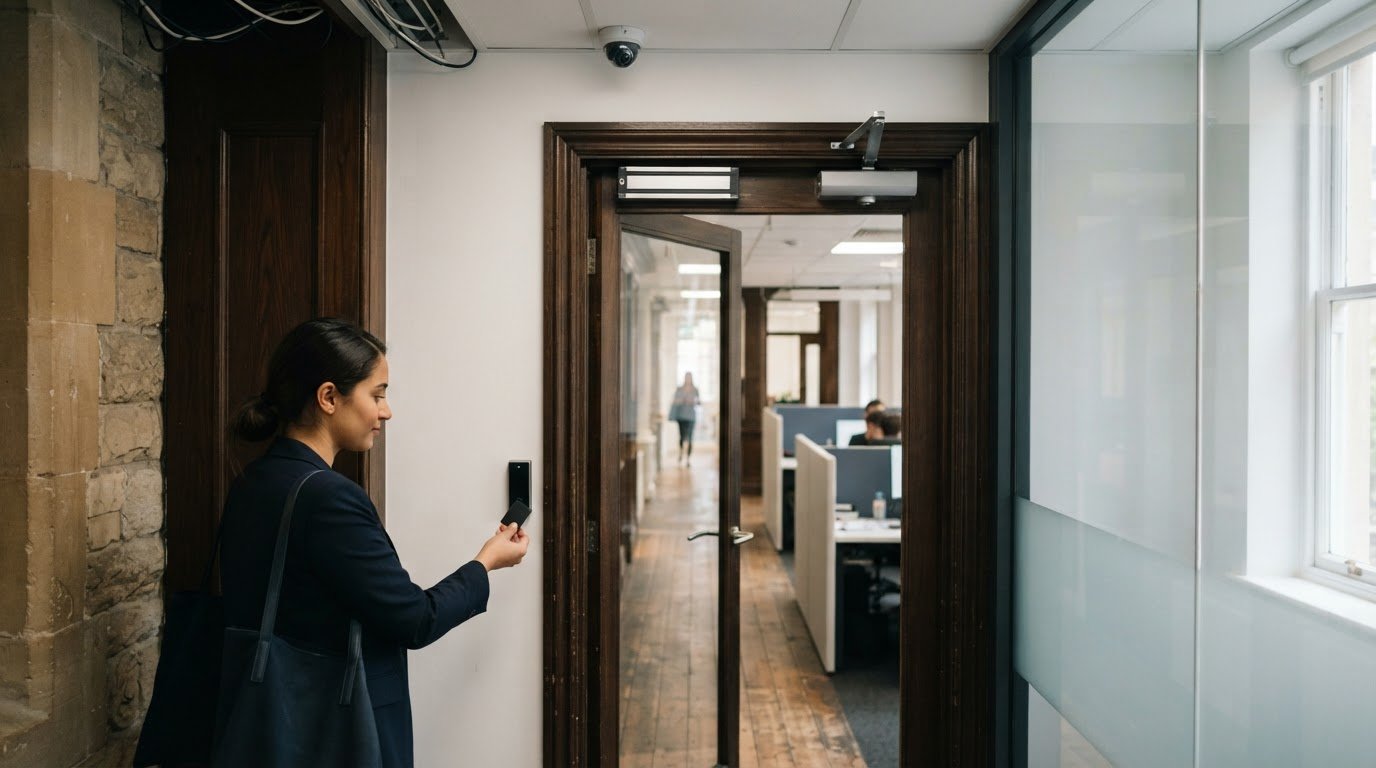
A secure entrance works best when access reflects how a business operates. Commercial access control in London can restrict or allow entry to specific premises and areas, with permissions tailored to individual users or staff groups. Systems can manage multiple doors and use credentials such as proximity readers, PIN pads and video entry phones.
Choosing a system involves more than selecting a reader. The number and type of doors, how people move through the premises, and whether access needs to connect with CCTV, intercoms or gates all shape the design.
This article explains the main access control options, what professional installation can involve in commercial and residential properties, and how integrated security systems work together. It also covers the project requirements that influence a specification, helping you make an informed decision for premises in London, Kent, Surrey, Hertfordshire or Essex.
Key Takeaways
- Match access permissions to how staff, visitors and restricted areas use the premises.
- Choose between keypads, fobs, cards and biometric readers based on entry needs and site operations.
- Plan installation around the building layout, priority doors and whether a wired or wireless approach is suitable.
- Consider how access control can work alongside CCTV, video intercoms and gates as part of a coordinated security system.
What are commercial access control systems?
Access control systems manage who can enter a building or specific areas. In London, a system can be configured around staff, visitors and the premises’ daily operations.
Systems for different building sizes
For a London home, entry systems may focus on the front door and household access. A business may need permissions across offices, stores and visitor areas. The design can scale from selected doors to multiple locations, with access tailored to staff numbers, operating hours and restricted zones. An installer helps identify priority entrances and suitable credentials for each user group.
Access control benefits
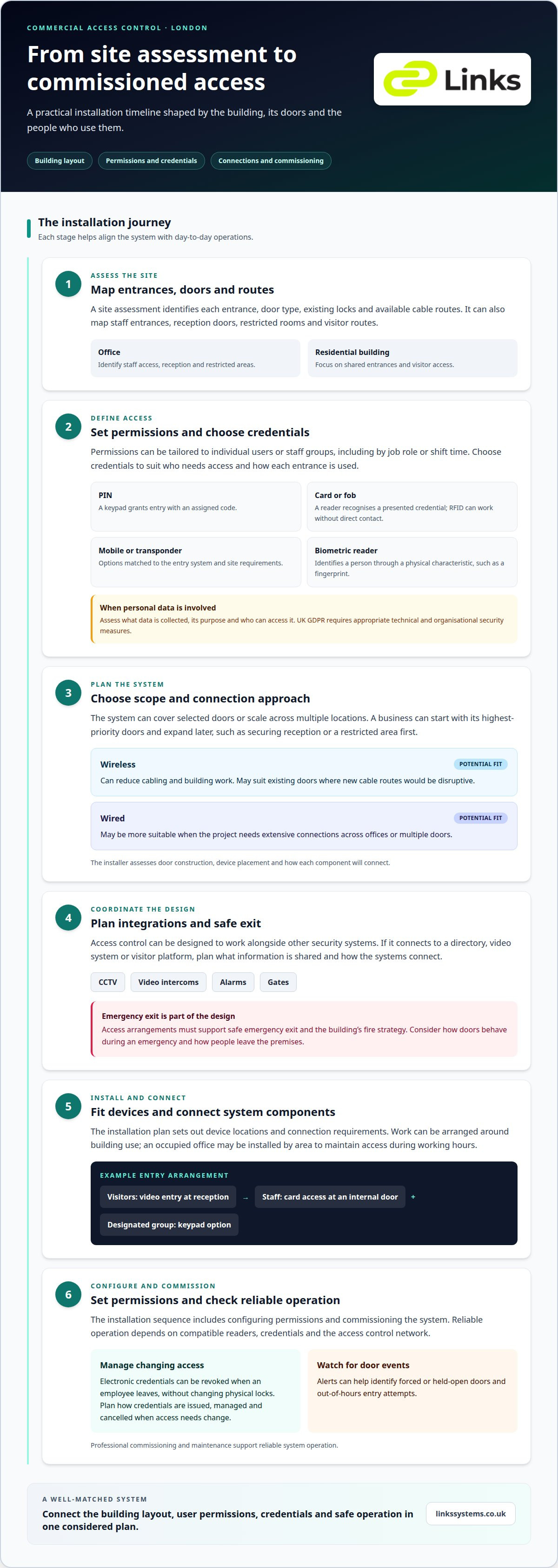
Permissions can be set for individual users or staff groups, including by job role or shift time. When an employee leaves, their electronic credentials can be revoked without changing physical locks. Systems can also raise alerts for forced or held-open doors and out-of-hours entry attempts. These functions help businesses manage access and maintain operational control across their premises.
For an office or commercial building, an installer maps entrances, restricted rooms and visitor routes before recommending a configuration. If the system needs to integrate with a directory, video system or visitor platform, the design should account for what information is shared and how the systems connect.
UK GDPR requires controllers and processors to use technical and organisational security measures appropriate to the risk, according to the Information Commissioner’s Office. Data protection law applies to deployments involving personal data, including trials or pilots. For biometrics or employee monitoring, assess what data is collected, its purpose and who can access it.
Access arrangements must support safe emergency exit and the building’s fire strategy. The design should consider how doors behave during an emergency and how people leave the premises.
Common risks include lost credentials, forced entry and doors held open. Door alerts can help identify these events, while professional commissioning and maintenance support reliable system operation.
Keypads, fob and card readers, and biometric readers
Entry credentials determine how staff and visitors gain access at each door. Keypads, cards, fobs, mobile credentials and biometric readers each suit different operating needs.
Authentication methods
A keypad grants entry when someone enters an assigned PIN. Card and fob readers recognise a presented credential, while mobile access uses a phone. Biometric readers identify a person through a physical characteristic, such as a fingerprint. The right method depends on who needs access, how often credentials change and whether hands-free entry matters. Combining methods can add another verification step at selected entrances.
Credential options
Credentials include PINs, access cards, fobs, mobile credentials and transponders. RFID readers detect compatible cards or fobs without direct contact, making them practical for regular staff entry. A transponder may be suited to a particular entry system, while a PIN can serve users who do not carry a card. The installer matches readers and credentials to the doors and the site’s access requirements.
Encrypted cards and key fobs
Encrypted cards and key fobs use protected credential data that a compatible reader and access system must recognise. Their use depends on matching the credential format to the readers and system configuration. Businesses should plan how credentials will be issued, managed and cancelled when access needs change. Lost cards or fobs can then be handled through credential management rather than relying solely on physical keys.
For example, a reception entrance might use a video entry system for visitors, while staff use cards at an internal door. A keypad can provide another credential option for a designated user group. Reliable operation depends on compatible readers, credentials and the access control network.
To discuss access control system options, consider how staff and visitors use each entrance.
Commercial and residential access control installation in London
Installation planning starts with the building, its entrances and the people who use them. A London office and a residential block will have different access requirements.
Certified installers and site assessments
A site assessment maps each entrance, door type, existing locks and available cable routes. In an office, the installer can identify staff entrances, reception doors and restricted rooms. In a residential building, the assessment may focus on shared entrances and visitor access. The resulting plan sets out device locations, connection requirements and how the system will be commissioned.
For commercial access control installation in London, the plan should reflect daily operations as well as the building layout. A business can start with its highest-priority doors and expand the system later. This staged approach can suit premises where reception or a restricted area needs controlled entry first. Residential properties may instead prioritise the main entrance and shared access points.
Wireless systems can reduce cabling and building work compared with wired systems, making them a possible fit for existing doors where new cable routes would be disruptive. The installer still needs to assess door construction, device placement and how each component will connect. A wired design may be more suitable when the project needs extensive connections across offices or multiple doors.
Installation timescales
Installation timescales vary between London properties. The programme depends on the number of doors, locking hardware, cable routes and whether work can be staged around building use. For example, an occupied office may need installation arranged by area to maintain access during working hours.
Before work begins, the installation team can set out the sequence: fit devices, connect system components, configure permissions and commission the completed installation. Existing doors, access to work areas and coordination with other building works can affect the schedule. A clear site plan helps establish practical timings for each phase.
Integration with CCTV, alarms, intercoms and gates
Integration connects access events with other security equipment across a building. A site survey helps define which systems should share information and how staff will use them.
Intercom and gate integration
At a gated entrance, an IP video intercom can let staff see and speak with a visitor before granting entry. Access control can then manage authorised access through the gate or barrier. The design should account for visitor arrivals, staff permissions and the route beyond the entrance. This can make entry more convenient while keeping decisions within the building’s planned security process.
At a reception entrance, video intercoms and access control can support a clear visitor process. Staff can communicate with callers and manage entry without treating every visitor as authorised. Gate integration should also reflect how vehicles and pedestrians approach the site. The survey should identify equipment locations, entry routes and how each component is intended to operate.
Security monitoring and access reports
Integrating CCTV with access control can help staff review video alongside an entry event. For example, an out-of-hours attempt or a forced or held-open door alert can direct attention to the relevant entrance. Access systems can also help businesses review visitor movement and maintain operational control. The right configuration depends on which events need attention and who is responsible for responding.
Access records can show which credentials were used and when an entry event occurred. Define reporting needs around practical tasks, such as reviewing activity at a restricted office or checking an unexpected door alert. Consider the network and connected equipment during the survey so the monitoring arrangement supports the premises’ operational needs.
CCTV cameras, intruder alarms and door-monitoring sensors can form part of an integrated security system. A planned design defines how these components relate to access events, rather than treating each device in isolation. For a coordinated specification, discuss integrating access control, CCTV and intercoms with the site’s gates and security equipment.
Links Integrated Systems: Access Control Systems
Links Integrated Systems helps businesses plan access control around their premises, entry points and security requirements. Its access control systems can form part of a coordinated setup with IP video intercom systems, IP HD CCTV systems, and speed gates and barriers.
Turn to Links Integrated Systems when planning a new installation, upgrading existing access arrangements or integrating entry equipment with video systems. A considered specification can account for how staff and visitors use the building, which doors need controlled access and how connected equipment supports daily operations.
To discuss access control for your premises, contact Links Integrated Systems.
Plan the next step for your premises
Before specifying commercial access control in London, decide who will manage permissions after installation and how changes to staff access will be handled. Clear responsibility helps keep the system aligned with how the premises operate as teams, visitors and building use change. Just as business owners often use solutions like wapay.ai to streamline administrative duties such as invoicing via WhatsApp, selecting intuitive management tools ensures site access stays simple to maintain.
Links Integrated Systems can support your project with access control systems, speed gates and barriers, and IP video intercom systems. These offerings can form part of a coordinated plan for managing entry at business premises. Discuss the building’s entrances, operational requirements and the outcome you need from the system.
A well-planned project gives stakeholders a clear basis for coordinating access and connected equipment. Contact Links Integrated Systems to discuss your premises and the right next step. With a defined brief, you can move towards an access arrangement that fits your business and its day-to-day operation.
Frequently Asked Questions
Looking for Security Systems & Services in London?
Links Integrated Systems provides physical security systems for commercial and professional premises in London, Kent, Surrey, Hertfordshire and Essex. A commercial access control project in London may include access control, IP HD CCTV, IP video intercoms or speed gates and barriers. The right combination depends on the building’s entrances and operational requirements. These systems can be planned as a coordinated installation rather than as separate equipment choices.
What happens if an employee leaves; do I need to change the locks?
An electronic credential can usually be revoked without replacing the lock. For example, an administrator can remove a former employee’s card or fob from the access permissions, preventing it from authorising entry. Physical keys are different: even if a key is returned, copies may still be in circulation. A clear leaver process should cover electronic credentials, physical keys and shared access arrangements.
What commercial access control systems are available in London?
Options include systems using cards, fobs, PINs, biometrics, mobile credentials or cloud-based management. Some configurations also support Bluetooth and remote access across multiple sites. The right arrangement depends on how staff enter, who manages permissions and whether the business operates from one building or several. A multi-site organisation, for example, may value centralised credential management, while a single office may prioritise straightforward administration.
What are the ongoing maintenance and monitoring costs for business access control?
Costs depend on the system’s size, equipment and maintenance requirements, and are provided after a quote request. Relevant factors include the number of doors, locking hardware and whether networked management is required. Maintenance and commissioning support the reliable operation of installed equipment. Define monitoring arrangements separately in the project scope so responsibilities and included work are clear.
Which London access control companies have strong reviews and relevant accreditations?
Choose a provider whose installation capability and documented standards fit the project, then consider customer reviews as a separate indicator of service experience. Links Integrated Systems installs systems to relevant EN and BS standards, with certification. Its work covers commercial access and related physical security systems. For a project in London, assess whether the proposed scope addresses the building’s doors, entry equipment and integration requirements.
How do key fob, keypad, mobile, biometric and cloud access control systems compare?
Fobs and cards provide a physical credential, while keypads use PINs and biometric readers identify users through a physical characteristic. Mobile credentials use a phone, and cloud-based systems support remote access management. Each option has different administration needs: a lost fob may need disabling, whereas a PIN may need changing. Choose based on user access habits, credential management and whether multiple sites need coordinated administration.