

A reliable entry system starts with the building’s access requirements, not just the choice of door panel. Video intercom systems for business in Canary Wharf need to suit how staff, visitors and authorised contractors enter the premises, and how access is managed when reception is unattended.
When an intercom fault disrupts entry, a clear diagnosis matters. The right system design matters too: entrance locations, user types and existing security equipment all affect what will work in practice.
This article explains how fobs, QR codes, passcodes, biometrics and app-based entry can suit different buildings. It also covers installation planning, integration with access control and CCTV, and bespoke design, from assessing the site through to commissioning.
Key Takeaways
- Match fobs, QR codes, passcodes, biometrics or app access to the people using each entrance and the way entry is managed.
- Understand how installation and integration with access control or CCTV can shape a coordinated building-entry system.
- See how bespoke design accounts for entrances, user needs and existing security infrastructure.
- Learn what to consider when selecting an installer and how commissioning and maintenance support system management.
Fob, QR code, passcode and biometric entry options
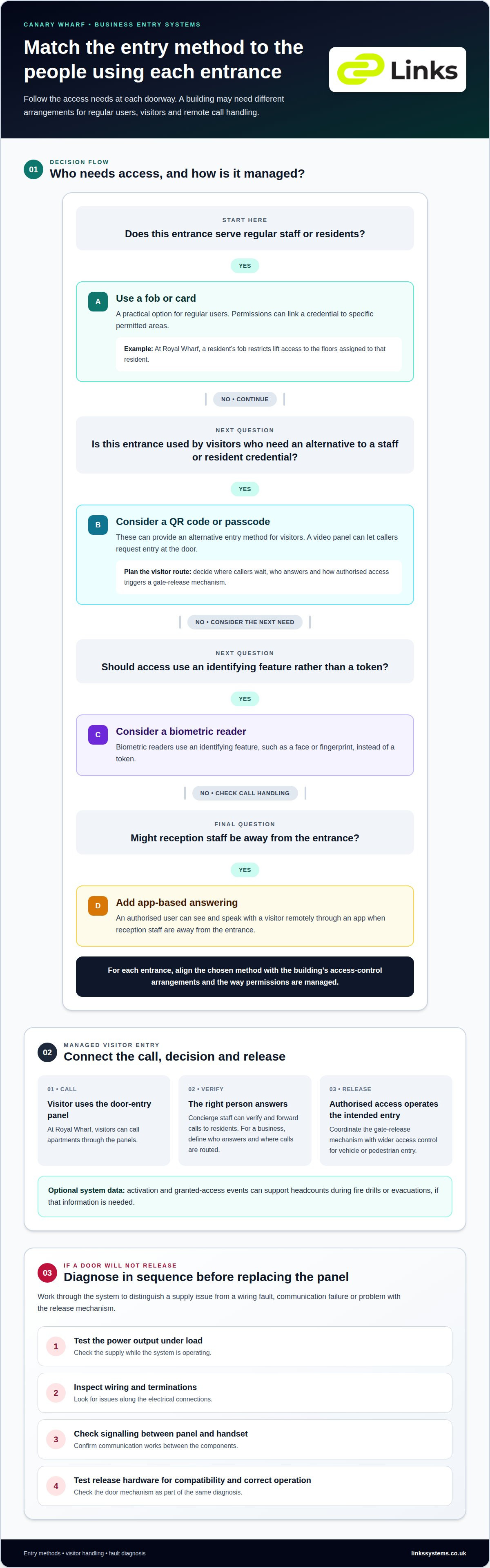
Choose an entry method around who needs access and how each doorway operates. A fob or card suits regular staff and residents, while a QR code or passcode can provide an alternative for a visitor. Biometric readers use an identifying feature, such as a face or fingerprint, rather than a token. The selected method should align with the building’s access control arrangements and how permissions are managed.
Apartment towers show why access may need to extend beyond the main entrance. At Royal Wharf, lift access is restricted to floors assigned to each resident’s fob. This illustrates how a credential can be linked to specific permitted areas. In a business, the design can distinguish staff access from visitor entry, with a video panel allowing callers to request entry at the door.
Mobile answering is useful when reception staff are away from the entrance: an app can let an authorised user see and speak with a visitor remotely. Consider whether entry-event data is also needed. System activation and granted access can generate data to support headcounts during fire drills or evacuations.
At Royal Wharf, visitors can call apartments through door-entry panels. Concierge staff can verify and forward calls to residents, showing how a panel can support a managed visitor process. For a business gate, consider where callers wait, who answers and how authorised access triggers the gate-release mechanism. These decisions help coordinate vehicle or pedestrian entry with the building’s wider access control.
If a door won’t release, diagnose the fault systematically before replacing the panel. Test the power output under load, inspect wiring and terminations, then check signalling between the panel and handset. Finally, test the release hardware for compatibility and correct operation. This sequence helps distinguish a supply issue from a wiring fault, communication failure or faulty door mechanism.
Installation, integration and management
Plan installation around the entrance layout, existing cabling and the routes between panels and monitors. The design should account for where visitors call, who answers and which doors or gates need release control. At an office entrance, for example, a panel can route a visitor’s call to an indoor monitor or mobile app. Clear user permissions and reliable communication between components are essential.
Integration connects the intercom with other building security equipment. Video intercom systems can work with access control, CCTV and commercial or residential gates. At Royal Wharf, access control was designed to integrate with CCTV cameras, allowing security teams and concierge staff to monitor the site. In a commercial building, this can help staff relate a visitor’s door-entry call to camera coverage at the entrance.
Smart-lock integration depends on compatibility between the lock and intercom. During design, the installer considers how door release is controlled and whether the existing lock will work with the intercom. Installation then covers the entry panel, internal monitor, wiring and release hardware. Commissioning tests should confirm that calls reach the right user and authorised release operates the intended door.
Management continues after installation. A clear record of the system layout, user permissions and connected equipment helps building teams manage staff changes and diagnose faults. In a multi-tenant building, shared equipment and individual units can be tested separately to isolate a problem. Scheduled maintenance can assess panel operation, connections and door-release performance, helping identify issues before they disrupt entry.
For a project involving CCTV, access control and door entry, plan the connections as one coordinated system rather than separate installations. Review integration planning as part of the project scope, including who manages user access and how each entrance is commissioned.
Bespoke video intercom system design and installation
Bespoke design starts with the building’s access patterns, not a standard panel layout. Map each entrance, visitors’ routes and the staff responsible for answering calls. For a Canary Wharf office, a staff entrance may need a different call route from a shared reception entrance. This helps determine panel and monitor locations, as well as how access control should manage permissions.
Next, assess the existing infrastructure. Check cabling, power, network connections, door-release hardware and any linked CCTV. Record which areas need coverage and whether the system serves one business or several tenants. Specify readers and panels for their intended positions, taking account of how staff, visitors and contractors use each entrance.
For UK businesses, data-protection rules are relevant when a system records identifiable visitors. Define why images are collected, who can view them and how long recordings are kept. Explain the recording process to visitors, and limit camera views to areas needed for door entry and security.
Cybersecurity and privacy checks should cover network access, user permissions and recorded video. For example, review who can answer remotely and whether former staff accounts are removed when roles change. A defined process for managing credentials and access to footage helps reduce avoidable exposure.
Install the system according to the agreed design: fit the entry panels and monitors, connect the required wiring, then link the door-release hardware and compatible systems. Test a visitor call from each entrance, confirm it reaches the correct monitor and verify that authorised release operates the intended door. If CCTV is integrated, check that camera coverage supports monitoring of the entrance.
Commissioning should include handover information for building managers. Document the system layout, user roles and routine operating steps, then demonstrate call handling and access permissions. At a multi-tenant site, test each tenant’s call route separately. This gives the building team a clear basis for day-to-day management and future fault diagnosis.
Which London suppliers and installers serve Canary Wharf?
Commercial security integrators and specialist access-system installers are relevant suppliers for Canary Wharf offices and mixed-use buildings. Their work can cover system design, installation and commissioning, rather than simply supplying an entry panel. The right design depends on the site: a single office entrance differs from a multi-tenant tower with shared reception and controlled internal doors.
Before comparing project scopes, define what the building needs. Specify which entrances need video entry, who will answer calls and whether the system must connect with access control, CCTV or gates. For example, a Canary Wharf office with staffed reception may route visitor calls differently from one where staff answer remotely. These details help establish the required design and installation scope.
Assess the proposed work across the project lifecycle. A clear process should cover the site layout, existing cabling and door-release equipment, system configuration, installation, testing and handover. Ask how commissioning will test each entrance and call route. In a multi-tenant building, testing each tenant’s call path separately helps ensure calls reach the intended recipient.
Management after installation matters too. The handover should explain user permissions, routine operation and the system layout. If an existing intercom has a fault, diagnosis should distinguish between the power supply, wiring, panel-to-handset signalling and release hardware. This is especially relevant in buildings with several entrances or shared equipment.
Location alone doesn’t establish whether an installer suits a project. The deciding factors are the system’s integration requirements, the building’s access arrangements and the work needed for commissioning and ongoing maintenance. For a Canary Wharf project, provide the entrance layout and existing security-system details when arranging a discussion. Discuss your Canary Wharf intercom project and its installation requirements.
Links Integrated Systems: IP Video Intercom Systems
Links Integrated Systems can help businesses plan a new entry system, upgrade an existing installation or resolve intercom faults. Its IP video intercom systems can be designed alongside access control, speed gates and barriers where these form part of the building’s entry arrangements.
For a Canary Wharf site, the design can account for entrance locations, visitor call handling and connections to existing equipment. Installation and commissioning establish how the system operates, while maintenance supports ongoing management. This is a practical next step when the system needs to fit the building rather than follow a standard layout.
Contact Links Integrated Systems to discuss your business’s video intercom requirements.
Plan the next step for your building
Before moving from a proposed layout to installation, define what the system needs to support over time. Consider planned changes to entrances, tenant arrangements and visitor-handling responsibilities. A design that accounts for these operational needs gives building managers a clearer basis for future system decisions.
Links Integrated Systems provides IP Video Intercom Systems alongside Access Control Systems and Speed Gates & Barriers. These offerings can support a coordinated approach when a building’s entry requirements involve more than an intercom alone. A tailored system for video intercom systems for business in Canary Wharf starts with the site’s needs and how people use its entrances.
To discuss your building’s requirements and possible next steps, contact Links Integrated Systems. A considered project scope is a practical starting point for moving forward with confidence.
Frequently Asked Questions
How quickly can you attend an intercom failure in an Isle of Dogs block?
Attendance depends on arranging a visit and diagnosing the fault; no fixed response time is promised. Links Integrated Systems offers system maintenance and commissioning, but not 24/7 emergency call-outs. For an entry failure, the assessment should distinguish between a power issue, damaged wiring, panel signalling and release hardware. These causes require different checks and may affect the work needed to restore normal operation.
Which video intercom systems are suitable for businesses in Canary Wharf?
Businesses choosing video intercom systems for business in Canary Wharf should match the setup to their entrances, call-handling arrangements and access permissions. An IP system can suit an office where callers need to be seen and heard, with calls answered on an indoor monitor or compatible app. A shared reception may need a different call route from a private office entrance for staff and invited visitors.
How do IP, wireless and wired video intercom systems compare for offices?
IP systems communicate over an internet protocol network and support networked video entry. Wired systems connect components physically, so existing cabling and installation routes matter. Wireless systems reduce the need for a cable run to every component but depend on suitable signal coverage. For an office refurbishment, base the choice on infrastructure, panel locations and how reliably calls need to reach monitors or users.
Can video intercoms integrate with access control, CCTV and business phone systems?
Video intercoms can integrate with access control and CCTV to coordinate the view of entry activity. Business phone integration depends on the equipment and call-routing arrangement, so treat it as a separate design requirement. For example, reception may answer during staffed hours, with a designated alternative route at other times. Define call handling and release permissions in the system design.
How long does installation take in Canary Wharf office buildings?
The installation programme for video intercom systems for business in Canary Wharf depends on the number of entrances, cabling routes, existing door-release equipment and integration requirements. Existing infrastructure presents different needs from new cabling or work across tenant areas. The programme also includes commissioning tests for call routing and door release. In an occupied office, access to shared spaces can affect the work sequence.