

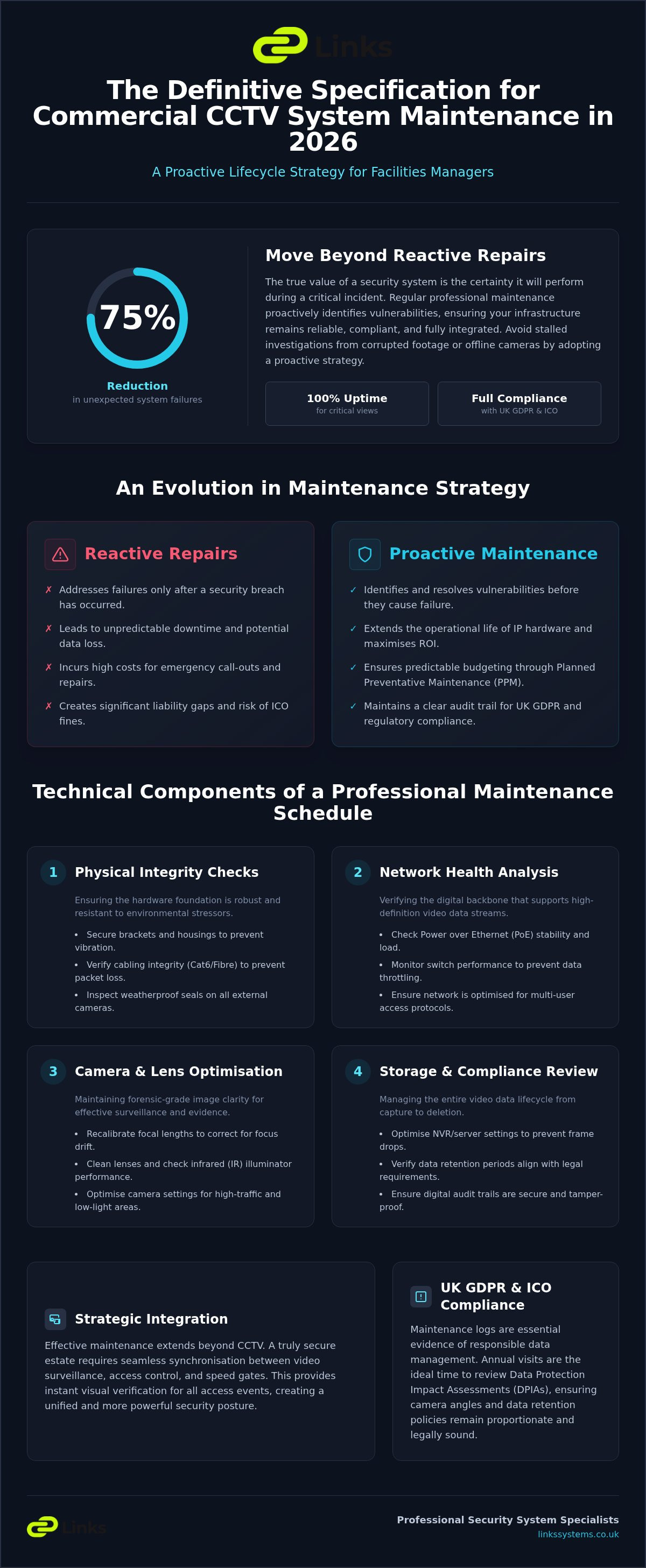
Did you know that regular professional maintenance can reduce unexpected system failures by up to 75%? For facilities managers across London and the South East, the true value of a security system isn’t found in the hardware itself. It’s found in the absolute certainty that it will perform when a critical incident occurs. We understand the pressure of managing complex estates where an investigation might be stalled by corrupted footage or a camera that dropped offline weeks ago without notice. This guide provides a definitive specification for commercial cctv system maintenance in 2026, ensuring your infrastructure remains reliable, compliant, and fully integrated.
You’ll learn how to achieve 100% uptime for critical views, maintain clear audit trails for UK GDPR compliance, and synchronise your video with access control and speed gates. By moving from a reactive model to a proactive lifecycle strategy, you can protect your organisation from the rising tide of ICO fines, which reached record levels in 2025, while securing the long-term value of your IP HD technology. We will outline the methodical approach required to keep your professional-grade surveillance running at peak performance.
Key Takeaways
- Understand the technical distinction between reactive repairs and a structured commercial cctv system maintenance programme designed to identify network failures before they occur.
- Discover the essential components of a professional inspection, from verifying cabling integrity to the optical optimisation of IP cameras in high-traffic lobbies.
- Learn how to synchronise video surveillance with access control and speed gates to provide seamless visual verification across your entire security estate.
- Analyse the financial advantages of Planned Preventative Maintenance (PPM) in extending the operational life of IP hardware and protecting against liability gaps.
- Recognise why rigorous system commissioning is the essential foundation for long-term reliability and ensuring your infrastructure meets its original design intent.
Defining Professional Commercial CCTV System Maintenance
Professional Closed-circuit television (CCTV) maintenance is far more than a cursory lens wipe. It’s a structured technical programme designed to ensure high-definition IP networks operate at peak efficiency. Unlike reactive repairs, which only address failures after a security breach has occurred, commercial cctv system maintenance identifies vulnerabilities in hardware or network architecture before they compromise your site. Effective maintenance is the proactive management of the entire video data lifecycle. By adhering to a rigorous schedule, facilities managers can guarantee 24/7 reliability, maintain forensic-grade image clarity, and ensure full regulatory compliance for their high-value assets.
The Difference Between Commercial and Residential Upkeep
Residential setups often rely on simple hardware, but commercial infrastructure requires sophisticated network management. Professional systems must handle high-bandwidth data streams and complex multi-user access protocols across multiple departments. In urban London or the industrial corridors of Kent, external cameras face harsh environmental stressors. Salt air, soot, and vibration from heavy transport can degrade housings and cabling faster than in domestic settings. Managing the storage demands of high-definition (HD) footage across large-scale estates also requires precise server optimisation. This prevents data loss or frame rate drops during critical recording periods. You need a system that remains robust under heavy load, ensuring that network switches and Power over Ethernet (PoE) injectors are functioning within their thermal limits.
Regulatory Compliance: UK GDPR and ICO Standards in 2026
The Information Commissioner’s Office (ICO) maintains strict oversight of commercial surveillance. Your maintenance logs aren’t just technical records; they serve as essential evidence of responsible data management. Under the UK GDPR and the Data (Use and Access) Act 2025, organisations must demonstrate that their surveillance remains necessary and proportionate. Annual maintenance visits provide the ideal opportunity to review Data Protection Impact Assessments (DPIAs). This process ensures that camera angles haven’t drifted into private spaces and that retention periods align with current legal requirements. Thorough documentation of these checks protects your business from liability gaps if footage is ever requested for legal proceedings or insurance audits. We ensure your signage is clear and your digital audit trails are tamper-proof, meeting the high standards expected of modern corporate security.
The Technical Components of a Professional Maintenance Schedule
A robust programme of commercial cctv system maintenance is built on technical precision. It isn’t just about checking if the power is on. It involves a deep dive into the infrastructure that supports high-definition video data. We start with physical integrity. Brackets and housings must be secure to prevent vibration or misalignment that can ruin evidentiary footage. Cabling integrity is equally vital. Even minor degradation in Cat6 or fibre runs can cause packet loss, leading to ghosting or dropped frames in your high-resolution streams.
Network health checks are a critical part of the process. We verify Power over Ethernet (PoE) stability to ensure cameras aren’t drawing more power than the switch can provide, which often leads to intermittent reboots. Switch performance is monitored to ensure the backplane isn’t throttled by the massive data throughput of modern IP HD systems.
Maintaining IP HD CCTV Cameras and Lenses
High-definition lenses are sensitive instruments. Over time, thermal expansion and subtle building vibrations can cause focus drift. This reduces image quality, turning a sharp 8MP view into a blurred mess that’s useless for facial recognition or legal evidence. During maintenance, we recalibrate focal lengths for maximum coverage in lobbies and perimeters. For sites in Surrey and Essex, we pay close attention to infrared (IR) illuminators. These must provide uniform light spread for effective low-light performance. We also verify the integrity of weather-proof seals on external bullet and PTZ cameras. Preventing moisture ingress is the most effective way to avoid premature hardware failure in the unpredictable UK climate.
Storage Management and NVR Optimisation
A final, essential part of commercial cctv system maintenance involves auditing your Network Video Recorders (NVRs). We perform rigorous testing on hard drive health, looking for bad sectors that could cause critical footage loss during an incident. It’s a matter of data redundancy and reliability. We review frame rates and bitrates to ensure you’re balancing image quality with storage capacity. If your bitrates are too high, you might only be keeping 14 days of footage when your internal policy or insurance requires 30. Firmware updates are another pillar of stability. We only apply the latest stable versions to ensure hardware reliability and close potential security vulnerabilities. If you are reviewing your site’s security posture, ensuring your video is correctly integrated with access control provides the highest level of visual verification.
Proactive Maintenance vs. Reactive Repairs: A 2026 Cost-Benefit Analysis
Managing a security budget requires a shift from reactive fire-fighting to strategic asset management. While reactive repairs might seem cheaper on a monthly balance sheet, they ignore the significant hidden costs of system failure. A sudden blackout in your surveillance coverage creates immediate liability gaps and can even lead to the invalidation of insurance policies. Professional commercial cctv system maintenance transforms these volatile risks into predictable operational expenditure (OpEx). By identifying wear and tear before it leads to a total outage, you avoid the high capital expenditure (CapEx) associated with emergency hardware replacements and urgent call-out fees.
Industry data indicates that regular professional maintenance can extend a CCTV system’s lifespan by four to seven years. This longevity significantly reduces the frequency of full-system refreshes. When you factor in the 75% reduction in unexpected failures, the total cost of ownership over a five-year period is substantially lowered compared to a reactive model. This methodical approach ensures that your high-value IP hardware delivers its maximum return on investment through sustained performance and reliability.
Minimising Operational Downtime in London Business Hubs
In high-traffic environments like City office lobbies or busy commercial centres, system downtime isn’t just a security risk; it’s an operational hurdle. We schedule maintenance visits to avoid peak hours, ensuring that your security posture remains intact without disrupting tenant movement. Modern commercial cctv system maintenance programmes now utilise remote diagnostics to monitor the health of IP networks in real time. This allows engineers to identify a failing hard drive or a struggling PoE switch before it impacts the site. Proactive part replacement is always more efficient than waiting for a total system blackout, as it allows for planned, non-disruptive upgrades that keep your facility running smoothly.
Insurance Requirements and Liability Protection
A valid maintenance certificate is a powerful tool for risk management. In the event of an on-site incident, insurance providers often require proof that security systems were fully operational and professionally maintained. Failing to produce these records can complicate claims or lead to reduced payouts. Adhering to the standards of the SSAIB or NSI is often a prerequisite for comprehensive commercial coverage in the UK. These maintenance records provide a clear audit trail, demonstrating that you’ve met your duty of care to staff and visitors. Should your organisation face legal challenges regarding site safety, a documented history of professional inspections serves as a robust defence, proving that your security infrastructure was managed with the necessary rigour and precision.
Strategic Integration: Maintaining Video Alongside Access Control
Modern security infrastructure doesn’t exist in silos. For a truly unified posture, integrating CCTV with access control systems is essential. This allows for immediate visual verification of every entry event. When we conduct commercial cctv system maintenance, we don’t just look at the cameras. We test the digital handshakes between your video management software and your reader databases. This ensures that every time a badge is swiped, a corresponding high-definition clip is tagged and archived. Accurate time-synchronisation across your entire physical security integration is non-negotiable. Without it, your audit trails become disjointed, making it impossible to reconstruct events for legal or insurance purposes.
Synchronising Video Analytics with Physical Barriers
We pay close attention to the triggers that link video analytics to commercial speed gates and vehicle barriers. Tailgating detection is a common requirement in City offices. We verify that cameras correctly trigger alerts when two people pass through a single gate cycle. In business parks across Kent and Essex, ANPR cameras must communicate flawlessly with vehicle barriers. Any latency in this link can cause traffic congestion or unauthorised entry. Maintenance also includes checking video intercoms. We ensure the audio is crisp and the camera view provides a clear, well-lit image of the visitor’s face, regardless of the time of day. This prevents “blind spots” at your most vulnerable entry points.
Unified Security Management and VMS Health
The health of your Video Management Software (VMS) is the heartbeat of an integrated system. We audit the software to ensure it’s communicating seamlessly with access databases without high CPU overhead. Managing user permissions is another critical task. As staff roles change, we help you ensure that only authorised personnel can access sensitive camera feeds. One of the most significant advantages of using a single maintenance partner for both video and access control is the elimination of finger-pointing during a failure. We take full responsibility for the entire ecosystem, ensuring that every component works in harmony. If you want to ensure your facility remains secure and compliant, we recommend reviewing our integrated maintenance services for a comprehensive security review.
Professional System Commissioning: The Foundation of Reliability
Commissioning is the rigorous process of verifying that a new installation meets the original design intent. It serves as the final bridge between a physical installation and a fully operational security estate. Commissioning ensures every camera, cable, and server is optimised before the site goes live. Without this critical phase, even the most advanced hardware will likely underperform or fail prematurely. This process is a prerequisite for any effective long-term commercial cctv system maintenance contract. It establishes the technical baseline for performance, allowing engineers to identify exactly when a component begins to deviate from its “day-one” capability during future inspections.
The transition from commissioning to maintenance is where the real value of a professional installation is realised. By establishing clear performance metrics at the outset, we move away from guesswork. We create a data-driven environment where the health of the system is measured against its peak commissioned state. This methodical approach provides facilities managers with the peace of mind that their infrastructure is not just installed, but perfected.
The Commissioning Checklist for IP HD CCTV
In the complex environments of London skyscrapers or high-density commercial perimeters, the commissioning checklist must be exhaustive. We verify network throughput to ensure that concurrent 4K or HD streams don’t drop frames or cause latency across the corporate LAN. Failover and redundancy protocols for recording servers are tested under simulated failure conditions to guarantee zero data loss. We document the “as-built” system in meticulous detail, including IP addresses, port maps, and cable routes. These records are essential for facilitating faster troubleshooting and precise commercial cctv system maintenance throughout the system’s life.
Long-Term Partnership and Lifecycle Planning
Commissioning data serves as the roadmap for your system’s entire lifecycle. It allows facilities managers to plan for future hardware refreshes and system expansions with financial precision rather than reacting to failures. A dedicated maintenance partner who understands the original system architecture can offer more than just basic repairs; they provide a steady hand for strategic growth. As your operational requirements evolve, technologies like cloud access control for business and video can be scaled together through unified lifecycle management. This approach ensures that your security infrastructure remains a master of proven, high-quality solutions. By starting with rigorous commissioning, you protect your long-term investment and ensure your facility is prepared for the technical demands of 2026 and beyond.
Securing Your Infrastructure for the Long Term
Effective security management in 2026 requires a transition from reactive repairs to a structured lifecycle strategy. By prioritising professional commissioning and a proactive commercial cctv system maintenance programme, facilities managers can ensure their high-definition IP networks remain reliable and compliant. This approach doesn’t just protect your hardware; it secures the integrity of your data and the safety of your site. We’ve explored how integrating video with physical barriers and access control creates a unified security posture that is both resilient and legally robust.
With 40 years of industry expertise, Links Integrated Systems provides the steady hand needed for complex technical requirements across London, Kent, Surrey, Hertfordshire, and Essex. Our comprehensive commissioning and maintenance programmes are designed to deliver peace of mind through technical precision and professional assurance. If you’re ready to move beyond basic upkeep and establish a definitive standard for your surveillance infrastructure, we’re here to guide the process.
Contact Links Integrated Systems for a Professional CCTV Maintenance Consultation to ensure your security estate remains a dependable pillar of your organisation’s safety strategy.
Frequently Asked Questions
What is the difference between a commercial CCTV maintenance contract and a standard repair service?
A maintenance contract is a proactive strategy designed to prevent downtime, whilst a standard repair service is reactive. Maintenance involves scheduled technical inspections that identify issues like cable degradation or storage health before they cause a system failure. This ensures continuous evidentiary quality and regulatory compliance. Standard repairs only address faults after they’ve occurred, often leaving your site vulnerable and resulting in higher emergency call-out costs.
How often should a commercial CCTV system be professionally maintained in the UK?
Most UK commercial sites require a professional inspection at least once every six months to satisfy insurance requirements and safety standards. High-risk environments or large-scale estates in London often benefit from quarterly visits. Regular commercial cctv system maintenance ensures that IP HD cameras remain correctly focused and network switches operate within safe thermal limits. Consistent checks prevent subtle performance drops from compromising your overall security posture.
How long should a business keep CCTV footage for UK GDPR compliance in 2026?
The standard retention period for most UK businesses is 30 days, but this isn’t a fixed legal limit. Under UK GDPR, you must not keep data longer than is necessary for its specific purpose. If your risk assessment justifies a different period, you must document this in your Data Protection Impact Assessment (DPIA). Keeping footage beyond 30 days without a clear insurance or legal requirement can lead to scrutiny from the ICO.
Does my business need to display signs if we have a commercial video surveillance system?
Yes, clear and legible signage is mandatory under the Data Protection Act 2018 and UK GDPR. You must place signs in prominent locations before individuals enter the monitored area. Signs should state that surveillance is in operation, explain the purpose of the recording, such as crime prevention, and provide contact details for the data controller. This ensures transparency for employees and visitors whilst meeting your legal obligations.
Can I integrate my existing speed gates with a new IP CCTV system during maintenance?
Integration is usually possible and highly recommended for achieving a unified security posture. During a maintenance review, we can assess the compatibility of your current speed gates with modern IP CCTV technology. This allows for visual verification of gate events, such as tailgating alerts or unauthorised access attempts. Synchronising these systems ensures that your security team has a complete, timestamped record of all physical entry and exit points.
What is professional system commissioning and why is it necessary for commercial sites?
Professional system commissioning is the rigorous process of testing every component of a new installation against the original design intent. It verifies network throughput, storage redundancy, and camera fields-of-view before the site goes live. For commercial facilities, it provides a performance baseline. This baseline is essential for future commercial cctv system maintenance, as it allows engineers to detect subtle performance deviations before they lead to total hardware failure.
Are there specific British Standards for CCTV maintenance that my business must follow?
Businesses should adhere to BS EN 62676, which is the British Standard for video surveillance systems used in security applications. This standard outlines the requirements for system design, installation, and ongoing upkeep. Following these guidelines ensures that your system provides high-quality evidentiary images and remains robust against technical failures. Compliance is often a prerequisite for obtaining NSI or SSAIB certification and meeting the terms of your commercial insurance policy.
Is cloud storage or on-premise storage better for maintaining commercial video security?
The choice depends on your specific bandwidth and security requirements. On-premise storage offers high-speed access to high-definition footage without relying on an internet connection, which is often preferred for large-scale IP HD systems. Cloud storage provides easier remote access and off-site redundancy but requires significant upload bandwidth. Many modern facilities now opt for a hybrid approach to balance local performance with secure cloud-based backup and scalability.