
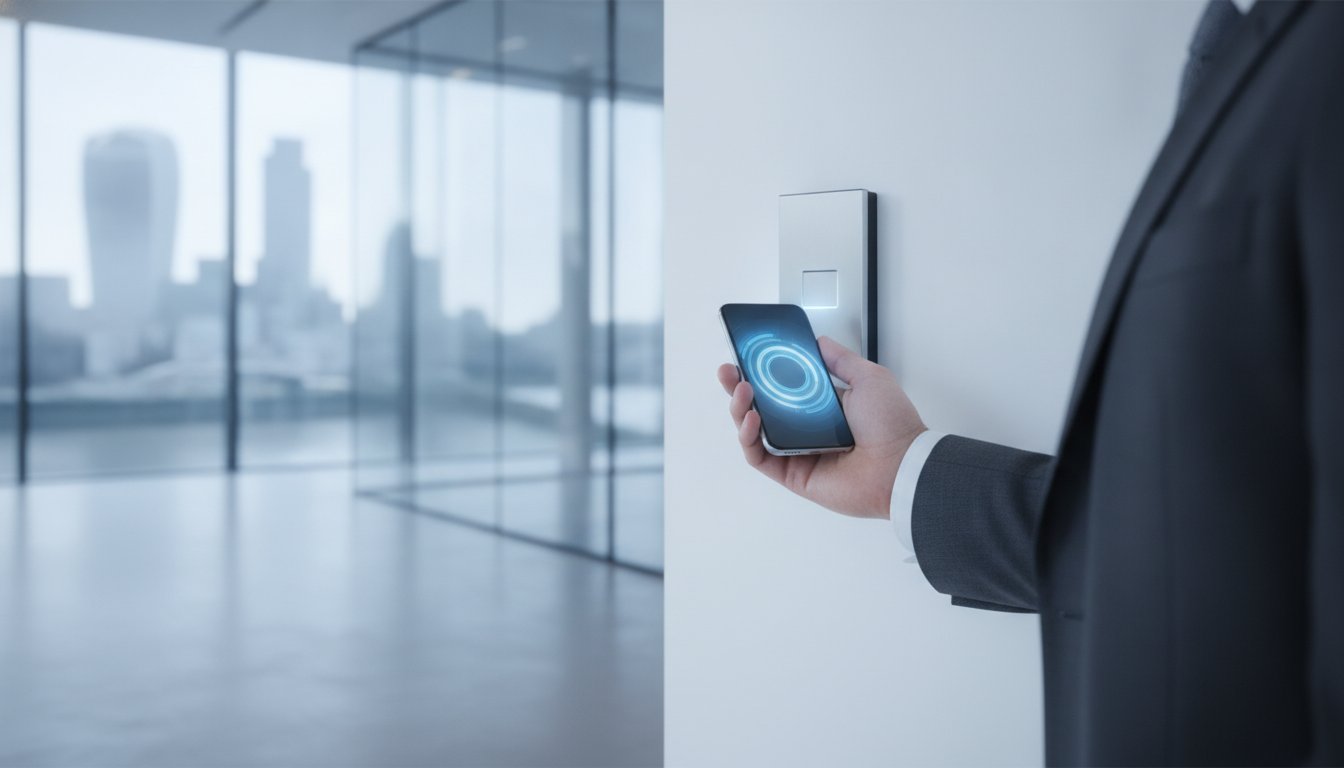
The traditional plastic key fob, once the gold standard of office security, has become an expensive liability for the modern UK business. Managing a drawer full of spare cards whilst wrestling with on-site server maintenance is a frustration most facility managers know all too well. This is where Paxton SOLO Access control introduces a more refined, professional approach to entry management. By removing the need for complex IT infrastructure and physical tokens, it addresses the core inefficiencies of legacy systems whilst improving site reliability.
You’ll discover how this system revolutionises commercial security by turning your smartphone into both the master controller and the digital key. We will provide a professional guide to the hardware requirements, the subscription-based credit model, and how this app-based solution ensures your site remains compliant with the latest NSI regulations. This overview explores how to streamline your operations and reduce your hardware footprint without compromising the stability or peace of mind your business demands.
Key Takeaways
- Understand how replacing traditional physical fobs and on-site servers with smartphone credentials reduces hardware overhead and simplifies user management.
- Explore the technical architecture of Paxton SOLO Access control, which enables secure entry management without the need for complex local data networks.
- Learn how the transition to a subscription-based credit model provides a predictable operational expenditure for growing commercial sites.
- Discover the importance of professional commissioning for ensuring biometric reliability and adherence to the latest UK security regulations.
- Identify how phone-based access can be integrated with physical barriers and speed gates to create a unified security strategy for London and South East offices.
What is Paxton SOLO Access Control?
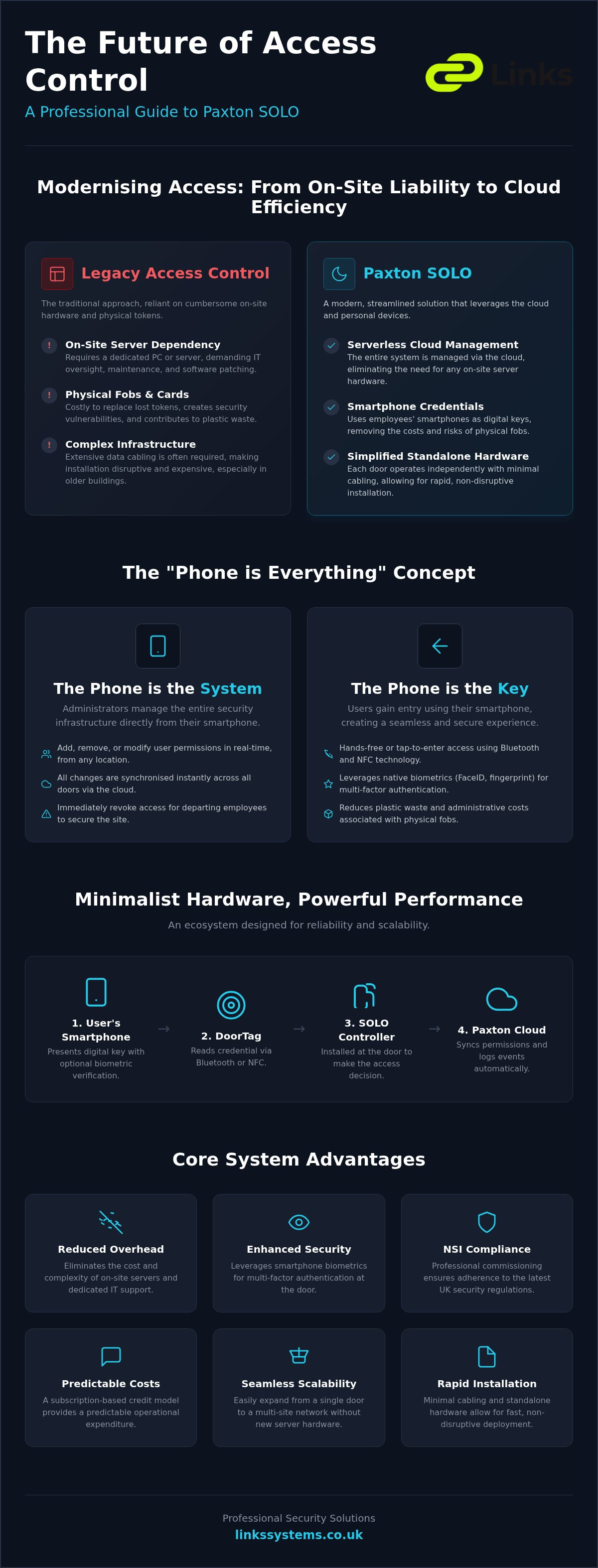
Paxton SOLO Access control represents a fundamental shift in how small to medium-sized commercial environments manage security. Historically, Access control systems required a dedicated on-site PC or a server tucked away in a communications room. These legacy setups often demand significant IT oversight, regular software patching, and complex data cabling to remain secure. Paxton SOLO removes these barriers by moving the entire management layer to the cloud. This serverless architecture is particularly effective for multi-tenant offices and businesses with remote sites where installing a full data network for security isn’t practical. It offers a stable, high-quality solution for site managers who need reliability without the overhead of traditional networked hardware.
The “Phone is the System” Concept
The management of your security infrastructure no longer requires a physical workstation or a dedicated IT suite. With the Paxton SOLO app, the smartphone becomes the primary management console for the entire site. Administrators can add or revoke user permissions directly from their handset, regardless of their location. This real-time capability ensures that if an employee leaves the company, their access is terminated across all doors in seconds. The cloud handles the synchronisation of data across the site, ensuring every controller is updated without manual intervention. This is a methodical approach. It prioritises efficiency for busy professionals who cannot afford to wait for external IT support to update a user database or fix a crashed server.
The “Phone is the Key” Concept
From the user’s perspective, the transition to phone-based security eliminates the friction of physical tokens. The system utilises Bluetooth and NFC technology to allow for hands-free or tap-to-enter access. This move significantly reduces the “lost fob” problem, which often leads to security vulnerabilities and recurring administrative costs. By leveraging native smartphone biometrics, such as FaceID or fingerprint recognition, businesses can implement multi-factor authentication at the door without installing specialised biometric hardware. This reliance on personal devices also helps reduce the plastic waste associated with traditional cards and fobs. It provides a secure, modern experience that aligns with the expectations of high-level stakeholders and project managers who value precision and streamlined technology in their London or South East facilities.
Technical Architecture: Standalone Simplicity with Networked Power
The hardware ecosystem for Paxton SOLO Access control is intentionally minimalist. It centres on three primary components: the Solo Controller, the DoorTag, and a dedicated power supply unit. Unlike traditional systems that require extensive Cat5e or Cat6 cabling back to a central switch, SOLO controllers operate independently at the door. This design significantly reduces the labour intensive process of pulling data cables through existing structures. It makes the system an ideal choice for heritage buildings or modern London offices where invasive works must be kept to a minimum. Once the hardware is commissioned by a professional engineer, it functions with a “fit and forget” reliability that commercial clients expect.
Scalability is a core strength of this architecture. You can start with a single entrance and expand to a multi-site network without upgrading central server hardware. Each additional door simply requires its own controller and DoorTag. Professional installation ensures that these components are positioned for optimal Bluetooth and NFC range, providing a seamless experience for every user. This methodical approach to hardware deployment allows for rapid installation in busy commercial hubs without disrupting daily operations.
Cloud-Hosted Flexibility
The intelligence of the system resides in the Paxton cloud rather than a local server. Each controller communicates securely with this central hub to verify permissions and log events. This allows facility managers based in London or managing multiple South East locations to oversee their entire estate from a single interface. Automatic firmware updates are pushed directly from the cloud to the controllers. This ensures the system remains resilient against new security threats without requiring a manual site visit or IT intervention. It’s a proactive model that prioritises long term system health.
Biometric Security and Data Privacy
Security is enhanced by leveraging the secure enclave within modern smartphones. When a user presents their phone at a DoorTag, the system can require native biometric verification, such as FaceID or a fingerprint. This ensures that the digital key cannot be used by anyone other than the authorised holder. This approach also simplifies GDPR compliance. Sensitive biometric data stays on the user’s personal device rather than being stored in a central company database. For businesses operating in high-security commercial zones, this provides a higher level of assurance than traditional proximity cards. Ensuring your hardware is correctly configured is essential for long-term stability; our team at Links Integrated Systems specialises in the precise commissioning required for these advanced setups.
Evaluating Paxton SOLO vs. Traditional Access Control
The financial model for Paxton SOLO Access control marks a departure from the capital-heavy investments typically associated with commercial security. Traditional systems often require significant initial capital expenditure (CAPEX) to cover the costs of on-site servers, dedicated management PCs, and complex software licensing. In contrast, the SOLO architecture shifts the balance towards operational expenditure (OPEX). By utilising a cloud-hosted infrastructure, businesses can secure their premises with a much lower upfront hardware cost. This predictable monthly model is particularly attractive for firms that prefer to manage security as a utility service rather than a depreciating asset.
In high-density London office hubs, the speed of deployment is a critical factor. Traditional networked systems can take weeks to commission due to the extensive data cabling required between every door and the central server. SOLO controllers operate independently, allowing for a phased and much faster installation process. This reduces the time our engineers spend on-site, minimising disruption to your daily operations. Maintenance requirements are also inherently lower. With no on-site server to patch or hardware-based management console to fail, the number of potential failure points is significantly reduced, ensuring a more stable long-term security posture.
SOLO vs. Standalone Systems
Many smaller businesses in Kent and Surrey currently rely on basic standalone keypads or card readers. Whilst these are cost-effective, they offer no audit trail or centralised control. If an employee leaves, a manager must manually visit every door to change codes or delete tokens. Paxton SOLO provides a professional alternative by offering the reporting capabilities of a networked system without its complexity. Administrators can view entry logs and manage permissions across multiple satellite offices from a single handset. This level of oversight is essential for maintaining compliance and site safety in remote or unmanned locations.
SOLO vs. Enterprise Networked Systems (Net2/Paxton10)
Choosing between SOLO and enterprise-grade systems like Net2 or Paxton10 depends on the complexity of your site requirements. Enterprise systems remain the standard for large-scale buildings that require deep integration with fire alarms, lift controllers, or complex third-party software. SOLO is designed for streamlined entry management where these deep integrations aren’t the primary focus. However, it can still form part of a broader strategy, such as integrating CCTV with access control systems to provide visual verification at key entry points. For sites that prioritise mobile-first access and rapid scalability, SOLO offers a refined, high-quality solution that enterprise systems often over-complicate.
Implementation: The Credit System and Professional Commissioning
The operational model for Paxton SOLO Access control is designed to be as streamlined as its physical installation. Unlike older systems that required expensive annual software maintenance contracts, SOLO uses a transparent credit-based approach. This ensures that businesses only pay for the cloud services they actually utilise. It’s a proactive model that allows facility managers to forecast their security spend with precision. Whilst the system is designed for simplicity, the transition from hardware installation to a fully operational security environment requires a methodical commissioning process to ensure long-term stability.
Understanding the Solo Credit Model
Operational costs are managed through a recurring credit system that powers the cloud functionality. For any system with more than one user or more than one door, a subscription is required. This currently costs £6 per door, per month, based on a requirement of 6 credits per door with a Recommended Retail Price (RRP) of £1 per credit. Management is handled entirely through the app, where administrators can monitor credit levels and top up as required. Credits are typically sourced through approved distributors, ensuring a secure and verified supply chain. This predictable monthly cost is particularly beneficial for London businesses that need to manage security as a flexible operational expense rather than a fixed capital burden.
- Predictable Budgeting: Fixed costs per door help avoid unexpected maintenance fees.
- Scalable Credits: Easily add credits as you expand your site or add new users.
- App-Based Management: Real-time visibility of your subscription status.
The Role of Professional Commissioning
Security is not a “plug and play” commodity. Even a system as user-friendly as Paxton SOLO requires expert configuration to meet commercial insurance requirements and UK safety standards. Professional commissioning involves more than just mounting hardware. Our engineers conduct rigorous testing of Bluetooth signal strength and NFC range to ensure that “tap-to-enter” functionality is reliable for every user. By following the National Security Inspectorate’s (NSI) NCP 109, Issue 4, we ensure that every installation meets the mandatory standards for risk assessment and cybersecurity that became effective in September 2025.
Professional installation also guarantees that the system is correctly handed over to your team. We ensure that the master controller handset is properly secured and that all administrative permissions are correctly assigned. This expert setup prevents the common configuration errors that can lead to security vulnerabilities or biometric failures at the door. If you are looking to modernise your site security with a reliable, app-based solution, our team at Links Integrated Systems provides the expertise required for professional system commissioning across London and the South East.
Integrating Paxton SOLO into Your London Security Strategy
Integrating Paxton SOLO Access control into your London security strategy requires a shift from viewing entry management as an isolated hardware purchase to seeing it as a component of a wider, mobile-first ecosystem. At Links Integrated Systems, we approach every installation with the precision gained from 40 years of industry experience. We focus on creating a seamless journey for employees and visitors across London and the South East. By transitioning from traditional fobs to a modern infrastructure, businesses achieve a higher level of security whilst significantly reducing the administrative burden of physical token management. This methodical transition ensures your site remains secure, compliant, and ready for future technological advancements.
Bespoke Solutions for London Office Buildings
Modern office environments, particularly multi-tenant skyscrapers and expansive business parks, demand a sophisticated approach to perimeter control. Paxton SOLO Access control is exceptionally effective in these settings because it allows for granular control without the need for a shared data network. We often recommend combining this phone-based technology with physical security measures for a truly robust solution. For instance, the system can be integrated with Professional Commercial Speed Gates & Barriers to manage high-volume traffic in reception foyers. This creates a unified entry experience where a single smartphone credential grants access from the external perimeter right through to the internal office door. We recently assisted a legacy commercial site in Kent with this exact transition, replacing a failing card system with a mobile-first architecture that eliminated their recurring card replacement costs.
Long-term Maintenance and Reliability
The stability of any security system relies on consistent maintenance and expert oversight. Whilst the SOLO hardware is designed for long-term durability, scheduled health checks of the electronic locking components and power supply units are essential. Our team supports users across Essex, Hertfordshire, and the wider South East, providing the professional assurance that your system will perform when it matters most. We don’t just install hardware; we act as a dedicated service partner. This includes regular reviews of your credit management and system logs to ensure optimal performance. Selecting a unified partner for both installation and maintenance ensures that your security infrastructure remains a dependable pillar of your business operations. If you are ready to modernise your entry management, contact Links Integrated Systems for a professional Paxton SOLO consultation to discuss your specific requirements.
Securing the Future of Your Commercial Facility
The transition to Paxton SOLO Access control represents a strategic move towards a more resilient and efficient security model. By decentralising entry management and leveraging the biometric security of modern smartphones, businesses can eliminate the recurring costs and vulnerabilities associated with physical tokens. This serverless architecture provides a stable foundation for growth, ensuring that your security infrastructure remains agile whilst reducing the burden on your internal IT resources.
Ensuring the long-term reliability of such a system requires a partner with deep-rooted industry presence. Links Integrated Systems brings 40 years of expertise in access control commissioning to every project. As an official Paxton partner for commercial installations, we specialise in delivering high-quality security solutions across London and the Home Counties. Our methodical approach to commissioning ensures that your system is not only functional but fully compliant with the latest industry standards.
If you’re ready to modernise your site security with a specialist installer, you can Request a Professional Paxton SOLO Specification for Your Business today. We look forward to helping you achieve lasting peace of mind through proven, reliable technology.
Frequently Asked Questions
Is Paxton SOLO secure if it relies on a smartphone?
Yes, the system is highly secure because it utilises the phone’s native biometric authentication. Unlike a physical card that can be used by anyone who finds it, a digital key requires FaceID or a fingerprint. The system also uses the phone’s secure enclave to store credentials. This multi-factor approach ensures that only the authorised user can gain entry to your commercial premises, providing a more stable security posture than traditional fobs.
What happens if I lose my phone or the battery dies?
If a phone is lost, the administrator can revoke its access permissions instantly through the management app. This eliminates the risk associated with lost physical tokens. For dead batteries, most modern smartphones maintain enough reserve power for NFC transactions. We recommend that facility managers keep a master handset or secondary credentials available to ensure continuity of access during such hardware failures, maintaining the reliability of the site.
Do I need a permanent internet connection for Paxton SOLO to work?
The system requires an internet connection for management tasks and data synchronisation, but it doesn’t need to be permanent at the door. The controllers communicate with the cloud via the administrator’s smartphone during the commissioning process. Once configured, the doors will continue to operate based on the last synchronised permissions. This makes the system ideal for remote sites or satellite offices with intermittent network coverage across the South East.
Can I still use physical cards or fobs with a SOLO system?
No, the Paxton SOLO Access control system is designed specifically as a mobile-first solution. It prioritises digital credentials over traditional plastic fobs to reduce hardware overhead and administrative complexity. If your site requires a mix of physical cards and mobile access, we recommend exploring the Net2 or Paxton10 platforms. These systems offer broader hardware compatibility for sites with diverse user requirements and legacy infrastructure needs.
How much does the Paxton SOLO credit system cost for a small office?
For a standard small office setup, the subscription cost is £6 per door, per month. This is calculated based on the requirement of 6 credits per door with a Recommended Retail Price (RRP) of £1 per credit. Single-door systems with only one user can operate without a subscription. This predictable monthly expenditure allows businesses to manage their security budget as a utility rather than a large capital investment.
Can Paxton SOLO be integrated with my existing CCTV system?
SOLO functions as a standalone entry management solution and doesn’t offer direct software integration with third-party CCTV. However, it can be part of a layered security strategy where IP HD CCTV monitors entry points managed by SOLO. For environments requiring deep software-level integration between video and access events, our team can specify alternative networked systems that provide a unified management interface. This ensures your site security remains robust.
Is Paxton SOLO suitable for high-traffic main entrance doors?
Yes, the system is engineered to handle the demands of busy commercial entrances. The Bluetooth and NFC readers provide rapid verification, ensuring that employee flow isn’t restricted during peak morning or evening periods. For high-volume environments like London office foyers, we often pair the system with commercial speed gates to ensure that security doesn’t compromise the efficiency of your building’s throughput or the user experience.
How many users can a Paxton SOLO system accommodate?
The system is designed to scale effectively for small and medium-sized enterprises. Whilst there’s no strict technical limit on the number of users, the management interface is optimised for sites with up to several hundred employees. For enterprise-level deployments with thousands of users and complex site-wide permissions, a server-based Paxton SOLO system might be less efficient than a dedicated networked solution that provides more comprehensive administrative controls.