

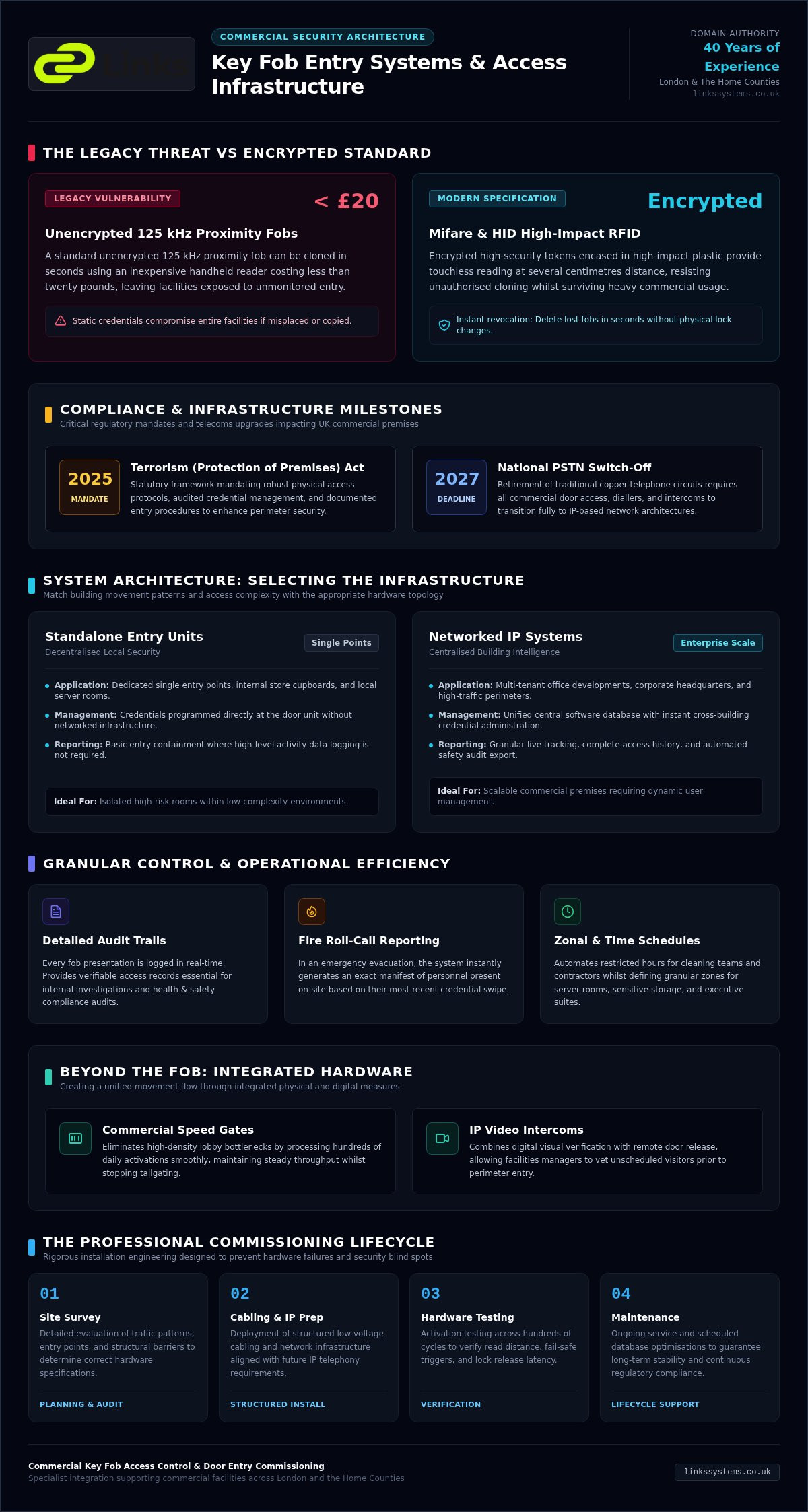
Did you know that a standard, unencrypted 125 kHz proximity fob can be cloned in seconds using a device that costs less than twenty pounds? For many facility managers, this hidden vulnerability is a sobering reminder that legacy security often provides little more than a false sense of protection. Engaging professional key fob door entry installers is the first step in moving away from these outdated risks and towards a truly resilient commercial infrastructure.
We understand the logistical headache of rekeying entire floors because a master key went missing, or the frustration of entry bottlenecks caused by unreliable hardware. You need a system that works every time and tells you exactly who is where. Professional commissioning allows you to transition to a high-security, encrypted system that eliminates the risk of unauthorised cloning whilst providing granular control over every zone in your building.
This article explores how modern access control integration provides robust audit trails, ensures compliance with the Terrorism (Protection of Premises) Act 2025, and creates a seamless movement experience for your staff. We’ll examine the shift to IP-based infrastructure, ensuring your premises remain secure and future-proofed against the upcoming 2027 PSTN switch-off and evolving security requirements.
Key Takeaways
- Understand the security advantages of digital identity over physical keys, specifically the ability to instantly revoke access when credentials are lost or stolen.
- Learn how to choose between standalone units and networked IP systems by consulting with expert key fob door entry installers to match your building’s scale and movement patterns.
- Discover how integrating your entry system with commercial speed gates and IP video intercoms creates a unified security infrastructure that streamlines staff movement.
- Gain insight into the professional commissioning process, covering everything from the initial site survey and cabling to final hardware testing and long-term maintenance.
- Recognise the value of partnering with a specialist who brings 40 years of experience to complex commercial projects across London and the Home Counties.
The Evolution of Commercial Access: Why Professional Key Fob Installation Matters
Commercial security has moved far beyond the limitations of the traditional metal key. Modern physical access control systems now rely on RFID-based digital identity, where a unique encrypted token replaces the vulnerability of a physical lock. When you engage professional key fob door entry installers, you’re not just buying a lock; you’re investing in a dynamic management tool. Physical keys are static. If one is lost, the security of the entire building is compromised until every lock is changed. Fobs, by contrast, offer instant revocability. A lost credential can be deleted from the database in seconds, maintaining the integrity of the site without the expense of a locksmith.
For high-traffic commercial centres, the long-term operational savings are substantial. Eliminating the need for physical lock changes across multi-tenant offices or large corporate headquarters removes a significant recurring cost. Professional design ensures that the hardware selected can withstand the rigours of hundreds of daily activations, preventing the entry bottlenecks that often plague poorly specified systems. A well-commissioned system creates a steady flow of authorised personnel whilst keeping unauthorised visitors at bay.
The Advantages of RFID and Proximity Technology
Most modern systems utilise Mifare or HID proximity fobs, which allow for touchless entry. These tokens are designed for durability, often encased in high-impact plastic that survives the daily wear and tear of a busy workplace. RFID technology, or Radio Frequency Identification, uses electromagnetic fields to automatically identify and track tags attached to objects or carried by personnel. This allows for a “read” distance of several centimetres, meaning staff don’t need to fumble with keyholes or swipe cards through physical slots. It’s a faster, cleaner, and more reliable method of movement.
Improving Operational Efficiency in the Workplace
Beyond basic security, fobs provide a level of granular control that keys simply cannot match. Facilities managers can set time-restricted access for contractors, cleaners, or temporary visitors, ensuring they only enter the building during their scheduled hours. This reduces the administrative burden on management teams who no longer need to sign keys in and out. It’s a shift from reactive security to proactive management.
- Detailed audit trails: Every entry event is logged, which is vital for health and safety compliance and internal investigations.
- Fire roll-call reporting: In the event of an emergency, the system can generate an instant list of who is on-site based on their last fob swipe.
- Zonal control: You can restrict access to sensitive areas like server rooms or executive suites without needing separate keys for every door.
By integrating these systems, businesses gain peace of mind and a clearer understanding of how their space is used. It’s about more than just a door; it’s about building a reliable infrastructure that supports the daily operations of a professional environment. Our experience as key fob door entry installers ensures that these technical requirements are met with precision and long-term stability.
Standalone vs. Networked Systems: Identifying the Right Infrastructure
Selecting the right infrastructure is a critical decision for any facility manager overseeing a commercial site. Professional key fob door entry installers generally categorise systems into two main types: standalone and networked. While both utilise RFID technology, the underlying architecture determines how you manage users and how the system responds to security events. The choice between them often depends on the scale of your premises and the complexity of your staff movement patterns.
Standalone Access Control: Simplicity for Single Points
Standalone systems are ideal for single points of entry where high-level data logging isn’t the primary concern. They’re often found on internal doors, such as server rooms or sensitive storage cupboards, where the goal is simply to keep unauthorised staff out. These units are programmed locally. You add or delete fobs directly at the door reader using a master card or remote. While cost-effective for a single door, they become an administrative burden if you’re managing dozens of users across multiple entries. There’s no central database to check who entered at what time, making them less suitable for primary perimeter security.
Networked IP Systems: Centralised Management for Skyscrapers
Networked IP systems represent the standard for modern commercial estates and multi-floor developments. These systems link every door controller to a central server or cloud-based platform via your existing data network. This allows for real-time monitoring and instant user revocation. If a member of staff leaves the organisation, their access is cancelled across the entire estate with a single click. Adhering to facility access control best practices ensures that these networked environments remain resilient against both physical and digital threats.
Power over Ethernet (PoE) technology has streamlined the installation of these systems significantly. It allows power and data to run over a single cable, reducing the need for local power points at every door. This is particularly beneficial for businesses in Essex and Kent business parks that require scalable solutions. As your business grows, adding a new door to the network is a straightforward process. Cloud-based controllers further enhance this by allowing facility managers to adjust permissions from a smartphone, regardless of their location.
The choice between these systems depends on your specific flow requirements and security objectives. Professional system commissioning ensures that whether you choose a standalone or networked approach, the hardware is configured for maximum reliability. Our role as key fob door entry installers is to guide you through this technical selection, ensuring the infrastructure supports your long-term operational goals.
Beyond the Fob: Integrating Access Control with Wider Security
A common oversight in commercial security is treating the access point as an isolated hardware installation. Professional key fob door entry installers prioritise the “Integrated” element of a security plan, ensuring that a single fob swipe triggers a chain of coordinated responses across the building. When your entry system exists in a vacuum, you lose the ability to verify events or manage flow effectively. True security is found in the synergy between different technologies, creating a unified environment that is easier to monitor and harder to breach.
Following established Interagency Security Committee best practices for facility access control, an integrated approach ensures that credentials are not just verified by a database, but supported by secondary security layers. For site managers, integrating CCTV with access control systems provides the ultimate layer of visual verification. If a fob is used at an unusual hour, the system can automatically flag the corresponding video footage. This “single pane of glass” management allows security teams to oversee gates, doors, and cameras from one interface, significantly improving response times and operational clarity.
Synchronising Fobs with Speed Gates and Barriers
In high-traffic environments, there is a natural synergy between fob entry and commercial speed gates. In busy London lobbies, these gates manage pedestrian flow with precision, preventing “tailgating” by ensuring the barrier only resets once a single person has passed. The same fob used for the front door can also control vehicle barriers in commercial car parks. This creates a seamless experience for staff whilst enforcing strict anti-passback rules, which prevent a user from passing their fob back to an unauthorised person once they’ve entered a zone.
IP Video Intercoms and Visitor Management
Staff members aren’t the only people moving through your building. IP video intercoms bridge the gap between staff and visitor access, allowing for high-definition visual verification before any entry is granted. This is particularly vital in commercial hubs where deliveries and guest meetings are constant. By using an IP-based system, receptionists or security guards can view visitors on their workstations or mobile devices, ensuring that the person requesting entry matches their stated purpose. It streamlines the delivery process without compromising the integrity of the secure perimeter, providing a professional first point of contact for every visitor.
By working with experienced key fob door entry installers, you ensure these complex technical layers are commissioned correctly. Our 40 years of industry experience allows us to design systems where speed gates, intercoms, and CCTV work in total harmony. It’s about moving away from fragmented security and towards a steady, reliable infrastructure that protects your assets and your people simultaneously.
The Installation and Commissioning Process: What to Expect
The process begins with a meticulous site survey. Professional key fob door entry installers don’t just count doors; they analyse how staff and visitors move through the space. We identify structural weak points and ensure that the chosen hardware matches the fire safety requirements of the building. This initial phase ensures that the system design is fit for purpose before a single cable is laid. It’s about understanding the unique flow of your environment to prevent future bottlenecks.
Hardware installation follows, involving the routing of data cables and the fitting of electronic locks. Whether using electromagnetic locks or electric strikes, the physical integration must be precise to ensure long-term durability. However, the most critical stage is commissioning. Unlike basic installers who might consider the job done once the reader lights up, specialist commissioning involves programming the database, setting up user groups, and testing every door against fail-safe scenarios. This ensures the system behaves exactly as intended during both daily operations and emergencies.
Specialist System Commissioning
Commissioning is where the technical stability of the system is established. It involves fine-tuning the management software to prevent data conflicts and ensuring that the network communication between controllers is seamless. A professional handover includes comprehensive staff training, allowing your facilities team to manage the system with confidence. We provide detailed O&M manuals that serve as a permanent record of the system’s configuration and wiring, which is vital for any future system expansions.
Scheduled Maintenance and Reliability
To maintain 99.9% system uptime, a structured maintenance contract is essential. Electronic components and moving lock parts require periodic inspection to prevent wear-related failures. We conduct preventative checks on magnetic locks, readers, and power supplies to ensure they remain within operational tolerances. This proactive approach identifies potential issues before they cause a system failure or an entry delay.
Regular firmware updates are equally important. These updates protect the system against evolving digital threats and ensure compatibility with new hardware. Effective physical security integration relies on this ongoing attention to detail. A system that is neglected will eventually become a liability rather than an asset, whereas a maintained system provides peace of mind for decades.
Our approach ensures that your security infrastructure remains a dependable pillar of your business operations. If you require a system designed for long-term reliability, you can contact our commissioning team to discuss your project requirements.
Securing London and the Home Counties: Your Local Partner
Choosing the right partner for a commercial security project requires more than just technical knowledge; it demands an understanding of the local landscape. Links Integrated Systems brings 40 years of industry experience to every project across London and the Home Counties. As established key fob door entry installers, we’ve developed a reputation for handling complex technical requirements with a composed, professional approach. Our longevity in the South East means we understand the specific operational pressures faced by facility managers in the UK’s most demanding commercial environments.
Our personality is that of an authoritative expert and a seasoned guide. We prioritise the quality of the relationship, moving away from transactional interactions towards a model of long-term partnership. This stability is vital when commissioning systems that must protect high-value assets and hundreds of staff members every day. We project the image of a specialist who deeply understands the expectations of high-level stakeholders, ensuring that every installation meets both technical and aesthetic standards.
Local Expertise in London and Kent
London’s architectural diversity presents unique challenges for access control. Historic buildings in the City or Westminster often feature thick masonry or listed status, which precludes traditional surface-mounted trunking. In these environments, we specialise in integrating wireless solutions or discreet cabling that preserves the building’s character whilst providing modern security. Conversely, the logistical needs of businesses in Kent, Surrey, and Hertfordshire often focus on wider perimeter control and the integration of vehicle barriers. Our commitment to local commercial infrastructure ensures that whether you’re managing a central skyscraper or a suburban business park, your system is designed for its specific context.
A Dedicated Partner for Commercial Stakeholders
We work closely with M&E contractors and property developers to ensure that security infrastructure is considered from the earliest stages of a project. We understand that a security system is only one part of a larger construction or renovation effort. By collaborating with these stakeholders, we ensure that the hardware installation aligns with the overall project timeline and aesthetic goals. Modern office environments demand high-spec finishes, such as brushed steel readers and minimalist glass speed gates, that complement contemporary architecture.
Our focus remains on building long-term relationships through precision and reliability. We don’t just install hardware; we commission integrated solutions that stand the test of time. For project managers who value meticulous planning and a proactive service model, we offer a level of expertise that generic providers cannot match. You can contact our London-based team for a professional consultation to discuss how we can secure your premises with a tailored access control strategy.
Building a Resilient Security Infrastructure for 2026
Transitioning to a modern access control system is more than a simple hardware upgrade; it’s a strategic move towards long-term operational stability. We’ve explored how moving from physical keys to encrypted RFID technology eliminates the recurring costs of lock changes whilst providing granular audit trails. By engaging professional key fob door entry installers, you ensure that your building’s infrastructure is not only secure but also future-proofed against evolving technical and regulatory requirements.
Integration remains the cornerstone of a truly effective commercial environment. Synchronising your fob system with IP video intercoms and commercial speed gates creates a unified management interface that simplifies staff movement and visitor verification. With over 40 years of specialist security experience, Links Integrated Systems provides the expert commissioning required for these complex projects across London, Kent, Surrey, Hertfordshire, and Essex.
Discuss your commercial access control requirements with our expert team to secure your premises with a system built on reliability and precision. We look forward to helping you streamline your building’s security and providing the peace of mind that comes with a professionally maintained solution.
Frequently Asked Questions
How much does a commercial key fob system installation cost?
Costs for commercial installations vary significantly based on the number of doors, the type of locking hardware required, and the complexity of the network infrastructure. Factors such as architectural constraints in historic London buildings or the need for integrated speed gates in corporate lobbies will influence the final investment. We provide bespoke specifications following a detailed site survey to ensure the hardware meets your specific operational requirements and security grade.
Can key fobs be copied or cloned by unauthorised persons?
Older 125 kHz proximity fobs are vulnerable to cloning; however, modern professional installations utilise encrypted standards like MIFARE DESFire EV3 or HID Seos. These high-security credentials use AES-128 or AES-256 encryption, making unauthorised duplication virtually impossible. Our role as key fob door entry installers is to specify hardware that protects your premises against common digital vulnerabilities, ensuring that only authorised tokens can communicate with your readers.
What happens to the door entry system during a power cut?
Professional systems include battery backup units (UPS) within the door controllers to maintain security during short-term power outages. In the event of a total or prolonged power failure, locks are configured to fail-safe or fail-secure depending on the fire safety strategy of the building. Fail-safe doors, such as those on designated escape routes, will automatically unlock to ensure safe egress, whilst fail-secure doors remain locked to protect sensitive assets.
Can I use my smartphone instead of a physical key fob?
Yes, modern IP-based access control systems support mobile credentials via Bluetooth (BLE) or Near Field Communication (NFC). This allows staff to use a secure app on their smartphone to gain entry, eliminating the need for physical tokens. This technology is increasingly popular in London office developments as it streamlines the onboarding process and reduces the administrative burden of managing physical fob inventories for large, mobile workforces.
Is it possible to integrate fobs with our existing CCTV cameras?
Integration is possible when using open-platform management software that links your entry events with high-definition IP CCTV systems. This allows for visual tagging; when a fob is swiped, the system automatically bookmarks the corresponding video footage for review. This synchronisation is a core part of the commissioning services we provide to commercial clients in Kent and Essex, creating a more robust and verifiable security audit trail.
How many users can a networked access control system handle?
Networked systems are highly scalable and can manage anywhere from a few dozen users to tens of thousands across multiple sites. For large-scale commercial projects in Surrey or Hertfordshire, we implement systems that grow with the organisation. There is virtually no limit to user capacity when using server-based or cloud controllers, allowing for granular permission management across complex estates with hundreds of individual entry points.
Do you provide key fob installation for residential blocks of flats?
We focus exclusively on commercial and professional environments, including large-scale multi-tenant office developments and corporate headquarters. Whilst we do not provide residential burglar alarms, we do install and maintain advanced access control and IP video intercom systems for commercial landlords and property developers managing large residential portfolios. Our expertise is tailored to the high-spec technical requirements of professional stakeholders and M&E contractors across the South East.
What is the difference between a proximity fob and a smart card?
A standard proximity fob typically uses low-frequency radio waves to transmit a simple ID number to a reader. In contrast, a smart card often operates at a higher frequency and contains a microprocessor capable of handling encrypted data and multiple applications. Smart cards provide a higher level of security through mutual authentication between the card and the reader, making them the preferred choice for high-security commercial centres across the London area.