
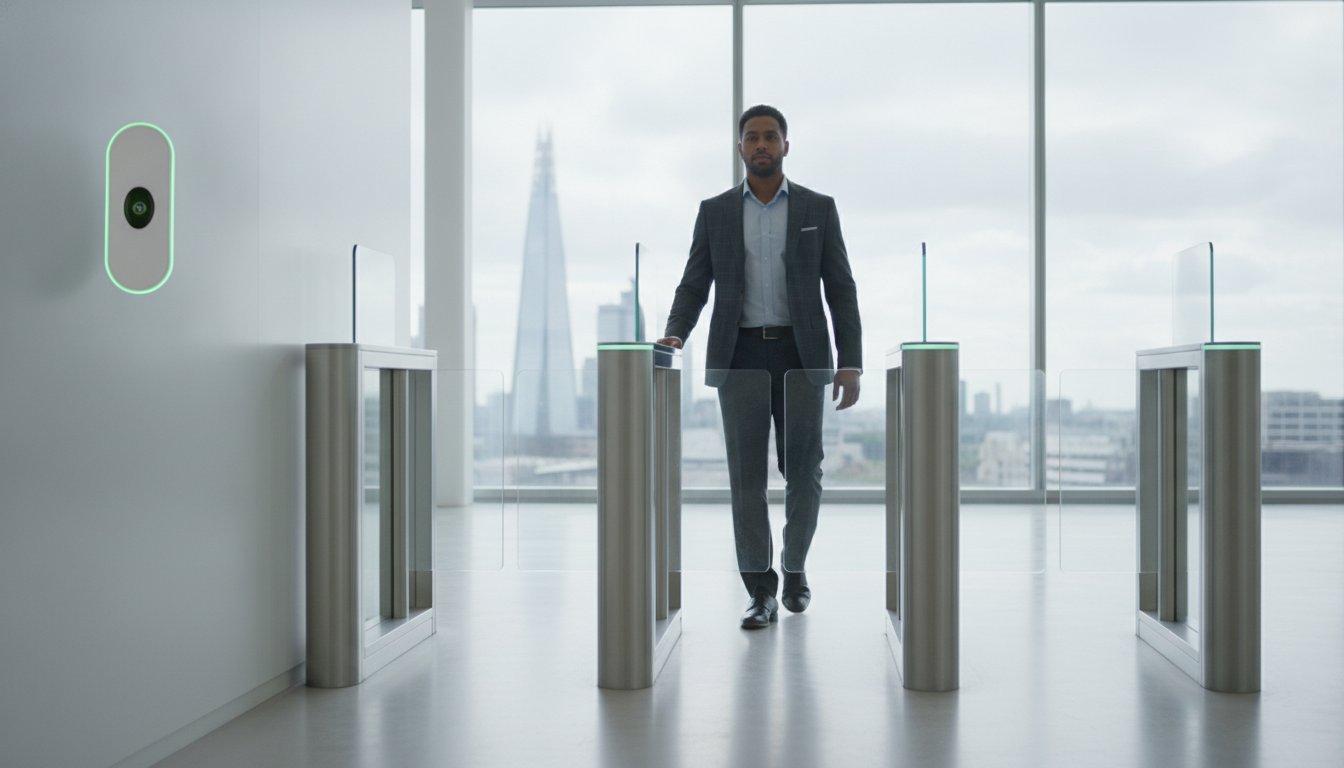
Physical security is only as strong as the credentials your staff are prone to losing. For many UK building managers, the morning rush is frequently interrupted by the frustrated beep of a forgotten card or the quiet slip of an unauthorised visitor through a busy lobby. Implementing biometric access control for business isn’t just about modernising an entrance; it’s about replacing these physical vulnerabilities with a permanent, unique identifier that cannot be misplaced, stolen, or shared between employees.
You likely recognise that whilst biometrics offer a truly frictionless entry experience, the complexity of managing special category data under the Data (Use and Access) Act 2025 requires a meticulous and expert approach. This guide will help you master the technical deployment of biometric hardware, ensuring your facility achieves a seamless flow whilst remaining fully compliant with the latest UK standards. We’ll examine the integration of high-performance readers with your existing CCTV and speed gates, alongside the essential audit trails and professional maintenance schedules required for robust corporate security in 2026.
Key Takeaways
- Identify how transitioning from physical fobs to physiological identification eliminates the operational risks associated with lost credentials and unauthorised tailgating.
- Compare the throughput efficiency of facial recognition, fingerprint scanning, and iris verification to select the optimal modality for high-traffic commercial lobbies.
- Navigate the legal complexities of the Data (Use and Access) Act 2025 by understanding the mandatory requirements for a Data Protection Impact Assessment (DPIA) when implementing biometric access control for business.
- Learn the technical strategies for integrating biometric readers with speed gates and barriers to ensure a frictionless, sub-second entry experience for authorised personnel.
- Recognise the critical role of professional commissioning and proactive maintenance in preventing false rejections and maintaining the long-term integrity of your security infrastructure.
Understanding Biometric Access Control in Modern Business Environments
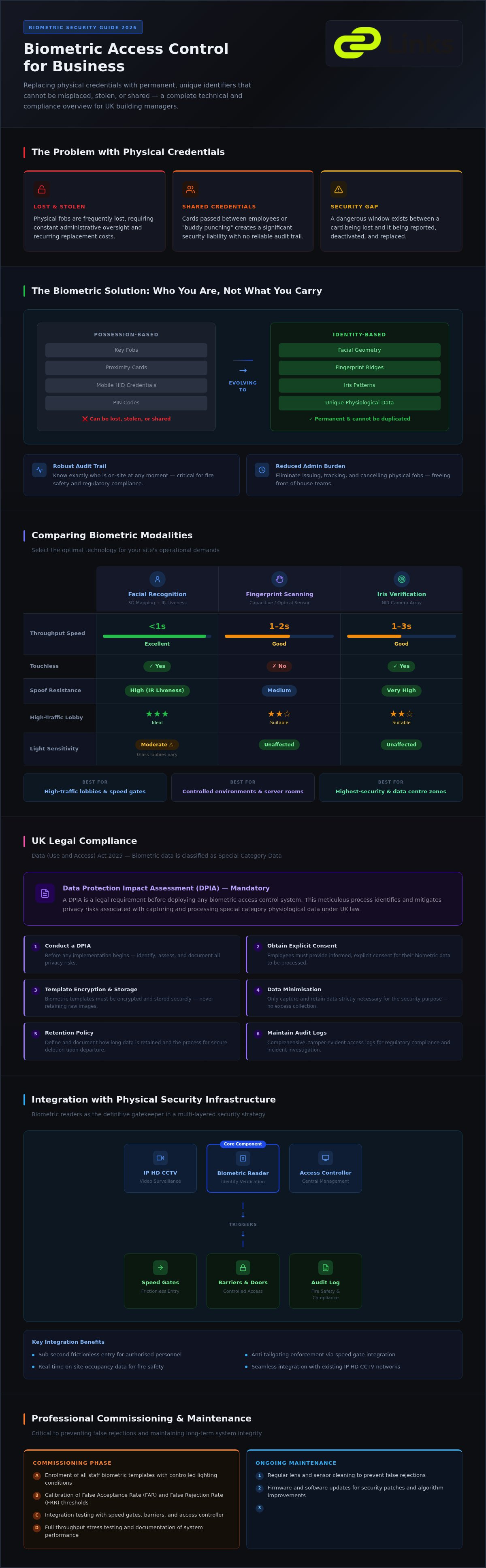
Biometric access control for business represents a fundamental shift in how we secure physical perimeters. Rather than relying on what a person carries, such as a fob or a key, these systems verify identity based on who the person is. This involves the capture and digital encoding of unique physiological characteristics, including iris patterns, facial geometry, or fingerprint ridges. A foundational Understanding Biometric Access Control begins with the transition from possession-based credentials to these inherent traits, which cannot be easily duplicated or shared.
In 2026, corporate security leads are prioritising these systems to address the growing risks of credential theft and “buddy punching.” Physical tokens are easily passed between employees or intercepted by unauthorised individuals. By contrast, a biometric template is tied strictly to the individual. When integrated into a multi-layered security strategy, these readers act as the definitive gatekeeper, ensuring that only authorised personnel can progress past the lobby or into sensitive server rooms.
The Evolution of Access Credentials
The history of commercial security has moved steadily towards reducing friction whilst increasing certainty. We’ve seen a logical progression from mechanical keys to proximity cards, and more recently, to mobile HID credentials stored on smartphones. However, physical tokens remain a significant liability for high-security sites. They’re frequently lost, requiring constant administrative oversight and the recurring cost of replacements.
The shift towards touchless technology in London’s commercial centres has accelerated this evolution. Modern offices now favour “frictionless” entry, where employees don’t need to pause to scan a card. Facial recognition and iris scanners allow for a continuous flow of traffic, which is essential for maintaining productivity in busy lobbies. This move away from touch-based systems also aligns with the high standards of hygiene expected in contemporary professional environments.
Core Benefits for Commercial Property Managers
For those managing large estates or multi-tenanted buildings, the operational advantages of biometrics are substantial. You can effectively eliminate the time-consuming task of issuing, tracking, and cancelling physical fobs. This reduces the administrative burden on front-of-house teams and removes the security gap that exists between a card being lost and it being reported and deactivated.
The precision of the data gathered is equally valuable. Unlike a shared card, a biometric scan provides a robust audit trail. You’ll know exactly who is on-site at any given time, which is a critical requirement for both fire safety and regulatory compliance. Beyond the technical benefits, these systems enhance the professional aesthetic of a corporate lobby. Sleek, integrated readers mounted on speed gates project an image of stability and technological competence, reassuring both stakeholders and visitors that the building’s security is managed by an experienced hand.
Comparative Analysis of Biometric Modalities for Commercial Use
Selecting the appropriate hardware for biometric access control for business requires a thorough assessment of your site’s specific operational demands. Different modalities offer varying levels of security, throughput, and environmental resilience. Whilst one technology might excel in a climate-controlled data centre, it may struggle in a glass-fronted lobby subject to changing light conditions. Choosing correctly ensures a balance between high-security assurance and the frictionless experience expected in modern professional spaces.
Facial Recognition: The Standard for Frictionless Entry
Facial recognition has become the preferred choice for high-traffic London lobbies due to its superior throughput speeds. Modern terminals utilise 3D mapping and infrared liveness detection to distinguish between a real person and a high-resolution photograph or video. This prevents spoofing attempts whilst maintaining a sub-second verification time. These systems frequently integrate with biometric access control for business and existing IP HD CCTV, allowing for secondary visual verification by security teams during peak hours.
Environmental factors, particularly lighting, are critical considerations. In glass lobbies, glare can interfere with standard 2D cameras; however, professional grade 2026 terminals use active illumination to remain reliable regardless of external weather or time of day. This reliability is vital for managing the intense pedestrian flow seen in skyscraper lobbies during the morning rush hour, where even a two-second delay per person can create significant bottlenecks at the speed gates.
Fingerprint and Palm Vein Technology
For industrial settings or back-of-house areas, fingerprint readers remain a staple. Systems like ievo-style readers are designed to handle challenging conditions where fingers may be wet, dusty, or cold. They provide a high level of security at a lower price point than facial recognition. However, the rise of palm vein scanning offers a more hygienic and secure alternative for sensitive environments like data centres. By mapping the unique vein patterns beneath the skin, this modality is nearly impossible to forge and requires no physical contact with the sensor.
Maintaining these systems is essential to prevent an increase in False Rejection Rates (FRR). Contact-based readers require regular cleaning to remove oils and debris, whilst contactless systems need periodic calibration of their optical sensors. Seeking professional system maintenance and commissioning ensures your chosen modality remains a dependable pillar of your security infrastructure, avoiding the frustration of legitimate staff being denied entry.
Navigating UK GDPR and Data Privacy for Biometric Security
Biometric data used for unique identification is classified as “special category data” under Article 9 of the UK GDPR. This classification means that implementing biometric access control for business requires a robust legal basis beyond simple commercial interest. The Data (Use and Access) Act 2025, which came into full effect in June 2026, further clarifies the responsibilities of data controllers in the UK. You must demonstrate that the use of biological data is necessary and proportionate to your security objectives, rather than just a matter of convenience.
Privacy by design is the cornerstone of a compliant installation. Professional systems don’t store raw images of faces or fingerprints; instead, they convert these traits into an encrypted mathematical template. This process is irreversible. Even if the database were compromised, the mathematical string could not be reconstructed into the original biological image. Clear communication of these technical safeguards is essential for maintaining employee trust. When staff understand that their biological data is secure and the system enhances their own safety, adoption rates typically increase.
Compliance Standards for 2026
The Information Commissioner’s Office (ICO) updated its guidance in early 2026 to reflect the nuances of the Data (Use and Access) Act. These standards require that your biometric access control for business deployment is supported by a clear privacy notice. Your security partner must guarantee that all data transmission between readers and the central controller is encrypted end-to-end. Additionally, you must respect the “Right to Object” by providing an alternative, non-biometric entry method for any staff member who declines enrolment. This ensures your security posture remains inclusive and legally sound.
Best Practices for Data Management
Effective data management requires strict retention policies that are reviewed as part of your annual security audit. When an employee leaves the organisation, their biometric template should be purged from the local database and the central server immediately. Professional Integrated Physical Security Solutions provide the administrative tools needed to automate these compliance tasks, reducing the risk of local data breaches. To remain compliant with UK law in 2026, every business must conduct a comprehensive Data Protection Impact Assessment (DPIA) to justify the necessity and proportionality of processing biometric data.
Integrating Biometrics with Physical Security Infrastructure
Biometric readers serve as the central intelligence for your physical barriers. For a successful deployment of biometric access control for business, the interaction between the software verification and the physical gate motor must be instantaneous. A reader that identifies a user in milliseconds is of little value if the speed gate relay is poorly configured, leading to a staggered and frustrating entry process. Precision commissioning ensures that the command to open is synchronised with the moment of recognition, maintaining the “frictionless” experience that modern corporate environments demand.
Linking these biometric events with IP HD CCTV creates a comprehensive, multi-dimensional audit trail. While the access system logs the digital identity, the integrated camera captures a high-definition visual record of the event. This dual-layer verification is essential for investigating tailgating incidents or unauthorised access attempts. For guests or employees facing biometric exceptions, IP video intercoms provide a vital communication link to security teams, allowing for manual verification without compromising the integrity of the secure perimeter.
Biometrics and Speed Gate Synchronisation
Managing the relay between the biometric reader and the speed gate controller requires technical expertise to ensure sub-second response times. In high-volume lobbies, we typically recommend one reader per lane to prevent bottlenecks. It’s also a legal necessity to ensure these systems are fail-safe. In accordance with BS 7273-4, all biometric-controlled gates must automatically unlock and remain open during a fire alarm or total power outage to allow for unimpeded evacuation. This level of professional speed gate and barrier integration is what separates a standard installation from a robust, compliant security solution.
Unified Security Platforms
Modern security management relies on a single, unified interface to monitor multiple sites across London, Kent, and Surrey. By integrating CCTV with access control, facility managers can oversee user permissions and view live entry footage from a central dashboard. This scalable IP architecture is designed to be future-proof, allowing for the addition of more readers or cameras as your business expands. Moving towards a unified platform reduces the complexity of managing disparate systems and ensures that your security infrastructure remains a stable, dependable asset for years to come.
Professional Commissioning and Maintenance of Biometric Systems
The successful deployment of biometric access control for business relies as much on precise commissioning as it does on the quality of the hardware. Whilst a standard card reader is relatively binary in its operation, biometric terminals are sophisticated optical and mathematical instruments. They require expert calibration to function reliably within the specific environmental conditions of your site. With 40 years of industry experience, Links Integrated Systems understands that the difference between a secure, efficient perimeter and a frustrated workforce lies in the meticulous attention paid during the initial setup phase.
A primary concern for any facility manager is the False Rejection Rate (FRR). This occurs when the system fails to recognise a legitimate, enrolled user, leading to bottlenecks at speed gates and a loss of business productivity. High FRR levels are rarely a fault of the technology itself; they’re typically the result of poor commissioning or a lack of user training. Professional installation ensures that readers are positioned and calibrated to minimise these errors, maintaining the frictionless flow of staff even during the busiest periods of the working day.
The Commissioning Process
Our commissioning workflow begins with rigorous environmental testing. A reader mounted in a glass-fronted lobby must be calibrated to account for the shifting glare of the afternoon sun; otherwise, it may fail to recognise authorised staff during peak hours. We also prioritise user enrolment training. It’s essential that your employees understand the correct positioning and “behaviour” required for a successful scan. Finally, we conduct system stress-testing. By simulating the heavy traffic loads typical of London’s commercial hubs, we ensure the network architecture can handle simultaneous biometric requests without latency.
Ensuring Long-Term Reliability
Biometric sensors are exposed to environmental contaminants such as dust, oils, and varying humidity levels. Over time, these factors can degrade the clarity of the sensor, leading to a steady increase in false rejections. This is why system maintenance and commissioning are non-negotiable for high-security environments. Scheduled visits involve the deep cleaning of optical surfaces and the application of 2026 security patches to the system’s firmware, protecting your infrastructure against evolving physical and digital threats.
Relying on ad-hoc repairs is often more costly than a proactive maintenance contract. Our teams provide local support across Hertfordshire, Essex, and Kent, ensuring a rapid response to any technical issues. By treating your security system as a long-term asset that requires regular professional care, you protect your investment and ensure that your building remains a safe, welcoming environment for your stakeholders. Precision and reliability aren’t just goals; they’re the standards we’ve maintained for four decades.
Securing the Future of Your Commercial Perimeter
Deploying biometric access control for business is a strategic investment in long-term operational stability. Moving beyond physical fobs and cards eliminates the recurring risks of credential sharing and theft, replacing them with a unique, encrypted identifier. Success depends on precision. You must navigate the 2026 UK data landscape whilst ensuring your hardware is perfectly synchronised with your physical barriers to maintain a frictionless flow of personnel.
A high-performance security system is only as reliable as its commissioning. With 40 years of experience in high-security integration, Links Integrated Systems provides the technical expertise required to achieve sub-second access reliability across your site. As specialist installers for London, Kent, Surrey, and the Home Counties, we ensure your infrastructure meets the most rigorous standards. We’re here to guide you through every stage of the project lifecycle.
Ready to modernise your facility? Contact Links Integrated Systems for a professional biometric specification and gain the peace of mind that comes from working with a seasoned industry leader.
Frequently Asked Questions
Is biometric access control legal for UK businesses under GDPR?
Biometric access control for business is legal in the UK provided you comply with the Data Protection Act 2018 and the recent Data (Use and Access) Act 2025. Because biological data is “special category data,” you must complete a Data Protection Impact Assessment (DPIA) before installation. This document justifies why biometrics are necessary for your security and outlines how you protect the privacy of your staff in London or the Home Counties.
What happens to biometric access control during a power cut or fire alarm?
All access control systems must integrate with your fire alarm to comply with BS 7273-4. During an alarm, the system triggers a fail-safe mode that automatically unlocks all doors and speed gates to allow for immediate evacuation. For power cuts, we install battery backup units to maintain security, or the hardware can be configured to unlock depending on the safety requirements of your specific commercial site.
Can biometric systems be fooled by photos or fake fingerprints?
Professional-grade biometric readers in 2026 utilise advanced “liveness detection” to prevent spoofing. Facial recognition terminals use infrared sensors and 3D mapping to distinguish a real person from a high-resolution photograph or video screen. Similarly, high-end fingerprint readers can detect blood flow or skin conductivity. These technical safeguards ensure your perimeter remains secure against fraudulent entry attempts, providing much higher assurance than traditional fobs or cards.
How long does it take to enrol an employee into a biometric system?
The enrolment process is efficient and typically takes less than two minutes per employee. During a session, the system captures multiple views of the user’s face or fingerprint to create a precise mathematical template. We recommend professional commissioning to ensure staff are trained on correct positioning. This initial investment in training significantly reduces the likelihood of false rejections when employees use the readers during busy periods in your lobby.
Which is better for a busy London lobby: facial recognition or fingerprints?
Facial recognition is generally the superior choice for high-traffic London lobbies. It offers faster throughput speeds, allowing staff to move through speed gates without breaking their stride. Because it is touchless, it also meets the high hygiene standards expected in modern corporate environments. Fingerprint readers are often better suited for internal high-security areas or industrial settings where lighting conditions might be less predictable or space is restricted.
How much does it cost to install biometric access control for an office?
The investment required for a biometric installation depends on several technical factors. These include the number of entry points, the specific modality chosen, and the complexity of integration with your existing speed gates or IP HD CCTV. Whilst hardware costs vary, the long-term value is found in the reduction of administrative tasks and fob replacement fees. We provide bespoke specifications to ensure the chosen system matches your building’s unique requirements.
Does biometric data storage pose a cybersecurity risk for my business?
Modern systems do not store raw images of your employees’ faces or fingerprints. Instead, the hardware converts biological traits into an encrypted mathematical string. This template is irreversible, meaning it cannot be turned back into a recognisable image if the database were compromised. By using end-to-end encryption for all data transmission, you significantly reduce the risk of a breach whilst maintaining a robust audit trail for compliance.
Can I integrate biometrics with my existing speed gates and turnstiles?
Integration is almost always possible if your existing infrastructure supports standard communication protocols like Wiegand or OSDP. We specialise in synchronising biometric readers with various models of speed gates and turnstiles across Kent, Surrey, and Essex. This allows you to upgrade your security credentials without the need to replace your entire physical barrier system, making it a cost-effective way to modernise the entrance of a commercial property.