
A door that fails to release, a credential that stops working or an access record that doesn’t match what happened can quickly disrupt a working day. Commercial access control maintenance in Kent is most useful when the plan reflects the doors, credentials and connected equipment at each site, rather than relying on a generic checklist.
If you manage an office, commercial building or multi-door premises, you need confidence that staff and visitors can move through the building as intended while restricted areas remain controlled. Planned maintenance checks system condition in advance; fault investigation starts with a problem that is already affecting access. Knowing the difference helps you set priorities and prepare the right information.
This guide explains what site-specific maintenance can cover, how to prepare for a maintenance visit or fault investigation, and what to consider when comparing approaches. It also looks at how access control may need to be considered alongside connected physical security equipment. Links Integrated Systems provides commercial system maintenance and commissioning, supporting the system throughout its lifecycle.
Key Takeaways
- Shape maintenance around the equipment installed and how each part of the site is used, rather than relying on a one-size-fits-all checklist.
- Review door hardware, readers, control equipment and user permissions to build a clearer picture of system condition.
- Compare maintenance approaches by scope, system coverage, records and coordination, especially when planning for multiple buildings.
- When reporting a fault, record the affected doors, user impact, recent changes and any visible system messages to help focus the investigation.
- Commercial access control maintenance in Kent can form part of a wider system lifecycle, alongside commissioning and connected physical security equipment.
Commercial access control maintenance in Kent: why plan before a fault?
For an office, commercial building or multi-door premises, access control needs to support everyday movement while keeping restricted areas controlled. A reader that responds inconsistently or a door that doesn’t operate as expected can delay staff, interrupt visitor arrivals and create uncertainty about entry. A site-specific plan for commercial access control maintenance Kent organisations rely on keeps these practical needs in view.
Access control combines credentials, readers, controlled doors and system functions to manage entry. The overview of physical access control explains the wider principles behind these arrangements. Maintenance applies those principles to the equipment and operating requirements of an individual site. A staff entrance, visitor route and restricted room may each need different attention.
Planned maintenance checks system condition before a fault is reported; fault investigation looks into a problem that has already affected operation. Both have a role. A planned check can review equipment and record issues for attention, while an investigation starts with a reported symptom and works towards its cause. Maintenance helps teams monitor the system, but it cannot ensure that faults will never occur.
What can a commercial access control maintenance plan cover?
Checks may include reader operation, credential use, controlled-door behaviour and relevant system functions. The right scope depends on the equipment installed and how the organisation uses each access point. For example, a staff entrance may experience frequent use, while a restricted room may need particular attention to who has permission to enter. A useful plan reflects those differences instead of applying the same checklist to every door.
Access control maintenance focuses on the access equipment and its operation. It isn’t a substitute for general building repairs or cybersecurity services. If access control connects with other physical security equipment, that relationship can inform site planning while keeping the scope of each maintenance task clear.
Which signs suggest an access control system needs attention?
Repeated reader failures, inconsistent door operation and permissions that need review are practical prompts to investigate. Recurring user reports or unexplained disruption also deserve attention, even if the system still works some of the time. Note whether reports involve the same door, credential or time of day. That pattern can help distinguish an isolated issue from one affecting a particular part of the system.
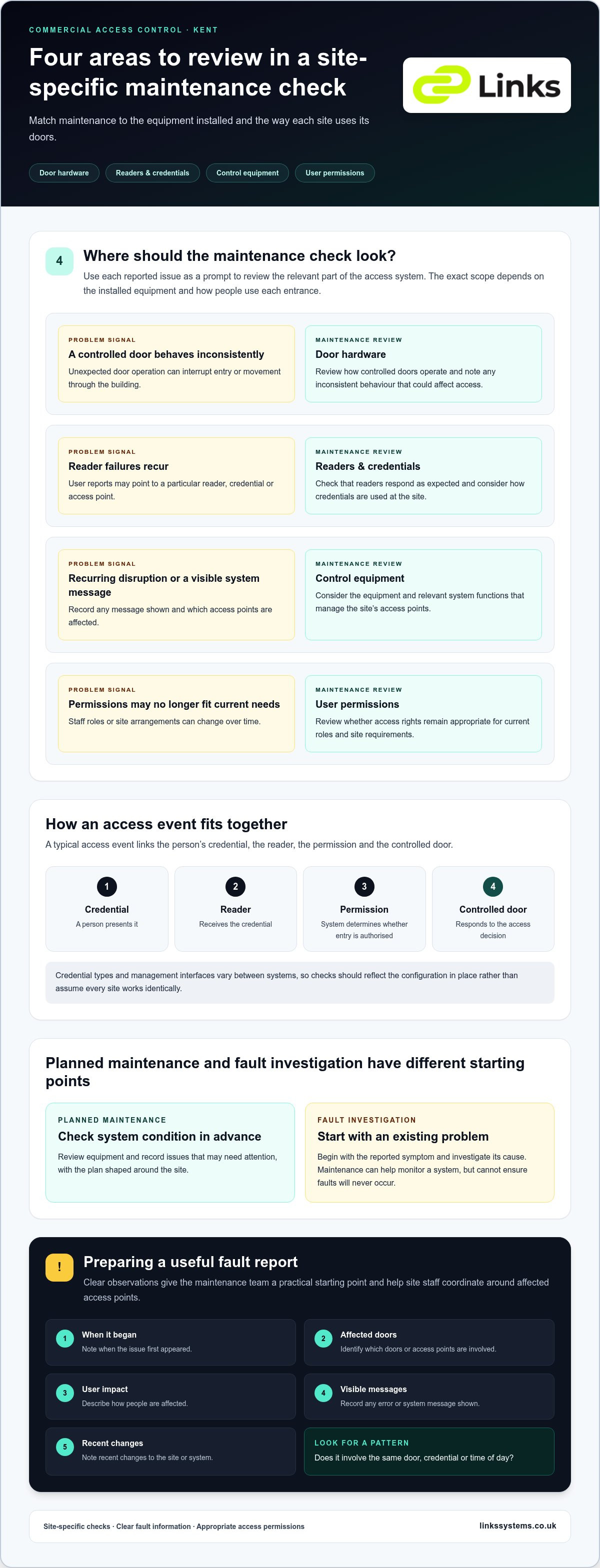
Before arranging an investigation, record when the issue began, which doors are affected, how users are impacted and any visible error messages. Note recent changes to the site or system, too. Clear observations give the maintenance team a useful starting point and help site staff coordinate around the access points in question.
What should Kent access control maintenance check across the system?
A well-planned approach to commercial access control maintenance Kent sites depend on looks at how the system works as a whole, not just whether an individual reader appears to respond. Checks can be organised into four areas: door hardware, credential readers, control equipment and user permissions. The precise scope should reflect the installed equipment and how people use each entrance.
Maintenance scope should match each site’s system configuration, because equipment and access requirements vary between premises. A single-door office and a building with several entry points may have different arrangements to review. A site-specific plan makes it clearer which components are included and helps identify where follow-up may be needed.
- Door hardware: Review the operation of controlled doors and note inconsistent behaviour that could affect entry or movement.
- Readers and credentials: Check that readers respond as expected and consider how credentials are used at the site.
- Control equipment: Consider the equipment and relevant system functions that manage the site’s access points.
- User permissions: Review whether access rights remain appropriate for current roles and site requirements.
How do door readers, credentials and access permissions fit together?
In a typical access event, a person presents a credential to a reader. The system uses the relevant permission to determine whether access is authorised, then the controlled door responds. Credential types and management interfaces vary between systems, so maintenance should account for the configuration in place rather than assume every site works identically.
Permissions can fall out of step with operational needs when staff roles or site arrangements change. Reviewing access records helps organisations identify rights that may need updating. This is a practical review of who should have access, not a replacement for the site’s own processes for managing staff changes. Handle records securely and share them only through the organisation’s established channels.
When should maintenance include connected security equipment?
If the site integrates access control with IP video intercoms or CCTV, maintenance planning can consider how that equipment relates to the access workflow. For example, an intercom may be part of how visitors request entry, while CCTV may provide visual context around an access point. Focus on the actual connections and how the equipment is used, rather than assuming every system is integrated.
For a closer look at system integration, read about integrating CCTV with access control systems. Links Integrated Systems also provides commercial system maintenance and commissioning as part of the wider lifecycle of physical security equipment.
How to compare commercial access control maintenance options in Kent
A useful comparison starts with how the maintenance approach fits the site, rather than with a standard package or assumed visit pattern. Consider which doors are in scope, how the system is configured, what records are available and how work can be coordinated around business activity. These points give you a clearer basis for assessing commercial access control maintenance Kent organisations need across different premises.
| Comparison area | What to consider |
|---|---|
| Scope | Which controlled doors and access functions are included, and whether the checks reflect how they are used. |
| System coverage | Whether the maintenance plan accounts for the installed configuration, including relevant connected equipment. |
| Records | How findings, identified issues and completed work are recorded for future reference. |
| Commissioning knowledge | Whether the original system configuration and intended operation can inform the maintenance checks. |
| Site coordination | How access to doors and equipment can be arranged around operating hours and business activity. |
Which maintenance scope suits a single building or multi-site estate?
A small office with one controlled entrance may need a focused plan for that door, its reader and the way staff use it. A multi-building estate may involve different door numbers, user groups and operating patterns at each location. This doesn’t mean every site needs an identical maintenance arrangement. The scope should reflect the actual equipment and the importance of each access point to daily operations.
Coordination matters as much as the equipment list. A busy entrance may need different arrangements during maintenance from a door used less frequently. Mapping the relevant doors, site contacts and working patterns helps organise the work and reduce avoidable clashes with normal operations.
How should commissioning and system records inform maintenance?
Accurate system records help establish what equipment is installed, how access points are configured and what operation was intended when the system was commissioned. They provide a practical reference, particularly if the system has changed over time. Keep available documentation together with a current door list and notes of relevant changes, such as updated access requirements or equipment.
System architecture also shapes what needs to be considered. A networked arrangement may have different operational dependencies from a more localised configuration. The guide to commercial access control systems offers further context on system choices. Where access control operates alongside other building security equipment, see physical security integration for commercial buildings.
Links Integrated Systems provides commercial system maintenance and commissioning. For a closer look at the service, visit commercial access control maintenance.
How to prepare for access control maintenance or a system fault in Kent
Clear information helps distinguish a fault affecting day-to-day access from checks arranged as planned maintenance. Before reporting an issue or preparing for a visit, gather practical details about what is happening and how the site operates. A precise summary gives the investigation or maintenance work a focused starting point.
What information helps investigate an access control fault?
Record what staff have observed rather than trying to diagnose the cause. Note the entrance, when the issue first appeared, how often it occurs and whether the system’s behaviour has changed. A reader that fails intermittently, a door that doesn’t operate consistently and a declined credential are different symptoms. Details such as whether the problem affects one user or several can help clarify what needs investigating.
Use your organisation’s normal secure process to share relevant system records or error messages. Avoid sending sensitive access information through informal channels.
How can a Kent site prepare for a maintenance visit?
For planned maintenance, make relevant doors, equipment locations and system records accessible while managing the effect on normal operations. A site contact can coordinate arrangements across an office, commercial building or multi-door premises. Let staff know the planned scope and any access arrangements they may need to follow.
Use this sequence to prepare:
- Record the symptoms. Note the affected door, time observed, frequency and any visible system message.
- Describe the impact. Identify who is affected and whether the issue concerns a reader, door operation, credential or user permission.
- Note recent changes. Include relevant changes to site use, access requirements or the system that may help explain the timing.
- Gather relevant records. Locate useful system information and share it through the organisation’s normal secure process.
- Coordinate access. Arrange access to the relevant doors and equipment locations, and flag busy operating periods or restricted areas to the site team.
- Follow established procedures. Keep building staff informed and follow the building’s existing access and security procedures while the issue is being assessed.
Planned maintenance examines system condition; fault investigation responds to a reported problem. A clear fault report helps focus the investigation, while good site coordination supports planned work with less avoidable disruption. Keep following the building’s established access and security procedures while any issue is assessed.
For commercial access control maintenance in Kent, view system maintenance and commissioning from Links Integrated Systems.
Commercial access control maintenance in Kent with Links Integrated Systems
Links Integrated Systems supports commercial sites in Kent with physical security system design, installation, commissioning and maintenance. This work connects maintenance with the wider system lifecycle: the installed arrangement and its intended operation can inform how checks are planned as a site’s needs evolve.
For a commercial premises, maintenance is most useful when it considers how access control is configured and used. A single office entrance has different operational priorities from a multi-door building with separate staff, visitor and restricted-area routes. The maintenance scope can reflect those differences and the equipment present.
How does a site-specific maintenance approach support reliability?
A site-specific plan brings together three considerations: the installed equipment, the way people move through the premises and the organisation’s operating priorities. That context helps focus attention on relevant access points and system functions. Commissioning knowledge can provide a useful reference for understanding intended operation, particularly where records describe the system configuration.
Links Integrated Systems’ commercial security work includes access control alongside related equipment such as speed gates, barriers, IP video intercoms and IP HD CCTV. These services are relevant when that equipment forms part of a site’s setup. The aim is to consider the actual system and its connections, rather than add unrelated checks.
What is the next step for a commercial site in Kent?
A useful starting point is a concise picture of the premises and its priorities. Outline whether the site is an office, commercial building or multi-site operation; describe the access control arrangement and any connected equipment; and note which doors or operating requirements need particular attention. If a fault prompted the discussion, include the symptoms and their effect on users.
These details help frame maintenance around the site’s configuration and operational needs. They also provide a starting point for considering how maintenance and commissioning fit into the wider lifecycle of commercial physical security systems.
For commercial access control maintenance Kent site managers can plan around their premises, discuss your commercial access control maintenance requirements with Links Integrated Systems.
Build a maintenance plan around your site
Dependable access control starts with a maintenance scope shaped around the equipment installed, the way people use the site and the importance of each access point. Planned checks assess system condition, while a clear fault procedure gives site teams a practical way to record symptoms and prepare useful information for investigation.
For commercial access control maintenance Kent businesses can plan effectively, keep system configuration, commissioning records and site operations in view. The right approach should reflect whether you manage a single office entrance or access across several buildings, and whether connected physical security equipment forms part of the setup.
Links Integrated Systems provides commercial security system maintenance and commissioning across Kent, London, Surrey, Hertfordshire and Essex. A conversation about your site type, system arrangement and maintenance priorities can help establish a practical way forward.
Discuss commercial access control maintenance in Kent with Links Integrated Systems to plan a maintenance approach around your premises.
Frequently Asked Questions
How often should commercial access control be maintained?
There’s no single maintenance interval that suits every commercial site. Planning should reflect the installed system, the number and use of controlled doors, operating patterns and the organisation’s requirements. A busy staff entrance may have different priorities from a door serving a restricted area. A site-specific plan can set out which checks are carried out and how findings are recorded, rather than relying on a generic schedule.
What does commercial access control maintenance include?
Maintenance may include checks on relevant readers, credentials, controlled doors, system functions and user permissions. The scope depends on the equipment installed and how the site manages entry. If access control is connected to IP video intercoms or CCTV, relevant interfaces may also be considered. A clear scope helps site managers understand which equipment is being examined and what records will be available after the work.
What should I do if a commercial access control system stops working?
Record the affected entrance or function, when the issue began, who is impacted and any visible system messages. Note whether the problem concerns a reader, door operation, credential or permission. Follow your organisation’s established access and security procedures while the fault is assessed, and share relevant system information through the normal secure process. These details provide useful context for investigation.
Can access control maintenance be carried out while a business is open?
Maintenance can be planned around normal business operations, with arrangements based on the site and system. Identify busy periods, affected entrances and restricted areas before work is arranged. Consider how staff and visitors will use the relevant routes during the work, then inform the people who may be affected. Clear coordination helps reduce confusion and supports orderly access while maintenance is undertaken.
Does access control maintenance cover CCTV and video intercoms as well?
The scope depends on the equipment installed and how the site’s systems are configured. Access control may operate alongside IP video intercoms or CCTV, with relevant connections forming part of a wider physical security arrangement. Identify which equipment and interfaces are included in the maintenance scope. Not every site uses connected systems, so the checks should reflect the actual setup.
What information should I prepare before arranging access control maintenance in Kent?
Prepare the site address, a summary of the access control arrangement, affected doors and any recurring issues or recent changes. Note operational priorities, access arrangements, suitable working periods and restricted areas. Relevant system records may also help explain a fault. Links Integrated Systems provides commercial system maintenance and commissioning across Kent, London, Surrey, Hertfordshire and Essex, supporting site-specific planning for commercial security infrastructure.
Can maintenance help reduce access control disruption?
Planned maintenance helps organise system checks and identify issues for investigation, but faults can still occur. A useful plan reflects the installed equipment and site priorities, records findings and clarifies how issues are documented for follow-up. Keeping accurate system information and preparing a clear fault report can also make an investigation more focused if a problem arises between planned maintenance visits.