

What if the strongest entry control for a London site isn’t the right choice for the people who use it every day? Choosing biometric access control systems London organisations can use responsibly means balancing identity assurance with privacy, reliable entry and the practical needs of staff and visitors.
It’s reasonable to have questions. Fingerprint, facial and other biometric methods work differently, and a system that suits a controlled office entrance may not fit a busy commercial building. Biometric access also involves personal information. Where it’s used to identify someone uniquely, that information is special category data under UK GDPR, so privacy needs to be considered alongside security from the outset.
This guide explains how biometric access works, compares common approaches with cards and fobs, and outlines considerations for commercial installations in London, Kent, Surrey, Hertfordshire and Essex. You’ll learn how to assess site security and entry traffic, plan for privacy and accessibility, and prepare for day-to-day operations. The aim is a considered access control design, with commissioning and ongoing maintenance included in the project lifecycle.
Key Takeaways
- Assess whether biometric access control systems suit your premises by matching the approach to site security, user groups and entry traffic.
- Remember that a biometric reader is only one part of access control: permissions and entry rules still determine who can enter and where.
- Compare biometrics with cards, fobs and PINs for ease of use, administration and privacy considerations.
- Plan user groups, access alternatives and system responsibilities before installation to support a considered rollout.
- Understand how design, installation, commissioning and scheduled maintenance fit together in a managed commercial security project.
Biometric access control systems in London
Biometric access uses a person’s physical or behavioural characteristic to support identity-based entry. A reader captures information for comparison with an enrolled user’s biometric data, then the access control system applies its configured permissions. The reader is one component, not a standalone security strategy: doors, entry rules, user permissions and the way people move through a building all matter.
In London, an office, managed building or commercial site may consider identity-based entry where access needs to be controlled for defined groups or areas. The case depends on site risks and routines, not simply on the availability of biometric technology. A busy reception entrance, for example, has different demands from a staff-only room used by a stable group of authorised people. The same considerations apply to commercial premises across Kent, Surrey, Hertfordshire and Essex.
How biometric entry differs from cards, fobs and PINs
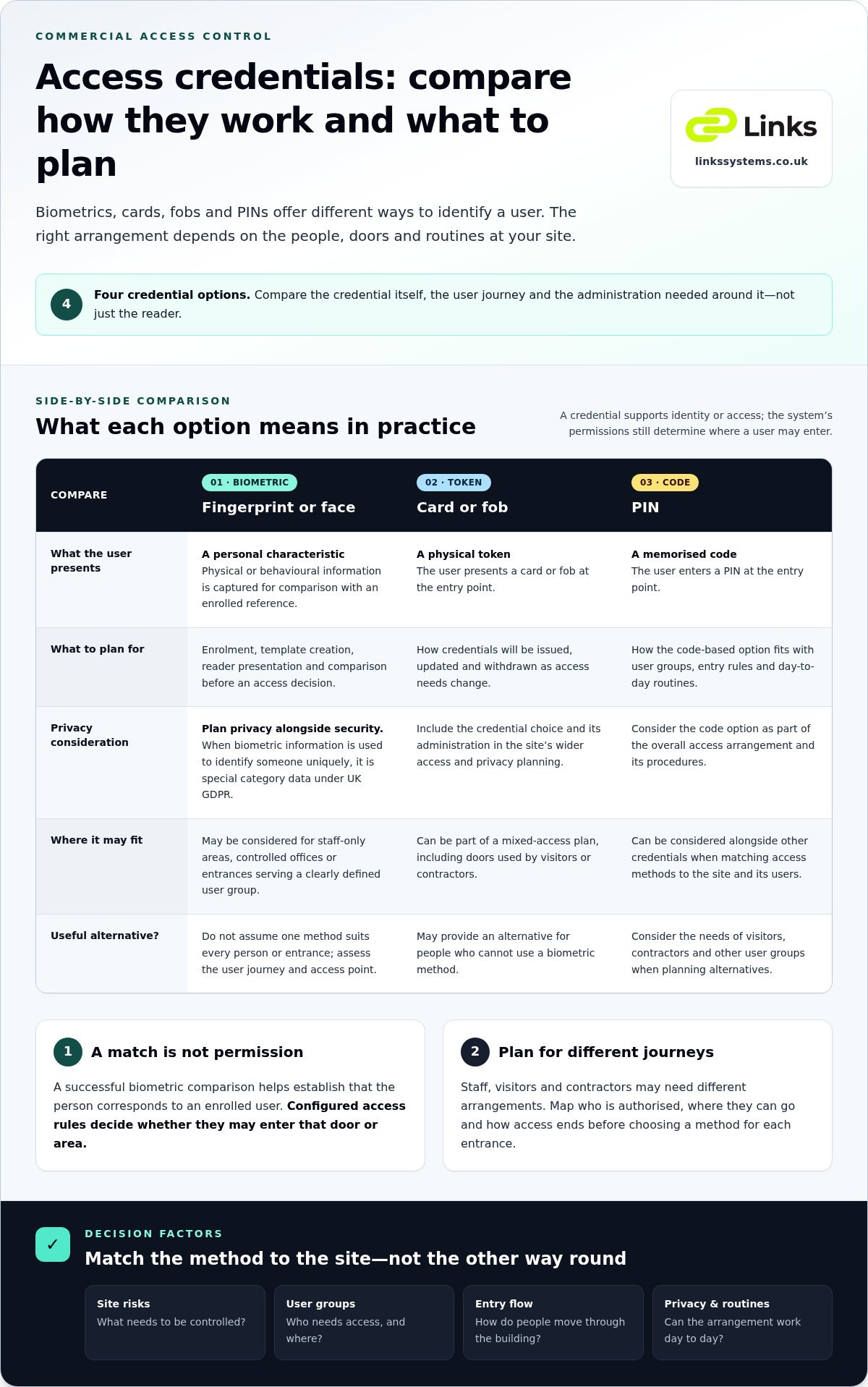
A biometric credential is based on a characteristic associated with the individual. A card or fob is a physical token, whilst a PIN is a code the user memorises. Each approach has different operational and privacy considerations. For a general overview of the concepts and identification methods, see Biometric Authentication.
Cards, fobs and PINs can remain useful within a mixed-access plan. They may suit doors used by visitors or contractors, or provide an alternative for people who cannot use a biometric method. To compare options, consider who needs access, how often permissions change and how credentials will be issued, updated and withdrawn. Biometrics should not be assumed to be more secure in every setting: the overall design and the site’s procedures also shape access control.
Where commercial biometric access may be considered
Potential locations include staff-only areas, controlled offices and entrances serving a clearly defined user group. These examples are starting points, not a standard prescription. The biometric access control systems London businesses select should reflect site risks, user groups, entry flow and privacy considerations. Assess each access point in context rather than choosing one method for the whole building by default.
Visitor and contractor journeys may need different arrangements from those used by permanent staff. Map how people are authorised, where they should be able to go and how their access ends when a visit is over. Reviewing these journeys before selecting doors for biometric entry can reveal where dedicated facility management software such as MyGatePass or an alternative credential is more practical for coordinating guest access and security personnel.
- Staff-only areas: Assess whether a defined group needs identity-based access, and decide who will update permissions as roles change.
- Controlled offices: Consider the number and type of users, the purpose of the restriction and how entry fits into normal working routines.
- Shared entrances: Review the flow of staff, visitors and contractors. Check how the arrangement will support orderly movement without treating every user in the same way.
Biometric access uses a person’s physical or behavioural characteristic to support identity-based entry within a wider access control system. This makes the role of biometrics clear: it can help establish who is seeking access, whilst the system’s permissions and the site’s operating procedures determine what happens next.
How biometric access control works from enrolment to an entry decision
A biometric entry request follows a sequence: a user is enrolled, a reference template is created, the user presents a biometric at a reader, the system compares the new capture with the enrolled reference, and an access decision follows. This explains the general process without assuming a particular system architecture. For an overview of biometric methods and deployment considerations, see Axis Communications’ How Biometric Access Control Works.
- Enrolment: The person is registered for the system, with the appropriate biometric information captured for the intended access arrangement.
- Template creation: The captured information is processed into a reference template for later comparison.
- Presentation: At an entry point, the person presents the relevant characteristic to the biometric reader.
- Comparison: The system compares the new capture with the enrolled reference to assess whether they correspond.
- Access decision: The access control rules determine whether the person is permitted to use that entry point.
A match and an authorisation are separate steps. A successful comparison helps establish that the person at the reader corresponds to an enrolled user. It doesn’t, by itself, decide whether that user is entitled to enter a particular area or at a particular time. Those permissions come from the access control configuration. This distinction matters when a site has restricted rooms, different staff roles or access rules that vary between parts of the premises.
Fingerprint and facial recognition: what the reader evaluates
Fingerprint and facial recognition are two biometric methods used in access control. The reader captures information from the presented characteristic and the system compares it with the reference created at enrolment. The detail varies by system. Don’t treat a modality’s name as evidence of a particular accuracy level, processing speed or ability to detect a presentation that isn’t genuine. Those claims depend on the specific equipment and configuration.
How permissions and access events fit into the wider system
An administrator-defined permission can determine access by person, area or time where the system supports those rules. For example, an authorised user might be permitted to enter one controlled area but not another. The decision depends on the rules configured for the relevant door and user, rather than on the biometric match alone.
Some access control systems can record events, such as an access request or its outcome. This can support site administration, but it isn’t a feature to assume is present in every installation. Event recording also needs to be considered within the organisation’s wider responsibilities for managing system information.
Commissioning should test the installed system against the agreed design. Check that intended users receive the right permissions and that entry points respond as expected when access is permitted or denied. These tests can help resolve configuration issues before the system becomes part of daily operations. Links Integrated Systems designs and installs commercial access control systems, with commissioning included in the project lifecycle. Find out more about commercial access control system design and installation.
Biometrics, cards or PINs: compare access methods for a London site
Choosing an entry method is a practical decision, not a technology contest. Consider who uses each entrance, how permissions are managed, how busy the access point becomes and what privacy responsibilities follow from the chosen credential. A London office with permanent staff and a controlled area may have different requirements from a shared building with regular visitors and contractors.
The comparison below highlights typical considerations. The exact experience depends on system design and site procedures.
| Credential | User experience | Administration | Privacy considerations |
|---|---|---|---|
| Biometric | Users present a personal characteristic at the reader. Consider accessibility and the entry process for the people expected to use it. | Users need to be enrolled, and their access permissions maintained. | Biometric information used to identify people requires careful consideration of purpose, handling and governance. |
| Card or fob | Users present a physical token. They need to carry it and use it at the relevant entry point. | Tokens can be issued and, where supported, deactivated or replaced if lost or no longer required. | The system uses a credential linked to a user. The organisation should consider how associated access information is managed. |
| PIN | Users enter a memorised code. The process may be straightforward, but codes must be kept private. | Codes can be assigned or changed, subject to the system’s functions and the organisation’s procedures. | A PIN isn’t biometric information, though its use and any related access records still need sensible management. |
The right access method depends on site risk, operational needs and governance. A mixed approach may make sense where user groups and entry requirements differ. For example, permanent staff might use one method for a controlled area, while visitors follow a separately managed route. Account for the movement of people as well as the credentials themselves.
When biometrics may suit a controlled commercial entrance
Biometrics may be considered where a defined user population needs identity-based access to a controlled area. Assess the level of identity assurance required alongside entry throughput and accessibility. At a busy entrance, pay particular attention to the user experience and flow of people. Biometric access doesn’t by itself prevent tailgating or remove the need for clear site procedures.
When cards, fobs or PINs may be more practical
Cards and fobs can suit sites where credentials need to be issued, replaced or withdrawn as people’s roles change. PINs may fit specific doors or user groups, but procedures should account for code sharing or disclosure. Temporary users and contractors also need a defined process for granting and ending access. Where the system design supports it, different doors can use different methods.
For biometric access control systems London organisations are planning, compare methods door by door. Note the users, entry flow, administration tasks and privacy considerations for each one. This keeps the decision grounded in actual use rather than a default choice for the whole premises.
Plan privacy, accessibility and installation before deployment
Responsible biometric deployment starts with a clear purpose, a proportionate design and documented governance. Before selecting equipment or setting an installation date, map how the system will affect people who use the building and the organisation responsible for its operation.
Use this planning checklist to frame the project:
- Purpose: Define the access control need and why biometric identification is being considered for it.
- Locations: Identify the doors or areas in scope, distinguishing controlled entrances from general circulation routes.
- User groups: Consider staff, visitors, contractors and anyone who may need a different access arrangement.
- Alternative access: Plan how people who cannot or prefer not to use the biometric method can enter appropriately.
- Responsibilities: Establish who manages permissions, enrolment, user information and the system’s ongoing operation.
- Impact assessment: Consider whether a Data Protection Impact Assessment (DPIA) is appropriate or required for the proposed processing.
Privacy and biometric information in a UK workplace
Biometric data is personal data produced through specific technical processing of physical, physiological or behavioural characteristics. It is treated as special category data under UK GDPR when processed for the purpose of uniquely identifying someone. The Data Protection Act 2018 also forms part of the UK data protection framework. Before deployment, organisations should review current Information Commissioner’s Office (ICO) guidance and establish which lawful basis and special category condition apply, as well as how people will be informed about the processing. A DPIA may be needed where the planned processing is likely to result in a high risk to people’s rights and freedoms, so assess the project rather than assume the same requirement applies in every case.
Site survey, installation and commissioning in London
Plan the physical work around the building’s layout and daily use. A site survey should consider door locations, how staff and visitors move through the premises, existing access arrangements and relevant building constraints. These factors help shape a design that supports the intended access rules without overlooking installation practicalities. The same site-led approach applies to commercial projects in London, Kent, Surrey, Hertfordshire and Essex.
Links Integrated Systems designs, installs and commissions physical access control systems for commercial environments. Commissioning checks should follow the agreed design: test that permissions produce the intended outcomes at each relevant entry point, and that the system operates as planned. Clear responsibilities for administration and maintenance also help keep the arrangement aligned with the site as users and requirements change.
For biometric access control systems London businesses are planning, privacy and operational decisions should sit alongside the physical design from the outset. Discuss your commercial access control project with Links Integrated Systems.
Deliver biometric access control as part of a managed London security system
Biometric access is one part of a commercial security design. A well-planned project follows a clear lifecycle: understand the premises and define access requirements, then design, supply, install, commission and maintain the system. This gives the organisation a consistent framework for planning equipment, installation work and ongoing responsibilities.
Links Integrated Systems designs, supplies, installs, commissions and maintains physical security and access control systems for commercial environments in London, Kent, Surrey, Hertfordshire and Essex. The design can be shaped around the site, its users and the entry points in scope, rather than treating every building as if it had the same operating requirements.
Coordinate access control with other physical security measures
Access control may sit alongside other measures where they serve a clear purpose in the building’s wider security plan. IP HD CCTV may be considered for relevant areas, whilst an IP video intercom can support an entrance where visitors need to be identified and admitted. Speed gates or barriers may form part of the entry arrangement at sites where pedestrian or vehicle movement needs to be managed. Give each element a defined role and make sure it fits the site’s operating procedures.
For a more connected design, consider how integrating CCTV with access control systems or physical security integration for commercial buildings relates to the project’s objectives. Coordinate systems around site requirements, rather than adding equipment without a clear operational reason. In highly regulated, mission-critical settings such as aviation infrastructure, specialist control system and software engineering providers like aac-ltd.co.uk demonstrate how tailored integration supports complex, demanding operational environments.
Commissioning and maintenance for dependable operation
Commissioning checks that the installed system reflects the agreed design. This can include testing relevant entry points and permissions, confirming that the intended access outcomes occur, and reviewing system operation against the site’s requirements. Recording what has been tested gives the organisation a useful reference for managing the system after handover.
Scheduled maintenance supports continued oversight of installed equipment and helps identify matters that may need attention as the system is used. Include it in lifecycle planning rather than treating it as an afterthought. Maintenance supports reliable operation, but no system should be presented as immune to faults or disruption. For organisations evaluating cloud access control for business, cloud management is a separate design consideration, with responsibilities and operational needs to assess alongside the access plan.
Planning biometric access control systems London premises can rely on means bringing site requirements, system design, installation and ongoing care together. If your organisation is planning or reviewing commercial access control in London, discuss your project with Links Integrated Systems.
Turn your access requirements into a clear project plan
Before specifying a system, bring facilities, security and data protection stakeholders together around a practical question: what should each entry point allow, and who will manage the arrangements once the system is in use? A shared brief helps clarify priorities and gives the project a sound basis for decisions as the premises, workforce and access needs evolve.
For organisations considering biometric access control systems London, the next step is to translate those priorities into a site-specific scope. Set out the outcomes required, the people affected and the responsibilities involved. Record which doors are in scope, who needs access and how alternative entry will work. This keeps technology choices connected to the way the building operates, rather than treating equipment selection as the whole project. A considered plan also gives stakeholders a useful reference for future reviews.
Discuss your commercial access control project in London with Links Integrated Systems. A clear starting brief can help move your organisation towards a well-planned solution with confidence.
Frequently Asked Questions
What is a biometric access control system?
It’s an entry arrangement that uses a person’s physical or behavioural characteristic as a credential within a wider access control system. A reader handles the biometric check, while configured permissions determine what happens at the door. For example, an organisation might set different access rights for employees working in separate areas. The reader alone doesn’t establish the site’s security policy or decide every user’s entitlement.
Are biometric access control systems suitable for London offices?
They can suit an office where there’s a defined reason to link entry to a person’s identity, such as controlling access to a restricted work area. Suitability depends on the premises, the people who use each entrance and the organisation’s privacy responsibilities. Businesses in London should assess whether the proposed method fits daily use, including staff with different access needs and visitors who follow a separate entry process.
Is biometric access control more secure than a card or PIN?
Not in every setting. A card can be misplaced or lent to someone else, while a PIN may be shared or observed. Biometric access avoids relying on a token or memorised code in the same way, but it introduces different privacy and user considerations. Compare the risks that matter at each door, how credentials are managed and what alternative entry arrangements are available, rather than treating one method as universally superior.
How does fingerprint access control work?
During enrolment, the system captures fingerprint information and creates a reference for later comparison. At the door, the user presents a finger to the reader, which checks the new capture against the enrolled reference. A comparison can support an identity check, but the access control rules still determine whether that user may enter. Before choosing this method, consider how enrolment and access will be managed for the intended users.
Does biometric access control use personal data?
Yes. Biometric information is personal data when it relates to an identifiable person. Under UK GDPR, it is special category data when processed for the purpose of uniquely identifying someone. The Data Protection Act 2018 also applies to UK data protection arrangements. An organisation should establish its lawful basis and relevant special category condition, explain the processing clearly and review current Information Commissioner’s Office guidance before deployment.
Can biometric access control work with CCTV or speed gates?
Biometric access can be planned alongside CCTV or speed gates as part of a commercial site’s wider physical security design. For instance, CCTV may have a role in monitoring an entrance, while a speed gate manages pedestrian passage and access control applies user permissions. Whether systems exchange information or operate separately depends on the design. Define the purpose of each measure and how staff will use it.
What should a business consider before installing biometric access control?
Start by documenting the purpose, the entry points involved and the user groups affected. Consider accessibility, an alternative route for people unable to use the chosen method, privacy responsibilities and who will manage enrolment and permissions. Review the building layout and existing access arrangements before installation. Assess whether a Data Protection Impact Assessment is required, then test the agreed permissions and entry outcomes during commissioning.