
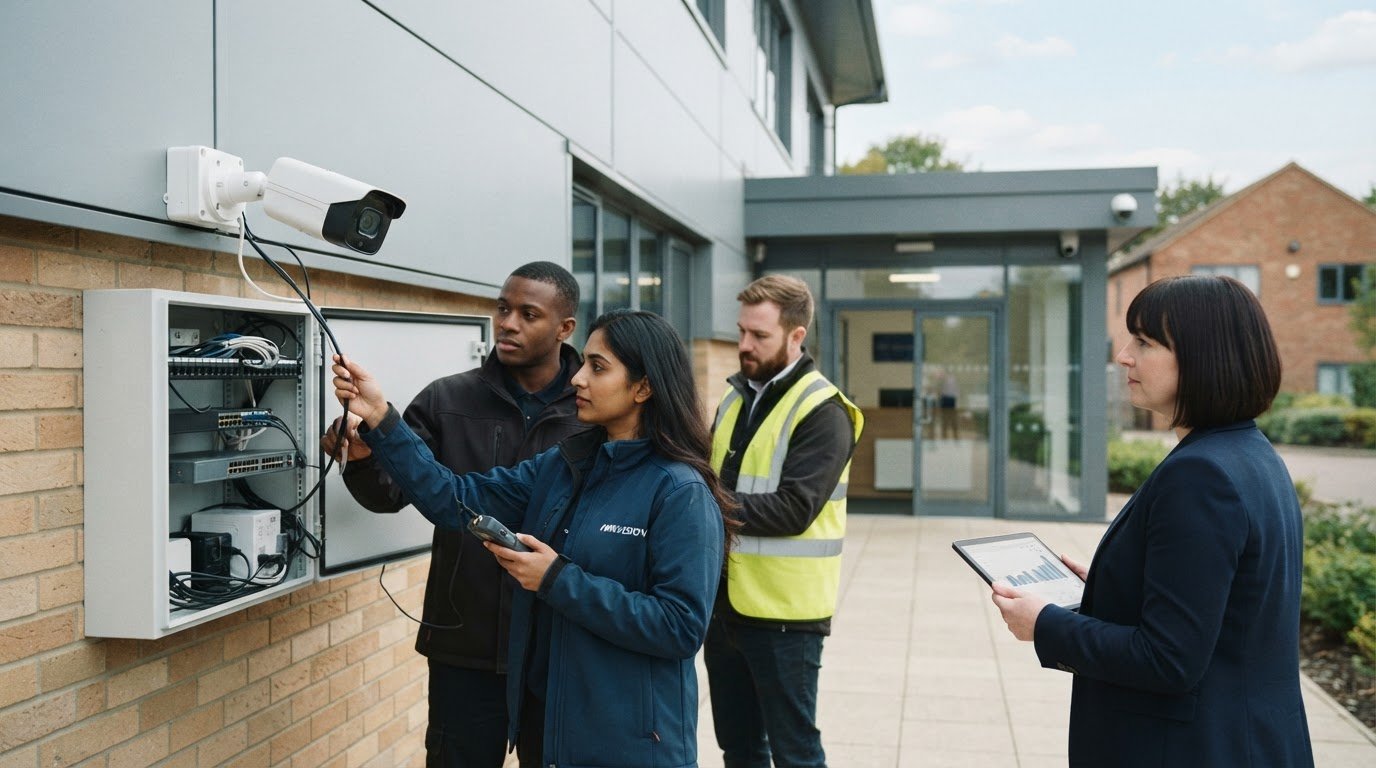
What if a camera appears to be working, but its footage isn’t recording when your business needs it? CCTV maintenance Colchester businesses plan around system condition and site operations can help identify issues before they affect day-to-day security.
It’s reasonable to want confidence that cameras and recording equipment are functioning as intended, while avoiding unnecessary disruption to staff and visitors. Planned maintenance differs from a reactive repair: it provides a structured way to review system condition and address care requirements over time.
This guide explains what professional maintenance can cover, how to assess support and how to prepare a commercial CCTV system for ongoing care. It also looks at how site layout, operational priorities and existing equipment shape a practical maintenance approach.
Links Integrated Systems works with commercial security infrastructure in Colchester and across Essex, including IP HD CCTV, maintenance and commissioning. The guidance below will help you assess ongoing CCTV care for your site and understand what to consider when planning a review.
Key Takeaways
- Planned care helps keep commercial CCTV useful as site conditions and operational needs change.
- A maintenance review can consider camera views, image clarity, housings, connections and visible damage or obstruction.
- Assess CCTV maintenance Colchester arrangements by their scope, documentation, reporting, site coordination and follow-up.
- Scheduled maintenance and fault-led repairs serve different purposes; the right approach depends on your system and site priorities.
- Prepare for maintenance by organising site access and system information, and noting affected cameras and when issues began.
Why planned CCTV maintenance matters for Colchester businesses
Installing CCTV is only the beginning for a facilities manager. The system needs to remain useful as the building, its surroundings and the way people use the site change. For example, a camera covering a delivery entrance may no longer provide a clear view after changes to the layout or vehicle access. Planned CCTV maintenance Colchester businesses arrange around their operational needs creates an opportunity to review the system rather than assume its original configuration still fits.
Regular attention can help identify issues such as a deteriorating image, an obstructed view or a recording concern before they undermine the system’s usefulness. Maintenance can’t prevent every fault or guarantee uninterrupted operation. It can give site teams a clearer picture of system condition and help them decide what needs attention.
This matters when staff need to review an incident, oversee areas of the site or follow established security procedures. CCTV is most useful when its coverage and recording function support those practical purposes. Planned maintenance provides a structured review; fault-led work responds after someone has noticed a problem. The approaches serve different needs and can both form part of wider site security management.
What can change after CCTV installation?
Buildings and their surroundings change over time. Refurbishment can alter camera positions or introduce obstructions, while changed lighting may affect how clearly a scene appears at different times of day. New shelving, signs, temporary structures or changes to access routes can also alter what a camera captures.
Network changes and ageing equipment may affect system performance, too. Reviewing the system against current security objectives helps facilities teams spot where coverage or operation may no longer match the site’s needs.
Why commercial sites benefit from a planned approach
Planning maintenance around site operations makes it easier to organise access and coordinate work with staff, visitors and other activities. It also creates an opportunity to record observations, recurring issues and required follow-up, rather than relying only on informal reports when something appears wrong.
Those records support informed facilities and security decisions, including whether the system still reflects the site’s priorities. They also provide context for future reviews without implying every fault can be predicted or avoided.
A practical review relates system condition to how the site operates today. Consider whether priority areas remain visible, whether lighting or layout changes have affected camera views, and whether the system still supports incident review and established procedures. If the site has changed, record what changed and which views may be affected. This gives the maintenance process a clear operational purpose.
For commercial sites in Colchester, maintenance is part of the wider lifecycle of physical security infrastructure. Links Integrated Systems designs, installs and commissions IP HD CCTV systems and provides professional maintenance for commercial security infrastructure across Essex. A planned approach helps site teams make decisions based on observed condition and current requirements, while recognising that faults may still arise between reviews.
What commercial CCTV maintenance in Colchester should cover
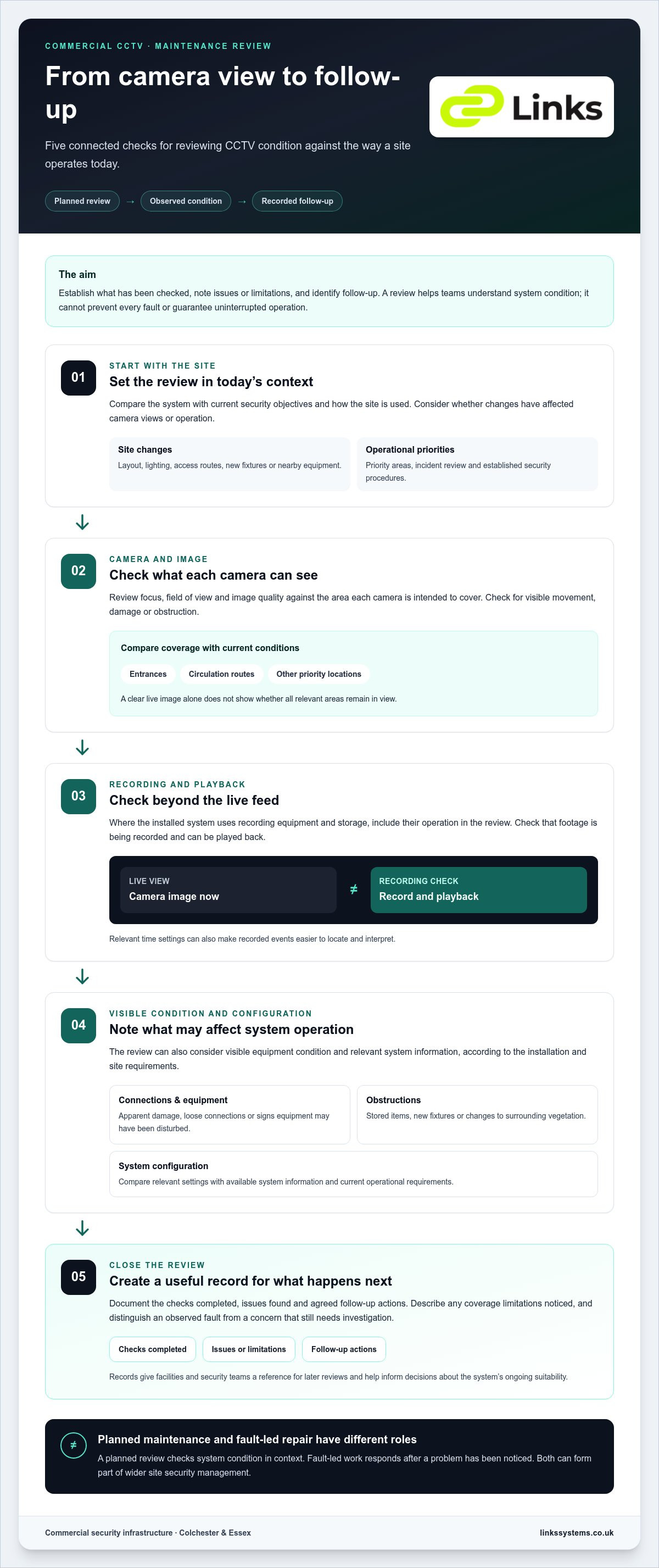
A useful maintenance review reflects the CCTV system’s design, condition and site requirements. It may include camera views and image clarity, visible equipment condition, connections, recording operation and system records. The purpose is to establish what has been checked and identify issues or follow-up work, rather than apply the same checklist to every installation.
Camera, image and coverage checks
Review each camera’s focus, field of view and image quality against the area it is intended to cover. Check visible housings and positioning for signs of damage, obstruction or movement. Changes to lighting, building layout, access routes or nearby equipment can affect the view, so assess coverage against current site conditions rather than relying only on the original design.
A clear live image doesn’t by itself show whether all relevant areas remain in view. Consider whether entrances, circulation routes and other priority locations can still be observed as intended. Maintenance findings should describe any limitations noticed without promising a particular resolution or detection outcome.
Recording, playback and system records
Viewing a live camera feed is different from checking that footage is being recorded and can be played back. If the installed system uses recording equipment and storage, include their operation in the review. Checking relevant time settings can also make recorded events easier to locate and interpret.
Record the checks completed, issues found and agreed follow-up actions. This gives facilities and security teams a reference for later reviews and helps distinguish an observed fault from a concern that still needs investigation.
Depending on the system, a review may also consider:
- Connections and visible condition: Look for apparent damage, loose connections or signs that equipment may have been disturbed.
- Obstructions: Note anything affecting a camera’s view, such as new fixtures, stored items or changes to surrounding vegetation.
- System configuration: Compare relevant settings with available system information and the site’s current operational requirements.
- Recording and playback: Where applicable, check recording operation and whether footage can be retrieved for review.
- Maintenance record: Document what was checked, observations made and any next steps, so the system’s condition is easier to track.
System documentation makes these checks more useful. Camera identifiers, coverage plans and configuration details provide context for findings and help teams understand which equipment or areas are affected. The scope should reflect the installed system, so components that aren’t part of the site’s configuration won’t be relevant to its review.
Links Integrated Systems provides professional maintenance and commissioning for commercial security infrastructure, including IP HD CCTV. Read about commercial CCTV maintenance support as part of a structured approach to system care.
How to assess CCTV maintenance arrangements for a Colchester site
A maintenance arrangement should fit the CCTV system and the way the site operates. The useful comparison isn’t simply how often visits are proposed. Consider what work is covered, how findings are recorded and how follow-up fits around your business. To assess CCTV maintenance Colchester businesses need, start with the site’s practical requirements and the condition of its equipment.
Planned maintenance or fault-led support?
Planned maintenance is organised around the system’s design, condition and site needs. It creates an opportunity to review equipment and identify concerns before they become reported faults. Fault-led work responds to an issue that has already been identified, such as a camera view problem or recording concern. These approaches serve different purposes, and a business can consider both in light of the operational importance of its CCTV.
Maintenance may seem unnecessary when a system appears to be working. A better basis for deciding is the system’s age and condition, the importance of the areas it covers, and the consequences of losing visibility or recording in those locations. A small site with limited coverage may have different priorities from a larger, multi-area operation. Match the scope of care to actual business needs rather than assuming every system requires the same arrangement.
Compare scope, reporting and operational fit
Use clear criteria to understand what an arrangement includes and how it would work at your site. The table below provides a practical framework for review.
| Area | What to assess |
|---|---|
| Scope | Which system elements are included, and how the work reflects the installed equipment and site requirements. |
| Documentation | Whether relevant system information can inform the work and help identify equipment or coverage areas. |
| Reporting | How completed checks, observed issues and proposed follow-up actions are recorded. |
| Operational coordination | How access, working areas and timing are organised to suit staff, visitors and site activity. |
| Follow-up | How findings are communicated and how next steps are distinguished from the maintenance review itself. |
These criteria make an arrangement easier to assess against operational priorities. A site with busy public areas, for example, may need particular attention to access planning, while a site with several camera locations may benefit from clear equipment identification in maintenance records. If CCTV is connected with access control, consider how the systems relate to your procedures. This CCTV and access control integration guidance provides useful context.
Links Integrated Systems works with commercial environments, providing IP HD CCTV, system commissioning and professional maintenance. The scope and coordination of this work can reflect the system and the site, rather than relying on one standard arrangement for every business.
How to prepare a commercial CCTV system for maintenance
A little preparation helps make a maintenance visit more focused and easier to coordinate with site operations. Facilities teams don’t need to diagnose faults in advance. Start by organising available system information, noting what staff have observed and identifying access or timing considerations. This connects the maintenance scope to the installed equipment and working environment.
Gather useful system and site information
Collect available records, such as camera schedules, system drawings, equipment details and previous maintenance notes. They help identify equipment and provide context for reported issues. Note recent building, lighting or network changes that may have affected camera views or system operation. If records are incomplete, gather what you have and note the gaps.
Use this checklist to prepare a clear brief:
- Collect system records. Gather available camera schedules, drawings, equipment information and previous maintenance records.
- Record known issues. List affected cameras and describe what staff have noticed, such as an unclear image, playback difficulty or equipment that appears offline.
- Note when problems began. Include when each issue was first observed and whether it appears ongoing or intermittent, if known.
- Describe recent changes. Record building work, altered lighting, new obstructions or network changes that may be relevant.
- Identify site arrangements. Note restricted areas, access requirements, operational hours and the relevant site contact for coordinating work.
Coordinate maintenance with site operations
Consider where access is needed and whether work in particular areas needs coordination with staff or site procedures. A camera above a busy reception area, for example, may require different arrangements from equipment in a restricted plant area. Identify practical working arrangements around business activity and security procedures so the maintenance scope accounts for the site.
If CCTV forms part of a wider physical security system, include relevant system context in the preparation brief. Connected equipment and shared operational procedures may affect what information is useful to the maintenance team. This physical security integration guidance can help frame the wider system relationship.
Keep preparation proportionate. A large site may have detailed equipment schedules, while a smaller installation may have fewer records. The aim is to provide a useful picture, not create paperwork for its own sake. Clear notes about access, affected cameras and operating conditions help shape maintenance around the system that is actually installed.
Links Integrated Systems provides professional maintenance and commissioning for commercial security infrastructure, including IP HD CCTV systems. Find details of commercial CCTV maintenance support alongside the information to prepare about your system, observed issues and site requirements.
CCTV maintenance in Colchester with Links Integrated Systems
Commercial CCTV forms part of a site’s wider physical security arrangements. Ongoing care needs to account for the equipment in place, how the business operates and what the system is expected to support. Links Integrated Systems provides IP HD CCTV, system commissioning and professional maintenance for security infrastructure to commercial environments in Colchester and across Essex, as well as London, Kent, Surrey and Hertfordshire.
Maintenance and commissioning across the system lifecycle
Commissioning and maintenance serve different stages of a system’s lifecycle. Commissioning establishes system operation as it is brought into service, while maintenance provides ongoing attention as equipment ages and site requirements evolve. Together, they form part of the wider management of commercial CCTV and physical security equipment. Neither is a guarantee of regulatory compliance or protection from incidents.
This lifecycle perspective matters when CCTV sits alongside other systems and established site procedures. A change to the building or the way people use it may affect how security equipment supports day-to-day operations. Considering the system in context helps decision-makers understand whether its role still aligns with current priorities and where further review may be appropriate.
Discuss a maintenance approach for your Colchester site
A useful starting point is a concise picture of the site and system. You don’t need every technical answer. Share the information that shapes your operational priorities, such as:
- Site context: The type of commercial environment and any areas with particular access or operational considerations.
- System overview: The CCTV equipment and coverage in place, along with relevant system records you have available.
- Business priorities: The tasks the system supports, such as site oversight or reviewing incidents, and any changes in those needs.
These details give the maintenance discussion a practical focus. A site with changing layouts may have different priorities from one with stable coverage; operational hours and access arrangements can also influence how work is planned. Links Integrated Systems brings IP HD CCTV, commissioning and maintenance capabilities together for commercial security infrastructure, with work shaped around project and site requirements.
For CCTV maintenance Colchester businesses can plan around their system and operational needs, a clear outline of the site, equipment and priorities is a helpful first step. Read more about commercial CCTV requirements from Links Integrated Systems.
Make ongoing CCTV care part of your site planning
Turn what you know about your system into a clear set of priorities. Consider which areas matter most to your operations, what has changed on site and what your team needs CCTV to support. This gives maintenance planning a practical starting point and keeps future decisions connected to how the business works.
Links Integrated Systems provides professional maintenance and commissioning alongside IP HD CCTV systems for commercial environments, supporting the ongoing care of physical security infrastructure across Essex. For businesses considering CCTV maintenance Colchester, a focused discussion can relate the system’s condition and site requirements to a suitable approach.
Discuss commercial CCTV maintenance for your site and take a considered next step in managing your system over its lifecycle.
Frequently Asked Questions
How often should commercial CCTV be maintained?
There’s no single maintenance interval that suits every commercial CCTV system. Set a review plan using the equipment manufacturer’s guidance, the system’s condition, its operating environment and the importance of the areas it covers. For CCTV maintenance Colchester businesses can plan effectively, also consider a review after building work, recurring faults or a change in security priorities. Keep a record of completed checks and revisit the interval as circumstances change.
Can CCTV maintenance be carried out during working hours?
It may be possible, depending on the work, access requirements and areas affected. Work near a staffed entrance, for example, may need coordination so people can continue to use the space safely and site procedures remain in place. Before arranging work, identify restricted areas, busy periods and a suitable site contact. Some tasks may temporarily affect access to equipment or camera coverage, so plan for that possibility rather than assuming there’ll be no impact.
What happens if CCTV footage is unclear?
Start by noting the affected camera and whether the issue occurs in live viewing, recorded footage or both. Include when it happens and any relevant conditions, such as a particular time of day or lighting change. Check for an obvious obstruction without changing system settings outside your authorised process. This information gives a maintenance assessment a useful starting point for investigating the camera, its connections and relevant recording components.
Is CCTV maintenance a legal requirement in the UK?
There isn’t one maintenance interval set for every CCTV system, and maintenance by itself doesn’t establish that surveillance is legally compliant. Organisations should consider their responsibilities for operating cameras and handling recorded personal data alongside system condition and manufacturer guidance. Requirements can depend on how CCTV is used and the organisation’s circumstances. Consult current Information Commissioner’s Office guidance and seek appropriate advice where you need help interpreting your obligations.
How long does commercial CCTV maintenance take?
The time required depends on the equipment, system configuration, agreed checks and practical access at the site. A system spread across several buildings, for instance, may need more coordination than equipment in one accessible area. Share available camera schedules or drawings, note restricted locations and identify operational constraints before work is arranged. This helps the maintenance scope and site arrangements be planned realistically, without assuming every system will take the same amount of time.
Can CCTV maintenance cover a system connected to access control?
Yes. A maintenance review can take account of CCTV connected with access control, with the scope shaped by how the systems are configured and used. For example, teams may need to consider whether camera coverage supports the site’s access procedures and how relevant system interfaces operate. Treating connected equipment as part of the wider physical security environment provides useful context. See the guidance on integrating CCTV with access control systems.