

Could adding more cameras still leave the areas that matter most poorly covered? For commercial buyers searching for CCTV installers near me Kent, the right choice starts with understanding site risks and security objectives, not simply counting cameras. You need useful coverage, minimal disruption to staff and visitors, and a proposal that accounts for the whole system.
This guide explains how to plan a commercial CCTV installation in Kent, from defining site requirements and designing coverage to installation, commissioning and ongoing maintenance. It also covers how to compare proposals, prepare your premises and consider CCTV alongside existing access control.
Links Integrated Systems designs, supplies, installs and commissions IP HD CCTV for commercial and professional environments. The guidance below explains the main project stages and the practical questions that help determine whether a system suits your premises now and can be maintained as your requirements change.
Key Takeaways
- Start commercial CCTV design with your premises’ operational risks and security objectives, not a target camera count.
- Map entrances, lighting, building layout and camera views before installation begins.
- When comparing CCTV installers near me Kent, look for a clear approach to design, commissioning, maintenance and system integration.
- Prepare site stakeholders, access arrangements, operating hours and security priorities to support a well-planned installation.
- Consider how IP HD CCTV can work alongside access control, with commissioning and maintenance supporting the system over time.
CCTV installers in Kent: what commercial buyers need from an installation
Commercial CCTV planning differs from fitting cameras at home. A business may have several entrances, shared facilities, staff and visitor routes, delivery points and areas with different security priorities. The system should reflect how the premises operate and what the organisation needs CCTV to do. Searching for CCTV installers near me Kent is a useful starting point, but the key question is whether the proposed design addresses the site’s specific risks and intended use.
A commercial CCTV installation is a security system planned around a site’s layout, operational risks and defined monitoring objectives. Decide what needs to be seen, where cameras can provide useful views and how footage will be used. An overview of Closed-circuit television (CCTV) explains the technology and its applications. For a commercial project, those capabilities need to be translated into a considered site plan.
Which Kent business premises may need professionally planned CCTV?
Offices, managed buildings and professional premises can each have distinct security requirements. An office may prioritise reception and entry points, while a managed building may need coverage planned for shared corridors, entrances and service areas. A professional premises might focus on access routes to operationally important spaces. These examples are not a standard camera list: the layout, occupancy and purpose of each site determine what is appropriate.
Begin by identifying the areas relevant to your security objectives. Consider how people approach an entrance, move through a shared area or access a particular operational space. Account for the building itself, including sightlines and the relationship between internal and external areas. CCTV can support security processes, but it should not be treated as a guarantee that incidents will be prevented.
What should a CCTV system be expected to do?
Set out the intended use before deciding on camera positions or system specification. Common requirements fall into three categories:
- Monitoring: Providing a view of selected areas to support routine awareness of activity.
- Incident review: Helping authorised staff examine recorded footage after an event.
- Operational oversight: Giving relevant teams visibility of activities or movements connected to site operations.
Different purposes call for different views. A camera intended to show activity at an entrance has a different task from one providing a broader view of a shared area. The intended use helps determine camera positions and the level of detail the system needs to support. Avoid assuming that one position or specification will suit every purpose.
Address privacy and data protection during planning, not as an afterthought. Consider who may be captured, which spaces genuinely require monitoring and how access to recorded footage will be managed. Clear objectives keep proposed coverage focused and give the project team a sound basis for decisions. Once you have defined the site requirements, you can assess the practical design and installation stages.
How a commercial CCTV installation in Kent is designed around the site
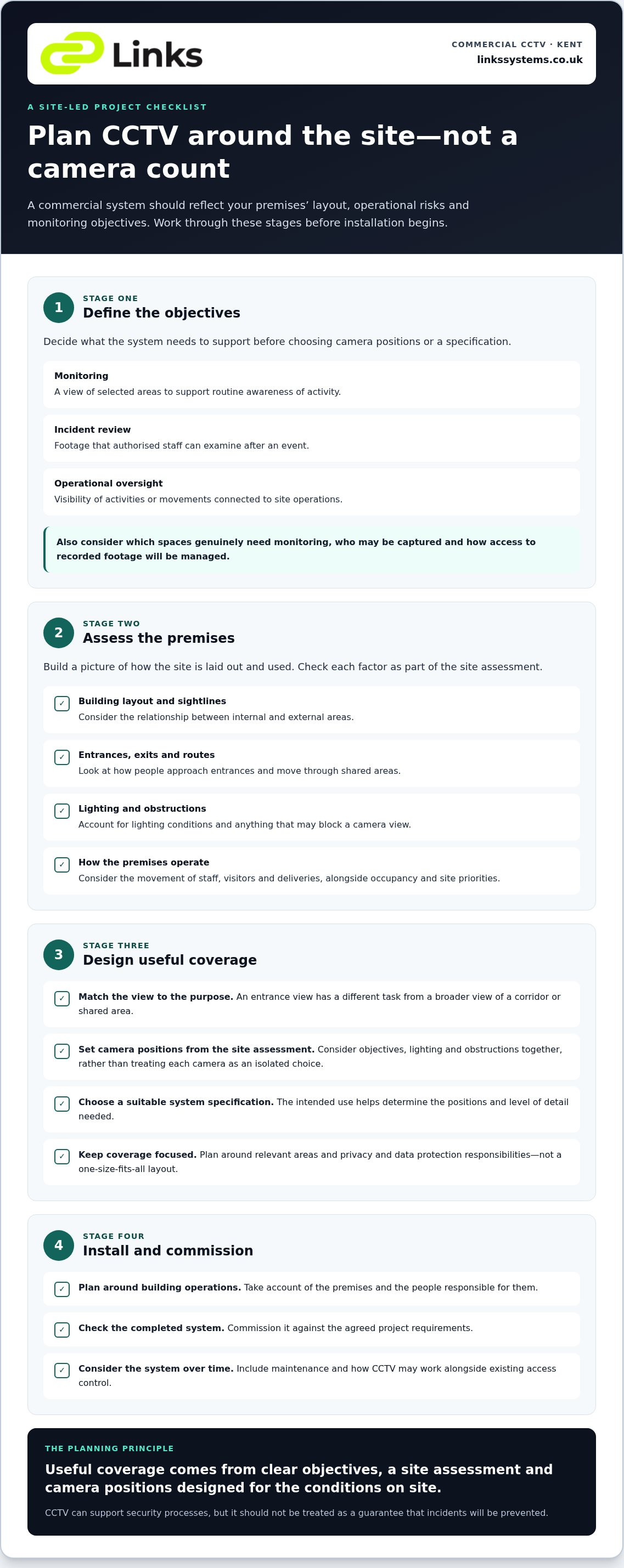
A well-planned installation follows a clear sequence, from defining security objectives to checking the completed system. Each stage informs the next, so the design reflects the site rather than relying on a standard camera layout. For organisations searching for CCTV installers near me Kent, understanding this process makes it easier to assess what a project involves and how decisions are made.
- Define objectives. Establish what the system needs to support, such as monitoring selected entrances, reviewing incidents or providing oversight of particular operational areas.
- Assess the site. Consider the building layout, entry and exit routes, lighting, obstructions and how staff, visitors or deliveries move through the premises.
- Design coverage. Use the objectives and site assessment to determine camera positions and an appropriate system specification.
- Install and commission. Plan installation around the building’s operations, then check the system against the agreed project requirements.
From security objectives to a site-specific CCTV design
Camera positions should reflect the areas the organisation needs to monitor and the conditions at the premises. Entrances may need a different view from corridors or shared spaces. Lighting can affect the image at different times, while walls, fixtures, landscaping or changes in how an area is used may create obstructions. Consider these factors together rather than treating each camera as an isolated choice.
Camera placement should follow the coverage objectives and the conditions of the site, not a one-size-fits-all layout. This is why a site assessment matters: two buildings with similar footprints may have different access routes, lighting and operational priorities. Links Integrated Systems designs, supplies and installs IP HD CCTV for commercial and professional environments, tailoring the system specification to the project requirements.
Planning should also consider how proposed coverage relates to people using the premises and to privacy and data protection responsibilities. A clearly defined purpose helps keep the design focused on relevant areas. It also gives the project team a reference when agreeing camera positions and what the system is expected to deliver.
Installation, commissioning and handover
Plan installation around building operations and the people responsible for the site. Coordinating access, work areas and relevant stakeholders in advance helps the project team fit installation activity around normal use of the premises. The practical arrangements depend on the building and project scope.
Commissioning is when the installed system is checked against the agreed requirements. The client and installation team can review whether the planned views and system operation align with the project objectives. Handover should make clear how to operate the system and who is responsible for relevant tasks, so the organisation can manage it day to day.
Links Integrated Systems provides commercial CCTV installation and commissioning, carrying the project from site planning through to operational handover.
How to compare CCTV installers near you in Kent
Commercial CCTV proposals are easiest to compare when they are based on the same site requirements. If one proposal covers entrances and shared areas while another uses a different brief, their scope and design are not directly comparable. Set out your priorities first, then assess how each proposal responds. For organisations searching for CCTV installers near me Kent, this keeps the comparison focused on project fit and delivery, rather than unsupported claims or headline price alone.
Use the criteria below to check whether a proposal explains the full project lifecycle. Look for a clear description of what is included, how decisions are recorded and who is responsible for each stage.
Project scope
Does the proposal describe the premises, security objectives, intended coverage and any stated exclusions? The scope should make clear what the project is intended to deliver.
System design
Does it explain how site conditions and coverage requirements inform camera positions and the system specification? Look for a clear link between the brief and proposed design, rather than a camera count without context.
Installation
Are installation activities and responsibilities clearly set out? The proposal should show how work will be planned around the building, its operations and relevant site stakeholders.
Commissioning
Does it include commissioning and explain how the installed system will be checked against the agreed requirements? Links Integrated Systems provides professional commissioning as part of its project work.
Maintenance and future changes
Does the proposal explain how ongoing maintenance is addressed and provide a basis for discussing changes as the premises or security requirements evolve? Links Integrated Systems offers scheduled system maintenance.
Integration
Does it identify whether CCTV needs to form part of a wider physical security arrangement, such as one that includes access control? Any integration should be explained in relation to the project, not assumed as an automatic feature.
What to assess in a CCTV installation proposal
Check that the proposal makes the intended coverage clear. It should connect the site objectives to the areas being considered, then explain installation and commissioning responsibilities. Review the maintenance approach too: a system’s lifecycle extends beyond installation, and future site changes may affect what needs to be monitored. Clear documentation helps internal stakeholders understand what has been agreed and how the project will be delivered.
For a fair comparison, provide the same brief to each project team. Include the areas of concern, how the premises operate and any known constraints. Compare scope with scope, commissioning with commissioning, and maintenance with maintenance. If proposals describe details differently, note what is included and what falls outside the proposed work before drawing conclusions.
When should CCTV integrate with access control?
Integration may be relevant where a site needs to consider video alongside access events, such as when reviewing activity around a controlled entrance. It can support a more joined-up physical security plan, but the design should be guided by the purpose and practical requirements. Links Integrated Systems works across IP HD CCTV and access control, so both can be considered within a wider project where appropriate.
A proposal should explain how the systems are intended to work together and how that supports the site’s objectives. For more detail on this planning consideration, see the article on integrating CCTV with access control systems.
Planning a commercial CCTV installation across Kent
A well-prepared brief helps the project team understand how the premises work before deciding on the installation. For businesses searching for CCTV installers near me Kent, preparation brings operational needs, site constraints and existing security systems into one clear picture. Record the following before the project begins.
- Premises and priorities: Note the building’s purpose, areas of concern and the security objectives the system should support.
- Stakeholders: Identify the facilities, security and project contacts who can explain site requirements and approve decisions.
- Operations: Set out normal operating hours, busy periods, staff and visitor movements, and activities that could affect installation planning.
- Access arrangements: Record how installation teams can access relevant areas, who will coordinate entry and any restrictions on working in occupied spaces.
- Existing systems: Document current CCTV and access control equipment, known coverage gaps and relevant system information available to the site team.
- Privacy review: Assign responsibility for reviewing the proposed monitoring purpose and coverage against current data protection responsibilities and ICO guidance.
Prepare the site brief and coordinate stakeholders
Bring together the people who understand the premises early. Facilities staff can explain building access and practical constraints; security contacts can describe priority areas and existing processes; project leads can coordinate decisions and communication. Their input helps separate essential requirements from assumptions.
Describe how the site operates, not just where cameras might go. For example, note when shared areas are busiest, whether deliveries use a separate route and which spaces have restricted access. Include known obstructions or planned building changes that could affect coverage. A concise, shared brief gives the installation team a consistent reference and helps stakeholders understand the project’s intended scope.
Before work begins, agree how access to relevant parts of the premises will be arranged and who will manage day-to-day coordination. Plan how installation activity can fit around normal operations, including movement of staff, visitors or services. Include privacy and data protection in the same preparation, with the responsible person consulting current ICO guidance for the organisation’s circumstances.
Plan for system upkeep after commissioning
Installation is one stage in the system lifecycle. Include maintenance in the initial plan because site use, security priorities and physical arrangements can change after commissioning. Recording who is responsible for system oversight and how maintenance will be scheduled gives the organisation a practical basis for reviewing the system over time. Links Integrated Systems provides scheduled system maintenance for commercial security systems.
Where CCTV is part of a wider physical security plan, record how it relates to existing access control and other relevant arrangements. This context helps keep decisions coordinated as requirements develop. For support with planning commercial CCTV, discuss your installation requirements with Links Integrated Systems.
CCTV installation in Kent with Links Integrated Systems
For commercial and professional premises, CCTV is most useful when its design reflects how the organisation uses the building. Links Integrated Systems designs, supplies, installs and commissions IP HD CCTV across Kent and nearby counties. Each project is considered in the context of the site’s layout, operational priorities and wider physical security arrangements.
A coordinated approach to commercial CCTV
A CCTV project may sit alongside access control or IP video intercoms where the site’s requirements connect these systems. For example, a business may want its physical security planning to account for monitored entrances as well as how entry is managed. Whether systems should be considered together depends on the project objectives and premises. Integration is a design consideration, not an automatic feature of every installation.
Commissioning and maintenance are also part of the system lifecycle. Commissioning provides a structured stage for checking the completed installation against the agreed project requirements. Scheduled maintenance supports ongoing system upkeep as premises and operational needs change. Considering these elements early helps the organisation plan beyond the initial installation and understand how the system will be managed over time.
Where a project involves multiple physical security systems, a coordinated view can help keep their roles clear. The guide to integrating CCTV with access control systems can help frame that consideration alongside the specific needs of a commercial site.
Discuss your Kent CCTV project
Before discussing a project, bring together a concise picture of the premises and what the system needs to support. Useful starting points include the site type, priority areas, operating arrangements and any existing CCTV or access control. Note known site constraints and identify the people responsible for facilities, security and project decisions. This gives the discussion a practical foundation without assuming every commercial property needs the same design.
For organisations searching for CCTV installers near me Kent, Links Integrated Systems provides a considered route from project requirements through design, installation and commissioning. The scope can be shaped around commercial and professional premises, with access control and scheduled maintenance considered where relevant.
Discuss a commercial CCTV project with Links Integrated Systems to outline your site, priorities and existing systems.
Turn your security priorities into a clear project brief
Before taking the next step, consider how your premises may change. New access routes, different working patterns or changes to shared spaces can affect what a CCTV system needs to support. A brief that records today’s priorities and likely future requirements gives the project team a practical foundation for planning.
For businesses searching for CCTV installers near me Kent, the aim is not simply to select equipment. It is to establish a system that fits the site and can be supported throughout its working life. Links Integrated Systems brings commercial IP HD CCTV design, supply, installation and commissioning together with scheduled maintenance, alongside physical security expertise in CCTV and access control. This provides a basis for discussing how the systems and ongoing upkeep may fit your organisation’s requirements.
Bring your site type, security priorities and details of existing systems to the conversation. Discuss your commercial CCTV project with Links Integrated Systems and take a considered next step towards a solution shaped around your premises.
Frequently Asked Questions
How do I choose CCTV installers near me in Kent for a commercial site?
Choose CCTV installers near me Kent by looking for a clear, site-specific approach rather than a standard camera package. Check that the proposed scope reflects how the premises are used and any existing security arrangements, and that commissioning and future maintenance are addressed. For a Kent site or an organisation with premises across London, Surrey, Hertfordshire or Essex, consider how the plan will account for differences between locations.
How much does commercial CCTV installation cost in Kent?
The cost depends on the project scope and conditions at the premises, so a reliable figure needs to reflect the actual requirements. Factors can include the coverage required, installation access, existing infrastructure and whether the project involves access control integration. Look for a proposal that sets out the work included and how the system is designed for your site. Links Integrated Systems tailors commercial IP HD CCTV projects to their requirements.
Can CCTV be integrated with an access control system?
Yes, CCTV and access control can be considered together where that supports the site’s security objectives. For example, a facilities team may want to review video in relation to activity at a controlled entrance. The relationship between the systems depends on the project design and existing equipment, so integration should not be assumed as an automatic feature. Links Integrated Systems works with both IP HD CCTV and access control systems for commercial premises.
How long does a commercial CCTV installation take?
There is no fixed installation duration for every commercial site. The programme depends on factors such as the project scope, building layout, access arrangements and whether work needs to be coordinated around occupied areas. A site with several separate buildings or restricted access may need a different plan from a single, straightforward premises. Before work begins, agree the sequence of activities and operational arrangements with the project team.
Do businesses need to follow data protection rules when using CCTV?
Yes. If business CCTV captures identifiable people, the organisation must consider its responsibilities under UK GDPR and the Data Protection Act 2018. This includes having a clear purpose for monitoring, providing visible signage, controlling access to footage and setting a retention period that is no longer than necessary. Assign a responsible person to review the organisation’s approach against current Information Commissioner’s Office (ICO) guidance.
What happens during CCTV commissioning?
During commissioning, the installed system is checked against the requirements agreed for the project. This can include reviewing whether the intended camera views and system operation correspond with the documented design. Any issues identified can then be addressed as part of the project process. Commissioning is also a useful point to clarify how the system is operated and which staff members are responsible for day-to-day use.
Can a commercial CCTV system be maintained after installation?
Yes. Scheduled maintenance can be planned as part of the system’s ongoing lifecycle, rather than considered only after a change or problem arises. It also gives the organisation an opportunity to review whether the installation remains suited to its premises as operational needs develop. Links Integrated Systems offers scheduled system maintenance for commercial security infrastructure, supporting businesses as site requirements evolve.