
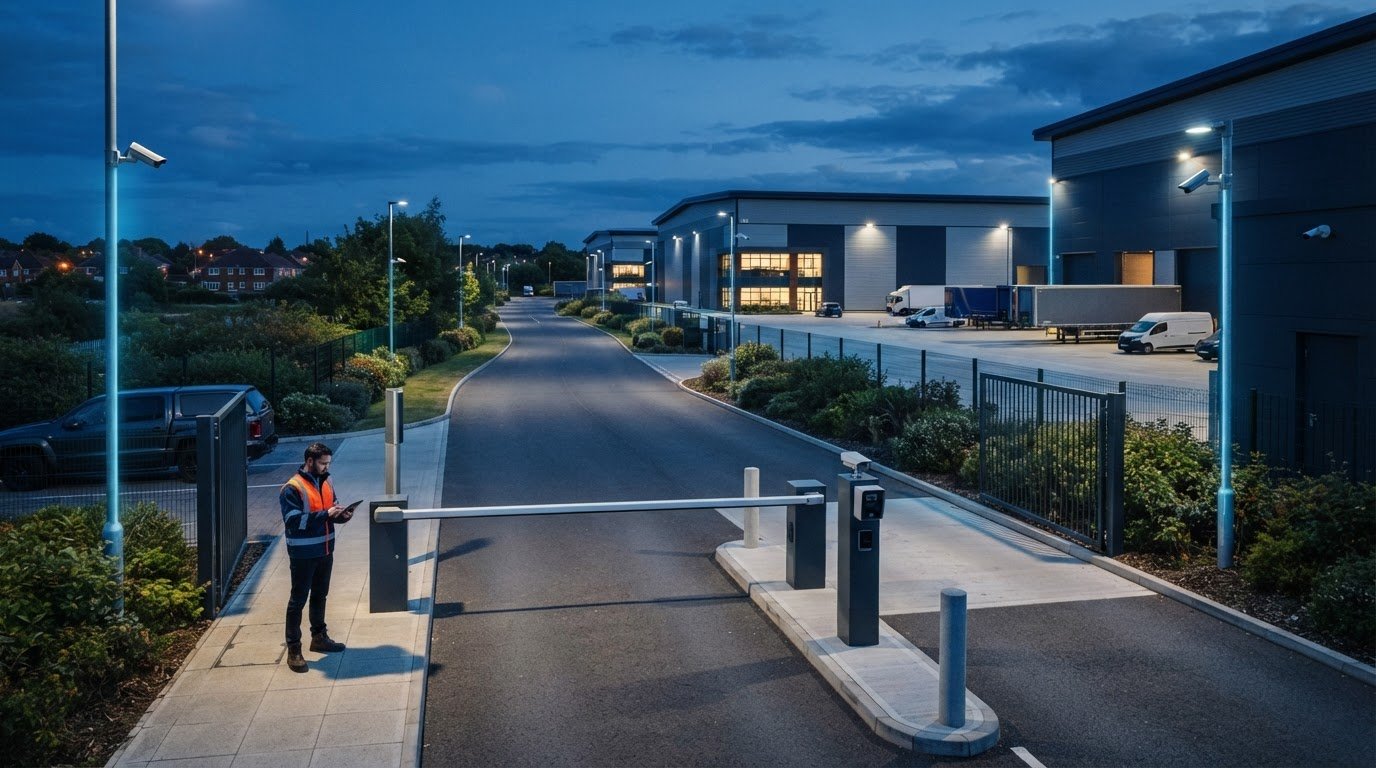
A cluster of standalone surveillance cameras won’t protect a busy commercial distribution park if vehicle access fails at the estate entrance. Specifying robust security systems for industrial estates Surrey facility managers oversee requires far more than mounting isolated hardware on perimeter posts. You likely already recognise the daily friction: balancing continuous HGV flow with tenant and visitor traffic without risking tailgating, coordinating access across shared yard spaces, and tackling blind spots across extensive boundary lines along major transport corridors.
In this guide, you’ll discover how to specify, integrate, and maintain commercial physical security infrastructure across Surrey industrial estates and multi-tenant logistics hubs. We examine how combining automated vehicle barriers and edge ANPR with integrated access control delivers frictionless tenant operations, while reviewing the critical British safety standards and planned preventative maintenance schedules necessary to protect your commercial investment over the long term.
Key Takeaways
- How to engineer layered security systems for industrial estates Surrey operators manage, balancing heavy freight throughput with automated barrier controls to eliminate tailgating.
- The critical infrastructure components required for robust commercial IP HD CCTV and IP video intercom networks across sprawling multi-acre logistics yards.
- A practical four-step governance framework to segregate commercial tenant access rights across shared loading bays, perimeter gates, and communal roadways.
- Essential British safety standards and machinery directives governing commercial automated gates, vehicle barriers, and evidential video recording.
- Why planned preventative maintenance contracts and formal commissioning protocols safeguard operational uptime and satisfy commercial insurance underwriters.
Perimeter Challenges for Surrey Industrial Estates & Business Parks
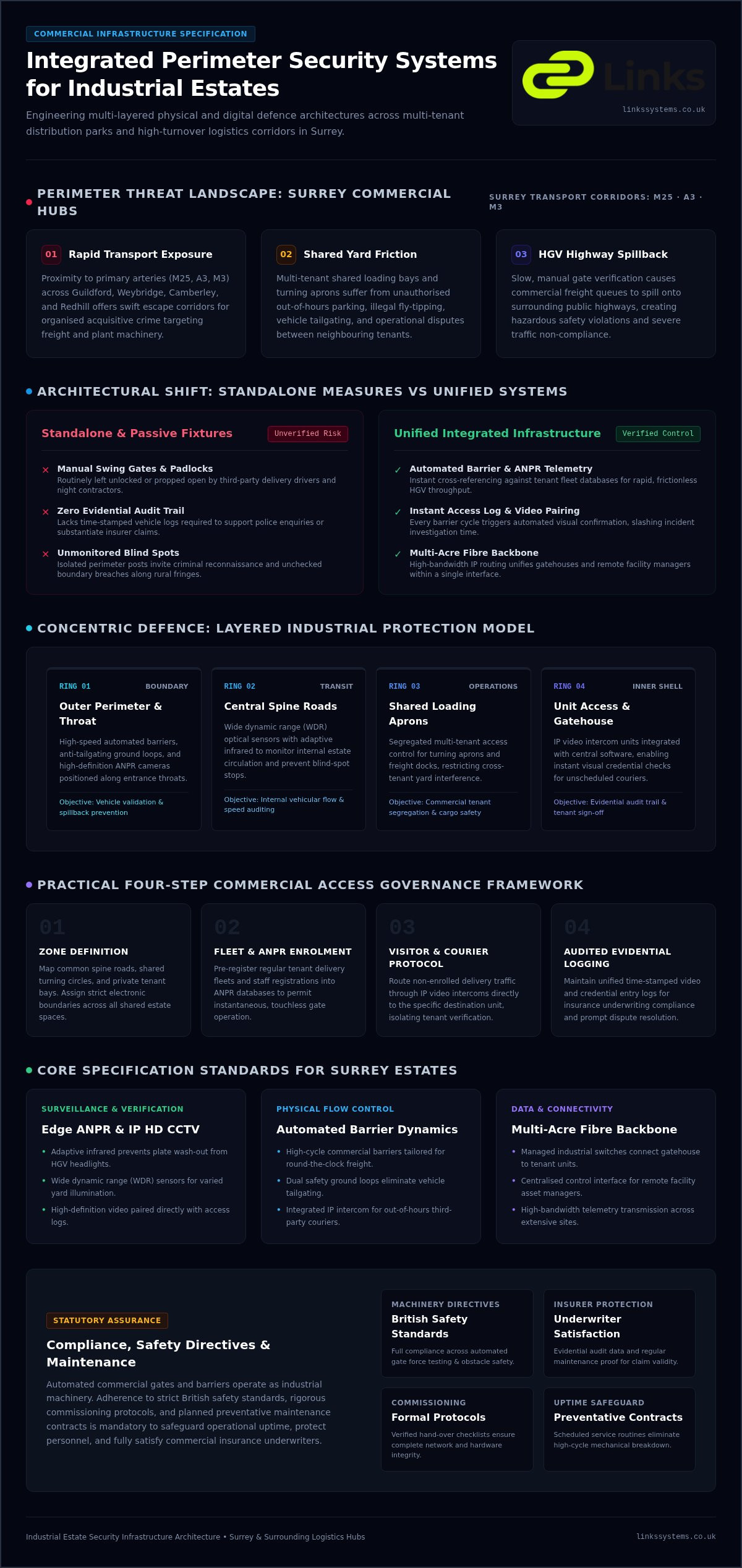
Commercial distribution parks across Guildford, Weybridge, Camberley, and Redhill face intense operational pressures. Round-the-clock freight turnaround and high-turnover logistics traffic create severe perimeter vulnerabilities that standard commercial premises rarely encounter. Without automated access control, unmonitored commercial yards quickly suffer from vehicle tailgating, unlawful fly-tipping, and cargo interference. In multi-tenant environments where storage yards and turning circles are shared, unmanaged access points also spark operational disputes between neighbouring businesses. Deploying dependable security systems for industrial estates Surrey asset managers oversee requires applying concentric protection rings. This defensive methodology establishes primary deterrence at the boundary line, creating the physical integrity demanded by commercial property underwriters.
Logistics Corridors and Rural-Urban Border Risks in Surrey
Surrey’s strategic road network offers exceptional transport connectivity, yet proximity to primary arteries like the M25, A3, and M3 brings acute operational exposure. Perimeter-exposed logistics parks provide swift escape routes for organised acquisitive crime syndicates targeting high-value freight, vehicle parts, and plant machinery. Conversely, semi-rural business parks bordering the county’s green belt regularly contend with opportunist boundary trespass and unauthorised out-of-hours parking that obstructs early-morning deliveries. When entrance controls create unnecessary friction, heavy goods vehicle queues can quickly spill onto public highways, making rapid, automated entrance management essential for both site safety and traffic compliance.
The Limitations of Standalone Perimeter Measures
Passive boundaries consistently fail in modern, high-tempo logistics environments. Unmonitored chain-link fencing is easily compromised, whilst manual swing gates secured with standard padlocks are routinely left open by third-party couriers and night-shift drivers. Crucially, passive fixtures provide no audit trail. When freight disappears or yard property is vandalised, operators lack the time-stamped vehicular data required to assist police enquiries or substantiate commercial insurance claims.
Effective boundary protection relies on integrating multi-layered physical security measures that connect physical containment with electronic verification. Pairing heavy-duty commercial barriers with IP HD CCTV and automatic number plate recognition transforms an open entrance into an active, audited checkpoint. This unified approach eliminates structural blind spots, deters criminal reconnaissance, and maintains frictionless movement for authorised fleet vehicles.
Core Components of an Integrated Industrial Estate Security System
Modern industrial security relies on an interconnected digital backbone. Rather than treating surveillance, gate control, and visitor intercoms as isolated silos, an integrated architecture routes telemetry and video across high-bandwidth industrial IP networks spanning entire commercial multi-acre sites. High-specification fibre backbones and managed switches ensure that estate gatehouses and remote facility managers operate from a single, unified interface. By integrating CCTV with access control systems, estate teams gain automated visual confirmation whenever a perimeter barrier cycles or an access credential registers. Operating unified security systems for industrial estates Surrey management companies oversee eliminates administrative friction: integrated commercial estate systems reduce incident investigation time significantly by pairing physical access logs with immediate, evidential video footage.
High-Definition IP CCTV and ANPR Integration
Delivering comprehensive estate surveillance demands high-resolution IP HD CCTV cameras positioned strategically across entrance throats, central spine roads, and shared loading aprons. Automatic Number Plate Recognition (ANPR) engines log incoming commercial freight automatically, cross-referencing registration marks against pre-approved tenant fleet databases. Because loading yards operate under mixed artificial illumination, specifying optical sensors with wide dynamic range and adaptive infrared illumination ensures clear facial identification and number plate capture without headlight glare.
Commercial Access Control and Perimeter Gates
Physical entrance points require automated, heavy-duty sliding cantilever gates or fast-acting commercial vehicle barriers capable of continuous freight cycles. These perimeter gates establish the primary vehicular cordon, which links internally to commercial speed gates to manage tenant and courier movement within shared multi-occupancy reception foyers. Operators can govern these entry points using encrypted RFID cards or cloud-managed mobile credentials, enabling instant credential revocation when sub-tenancies change.
IP Video Intercoms for Delivery and Visitor Management
Unscheduled logistics deliveries require robust communication hardware at main boundary barriers. Weatherproof, vandal-resistant IP video intercom stations allow HGV drivers to call designated tenant units directly or connect to central estate management. Calls transmit crystal-clear two-way audio alongside evidential video, creating a tamper-resistant operational log of every outside visitor admitted to the estate.
To align system architecture with the statutory Surveillance Camera Code of Practice and ensure long-term engineering reliability, estate managers frequently partner with experienced engineering specialists like Links Integrated Systems to design and commission integrated estate infrastructure.
Evaluating Access Control Hardware for Industrial Entrances
Selecting entrance control machinery requires balancing physical deterrence against vehicle processing volume. In high-tempo distribution yards, installing an incorrect physical barrier creates chronic bottlenecking, encouraging drivers to tailgate or damage equipment. Robust security systems for industrial estates Surrey logistics operations rely upon must feature entrance hardware matched precisely to site geometry, road approach angles, and peak hourly freight flow. Crucially, all automated vehicular barriers and gates operate as industrial machinery under UK law, requiring rigorous force testing and dual-height safety photocell integration to comply fully with BS EN 12453.
Automatic Rising Arm Barriers vs. Sliding Cantilever Gates
Rising arm barriers deliver high-speed vehicle processing. With operating cycle speeds under two seconds, automated boom barriers prevent entry queues from backing up onto surrounding transport arteries during shift changes. However, boom arms offer limited out-of-hours physical deterrence. Cantilever sliding gates, by contrast, present an imposing anti-ram boundary with no ground track to become fouled by road debris or heavy articulated lorries. Specifying a tandem arrangement, where fast-acting boom barriers control daytime deliveries and automated sliding gates lock the estate down after hours, offers the ideal operational compromise.
The table below provides a structured specification matrix for primary entrance options across commercial estates:
| Hardware Type | Operating Speed | Duty Cycle Rating | Primary Application |
|---|---|---|---|
| Rising Arm Barriers | 1.5 to 3.0 seconds | 100% continuous duty | Daytime freight control, ANPR lane logging, and anti-tailgating enforcement. |
| Sliding Cantilever Gates | 10 to 25 seconds | Heavy commercial duty | Out-of-hours physical perimeter sealing and high-security yard enclosure. |
| Pedestrian Speed Gates | Instantaneous optical | High-frequency intensive | Multi-tenant reception foyers, core building security, and staff turnstiles. |
Segregating Pedestrian Access from Commercial Freight
Mixing foot traffic with 44-tonne articulated lorries creates catastrophic health and safety liabilities. Perimeter layouts must establish dedicated pedestrian pathways physically isolated from HGV approach lanes by crash barriers. Full-height external turnstiles enforce single-entry credential checks at boundary fences, preventing unauthorised personnel from entering behind authorised hauliers. Internally, managing shared entrances across multi-occupancy units is streamlined by deploying modern cloud-based access control systems for business, allowing building managers to assign floor-by-floor permissions whilst capturing visual logs that align with published ICO guidance on CCTV and video surveillance.
Multi-Tenant Management, Compliance, and Data Governance
Governing shared infrastructure across multi-occupancy business parks demands rigorous administrative separation. When numerous commercial tenants occupy a single estate, disputes frequently arise over yard blockages, out-of-hours gate controls, and parking allocations. Specifying security systems for industrial estates Surrey landlords manage requires establishing clear demarcation lines between communal estate roads and private tenant demises. The estate management entity acts as the primary data controller for perimeter infrastructure, while individual unit holders govern internal warehouse doors.
To avoid operational friction and regulatory exposure, estate managers should implement a structured four-step governance framework:
- Demarcate Legal Jurisdictions: Establish contractual boundaries within commercial lease agreements, clarifying that common roadways, barrier mechanisms, and external ANPR networks remain under central estate oversight.
- Tier Administrative Privileges: Segment system roles so facility managers retain master control over perimeter boundaries, while individual business tenants govern internal turnstiles and office entrance doors.
- Enforce Proportionate Data Policies: Align surveillance capture across communal zones with statutory UK General Data Protection Regulation (UK GDPR) mandates, setting clear data retention windows.
- Harden Device Networks: Segment edge physical security equipment onto isolated local area networks, ensuring on-premise network video recorders and access controllers resist local tampering.
Multi-Tenancy Access Partitioning and System Administration
Modern access controllers allow multi-tenant partitioning, enabling unit managers to issue digital visitor passes or revoke staff credentials without gaining visibility into adjacent commercial operations. This layered permission architecture ensures central gatehouses retain estate-wide visibility while granting tenants day-to-day administrative autonomy. Adopting cohesive physical security integration for commercial buildings consolidates vehicle barriers, internal staff readers, and IP intercom directories into a single manageable ecosystem.
Surveillance Compliance, ICO Codes, and Signage
Operating communal CCTV and ANPR networks triggers mandatory statutory compliance under the Information Commissioner’s Office (ICO). Commercial landlords operating shared estate systems must pay an annual ICO data protection fee, with fee tiers scaling from micro-organisations and SMEs up to large corporate entities. Weatherproof, high-visibility advisory signage must be mounted at all primary vehicle entrances and shared pedestrian routes, clearly displaying the data controller’s corporate identity, the specific security purpose of recording, and formal contact details for subject access requests. Standard commercial surveillance protocol enforces a strict 31-day retention limit before automated overwriting, maintaining legal proportionality while ensuring adequate investigative footage remains available.
For expert guidance on structuring partitioned multi-tenant infrastructure, contact Links Integrated Systems to discuss your site’s physical access requirements.
Commissioning, Standards, and Preventative Maintenance in Surrey
Commissioning represents the bridge between physical installation and operational resilience. Specifying top-tier hardware provides little protection if cameras drop frames under heavy network loads or vehicle barriers drift out of calibration. For commercial property managers overseeing security systems for industrial estates Surrey distribution hubs rely upon, rigorous commissioning establishes the verified technical baseline required to satisfy commercial insurance underwriters. System architecture must align with established standards such as BS EN 62676 for video surveillance systems, proving that optical clarity, frame rates, and field-of-view targets satisfy evidential requirements.
Neglecting ongoing maintenance leads to predictable engineering failures across busy industrial environments:
- Barrier Drive Fatigue: Continuous freight cycles cause hydraulic fluid degradation and mechanical gearbox wear, leading to sudden arm failure during morning peak arrivals.
- Optical Housing Contamination: Airborne particulate matter, diesel exhaust residue, and road grime accumulate on camera domes, impairing ANPR accuracy and night-time infrared illumination.
- Intercom Sensor Misalignment: Constant ground vibration from 44-tonne HGVs loosens physical fixings, shifting camera angles and degrading boundary intercom audio clarity.
Rigorous Engineering Handover and Standards Verification
Professional commissioning requires systematic physical and technical testing before client handover. Engineers must conduct physical force testing across all automated vehicle gates and barriers, verifying that crush-prevention mechanisms comply with statutory machinery safety directives. Technical network validation ensures industrial network switches handle concurrent IP HD CCTV streams without packet loss, while battery backup units undergo controlled discharge testing to verify fail-safe switchover during mains power interruptions. Every installation concludes with detailed as-built schematics, certification packs, and thorough operational training for facility staff.
The Value of Scheduled Preventative Maintenance Contracts
Commercial estates cannot afford unannounced gate failures that trap outbound freight or back queues onto surrounding highways. Scheduled bi-annual preventative maintenance contracts provide the primary safeguard against operational downtime. During scheduled servicing, qualified engineers inspect mechanical drive assemblies, re-torque structural anchor bolts, deep-clean optical lenses, and apply crucial firmware patches to edge access controllers. Diagnosing mechanical fatigue early prevents small component wear from spiralling into total estate paralysis.
Backed by over four decades of specialist commercial security engineering experience across the South East, our team delivers complete lifecycle support encompassing technical design, installation, commissioning, and planned preventative maintenance. Discuss your Surrey industrial estate security requirements with Links Integrated Systems to arrange a site evaluation with our engineering specialists.
Securing Your Commercial Estate Infrastructure for the Future
Protecting a commercial logistics park requires far more than passive boundary fencing. Long-term operational resilience depends on integrating fast-acting vehicle barriers, edge ANPR, and partitioned access controls into a unified physical network. By establishing clear multi-tenant data governance and adhering strictly to British machinery safety standards, estate operators eliminate vehicle bottlenecks while satisfying demanding insurance requirements. Specifying reliable security systems for industrial estates Surrey landlords oversee safeguards valuable asset portfolios and keeps freight moving seamlessly.
With over four decades of specialised commercial security engineering expertise across London and Surrey, Links Integrated Systems provides comprehensive project management covering technical design, installation, commissioning, and scheduled preventative maintenance. Whether you need to modernise heavy-duty vehicle barriers, upgrade pedestrian speed gates, or deploy resilient IP infrastructure across shared logistics yards, our experienced engineers deliver dependable protection tailored to your site layout. Consult Links Integrated Systems to engineer your commercial estate security and safeguard your facility with proven, high-standard solutions.
Frequently Asked Questions
What security systems are most critical for industrial estates in Surrey?
The most critical infrastructure includes heavy-duty rising arm barriers, perimeter sliding cantilever gates, high-definition IP CCTV, and IP video intercoms. Integrating these core elements ensures complete boundary protection and audited vehicle throughput. For logistics hubs bordering transport arteries, robust security systems for industrial estates Surrey facilities rely on combine automated physical containment with centralised electronic verification to stop unauthorised vehicular incursions before drivers enter internal yards.
How do automated barriers manage busy morning delivery traffic without queues?
Automated barriers resolve congestion by pairing fast-acting mechanical drive motors with instant electronic credential verification. High-speed commercial boom arms open in under two seconds when triggered by automated number plate recognition or active proximity readers. This rapid cycle eliminates driver delays at the boundary, processing legitimate freight smoothly whilst dual-height safety loops immediately lower the arm behind each vehicle to deter tailgating into shared logistics yards.
Can individual tenants control their own access through shared estate gates?
Yes, modern partitioned access control systems allow individual tenants to manage their own visitor admissions independently. Using networked IP video intercoms, delivery drivers call unit reception desks directly from the entrance barrier. Tenants grant entry remotely via dedicated desktop software or mobile applications. Meanwhile, the estate managing agent maintains overall system logs, retaining central administrative oversight without having to manage daily tenant visitor lists manually.
What British Standards apply to commercial automated gates and barriers?
Power-operated commercial gates and rising barriers are classified as industrial machinery and must comply with BS EN 12453:2017+A1:2021. This standard governs mechanical safety, anti-crush force limitations, and fail-safe sensor testing. Video surveillance networks fall under BS EN 62676 for video quality and retention standards. Adhering to these established standards ensures commercial property installations satisfy statutory machinery safety legislation alongside rigorous commercial insurance underwriting criteria.
How does ANPR technology improve security across a multi-tenant business park?
Automatic Number Plate Recognition (ANPR) turns estate barriers into automated checkpoints by instantly matching vehicle registrations against approved tenant fleet lists. When deployed within security systems for industrial estates Surrey logistics operators oversee, ANPR eliminates manual gate check-ins, tracks vehicle dwell times, and logs exact arrival timestamps. Unregistered hauliers or suspicious vehicles are stopped automatically at the boundary, prompting manual intercom verification before gaining entry.
Who is legally responsible for CCTV data collected across shared industrial estate roads?
The estate management company or commercial landlord acts as the primary data controller for surveillance cameras monitoring communal roadways, entrance barriers, and shared estate perimeters. They are legally accountable under UK GDPR and must pay the statutory annual ICO fee. Conversely, commercial tenants act as independent data controllers for any internal cameras covering their private leased premises, requiring their own individual data management registrations.
Why is scheduled preventative maintenance essential for industrial security hardware?
Scheduled preventative servicing prevents unforeseen mechanical breakdowns that halt freight operations and cause expensive logistical delays. Heavy commercial barriers, sliding gates, and optical cameras endure intense operational stress from continuous vehicle movements, road grime, and ground vibrations. Regular bi-annual engineering inspections identify hydraulic fluid loss, gearbox fatigue, and optical lens contamination early. Addressing minor component wear proactively ensures long-term operational reliability and protects commercial site warranties.