
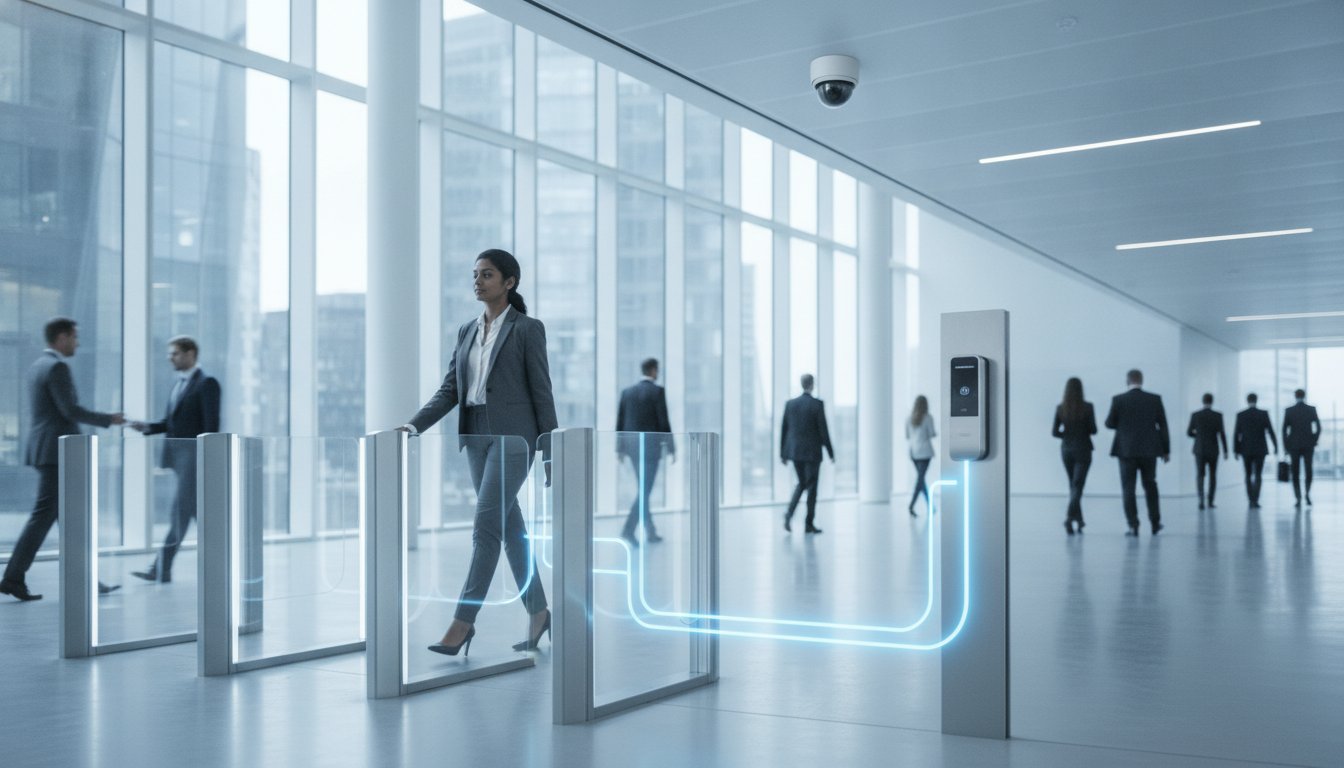
By 2026, over 60% of organisations have moved away from isolated security silos in favour of unified or integrated solutions. Managing a busy London lobby often feels like a constant battle against friction, especially when your speed gates don’t talk to your access control or your CCTV operates in a vacuum. You’re likely tired of juggling different vendor platforms and dealing with the high maintenance costs that come from a lack of system synergy. Achieving effective physical security integration for commercial buildings is no longer just a technical preference; it’s a requirement for operational stability and long-term asset protection.
We understand that you need a reliable, cohesive strategy that simplifies oversight rather than complicating it. This guide explains how to unify speed gates, access control, and IP CCTV into a seamless, high-performance security ecosystem for your commercial property. You’ll learn how to establish a single-view dashboard for your entire site, reduce tailgating, and future-proof your infrastructure to meet rigorous UK compliance standards. We’ll move through the technical requirements and commissioning processes that define a truly integrated professional environment.
Key Takeaways
- Understand the shift from siloed hardware to a unified IP-based ecosystem where physical barriers and electronic systems share data through a single interface.
- Discover how to combine speed gates, access control, and IP HD CCTV to achieve effective physical security integration for commercial buildings.
- Learn the technical logic behind the “digital handshake” that allows physical barriers to act as the primary enforcement layer for your access control system.
- Identify the essential steps for conducting a site-wide audit and aligning your security specifications with UK building regulations and “Secured by Design” standards.
- Recognise why professional commissioning and methodical maintenance are critical to ensure the long-term reliability and performance of your integrated ecosystem.
Integrated Physical Security Systems for Commercial Buildings: A 2026 Definition
Effective physical security integration for commercial buildings is defined by the technical synergy between physical barriers and electronic intelligence. In 2026, this means moving beyond a simple collection of hardware from various vendors. True integration creates a unified ecosystem where speed gates, access control, and IP HD CCTV share data in real time whilst operating under a single, cohesive interface. For facilities managers in high-traffic London environments, this shift is essential. Standalone systems often result in operational friction, where security teams must cross-reference disconnected logs to investigate a single incident.
The transition from “siloed” security hardware to unified IP-based infrastructure marks a significant evolution in how commercial properties are protected. Previously, a barrier might operate independently of the video management system. Today, a proactive model ensures that every physical action triggers a corresponding digital record. This level of coordination reduces the likelihood of unauthorised access and streamlines the flow of people through complex urban lobbies. It positions the security system as a steady, reliable hand that supports business continuity rather than a series of technical hurdles.
Moving Beyond Siloed Security Hardware
Operating with siloed hardware creates “data blindness.” When your speed gates and cameras don’t communicate, a tailgating event might go unnoticed until a manual audit is performed hours later. Managing multiple proprietary software platforms increases the administrative burden on your team and leads to higher maintenance costs. By contrast, an integrated approach allows for a proactive security posture. If a barrier is obstructed, the system can automatically trigger the nearest IP HD CCTV camera to provide visual verification on the central dashboard. This immediate response is vital for maintaining safety in busy corporate centres.
The IP Revolution in Site Protection
The modern security landscape is built upon the corporate data network. The transition to IP-based infrastructure allows for greater scalability and the use of non-proprietary standards. This connectivity ensures that your security ecosystem is not limited to a single physical location. With IP-based systems, remote monitoring and diagnostics become standard features. Specialists can assess system health across multiple sites without being present on-site. Centring your infrastructure on modern standards, such as ONVIF Profile T for video streaming, ensures your investment remains relevant. As of June 2026, Profile T has replaced older standards to provide advanced video features and improved cybersecurity across the network. This methodical approach to infrastructure planning ensures that your physical security integration for commercial buildings remains robust against both physical and digital threats.
The Essential Components of a Unified Security Infrastructure
A unified security ecosystem is only as strong as its weakest link. For successful physical security integration for commercial buildings, four primary components must work in unison. While some providers focus solely on software, a robust installation requires a balance between digital intelligence and physical enforcement. This synergy ensures that your security measures are not just reactive alarms, but a proactive deterrent that manages flow and risk simultaneously.
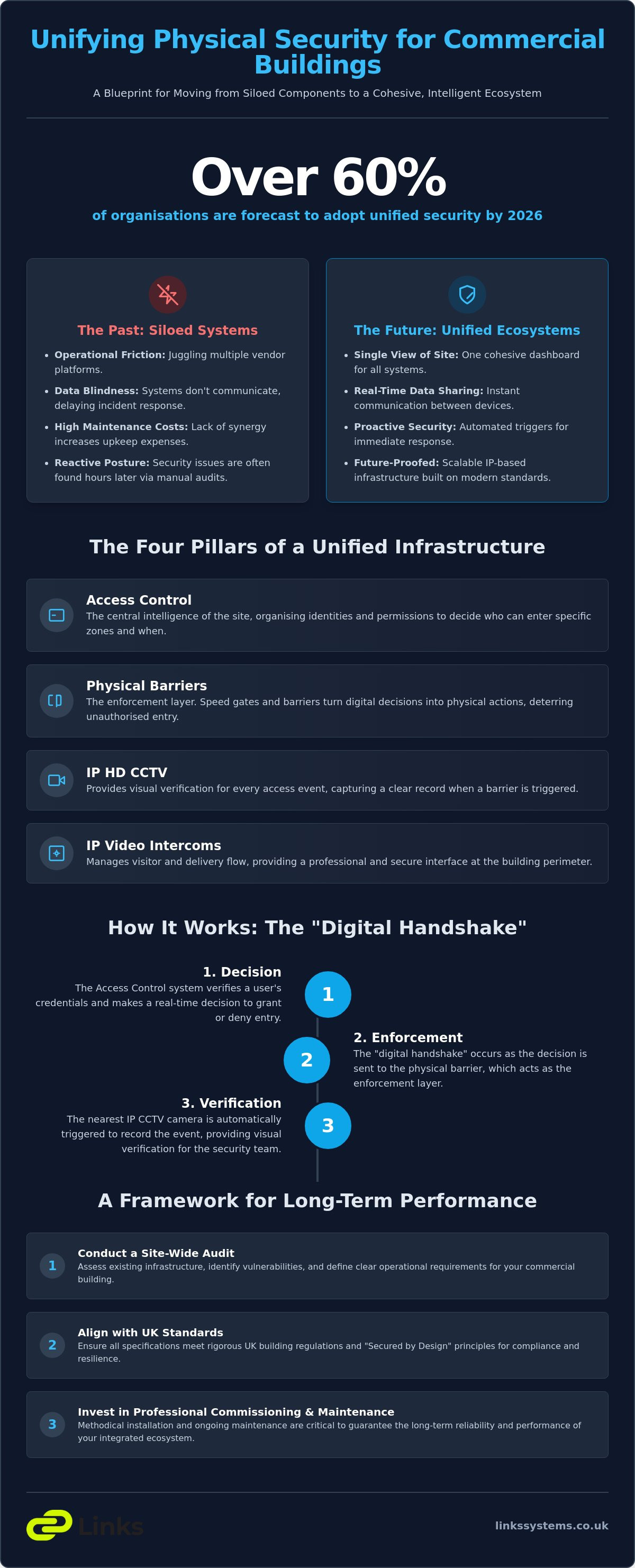
- Access Control: This acts as the central intelligence of the site. It organises identities and permissions, deciding who is permitted to enter specific zones and at what times.
- Physical Barriers: Speed gates and vehicle barriers are the enforcement layer. They turn digital decisions into physical actions, providing a tangible deterrent against unauthorised entry.
- IP HD CCTV: High-definition cameras provide visual verification for every access event. When a barrier is triggered, the system captures a clear record of the individual or vehicle involved.
- IP Video Intercoms: These systems manage visitor flow and delivery access amongst staff and guests, ensuring a professional interface at the building perimeter.
By selecting components that adhere to modern standards, such as ONVIF Profile T, you ensure that your investment is future-proofed. This methodical approach to selecting hardware is a hallmark of high-quality physical security integration for commercial buildings.
High-Definition IP CCTV and Video Verification
Clarity is paramount for forensic evidence in commercial settings. 4K resolution and Wide Dynamic Range (WDR) are essential for identifying individuals in challenging lighting, such as glass-fronted lobbies or dimly lit car parks. Integrating these video feeds directly into your access control dashboard allows security teams to verify a user’s identity against a live image instantly. Strategic camera placement is equally vital. By eliminating blind spots in high-traffic areas, you create a complete audit trail that supports insurance compliance and internal investigations.
Access Control and IP Intercom Systems
Modern workplaces are increasingly moving towards mobile credentials and biometric integration for staff. These technologies provide a frictionless experience that removes the need for physical fobs or cards. IP intercoms complement this by providing a professional first impression for visitors. For those managing multiple sites across Kent and Surrey business parks, centralised intercom management allows a single reception team to handle deliveries and guest arrivals for several buildings at once. If you are looking to modernise your current setup, our specialists in access control systems can design a solution tailored to your specific building layout and technical requirements.
The Digital Handshake: How Speed Gates and Barriers Communicate with IP Data
Physical barriers are often viewed as standalone mechanical installations, but in a sophisticated ecosystem, they serve as the vital enforcement layer. True physical security integration for commercial buildings relies on a seamless digital handshake between the network and the hardware. When a barrier isn’t integrated, it’s merely a gate; when it’s connected, it becomes an intelligent point of data capture and risk mitigation. This connection ensures that every physical movement is authorised by a central logic check before the hardware reacts.
The technical process follows a precise sequence. It begins with a credential read, such as a mobile token or biometric scan. The access control system performs an immediate logic check against the user database. If access is granted, the speed gate or vehicle barrier receives a command to open. Simultaneously, the integrated IP HD CCTV system bookmarks the footage of the event. This automated chain of events removes human error and provides a clear, timestamped audit trail for every person entering the premises.
Managing the risk of tailgating is a primary objective for modern site managers. Integrated speed gates use sophisticated infrared sensors and logic timing to detect when a second individual attempts to follow an authorised user. If the sensors detect a breach, the system can trigger an immediate alert on the security dashboard or keep the barrier closed. This proactive approach is further enhanced by telemetry and health monitoring. Modern gates report their own operational status, allowing facilities teams to identify a motor strain or sensor misalignment before it leads to a total system failure.
Managing Pedestrian Flow in London Skyscrapers
High-traffic lobbies in London skyscrapers require a delicate balance between throughput and rigorous security. Speed gates must handle significant volumes of people during morning peaks whilst maintaining the building’s aesthetic integrity. Choosing finishes like brushed stainless steel or bespoke glass panels ensures the hardware complements modern corporate interiors. Safety is equally critical. In accordance with UK fire regulations, all integrated gates must be configured to fail-safe, ensuring clear egress routes are maintained during an emergency evacuation.
Vehicle Barriers and Perimeter Integration
Vehicle access in Essex and Hertfordshire business hubs often relies on linking Automatic Number Plate Recognition (ANPR) directly to physical barriers. This integration allows for seamless entry for authorised staff and pre-registered delivery vehicles. Safety loops and ground sensors are essential components here, as they prevent the barrier from descending whilst a vehicle is still in the detection zone. By centralising this data, managers can monitor occupancy levels in real time and ensure that delivery bays are used efficiently without compromising the security of the wider perimeter. This methodical approach to physical security integration for commercial buildings provides the stability and reliability required for complex professional environments.
Planning and Specifying Your Integrated Security System
Successful physical security integration for commercial buildings begins long before a single cable is pulled. It requires a meticulous site-wide audit to identify hardware requirements and assess the existing network capacity. It’s a common pitfall to specify advanced IP HD CCTV and access control without verifying if the underlying data infrastructure can handle the increased bandwidth. We’ve found that specifying non-proprietary hardware is the most reliable way to ensure long-term maintenance flexibility. This approach prevents vendor lock-in and allows your system to evolve as new technologies emerge.
Specifications must align with “Secured by Design” standards and current UK building regulations. This ensures that the security measures are not only effective but also legally compliant. Selecting scalable hardware allows for future expansion, such as adding extra speed gates or cameras, without requiring a total system replacement. This methodical planning protects your capital investment and ensures the longevity of physical security integration for commercial buildings. Every component should be selected based on its ability to contribute to a unified ecosystem rather than its performance as a standalone unit.
Compliance and Regulatory Behaviours
Managing security data requires strict adherence to GDPR and the Data Protection Act. Every camera feed and access log contains personal data that must be stored and processed securely. Additionally, integrated speed gates and barriers must meet stringent fire safety standards. They must be configured to release automatically upon a fire alarm trigger to facilitate safe egress. For a deeper look at these requirements, see our Commercial Access Control Systems: A Professional Guide for 2026.
Working with Specialist Security Contractors
Developing a robust security specification for a new build or refurbishment involves close coordination between several parties. A specialist installer acts as the steady hand, aligning with M&E and IT contractors to ensure the physical hardware integrates perfectly with the building’s digital backbone. This collaborative model prevents technical conflicts during the installation phase. Detailed guidance on this process is available in our Professional Commercial Speed Gates & Barriers: The 2026 Specification Guide. If you are currently drafting a project specification, our team can provide the technical support needed for integrated physical security design.
Ensuring Long-Term Performance through Professional Commissioning and Maintenance
The final stage of physical security integration for commercial buildings is perhaps the most critical: the commissioning phase. This is the moment where theory meets practice; every digital handshake and logic sequence is rigorously tested before the system is handed over to the client. Without professional commissioning, even the most advanced hardware remains a collection of isolated parts rather than a unified ecosystem. It’s the difference between a system that works in isolation and one that provides a seamless, high-performance security environment for your staff and assets.
Our approach at Links Integrated Systems is built on technical precision backed by a 40-year legacy. We understand that project managers and stakeholders in London and the Home Counties require a steady, experienced hand to manage these complex technical requirements. This heritage isn’t just about time; it’s about the accumulated expertise of handling thousands of successful handovers in high-pressure commercial environments. We ensure that your investment is protected through a meticulous end-to-end process that prioritises reliability over rapid, transactional interactions.
The Critical Nature of System Commissioning
Commissioning involves testing hardware logic, fail-safes, and software reporting under peak load conditions. It’s essential to verify that the system behaves correctly during a power failure or a network outage. For example, ensuring that speed gates fail-safe in accordance with fire regulations is a non-negotiable safety check. Providing comprehensive staff training is another vital component. If your security team doesn’t know how to utilise the single-view dashboard to its full potential, the system’s effectiveness is halved. A “set and forget” strategy is a dangerous approach that leads to glitches and vulnerabilities down the line.
Structured Maintenance for Business Continuity
Maintenance is the foundation of long-term system health. In busy Kent, Surrey, and London environments, physical barriers like speed gates undergo significant mechanical stress. A scheduled maintenance contract provides regular inspections to identify wear before it leads to a failure. On the digital side, remote firmware updates and security patching are necessary to defend against evolving threats. Working with a partner who has deep local roots in the South East ensures that you have access to rapid support when it’s needed most. This proactive maintenance model keeps your physical security integration for commercial buildings functioning at peak performance for years to come.
Securing the Future of Your Commercial Infrastructure
The transition from siloed hardware to unified IP ecosystems has become the definitive standard for modern site protection. By prioritising technical synergy between physical barriers and digital intelligence, you create an environment that is both secure and operationally efficient. You’ve seen how the digital handshake between speed gates and access control reduces risk whilst streamlining pedestrian flow in high-traffic lobbies. This level of coordination is the foundation of a proactive security posture that protects your assets and your people.
Achieving successful physical security integration for commercial buildings requires a partner who understands the full lifecycle of a project, from the initial audit to long-term maintenance. With 40 years of expertise in physical and IP security, we act as the steady hand for complex technical requirements across London, Kent, Surrey, Hertfordshire, and Essex. Our specialist installers focus on professional commissioning and structured maintenance to ensure your infrastructure remains robust, reliable, and compliant for years to come.
Take the first step towards a unified security ecosystem today. Enquire about your bespoke integrated security solution today and ensure your property is protected by proven, high-quality standards that provide lasting peace of mind.
Frequently Asked Questions
What is an integrated security system for a commercial building?
An integrated security system is a unified ecosystem where physical hardware and software platforms communicate through a shared network. Rather than operating as isolated “silos,” components like speed gates, access control, and IP HD CCTV share data in real time. This allows a single event, such as a credential scan, to trigger multiple actions across the network, including barrier opening and video recording.
How much do integrated security systems cost for UK businesses?
The cost of physical security integration for commercial buildings depends on variables such as the number of entry points and the technical specifications of the IP hardware. Factors including the choice of biometric sensors, the resolution of CCTV cameras, and the requirement for bespoke speed gate finishes will influence the total investment. A detailed site audit is necessary to provide an accurate estimate based on your specific infrastructure needs.
Can I integrate my existing CCTV with a new access control system?
Integration is possible if your existing CCTV hardware supports open standards such as ONVIF Profile T or S. Many modern systems are designed to be non-proprietary, allowing a new access control platform to communicate with legacy cameras through a central Video Management System (VMS). If your current cameras are analogue, you may require IP encoders to bring those feeds onto the digital network.
What are the benefits of linking speed gates with access control?
Linking speed gates with access control ensures that physical barriers enforce the digital decisions made by your security software. This synergy effectively eliminates tailgating by using infrared sensors to detect unauthorised followers. It also provides a visual audit trail by automatically bookmarking CCTV footage at the exact moment a barrier is triggered, simplifying future forensic investigations.
How does an integrated system improve GDPR compliance?
Integration improves compliance by centralising data management and providing a single point of audit for all access and video records. Under the Data Protection Act, businesses must be able to manage and delete personal data efficiently. A unified system allows security managers to oversee data permissions and retention periods from one interface, ensuring that sensitive information is handled within a secure, encrypted environment.
Does a business in London need a specific maintenance contract for integrated systems?
A specialist maintenance contract is highly recommended for ensuring the long-term reliability of physical security integration for commercial buildings. High-traffic urban environments in London place significant mechanical stress on barriers and gates. Regular inspections and remote firmware updates are essential for preventing system downtime and ensuring that your security posture remains robust against evolving technical threats.
What happens if the network goes down in an integrated system?
Professionally designed integrated systems are built with local redundancy, meaning individual controllers can store permissions locally. If the main network fails, speed gates and door controllers will continue to operate based on their cached data. Once the connection is restored, the hardware automatically synchronises its offline logs with the central server to maintain a complete and accurate audit trail.
How long does it take to install and commission an integrated security system?
The duration of an installation varies based on project complexity and the depth of the commissioning phase required. Whilst the physical mounting of hardware may take only a few weeks, the technical process of configuring handshakes and testing fail-safe logic is a methodical task. A steady, planned approach ensures that the system is fully optimised and stable before the final handover to your facilities team.