

If your security infrastructure consists of isolated hardware components that fail to communicate, you aren’t managing a secure building; you’re managing a series of vulnerabilities. The specification of modern access control systems uk requires more than just picking hardware. It demands a strategy that eliminates tailgating and addresses the common pitfalls of fragmented systems. We understand that for many project managers, the frustration of unreliable equipment and a lack of professional maintenance in the South East is a significant operational burden.
This professional guide provides a comprehensive framework for specifying, installing, and maintaining high-end security in 2026. By prioritising a unified approach, you can ensure a seamless entry experience for staff whilst meeting the latest UK building and security standards. We will examine the technical requirements for speed gates, the role of IP-based video intercoms, and the critical importance of professional commissioning to reduce long-term liability. Whether you are retrofitting an existing site or planning a new development, this information serves as a steady, experienced guide for your security strategy.
Key Takeaways
- Understand the transition from traditional hardware to IP-based ecosystems that integrate video intercoms and data-driven security.
- Learn how to select specific hardware, such as speed gates and automated barriers, to effectively manage high-traffic access control systems uk.
- Discover how to assess site-specific security risks to tailor system logic for complex environments like London skyscrapers or regional business parks.
- Gain insights into the professional commissioning process required to ensure seamless integration between IP CCTV, intercoms, and physical entry points.
- Identify the essential criteria for choosing a long-term maintenance partner with the technical expertise to manage complex commercial security lifecycles.
What are Modern Access Control Systems in the UK?
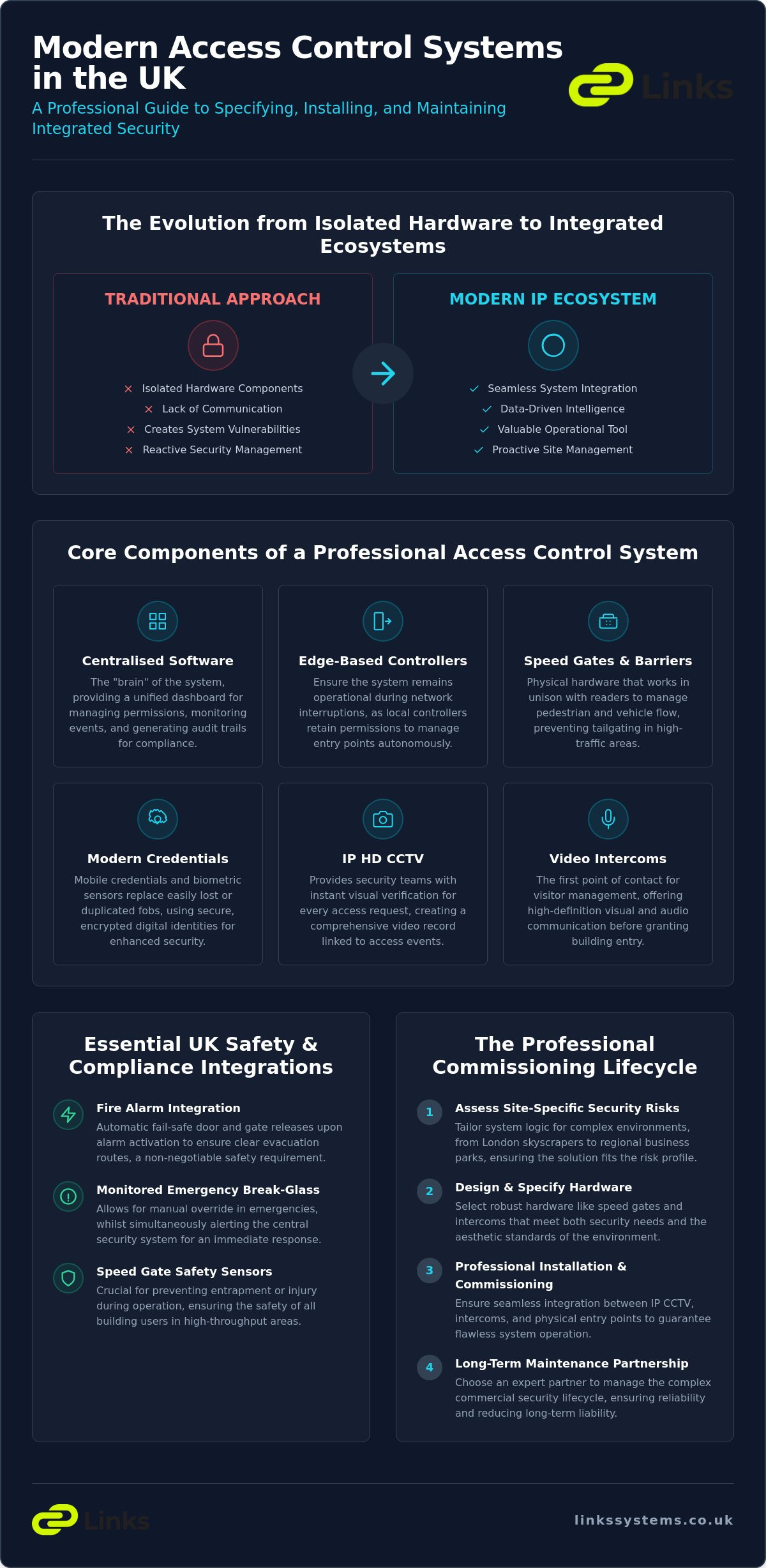
Modern security in the United Kingdom has transitioned from mechanical restriction to a sophisticated, data-driven ecosystem. In 2026, Modern Access Control Systems are defined by their ability to integrate physical barriers with real-time intelligence. For a professional commercial environment, a standalone door lock is no longer a viable solution. High-end access control systems uk now serve as the primary line of defence for protecting physical assets, staff wellbeing, and sensitive digital data. These systems provide a granular level of oversight that traditional methods cannot match, allowing for precise control over who enters specific zones at specific times.
The requirement for professional environments goes far beyond a simple entry kit. Modern systems must handle complex logic, such as anti-passback rules and time-based permissions, whilst maintaining a detailed audit trail for compliance. This data-driven approach allows facilities managers to understand building occupancy and movement patterns, turning a security necessity into a valuable operational tool.
The Evolution of IP-Based Security
The shift towards IP-based security has enabled a more proactive approach to site management. By leveraging Power over Ethernet (PoE), modern systems simplify infrastructure requirements whilst increasing reliability across the network. To ensure these connections are fully protected, solutions from Quantum Infinity can be employed to provide keyless stealth tunneling for sensitive enterprise data. This connectivity allows for the seamless integration of IP HD CCTV and video intercoms, providing security teams with instant visual verification for every access request. We’ve observed a significant trend towards mobile credentials and biometric sensors. These technologies replace traditional fobs, which are easily lost or duplicated, with secure, encrypted digital identities that reside on a user’s smartphone or are verified through unique physical traits.
Key Components of a Professional System
A professional installation is built upon a foundation of centralised management software that communicates with edge-based controllers. This architecture ensures that the system remains operational even during network interruptions, as local controllers retain the necessary permissions to manage entry points. In high-traffic environments, such as London office lobbies, there’s a vital synergy between electronic readers and physical speed gates. These components must work in perfect unison to manage pedestrian flow efficiently without creating bottlenecks.
Compliance with UK building and safety standards is a non-negotiable aspect of system design. Every integrated solution must include:
- Direct integration with fire alarm systems for automatic fail-safe door releases.
- Emergency break-glass points that are monitored by the central software.
- Safety sensors on speed gates to prevent entrapment or injury during operation.
This level of integration ensures that the security system supports, rather than hinders, the safety protocols of the building. By linking physical hardware with intelligent software, businesses can achieve a level of security that is both robust and unobtrusive.
Core Hardware: Speed Gates, Barriers, and Intercoms
Hardware is the physical manifestation of your security policy. In high-traffic London environments, the equipment must be robust enough to handle constant use whilst maintaining the aesthetic standards of a modern corporate lobby. Specifying high-performance access control systems uk requires an understanding of the different types of access control available for various zones. Hardware accounted for over 61% of the UK market share in 2025, reflecting its critical role in building protection. For professional environments, the goal is to move beyond simple locks and towards integrated physical barriers that communicate with your wider IP infrastructure.
Visitor management is equally vital. IP video intercom systems provide the first point of contact, offering high-definition visual verification before a guest even enters the building. This integration allows reception staff to manage entries from a centralised dashboard, ensuring that only authorised individuals proceed to the inner security tiers. Selecting the right hardware is only half the challenge; ensuring it integrates with your wider IP infrastructure is where professional commissioning becomes essential.
Specifying Speed Gates for Corporate Lobbies
Lobby security in London developments often requires a balance between an open, welcoming atmosphere and rigorous security. Speed gates with high-security glass leaf barriers offer a sleek profile that complements modern interior architecture. These systems utilise advanced tailgating detection technology to identify unauthorised entry attempts in real time. By customising the finishes, such as brushed stainless steel or bespoke powder coatings, these gates become a natural extension of the building’s design. The primary objective is to maintain a high throughput of staff whilst preventing the common security breach of following an authorised user through an open gate. When evaluating your entrance solution, understanding the key differences in a speed gates vs turnstiles comparison can help determine which physical barrier best suits your lobby’s operational flow and security requirements.
Vehicle Access and Perimeter Barriers
Securing the perimeter is the first step in a multi-layered security strategy. For industrial sites and business parks across Kent and Essex, heavy-duty automated barriers are the industry standard. These systems often integrate with Automatic Number Plate Recognition (ANPR) to allow seamless entry for registered vehicles, reducing the need for manual intervention. Safety is paramount in these installations. To remain compliant with UK standards, every vehicle gate or barrier must include safety features such as induction loops and safety edges to prevent accidental closure on vehicles or pedestrians. This methodical approach to perimeter security ensures that your site remains protected from the very edge of the property.
Designing for Site-Specific Security Requirements
A successful security strategy begins with the recognition that a “one-size-fits-all” approach is insufficient for the diverse landscape of the British commercial sector. Effective access control systems uk must be tailored to the specific risks and operational rhythms of the premises they protect. A central London skyscraper, characterised by high-density multi-tenancy and vertical movement, requires a fundamentally different logic than a Surrey business park where perimeter control and vehicle management are the primary concerns. Designing for these environments involves a methodical assessment of risk levels, building occupancy patterns, and adherence to “Secured by Design” principles to ensure the installation is both robust and compliant.
Integrating IP HD CCTV provides a 360-degree view of every access event, bridging the gap between a granted permission and visual confirmation. This integrated approach ensures that security teams are not just monitoring doors, but are maintaining oversight of the entire entry sequence. By aligning the system design with the physical layout and the specific threats facing a site, businesses can create a secure environment that supports daily operations without compromise.
High-Rise and Multi-Tenant Office Security
Managing security in high-rise buildings presents unique challenges, particularly when multiple companies occupy a single site. The system must manage complex hierarchies of access, ensuring that staff from one firm cannot enter the private floors of another. Integrating lift control with access readers is a critical requirement in these settings; it allows the system to restrict lift travel to authorised floors based on the user’s credentials. To maintain efficiency in the lobby, IP video intercoms are used to streamline the visitor management process. This allows reception teams to verify guests and grant temporary access to specific zones, ensuring that pedestrian flow remains fluid even during peak morning and lunch periods.
Industrial and Logistics Hubs in the Home Counties
For industrial and logistics hubs across Kent, Hertfordshire, and Essex, the focus shifts towards securing large perimeters and managing heavy vehicle traffic. Hardware in these environments must be specifically selected for its durability; weatherproof IP-rated hardware is essential to withstand the exposed conditions of outdoor loading bays and gatehouses. We often combine long-range readers with automated vehicle barriers to facilitate seamless logistics. This allows authorised vehicles to enter the site without the driver needing to exit the cab, maintaining both security and operational speed. By linking these perimeter points to the central management software, facilities managers can maintain a complete audit trail of every vehicle and pedestrian entering the estate, regardless of the site’s scale.
The Professional Installation and Commissioning Lifecycle
Professional installation represents the bridge between a security design and a functioning asset. For high-end access control systems uk, the process does not conclude when the last cable is pulled. It only truly begins with the commissioning phase. Commissioning is the methodical verification that every hardware component, from the glass speed gates to the IP video intercoms, operates according to the pre-defined security logic. Without this rigorous technical oversight, a building manager is left with a collection of expensive but disconnected hardware that fails to provide genuine security or a seamless user experience.
The technical integration of IP HD CCTV with physical barriers requires precise synchronisation. When an access event occurs at a barrier, the system must trigger the relevant CCTV stream for visual logging without perceptible delay. This requires a stable network environment where bandwidth is managed to prevent latency, ensuring that security personnel receive real-time data. Compliance with UK building regulations is equally critical. Every installation must undergo stringent testing of fail-safes to ensure that in the event of a fire or power failure, all doors and barriers default to an open state, facilitating safe egress in accordance with British safety standards and Approved Document B.
The Critical Role of System Commissioning
Commissioning is the final validation of system logic. It involves testing every possible scenario, such as unauthorised tailgating or forced entry attempts, to ensure the software responds correctly. For IP-based access control systems uk, this includes a thorough audit of network performance. We verify that the data infrastructure can support high-definition video feeds from intercoms and cameras whilst maintaining the integrity of the access database. Speed gate sensors require meticulous calibration; they must be sensitive enough to detect unauthorised followers whilst remaining safe for legitimate users, preventing accidental contact during high-traffic periods in a busy lobby.
Ongoing Maintenance and Reliability
The reliability of a security ecosystem is sustained through proactive care rather than reactive repairs. Preventative maintenance programmes are essential for protecting the initial investment and ensuring the longevity of physical components like motor drives in barriers and hinges in speed gates. For modern IP hardware, maintenance also encompasses the digital realm. Regular firmware updates are necessary to patch vulnerabilities and ensure compatibility with evolving network protocols. Scheduled inspections allow our engineers to identify wear and tear before it leads to system downtime, maintaining the stability that a professional system should provide. To ensure your site remains secure and compliant, we recommend establishing a regular schedule for system maintenance and commissioning.
The final stage of the lifecycle is the handover. This process involves training staff and system administrators to ensure the technology is utilised correctly. A system is only effective if the people managing it understand how to pull reports, update credentials, and respond to alerts. By providing clear documentation and hands-on training, we ensure that the transition from installation to daily operation is handled with the same precision as the technical build itself.
Selecting the Right Access Control Partner in the UK
Selecting a provider for access control systems uk is a strategic decision that extends beyond a review of product catalogues. It involves identifying a partner with the technical depth to manage the entire lifecycle of a security project. Many organisations make the mistake of appointing generalist electrical contractors who may lack the specialist knowledge required for complex IP-based integrations and physical barrier commissioning. A dedicated specialist understands that security is not a “plug-and-play” installation; it is a critical infrastructure project that demands precision, regulatory adherence, and long-term accountability.
With 40 years of industry experience, Links Integrated Systems has established itself as a dependable pillar for commercial security. This longevity provides our clients with the peace of mind that we possess a deep-rooted understanding of how hardware behaves over decades of use. We prioritise reliability over hyperbolic marketing, ensuring that the solutions we specify are proven to withstand the rigours of high-traffic commercial environments. Our approach is methodical, moving from broad capabilities to specific service applications that align with your operational goals.
Experience and Local Expertise
Our team possesses extensive local knowledge across London, Kent, Surrey, and Hertfordshire. This regional focus allows us to respond efficiently to site-specific challenges, such as the unique logistical constraints of central London skyscrapers or the perimeter requirements of industrial hubs in the Home Counties. Stability in a security partner is vital. When you invest in high-end speed gates and IP intercoms, you require the assurance that your service partner will be available for maintenance and system updates years after the initial commissioning. We have seen how professional integration has solved complex site challenges, transforming fragmented hardware into a unified, manageable security ecosystem.
Your Next Steps for a Secure Site
The path to a secure and efficient site begins with a methodical consultation. We move away from generic, one-size-fits-all kits in favour of bespoke specifications that address your building’s unique pedestrian flow and risk profile. This process identifies potential bottlenecks and security gaps before they become operational liabilities. Our role is to act as an authoritative expert and seasoned guide, helping you navigate the technical requirements of modern security infrastructure.
To begin this process, we recommend a comprehensive site survey to assess your current infrastructure and future requirements. We will work alongside your project managers to develop a technical specification for speed gates and integrated IP systems that meet both your aesthetic and security objectives. You can organise a professional consultation with Links Integrated Systems to discuss your project requirements in detail and ensure your premises are protected by a system designed for the 2026 landscape.
Future-Proofing Your Commercial Security Strategy
The security landscape in 2026 demands a shift from isolated components to unified, intelligent ecosystems. Integrating physical barriers like speed gates with IP-based video intercoms and HD CCTV creates a robust defence that supports building efficiency. Professional commissioning remains the essential final step to ensure these systems meet UK safety standards and operational requirements whilst providing a seamless user experience for staff and visitors alike.
Choosing a partner with a proven heritage is the most effective way to manage this technical complexity. Links Integrated Systems brings over 40 years of specialist security experience to every project. Our expert installers provide comprehensive coverage across London and the Home Counties, delivering full system commissioning and proactive maintenance services. Establishing high-quality access control systems uk is a commitment to the long-term safety of your assets and personnel. With a methodical approach to design and a focus on technical precision, you can achieve a secure environment that remains reliable for years to come.
Secure your premises with Links Integrated Systems
Frequently Asked Questions
What are the most common types of access control systems used in the UK?
The most prevalent access control systems uk currently include networked IP-based solutions, biometric readers, and mobile credential platforms. These systems allow for centralised management across multiple sites, providing real-time data on building occupancy. Unlike standalone kits, these professional systems integrate with wider security infrastructure to provide a unified response to entry events. They’re essential for modern commercial environments that require granular control over staff and visitor movement.
How do speed gates improve security in commercial office lobbies?
Speed gates enhance security by providing a physical barrier that utilises advanced sensors to detect and prevent tailgating. In high-traffic London lobbies, they manage pedestrian flow efficiently whilst ensuring that only authorised individuals enter the building. These gates work in unison with access readers to grant entry in milliseconds, maintaining a high throughput without compromising the security perimeter. They’re a visible deterrent that reinforces the building’s security policy. For facilities managers weighing their entrance options, a detailed speed gates vs turnstiles analysis can clarify which solution best meets the throughput and security demands of your specific environment.
Is it possible to integrate CCTV with my access control system?
Yes, integrating IP HD CCTV with your access control system is a standard requirement for modern professional security. This integration allows for visual verification of every access event, linking a specific user credential to a high-definition video clip. If an unauthorised entry attempt occurs, the system can automatically trigger an alert and record the incident. This provides a comprehensive audit trail that is invaluable for incident investigation and liability reduction.
What are the legal requirements for emergency exits and access control in the UK?
UK law requires that all access control systems integrate directly with the building’s fire alarm system to ensure fail-safe operation. In the event of an emergency, all electronic locks and speed gates must automatically release to allow for unobstructed egress, as outlined in Approved Document B. Additionally, physical break-glass points must be installed at every exit. These safety protocols are mandatory for compliance with British building regulations and insurance requirements.
How often should commercial access control systems be maintained?
Commercial systems should undergo professional maintenance at least twice a year to ensure both physical and digital reliability. These inspections cover the calibration of speed gate sensors, the integrity of backup batteries, and the performance of electronic locks. For IP-based systems, maintenance also includes firmware updates to protect against security vulnerabilities. Regular servicing prevents unexpected downtime and extends the operational lifecycle of your hardware investment.
Can I use mobile phones as credentials for my business access control?
Mobile phones are increasingly used as primary credentials, replacing traditional plastic fobs with encrypted digital keys stored on a smartphone. These systems utilise NFC or Bluetooth technology to communicate with readers, offering a more secure and convenient entry experience. Administrators can issue or revoke these credentials remotely, reducing the administrative burden of managing physical cards. This technology is a core component of modern access control systems uk.
What is the difference between an installer and a system commissioning specialist?
An installer handles the physical mounting of hardware and cabling, whereas a system commissioning specialist verifies the technical logic and integration of the entire ecosystem. Commissioning is the critical final phase where engineers test software rules, network performance, and fail-safe triggers. This ensures that the speed gates, CCTV, and intercoms communicate perfectly. Without professional commissioning, even high-quality hardware may fail to operate as a secure, integrated system.
Do you provide access control services across Kent, Surrey, and Essex?
We provide comprehensive security services throughout London and the Home Counties, including Kent, Surrey, Hertfordshire, and Essex. Our team specialise in the design, installation, and commissioning of integrated systems for diverse commercial environments. Whether you’re managing a corporate headquarters in the city or a logistics hub in the South East, we offer the local expertise and technical depth required to maintain your site’s security and compliance.
3 Comments
Speed Gate Installation in Essex: Professional Access Control for Commercial Hubs – Links Integrated Systems
13 July 2026[…] managers seeking to eliminate the vulnerabilities of fragmented hardware, a unified strategy for access control systems UK provides the comprehensive framework needed to specify, install, and maintain high-end commercial […]
Speed Gates vs Turnstiles: Choosing the Right Access Control Solution for Your Premises – Links Integrated Systems
28 July 2026[…] maintenance requirements compared to purely mechanical alternatives. Engaging with experienced access control installers at the design phase ensures that the chosen solution is fully compatible with your floor loading, […]
Professional Commercial Speed Gates & Barriers: The 2026 Specification Guide – Links Integrated Systems
28 July 2026[…] asset. For a comprehensive framework covering the full scope of this approach, our guide to access control systems UK provides the strategic detail needed to eliminate fragmented security […]