

If your lobby feels more like a bottleneck than a gateway during the morning peak, is your security infrastructure actually serving your tenants or simply obstructing them? Managing multi-tenant office building access control is a complex balancing act that requires a methodical approach. You’re tasked with providing a frictionless entry experience for hundreds of employees whilst maintaining the rigid privacy demands of individual high-value firms. It’s often a struggle to synchronise disparate systems or revoke credentials for departing staff without increasing the administrative burden on your team.
We understand that security should provide peace of mind, not operational headaches. This 2026 specification guide provides a stable roadmap to help you master shared infrastructure and ensure your property remains a premium, scalable asset. You’ll learn how to integrate the latest IP-based hardware and software solutions to create a unified security backbone that satisfies both project managers and end-users.
We’ll examine the shift towards cloud-native platforms, the importance of UL 294 compliance, and how 2026 updates like C•CURE IQ 3.2 are redefining system interoperability. From the installation of high-flow speed gates to the deployment of mobile credentials, this guide details the end-to-end process of building a secure, future-proof environment.
Key Takeaways
- Learn how to balance shared building infrastructure with the specific privacy requirements of individual firms to maintain a seamless pedestrian flow throughout the day.
- Discover why high-definition IP video intercoms and aesthetically integrated speed gates are essential components for professional lobbies in 2026.
- Master a layered architecture for multi-tenant office building access control that effectively filters authorised personnel from visitors at every entry point.
- Understand why professional commissioning is the most critical stage of any security project to ensure long-term reliability and compliance with industry standards.
- Identify the risks of an “install and forget” mentality and how structured maintenance contracts protect your infrastructure investment from technical obsolescence.
The Challenges of Multi-Tenant Access Control in 2026
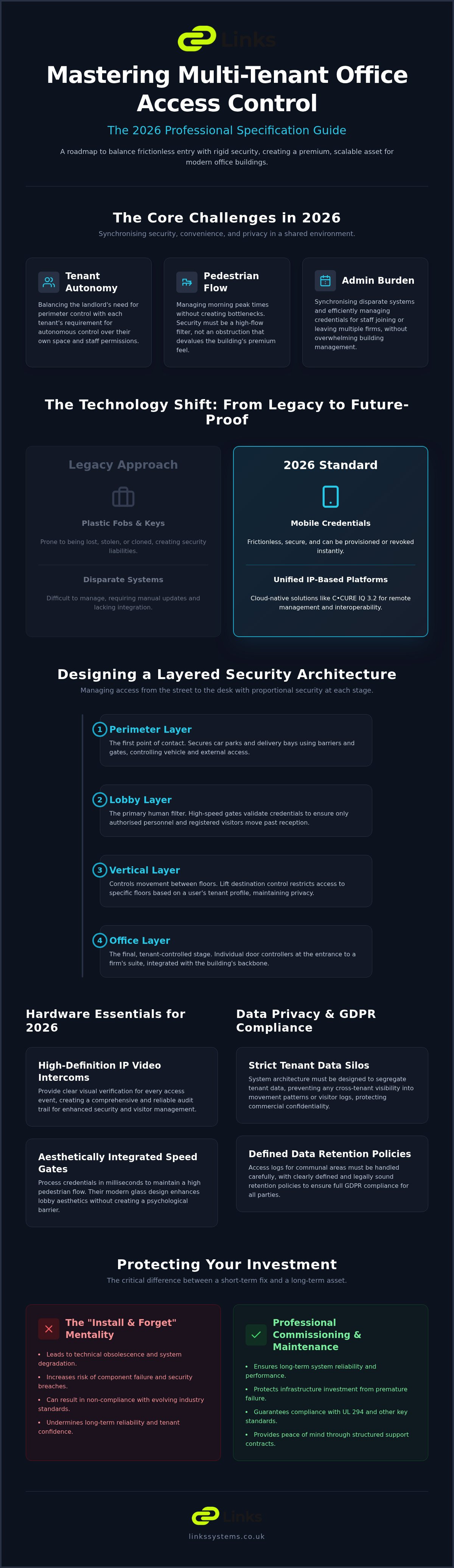
The multi-tenant security model is a study in tiered permissions. At its core, multi-tenant office building access control requires a centralised infrastructure that remains flexible enough to accommodate individual tenant needs. Landlords are responsible for the perimeter and communal zones, whilst tenants require autonomous control over their leased footprints. This creates a complex environment where the landlord provides the “utility” of security, and the tenant manages the specific “usage” for their staff. It’s a relationship built on trust and technical precision.
Modern tenant expectations have shifted significantly. In 2026, plastic fobs are increasingly viewed as legacy technology. Users now demand mobile credentials and frictionless entry as standard. IP-based Access control systems have become the primary tool for building managers to handle these demands. These systems allow for remote management and instant credential updates, which reduces the administrative burden when staff join or leave a firm. This shift to digital-first credentials also helps landlords mitigate the liability associated with lost or stolen physical keys.
Balancing Security with Pedestrian Flow
Lobby management is the most visible aspect of building security. Traditional tripod turnstiles often create a psychological barrier and physical bottleneck, especially in high-occupancy London office blocks. We’ve seen a decisive move towards high-speed glass gates. These units provide a high-flow filter that maintains security without making the lobby feel like a restricted zone. Managing the morning peak requires hardware that processes credentials in milliseconds. If the pedestrian flow is interrupted, the perceived value of the building drops for both tenants and their visitors. A smooth entry experience reinforces the building’s status as a premium professional environment.
Data Privacy and GDPR Compliance
Operating a shared system introduces specific data challenges. It’s vital to organise tenant data within strict silos to prevent cross-tenant leaks. A firm on the third floor must not have visibility into the movement patterns or visitor logs of a firm on the tenth. We design system architectures that ensure data segregation is baked into the software level. This protects the landlord from liability and ensures compliance with GDPR. Access logs for communal areas must be handled with care, ensuring that data retention policies are clearly defined and legally sound for all parties involved. Maintaining these silos is essential for protecting tenant privacy and commercial confidentiality.
Designing a Layered Security Architecture
Effective multi-tenant office building access control relies on a layered architecture that manages movement from the street to the desk. This approach ensures that security is proportional to the area being protected. The perimeter layer acts as the first point of contact, utilising barriers and gates to secure car parks and delivery bays. Once inside, the lobby layer serves as the primary filter. Here, speed gates validate credentials before individuals can progress further into the building, ensuring only authorised personnel move beyond the reception area.
The vertical layer is where complex permissions become critical for shared spaces. By implementing lift destination control, you can restrict access to specific floors based on a user’s tenant profile. This prevents unauthorised transit between different firms and maintains the privacy of each floor. Finally, the office layer involves individual door controllers at the tenant’s own entrance. These units should integrate seamlessly into the building backbone whilst allowing the tenant to manage their own internal staff permissions independently from the landlord.
Integrating Physical Security Hardware
Linking speed gates with lift call systems creates a seamless transit experience for employees. When a staff member scans their mobile credential at the lobby gate, the system can automatically pre-call a lift to their designated floor. This level of technical synergy is why integrating CCTV with access control systems is essential for modern developments. It provides visual verification for every access event, creating a comprehensive and reliable audit trail. Choosing IP-based hardware is no longer just a recommendation for 2026 specifications; it is the foundation for a future-proof and scalable system.
Visitor Management and IP Intercoms
Managing guests shouldn’t overwhelm your front-of-house team or create queues in the lobby. IP video intercom systems empower tenants to manage their own visitors directly from their desks or mobile devices. This decentralised approach reduces the burden on reception staff and significantly speeds up the check-in process. Modern systems often utilise QR codes or temporary mobile passes for scheduled guests, allowing them to bypass the main desk and proceed through the speed gates autonomously. If you are planning a new installation, our team can help you design a bespoke security layout that balances pedestrian flow with robust functionality.
Hardware Essentials: Speed Gates and IP Intercoms
Hardware isn’t just a security barrier; it’s a primary touchpoint for every person entering the building. In the context of multi-tenant office building access control, these physical components must be exceptionally durable. London’s high-traffic commercial centres demand equipment that can handle thousands of cycles every day without mechanical failure. High-definition IP video intercoms have become a non-negotiable standard for professional firms. These systems provide the visual clarity required for positive identification whilst ensuring the building’s technical infrastructure matches the premium expectations of its tenants. We’re also seeing an increased deployment of biometric readers and facial recognition in high-security hubs. These technologies offer a higher level of assurance than traditional cards by ensuring that the person using the credential is the authorised owner.
Specifying Commercial Speed Gates
Specifying the right speed gate requires a balance between aesthetics and performance. Architects often demand specific glass heights and cabinet finishes, such as brushed stainless steel or bespoke powder coatings, to match the lobby’s interior design. However, the gate’s behaviour is what truly defines its effectiveness. Sensors must be precise enough to prevent tailgating whilst being sensitive enough to ensure user safety. Each installation must be meticulously configured for DDA compliance to provide accessible entry for all users. These units must also integrate with the building’s life safety systems to ensure immediate emergency egress during a fire alarm. For more technical details, refer to our 2026 specification guide for speed gates and barriers.
The Role of HD IP CCTV
IP HD CCTV systems provide the vital visual layer that supports physical access hardware. Strategic placement of cameras at entry and exit points ensures there are no blind spots in the pedestrian flow. We use advanced video analytics to monitor speed gates for tailgating or “pass-back” attempts, where a single credential is used for multiple entries. In a multi-tenant setting, the challenge lies in data management. The system must store footage on a secure, central server whilst providing granular access rights. This allows authorised tenants to view feeds from their specific office entrances without compromising the privacy of other occupiers or the security of the building’s communal zones.
System Commissioning and Long-Term Maintenance
Professional commissioning is the critical transition point between a construction site and a live commercial environment. For multi-tenant office building access control, this phase is where complex software permissions are rigorously tested against physical hardware. Without thorough commissioning, the intricate balance of shared lobby access and private tenant silos remains unverified. We ensure every controller, reader, and gate responds exactly as specified before the first tenant moves in. This methodical approach prevents the operational friction that often plagues poorly executed handovers.
The risks of an “install and forget” approach are substantial. Over time, systems can suffer from “drift” where hardware misalignments or outdated software protocols create security vulnerabilities. A proactive maintenance strategy ensures that your investment continues to perform at its peak. By planning for hardware lifecycle management early, building managers can schedule component upgrades before failure occurs, avoiding the disruption and cost associated with emergency reactive repairs.
The Commissioning Process
The process begins with stress-testing the system under simulated peak traffic conditions. We verify that fail-safe mechanisms operate correctly during power loss or fire alarms, ensuring occupant safety isn’t compromised by security protocols. Every integration point, from the IP video intercoms to the central database, is checked for latency and accuracy. Finally, we provide building management teams with comprehensive O&M manuals. These documents are essential for long-term site management, detailing every technical specification and configuration within the building’s security infrastructure.
Maintenance for Commercial Reliability
Adopting a preventative maintenance schedule is essential for commercial reliability. Physical hardware like speed gates and barriers contains mechanical parts that require regular lubrication and alignment to operate at peak efficiency. This preventative approach always saves money in the long run by identifying potential points of failure before they cause a total system shutdown. We also test backup power systems to guarantee that security remains intact during local power outages, which is vital for maintaining the building’s integrity.
Software and firmware management is equally vital for IP-based systems. Regular updates protect your hardware from evolving threats and ensure compatibility with new mobile credentials. Planning for hardware lifecycle management allows you to schedule upgrades systematically rather than dealing with emergency replacements. If you require a structured approach to your building’s security, you can book a maintenance consultation with our experienced engineering team to ensure your infrastructure remains secure and compliant.
Implementing a Future-Proof Solution with Links
Links Integrated Systems brings over 40 years of industry experience to every project. We’ve established ourselves as a dependable pillar for physical security integration for commercial buildings, specifically within the demanding London and South East markets. Our expertise spans the full lifecycle of multi-tenant office building access control, from the initial design phase through to long-term maintenance. We understand that high-level stakeholders require a specialist who can navigate the complexities of modern data infrastructure whilst maintaining the traditional values of reliability and precision.
Our approach is inherently collaborative. We don’t operate in a vacuum; instead, we work closely with landlords, architects, and MEP consultants to ensure our security systems align perfectly with the building’s broader operational goals. Whether you’re managing a new development in Kent or refurbishing a high-rise in Surrey, Hertfordshire, or Essex, we provide the technical guidance needed to future-proof your assets. We act as a seasoned guide, helping you avoid common pitfalls and ensuring that your security hardware serves as a long-term investment rather than a short-term fix.
The Links Integrated Systems Difference
Reliability is the cornerstone of our service model. Our technical commissioning process is designed to ensure zero-day reliability for every new tenant that enters your building. We’ve spent decades refining our methods. We only specify high-quality hardware from leading global manufacturers. This commitment to quality ensures that your speed gates, intercoms, and access readers perform consistently under the pressure of daily commercial use. You’ll receive a personalised service that reflects our deep-rooted stability in the industry, providing you with the peace of mind that your infrastructure is in capable hands.
Next Steps for Your Building
Beginning the consultation process for your multi-tenant development is a straightforward procedure. We recommend starting with a detailed security audit, particularly for existing office refurbishments where legacy systems may still be present. This allows us to identify potential vulnerabilities and propose a scalable solution that meets 2026 standards. Our team is available to conduct professional site surveys across the South East, providing the technical specifications required to secure your assets. Contact Links Integrated Systems today to arrange an initial consultation and take the first step towards a more secure, frictionless commercial environment.
Mastering Shared Infrastructure for 2026
The evolution of multi-tenant office building access control demands a shift from isolated security points to a unified, IP-based ecosystem. Success in 2026 depends on balancing the high-flow requirements of a shared lobby whilst ensuring the rigid privacy needs of individual tenants. By implementing a layered architecture that integrates speed gates, HD IP video intercoms, and lift destination control, landlords can provide a frictionless experience that attracts and retains high-value occupiers. We’ve seen that even the most robust hardware is only as effective as the commissioning process behind it.
Professional testing and structured maintenance contracts are essential to prevent system drift and ensure long-term operational reliability. With 40 years of commercial security expertise, Links Integrated Systems provides the steady hand required to manage these complex technical environments. As specialist installers for London and the South East, we deliver comprehensive maintenance and commissioning services that protect your infrastructure investment. We’re ready to help you navigate the full lifecycle of your project with precision.
Contact Links Integrated Systems for a professional access control consultation to begin your site survey. We look forward to securing your commercial assets with reliability and expertise.
Frequently Asked Questions
How do speed gates improve tenant experience in multi-tenant buildings?
Speed gates provide a high-flow, frictionless entry point that significantly reduces lobby congestion during morning peaks. Unlike traditional barriers, these units use advanced sensors to process credentials in milliseconds, allowing authorised staff to pass through without breaking their stride. This creates a premium first impression for clients and employees in high-occupancy London offices. They combine robust physical security with an open, welcoming aesthetic that enhances the overall building value for every tenant.
Can tenants manage their own access permissions within a shared building system?
Yes, modern multi-tenant office building access control systems allow for segregated administrative rights. This means that whilst the landlord manages the building’s perimeter and communal zones, individual tenants can autonomously manage their own staff permissions and visitor lists. These software silos ensure that sensitive movement data remains private to each firm. It reduces the administrative burden on building managers and gives tenants the control they require over their specific leased footprints.
What is the difference between a standard turnstile and a high-speed glass gate?
High-speed glass gates offer superior throughput and a more sophisticated aesthetic than standard tripod turnstiles. While a turnstile acts as a physical deterrent that can slow down pedestrian flow, speed gates use motorised glass leaves and infrared sensors to allow for rapid, hands-free passage. This is particularly important for Grade A commercial centres in the South East, where maintaining a professional, non-restrictive atmosphere is as vital as the security itself.
How do IP video intercoms integrate with mobile phone apps for visitors?
IP video intercoms use the building’s data network to route calls directly to a tenant’s smartphone or tablet app. This allows staff to visually verify visitors and grant entry from anywhere in the office or even remotely. In 2026, these systems often issue temporary QR codes or mobile passes to guests, which allows them to move through the lobby speed gates without needing assistance from a physical reception desk, streamlining the entire visitor management process.
What maintenance is required for a commercial access control system?
Commercial systems require regular preventative maintenance to ensure mechanical components like gate motors and barriers remain aligned. We recommend bi-annual inspections to test backup power systems and verify that all IP hardware is running the latest secure firmware. Regular maintenance prevents system drift and identifies potential failures before they cause operational downtime. This proactive approach is essential for maintaining the high-traffic security infrastructure expected in London, Kent, and the surrounding counties.
Is it possible to integrate lift control with my lobby speed gates?
Integration between lobby speed gates and lift destination control is a standard feature of modern multi-tenant developments. When a user scans their credential at the gate, the system identifies their designated floor and automatically pre-calls a lift to meet them. This technical synergy reduces wait times and ensures that individuals can only access the specific floors they are authorised to visit, which is a critical component of a layered security strategy.
How does a layered security model protect individual tenant assets?
A layered security model creates multiple points of verification that protect a tenant’s private office from unauthorised access. By securing the perimeter, the lobby, and the vertical lift transit, the system ensures that a person must pass through several filters before reaching an individual office door. This architecture prevents a security breach in a communal area from compromising the private assets or data of a specific firm, maintaining strict operational silos.
What are the benefits of using an IP-based security system in 2026?
IP-based systems offer unparalleled scalability and the ability to integrate disparate hardware into a single management platform. In 2026, using IP infrastructure allows for remote system commissioning and real-time monitoring of security events across multiple sites in Essex or Hertfordshire. These systems are essential for modern multi-tenant office building access control, as they allow for easy updates to accommodate new biometric technologies or mobile credentials without requiring a complete overhaul of the building’s physical cabling.