

In the high-stakes environment of London retail, a grainy image is more than a technical failure; it represents a vulnerability in your asset protection strategy. You likely already know that legacy analogue systems often fail when you need them most, leaving security teams with unusable footage during critical incidents. High shrinkage rates in busy urban centres demand more than just a visible deterrent. Investing in high definition CCTV for retail London has shifted from an optional upgrade to a fundamental requirement for protecting assets and staff.
This 2026 specification guide provides the technical clarity required to master your security infrastructure. We’ll show you how to transition to IP-based systems that offer crystal-clear facial recognition and precise till-point monitoring. You’ll learn how to integrate video with back-of-house access control and establish a maintenance schedule that ensures long-term reliability. We will explore the strategic implementation of high-definition hardware to turn passive recording into a proactive tool for retail intelligence.
Key Takeaways
- Transitioning from legacy analogue to IP-based 4K systems ensures your footage meets modern evidential standards for facial recognition and till-point monitoring.
- Learn why Wide Dynamic Range (WDR) and low-light sensors are essential for capturing clear images across London’s varying storefront lighting conditions.
- Discover the operational benefits of integrating high definition CCTV for retail London with back-of-house access control and delivery bay monitoring.
- Understand how to apply privacy masking and strategic camera placement to protect high-value aisles whilst remaining compliant with UK data protection laws.
- Establish a professional commissioning and maintenance schedule to prevent hardware failures and ensure consistent system performance over time.
Understanding High Definition IP CCTV for London Retail
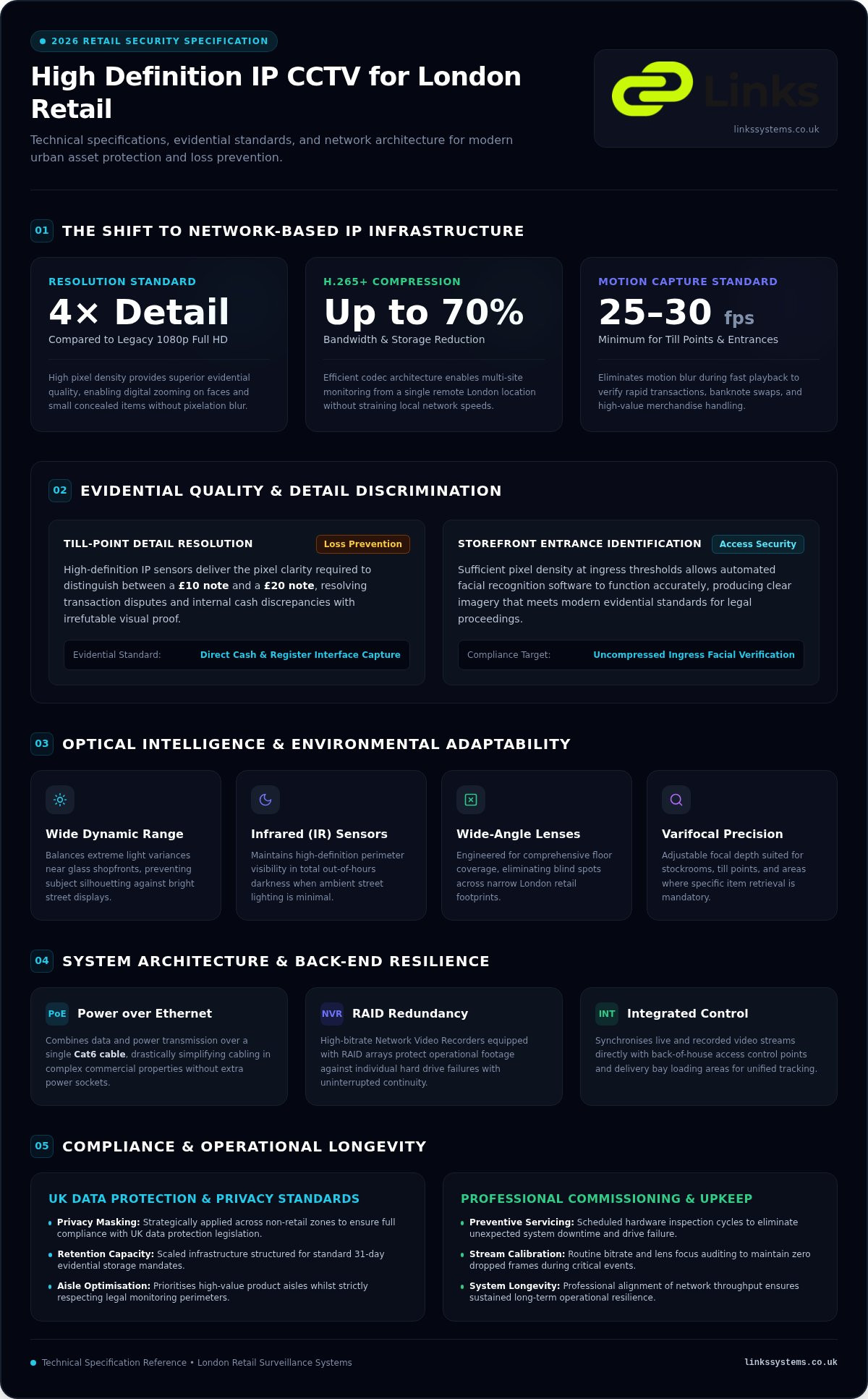
Modern commercial security has moved beyond simple recording. High definition CCTV for retail London now relies on IP (Internet Protocol) technology as the foundational standard. Unlike older systems, IP cameras transmit data over a digital network, allowing for significantly higher data throughput and sophisticated image processing. This shift ensures that security footage is no longer just a grainy deterrent but a high-precision tool for evidence and operational insight.
Resolution standards have evolved rapidly. Whilst 1080p was once the benchmark for quality, 2026 specifications increasingly favour 4K resolution and beyond. This jump provides four times the detail of Full HD, which is vital when zooming into recorded footage to identify a specific face or a small item being concealed. We define pixel density as the measurement of how many pixels are packed into a specific area of the sensor, which acts as the primary metric for determining evidential quality.
Retail environments are fast-paced, meaning frame rates are just as critical as resolution. A low frame rate might miss the exact second a banknote is swapped or a high-value product is pocketed. We recommend a minimum of 25 to 30 frames per second (fps) for till points and entrances to ensure fluid motion capture without motion blur during playback. To power these advanced units, Power over Ethernet (PoE) simplifies the installation process in complex London retail units. By carrying both power and data over a single Cat6 cable, it reduces the need for additional electrical points at every camera location.
The Shift from Analogue to IP Infrastructure
The transition from legacy coax cabling to modern network infrastructure is a technical necessity for reliability. Modern closed-circuit television systems utilise H.265+ compression to manage the vast amounts of data generated by 4K sensors. This technology can reduce bandwidth and storage requirements by up to 70% compared to older codecs. This efficiency allows retailers to manage multiple London sites from a single remote location without straining local network speeds or sacrificing image clarity.
Why Resolution Matters in a Retail Context
In a busy shop, the ability to distinguish between a £10 and a £20 note is the difference between a resolved dispute and an unresolved loss. High-resolution sensors allow for digital zooming without the image pixelating into an unrecognisable blur. At store entrances, this clarity is essential for facial recognition software to function accurately. Implementing high definition CCTV for retail London ensures that every transaction and interaction is documented with enough detail to be used in formal legal proceedings or internal disciplinary reviews.
Technical Specifications for Retail Surveillance in 2026
Selecting the right hardware for high definition CCTV for retail London requires a balance between resolution and environmental adaptability. London storefronts often present unique challenges, such as narrow floorplans and high-contrast lighting from street-level displays. Lens selection is a primary consideration; wide-angle lenses provide comprehensive floor coverage, whilst varifocal lenses are superior for stockrooms or till points where specific detail retrieval is mandatory. These technical choices dictate whether your system provides usable evidence or merely a general overview of the premises.
Reliability stems from the back-end infrastructure. A robust Network Video Recorder (NVR) must support high-bitrate recording without dropping frames. For professional environments, we recommend NVRs equipped with RAID redundancy. This configuration ensures that if a single hard drive fails, your data remains intact and the system continues to operate without interruption. This level of technical resilience is a hallmark of professionally commissioned IP HD CCTV systems designed for long-term stability.
Low-Light Performance and WDR
London’s urban environment creates significant light variance. A camera positioned near a glass storefront faces bright external light whilst trying to capture detail in a shadowed interior. Wide Dynamic Range (WDR) technology is essential here; it balances these extremes to prevent silhouetting, where a subject appears as a dark outline against a bright background. For out-of-hours security, high-performance infrared (IR) sensors provide visibility in total darkness. This ensures the perimeter remains secure even when streetlights are the only available light source.
Storage and Data Management
High-resolution 4K streams generate substantial data volumes. Balancing this with the need for a typical 31-day retention period requires meticulous storage planning. You must ensure your hardware and data management policies comply with the UK Surveillance Camera Code of Practice, which emphasises that data should only be kept for as long as necessary. Managing high-bitrate recording without frame loss requires enterprise-grade hard drives designed for constant 24/7 write cycles. Hybrid models, combining on-site NVR storage with secure off-site backups, provide the best protection against physical theft or damage to the recording unit itself.
Integrating CCTV with Access Control Systems
A fragmented security system creates blind spots that modern retail criminals are quick to exploit. For a truly robust defence, high definition CCTV for retail London must be unified with your access control infrastructure. By integrating CCTV with access control systems, you create a searchable audit trail where every door opening or delivery bay activation is linked to a specific video timestamp. This synergy is particularly vital in busy London hubs where high staff turnover and frequent deliveries increase the risk of internal shrinkage and unauthorised entry.
Monitoring back-of-house areas requires a precise approach to both hardware and legal compliance. Whilst capturing clear footage of delivery bays is essential for verifying stock arrivals, retailers must adhere to the UK Surveillance Camera Code of Practice to ensure monitoring remains proportionate. High-definition cameras allow managers to identify “tailgating” incidents, where an unauthorised person follows a staff member through a secure door. Without this visual verification, a standard access log would only show a single valid entry, leaving the breach undetected.
Video Verification for Staff Entrances
Staff entrances are often the weakest point in a retail security perimeter. IP video intercoms provide a first line of defence by allowing security teams to visually confirm the identity of anyone requesting access before the door is released. When these intercoms are linked to the central CCTV platform, the video stream is recorded in the same high-bitrate quality as your primary floor cameras. This setup reduces the risk in high-value stock areas by ensuring that every request for access is documented with crystal-clear visual evidence. It’s a proactive model that prevents security breaches before they occur.
Synergy with Speed Gates and Barriers
In larger retail environments or department stores, managing pedestrian flow is a complex task. Monitoring this movement through professional commercial speed gates allows for the capture of high-definition footage of every individual entering or exiting the premises. By positioning HD cameras at eye level near these barriers, you ensure the highest possible chance of positive identification. Modern video analytics can also process this data to identify bottlenecks in lobby areas, turning your security infrastructure into a valuable tool for optimising store operations and improving the customer experience.
Strategic Placement and Regulatory Compliance
The effectiveness of high definition CCTV for retail London depends heavily on strategic positioning. Even the highest resolution 4K camera is wasted if it’s placed at a height that only captures the tops of heads. Strategic placement involves identifying high-risk zones such as point-of-sale terminals, high-value aisles, and structural blind spots. In luxury London boutiques, this requires balancing the deterrent value of visible hardware with the store’s interior aesthetics. Discreet, high-performance units can be integrated into the design without compromising the security posture of the business.
Regulatory compliance is equally important. In a densely populated city like London, cameras often overlook public pavements or neighbouring businesses. Privacy masking is a software-based solution that blacks out these areas, ensuring your system respects the privacy of the public whilst focusing on your shopfront. For businesses looking to ensure their system meets these rigorous standards, professional CCTV design and installation is essential for both security and legal protection.
Optimising Camera Placement for Loss Prevention
Capturing usable evidence for the police requires specific angles. We recommend placing cameras at eye level near entrances to get a clear, unobstructed view of faces as people enter. For till points, overhead cameras must use specific focal lengths to allow for currency identification and the monitoring of hand movements during transactions. When covering delivery yards or loading bays, the field of view must be carefully calibrated. This ensures you monitor your assets without inadvertently recording private property, which could lead to legal disputes or complaints from neighbours.
GDPR and DPA Compliance for Retailers
Operating a surveillance system in the UK carries significant legal responsibilities under the Data Protection Act (DPA) and GDPR. Before installation, a Data Protection Impact Assessment (DPIA) should be conducted to justify the use of cameras in specific areas. Retailers must also be prepared to handle Subject Access Requests (SARs), where individuals have the right to request a copy of any footage featuring them. In the UK, it’s a mandatory requirement to display clear, legible CCTV signage that informs the public that recording is taking place and provides contact details for the data controller. Proper management of this data is vital to avoid heavy fines and ensure the footage remains admissible in court.
Professional Commissioning and Maintenance
A high-specification installation is only as effective as its final configuration. Commissioning represents the critical bridge between physical hardware placement and operational reliability. For high definition CCTV for retail London, this process ensures that the network infrastructure can handle the high-bitrate demands of 4K streams without latency or packet loss. Without rigorous testing, even the most expensive sensors can fail to deliver the evidential quality required during a security incident. Professional commissioning is the final safeguard that confirms every component operates according to the original design intent.
Scheduled maintenance protects the long-term ROI of HD hardware by addressing minor issues before they lead to system-wide failures. Links Integrated Systems adopts a comprehensive lifecycle management approach, drawing on 40 years of industry experience to maintain system integrity. We focus on the specific challenges faced by London retailers, ensuring that equipment remains functional in demanding urban environments. This proactive model moves away from reactive repairs, prioritising the stability and longevity of your security investment.
The Importance of System Commissioning
Commissioning involves more than just checking a video feed. It requires testing network stability and failover protocols under maximum load to ensure the system doesn’t crash during high-activity periods. Every camera must be precisely focused and configured for its specific environment, accounting for the unique lighting and movement patterns of the retail floor. The final step of this process is the handover, where retail staff are trained on the management software. This ensures your team can confidently retrieve footage and manage alerts without technical hesitation.
Scheduled Maintenance for London Sites
London’s urban environment presents unique challenges for hardware. High levels of airborne particulates can lead to lens obscuration and camera drift if left unmanaged. Regular maintenance visits include:
- Lens and Housing Cleaning: Removing urban grime to maintain the clarity of 4K imagery.
- Firmware Updates: Applying the latest manufacturer patches to protect hardware against emerging vulnerabilities.
- Storage and Power Testing: Verifying the health of NVR storage drives and testing backup power supplies to ensure continuity during a power cut.
Regularly testing these components prevents the “silent failures” that often go unnoticed until footage is desperately needed. By maintaining a strict service schedule, you ensure that your high-definition system remains a reliable asset for years to face, rather than a depreciating piece of hardware.
Securing the Future of Your London Retail Assets
Implementing a modern security infrastructure requires a transition from passive recording to active operational intelligence. By adopting 4K resolution and integrating video with access control, you create a unified system that protects high-value assets whilst providing clear, admissible evidence. We’ve detailed how technical specifications such as Wide Dynamic Range and professional commissioning are the essential benchmarks for system reliability in 2026. These elements ensure your security remains robust against the evolving challenges of the urban retail environment.
Links Integrated Systems brings over 40 years of security expertise to every project. As specialists in London commercial property security, we provide the technical precision required for high definition CCTV for retail London. Our team manages the full lifecycle of your installation, from initial design to comprehensive maintenance and commissioning services. Contact Links Integrated Systems for a Professional CCTV Consultation today to ensure your premises remain secure and compliant. Investing in a stable, professionally managed system provides the long-term peace of mind required to focus on your core business operations.
Frequently Asked Questions
What is the best resolution for retail CCTV in London?
4K resolution, also known as 8MP, is the current professional standard for critical retail areas such as till points and entrances. Whilst 1080p remains a baseline for general floor coverage, the higher pixel density of 4K allows for precise digital zooming without losing clarity. This level of detail is essential for identifying currency denominations or capturing clear facial features in the high-traffic environments typical of busy London storefronts.
How long should retail CCTV footage be stored in the UK?
The standard industry recommendation for retail data retention is 31 days. UK data protection law does not specify a mandatory timeframe but requires that footage is kept only for as long as is strictly necessary. Retailers must justify their chosen retention period within a Data Protection Impact Assessment. This ensures you have sufficient time to review incidents whilst remaining compliant with the Information Commissioner’s Office guidelines on data storage.
Can I integrate my CCTV with my existing access control system?
Yes, modern IP-based high definition CCTV for retail London is designed for seamless integration with professional access control infrastructure. This synergy allows security managers to link specific video timestamps to door events or delivery bay activations. By unifying these platforms, you create a comprehensive audit trail that makes it easier to investigate unauthorised access attempts or verify the identity of individuals entering secure back-of-house areas.
Is facial recognition legal in London retail stores?
Facial recognition technology is legal in the UK provided its use is proportionate, transparent, and compliant with GDPR. Retailers must conduct a thorough Data Protection Impact Assessment before implementation and display clear signage to inform the public. The Information Commissioner’s Office provides strict guidelines on the use of biometric data. This ensures that the technology serves a legitimate security purpose without infringing on the privacy rights of customers.
How often does a commercial CCTV system require maintenance?
Professional commercial systems should undergo a full maintenance check at least once or twice per year. London’s urban environment often leads to faster lens obscuration due to airborne particulates and pollution. Regular servicing involves cleaning optics, testing network failover protocols, and updating firmware to protect against vulnerabilities. This proactive approach prevents silent hardware failures and ensures your high-definition cameras remain fully operational when you need them most.
What is the difference between analogue HD and IP HD CCTV?
IP HD CCTV transmits digital data over network cabling, offering superior resolution and built-in intelligence compared to analogue alternatives. Analogue systems rely on older coaxial cables and are often limited by lower data throughput and scalability issues. IP-based infrastructure is the modern standard for high definition CCTV for retail London because it supports 4K streams and allows for easier remote management across multiple sites from a single central platform.
Do I need a licence to install CCTV in my London shop?
You don’t need a specific licence to install a system on your own premises, but you must comply with the Data Protection Act. This involves registering as a data controller with the ICO and paying the relevant data protection fee. If you employ a contractor to design or maintain your system, ensure they are a professionally accredited specialist. This guarantees the installation meets the technical and legal standards required for commercial properties.
How does high definition CCTV help with insurance claims?
High-definition footage provides indisputable visual evidence that can significantly accelerate the processing of insurance claims. Clear video detail helps to verify the exact circumstances of an incident, such as a staged “slip and trip” or a specific theft event. By providing crystal-clear imagery, you reduce the likelihood of protracted liability disputes. This level of evidential quality protects your business from fraudulent claims and helps to maintain stable insurance premiums over time.