
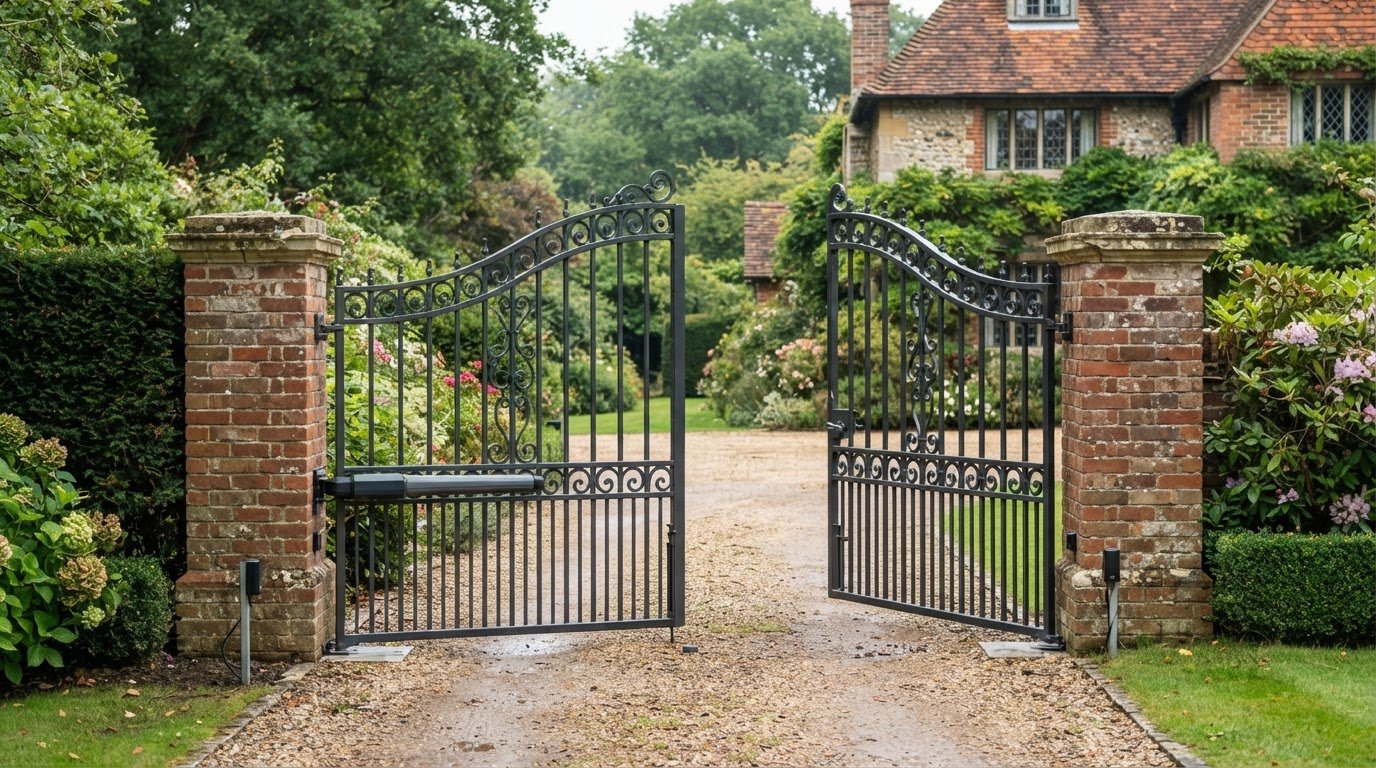
An existing swing gate can often be automated, provided its structure, hinges and posts are sound and it moves freely. The right automatic swing gate operators in Hertfordshire depend on the gate’s size, movement and setting, as well as how people will access the site. Any powered system must also be designed with safe operation in mind.
It’s reasonable to want to keep a gate that already suits the property rather than replace it before finding out whether automation is practical. This guide explains what makes an existing gate suitable, which safety considerations apply and how requirements can differ between domestic and industrial settings.
You’ll also learn how operators work with access control, what affects the installation approach and what industrial swing gate systems need particular attention. This provides a practical basis for deciding what to do next.
Key Takeaways
- Assess the gate’s structure, hinges and movement to understand whether it may be suitable for automation.
- Learn why safety planning matters and which standard is cited for industrial pedestrian gates in Parsonage Estate.
- Understand how installation needs can differ between domestic properties and industrial sites across Hertfordshire and neighbouring counties.
- See how the gate’s use and access-control requirements shape the choice of an industrial drive system.
Can you automate an existing gate?
Often, yes. An existing swing gate can be automated if its structure, hinges and movement are suitable for powered operation. An assessment should cover the gate, its surroundings and how people enter the site, whether it is a home, school or commercial property.
Automatic Gate Supply and Installation
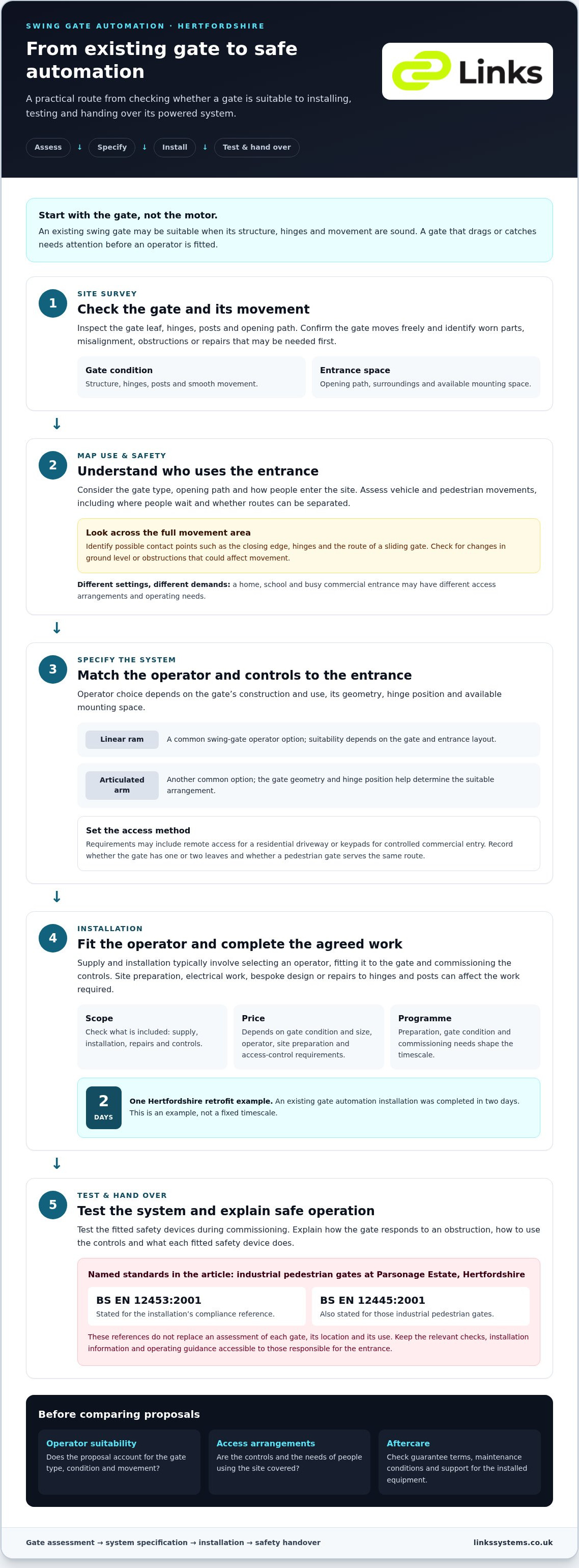
Supply and installation typically involve selecting an operator, fitting it to the gate and commissioning the controls. Before specifying automatic operation, inspect the gate leaf, hinges, posts and opening path. A gate that drags or catches needs attention before an operator is fitted.
Electric gate specialists may also design bespoke driveway gates to suit the entrance layout and appearance. Repairs can address worn components or operating faults, while scheduled maintenance supports reliable operation. At a school entrance, consider how staff, visitors and pedestrians will use the gate, not just vehicle access.
Installer Experience and Service Coverage
Choose an installer with experience relevant to the gate type and setting, from a residential entrance in St Albans to a commercial access point. The assessment should explain the proposed operator, installation work, controls and commissioning, and clearly set out the scope of any repair or maintenance.
Review any guarantee terms to understand what they cover, how long they apply and whether maintenance conditions apply. After-installation support matters particularly where a school or business relies on controlled access. Make sure the proposed support covers the site and equipment being installed.
Installation Costs and Timescales
Installation price depends on the gate’s condition and size, the operator, site preparation and access-control requirements; the price is provided after a quote request. Bespoke design, electrical work and repairs to hinges or posts can also affect the work required, so a site assessment informs the specification.
One existing gate automation retrofit in Hertfordshire was completed in two days. This is an example, not a fixed timescale: preparation, gate condition and commissioning needs all shape the programme.
Installation Companies and Steps
Specialist gate automation companies install swing operators in Hertfordshire. The process usually starts with a site survey and checks of the gate’s condition and movement, followed by selection of a suitable drive system, installation, testing and commissioning of the controls.
When comparing automatic swing gate operators in Hertfordshire, look at each proposal’s scope, operator suitability, access arrangements and aftercare. This helps distinguish a complete installation from a supply-only quotation and clarifies what support is included if repairs or maintenance are needed later.
Gate safety standards and building regulations
Safety planning should account for the gate type, its opening path and who uses the property. For an existing driveway, assess vehicle and pedestrian movements before selecting an automatic gate system.
Safety Considerations and Handover
At handover, review how the gate opens, where people wait and how users operate it. Check the ground around the opening for changes in level or obstructions that could affect movement. A sliding gate needs its travel route assessed too, including the space alongside the driveway.
For industrial pedestrian gates supplied and installed in Parsonage Estate, Hertfordshire, compliance with BS EN 12453:2001 is stated, according to the British Standards Institution. The standard is a useful reference when reviewing the documented safety approach for those gates. Keep installation and handover information accessible to the people responsible for operating the entrance.
Where pedestrians enter beside a vehicle entrance, consider whether the routes can be separated. At handover, explain the operating controls and access arrangements to relevant users, including staff at a commercial property.
Obstacle Protection and Safety Devices
Consider obstacle protection around the gate’s full movement, not just at the vehicle opening. Identify likely contact points, such as the closing edge, hinges and the path of a sliding gate. The design and placement of safety devices depend on the gate’s movement and the risks around that specific entrance.
Discuss how the system responds to an obstruction, and ensure the installed devices are tested during commissioning. For a driveway used by pedestrians and vehicles, include both routes in the assessment. A clear handover should explain normal operation and the purpose of each fitted safety device.
BS EN 12445:2001 is also stated for the industrial pedestrian gates at Parsonage Estate. Together, these named standards provide specific references for that installation; they should not be treated as a substitute for assessing each gate, its location and its use. Record the relevant checks and operating guidance as part of the site handover.
Service area across Hertfordshire and neighbouring counties
For residential and commercial swing gates, operator choice depends on the gate’s construction, use and available mounting space. Linear ram and articulated-arm operators are common options. The gate geometry and hinge position help determine which arrangement is suitable. An entrance with occasional residential vehicle access has different operating demands from a busy commercial entrance.
Across Hertfordshire, assess the whole entrance rather than the operator alone. Record whether the gate has one or two leaves, how it moves and whether a pedestrian gate serves the same route. For example, a residential driveway may need remote access, while a commercial site may also require keypads for controlled entry.
Common electric gate faults include stiff hinges, misalignment, an obstructed opening or problems with the controls. These can prevent smooth movement or interrupt access. Keep the gate’s travel path clear, avoid forcing a gate that has stopped and arrange servicing if its movement or response changes. A specialist can inspect the gate, operator and controls together to identify whether repair or adjustment is needed.
Maintenance should reflect the gate’s setting and use. At a residential property, check that the leaves move freely and the opening remains clear. At a commercial entrance, consider how regular vehicle and pedestrian traffic affects operation. Test remote controls and keypads during routine checks, and record faults to help identify recurring issues.
Hertfordshire includes varied settings, from residential entrances in St Albans to commercial access points. For projects across neighbouring counties, the site location and journey requirements shape service arrangements. Before planning installation or repair, note the gate type, access method, fault symptoms and operating needs. These details provide a practical starting point for assessing the right operator and maintenance approach.
Industrial automatic swing gate drive systems
For heavy, wide or frequently used swing gates, the operator should be selected to suit the gate’s dimensions, weight, movement and frequency of use. A specialist assesses these factors alongside hinge condition and mounting positions. Choosing by motor power alone can overlook how the complete gate behaves.
At an industrial entrance, each gate leaf places a different load on its drive system. The assessment should record the leaf construction, including whether it is steel or aluminium, and how often vehicles pass through. Wind exposure and the gate’s movement also affect the demands on the motors. These details guide the choice of drive arrangement and installation.
Reliable operation depends on the whole entrance. Check the hinges, supports, stops and opening path before fitting drives. A wide leaf may have different leverage and clearance requirements from a narrower one. The operator must move the gate through its full travel without binding, while the site layout determines where equipment can be mounted.
Access control shapes how staff and visitors use an entrance. A commercial site may combine gate operation with keypads, access control systems or intercoms, allowing authorised users to request entry through a defined process. An IP video intercom supports visitor communication, while the gate operator controls physical movement. Plan these interfaces together rather than treating the drive as a standalone system.
“Premium” materials or a larger motor do not by themselves establish suitability. A useful specification connects gate construction, frequency of use, drive selection, controls and commissioning. For example, a frequently used service entrance needs a system assessed for repeated operation and coordinated access management. Documenting these requirements gives the installation team a clear basis for selecting and testing the complete system.
Links Integrated Systems: Speed Gates & Barriers
Links Integrated Systems helps businesses plan controlled access around commercial entrances. Its Speed Gates & Barriers and Access Control Systems are relevant where a site needs to manage vehicle or pedestrian entry alongside its gate arrangements.
For a wider entrance-security plan, IP Video Intercom Systems support visitor communication, while IP HD CCTV Systems provide video surveillance. The right combination depends on the site layout, users and access arrangements. These systems can form part of a coordinated approach to an industrial or commercial entrance.
If you’re planning an access-control project or reviewing existing site systems, contact Links Integrated Systems to discuss your access requirements.
Plan your next access-control step
Before committing to a change, define what the entrance needs to achieve each day. Consider how staff, visitors and vehicles approach it, who should authorise access and how the gate will connect with the wider site. This creates a useful brief for discussing automatic swing gate operators in Hertfordshire and related access-control requirements.
Links Integrated Systems can coordinate Speed Gates & Barriers, Access Control Systems and IP Video Intercom Systems as part of an entrance solution. The right combination depends on the site and its operating needs. Discussing those requirements helps shape a practical project scope.
Share your site requirements and access objectives with Links Integrated Systems to discuss the next step. Contact Links Integrated Systems and move your entrance project forward with a clear plan.
Frequently Asked Questions
Which areas do you cover?
Links Integrated Systems serves London, Kent, Surrey, Hertfordshire and Essex. For a Hertfordshire project, share the site location and whether it is a commercial, office or new-build residential setting. This helps establish the project context and access requirements. The company’s work includes access control, speed gates and barriers, IP video intercoms and IP HD CCTV.
How much does it cost to supply and install an automatic swing gate operator in Hertfordshire?
There is no single suitable figure: cost depends on the gate, site work and system specification. Relevant factors include the gate’s condition, operator selection, electrical requirements, access controls and commissioning needs. The price depends on the case and is given after a quote request. Links Integrated Systems lists access control and barrier systems, rather than domestic swing gate operators.
What safety devices and standards are required for automatic gates in the UK?
Safety devices must suit the gate’s movement and the hazards around its operating area; there is no device list here that applies to every installation. For industrial pedestrian gates supplied and installed in Parsonage Estate, Hertfordshire, compliance with BS EN 12453:2001 is stated, according to the British Standards Institution. The installation record should identify the relevant safety measures and commissioning checks.
Do I need planning permission or building regulations approval for an automated gate in Hertfordshire?
Whether approval is needed depends on the proposed physical work and the property’s circumstances, not simply on adding automation. Gate position, changes to the entrance and property restrictions can affect the assessment. Consider planning permission separately from building control, and describe the intended work and site conditions to the relevant local authority before starting construction or alteration.
What site checks are needed before installing an automatic swing gate operator?
Start by recording each gate leaf’s material, dimensions, weight and opening direction, then inspect hinges, posts and mounting points for movement or damage. Check the ground and clearance through the full swing path. Note power access, vehicle approach, pedestrian routes and how authorised users will enter, such as by keypad or intercom. These details help define the installation scope.
What maintenance and servicing do automatic swing gate operators need?
Maintenance should cover the gate’s mechanical movement and the operator’s controls. Keep the opening area clear, watch for new noise, slow movement or inconsistent responses, and record faults rather than repeatedly operating a gate that sticks. A service visit can assess wear, alignment and system operation. Links Integrated Systems provides system maintenance and commissioning for security infrastructure.