
The cost to service a commercial security system in London depends on the system’s size, condition and required work. There is no single price for every site: the service scope must be assessed before a quote can be provided.
A clear annual budget is useful, but a maintenance visit is only one part of the total. Equipment ownership, existing service agreements and the condition of cameras, access control and other components all affect what to budget for.
This article explains the main cost factors, how ownership and recurring fees shape a budget, and when to schedule servicing. It also covers additional costs that may arise when equipment needs attention, helping you plan for the full lifecycle of a commercial system.
Key Takeaways
- Separate routine servicing from repairs and replacement when setting a maintenance budget for CCTV and access control.
- Distinguish equipment you own from ongoing monitoring arrangements to understand which costs recur.
- Keep maintenance records and consider how system condition and servicing affect insurance requirements.
- Set servicing intervals around the system type and applicable guidance, rather than waiting for a fault to appear.
Intruder alarms, CCTV and access control
Service budgets depend on what the premises use, from CCTV and access control to intercoms and fire alarms. Separate routine inspection from repairs, monitoring and key holding, since each covers different work.
Alarm and CCTV servicing prices
Servicing checks alarm and camera operation, connections and recorded faults, helping identify issues before they disrupt security. Commercial alarm and CCTV servicing costs depend on equipment, condition and the scope of inspection. Fire alarm servicing is a separate consideration: The Regulatory Reform (Fire Safety) Order 2005 requires non-domestic premises in England and Wales to have appropriate fire detection and warning, according to The National Archives (legislation.gov.uk). Intercoms also need assessment as part of the site’s entry arrangements.
Call-out and hourly labour rates
Repair charges can combine a call-out with hourly labour, parts and any additional work needed to restore the system. London rates vary with travel, access to equipment, fault complexity and the time required; there is no single standard call-out or hourly rate. A fault affecting one CCTV camera differs from a failure across a linked access control system. Key holding and alarm response are separate recurring services, not the same as a repair visit. Include their scope when comparing the overall operating budget.
Service price variation by system and site
System size, age and site count all shape servicing requirements. A single-site premises with a small alarm and camera setup differs from several buildings with interconnected CCTV, access control and IP video intercoms. Older equipment can need more fault investigation, while varied equipment may require distinct checks. A risk assessment helps identify which systems and locations need attention. Security systems must meet BS EN 50131 standards for Grade 2 or higher protection, according to the British Standards Institution.
For personnel involved in security work, the Private Security Industry Act 2001 provides the statutory basis for licensing individual security operatives in the UK, according to The National Archives (legislation.gov.uk). BS 7858 is the British Standard for screening security personnel, including identity verification, employment history checks and criminal record screening, according to the British Standards Institution. For your budget, the price depends on system type, condition, site access and repair scope; the exact figure is provided in a quote for your case.
Equipment ownership and monthly fees
Equipment ownership and recurring charges are separate parts of a commercial security budget. A business that owns its cameras or access equipment still needs to budget for maintenance and any separate monitoring arrangement. A monthly payment alone does not show whether equipment is owned, leased or covered by a service agreement. The agreement terms determine what the recurring charge includes.
A recurring monitoring charge is distinct from routine servicing or repairs. For example, a premises might pay for monitoring while budgeting separately for an engineer to inspect a fault or maintain equipment. Compare the service scope, response arrangements and renewal terms when reviewing monthly commitments.
- Owned equipment: Include planned maintenance and eventual replacement in the system budget, rather than treating ownership as the end of its costs.
- Leased or subscription equipment: Review the agreement to understand recurring payments, equipment responsibilities and what happens when the arrangement ends.
- Monitoring: Check which response type and coverage the monthly fee provides, and distinguish it from servicing visits.
Condition also affects long-term planning. Professional security systems typically last 10-15 years with regular maintenance, so assessment of equipment condition can help inform replacement planning. Keep an inventory showing which devices the business owns and record the monitoring and maintenance terms alongside it. This makes it easier to identify overlapping charges and separate operating costs from future equipment decisions. For system upkeep, system maintenance and commissioning can support a planned approach to maintaining commercial security infrastructure.
Maintenance and insurance considerations
Maintenance records show what was inspected, which faults were found and what work was completed. Keep dated reports, repair details and test results together for each premises. This gives facilities teams a clear reference when reviewing insurance conditions or planning further work. For example, a record of a camera fault and repair helps distinguish a known issue from an unexplained system outage.
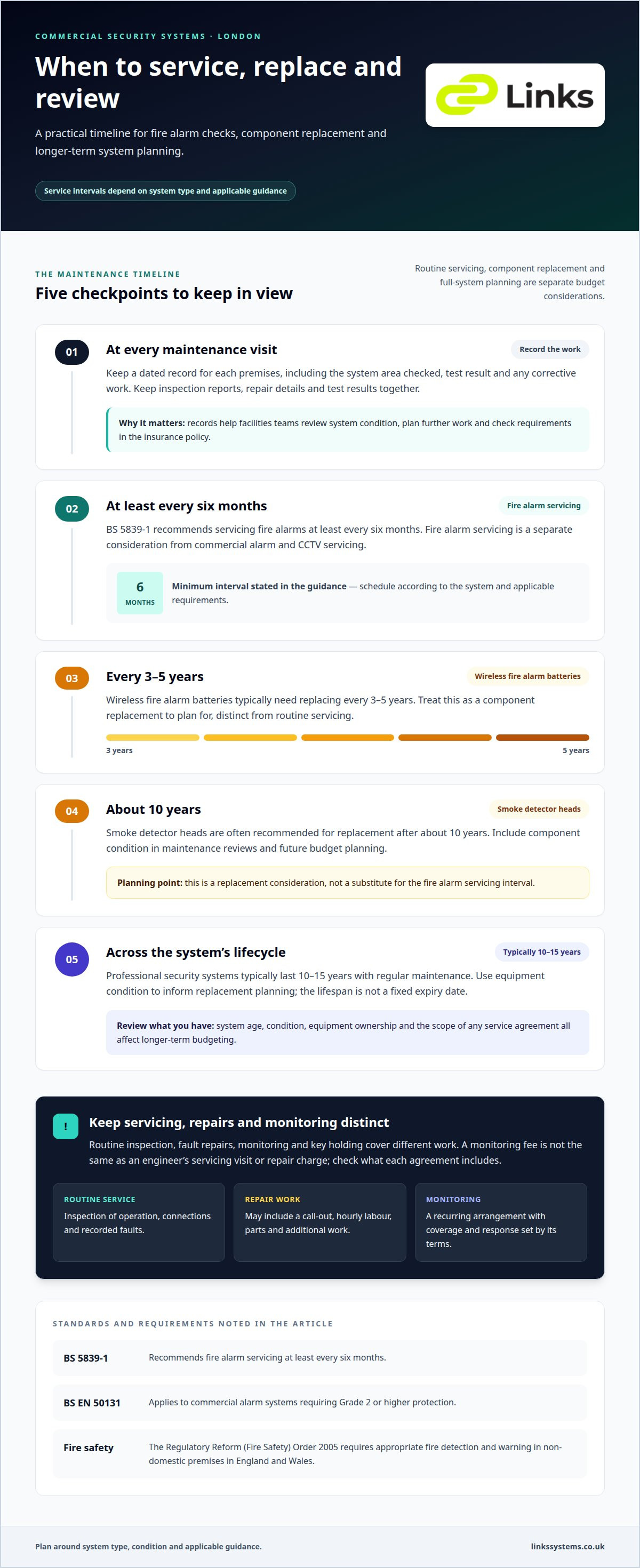
For commercial alarm maintenance, BS EN 50131 applies to systems requiring Grade 2 or higher protection, according to the British Standards Institution. Fire alarm servicing follows separate guidance: BS 5839-1 recommends servicing at least every six months. The Regulatory Reform (Fire Safety) Order 2005 also requires appropriate fire detection and warning in non-domestic premises in England and Wales, according to The National Archives (legislation.gov.uk).
Insurance considerations depend on the policy wording and the security measures specified for the premises. Review requirements for alarm operation, CCTV coverage, access control and maintenance records. A documented inspection can help show the system’s condition at a particular time, while an unresolved fault may mean installed measures no longer match the site’s risk assessment. Keep policy documents with the service reports.
Ageing components deserve attention during maintenance reviews. Professional security systems typically last 10-15 years with regular maintenance. Smoke detector heads are often recommended for replacement after about 10 years, while wireless fire alarm batteries typically need replacing every 3-5 years. These points help distinguish routine servicing from planned component replacement, which can affect both system operation and future budgets.
- Record the date, system area, test result and corrective work for each visit.
- Compare inspection records with the policy’s stated security conditions.
- Track component age, particularly detector heads and wireless batteries.
Recommended servicing frequency
Commercial intruder alarm servicing may include checks of the control panel, detectors, sounders, connections and event history. The visit should record faults and confirm that devices respond as intended. The appropriate interval depends on manufacturer guidance, system condition, site use and monitoring terms. A warehouse with frequent layout changes may need its assessment revisited after those changes.
For a commercial fire alarm, BS 5839-1 recommends servicing at least every six months. Staff should also test one manual call point in rotation weekly. These checks serve different purposes: the weekly test helps confirm a call point operates, while scheduled professional servicing examines the wider system and its components.
Plan service dates across all buildings to minimise disruption. Keep a calendar for each site, noting the system type, last visit, reported faults and next planned inspection. If a device repeatedly fails or a premises changes its layout, review the service plan sooner rather than waiting for the next routine date.
- Record the baseline: Keep the latest service report, device locations and outstanding defects together.
- Track changes: Note building alterations, access changes or new equipment that could affect detection or coverage.
- Coordinate testing: Tell relevant staff when alarms will be tested, so they can distinguish planned activity from an incident.
Service frequency affects system condition and budgeting. A missed visit can leave faults undiscovered, while a planned schedule makes labour and access arrangements easier to manage. For example, a multi-building site can coordinate visits around operational periods and keep separate records for each system. Use service reports to update the next date and identify follow-up work.
Set the schedule around system guidance, the premises’ operating pattern and documented faults. Keep weekly fire alarm tests distinct from professional servicing, and review the plan whenever site conditions change.
Links Integrated Systems: Speed Gates & Barriers
Links Integrated Systems provides maintenance and commissioning for commercial security infrastructure. Its systems include Speed Gates & Barriers, Access Control Systems, IP Video Intercom Systems and IP HD CCTV Systems.
Consider a system review when equipment is ageing, entry arrangements are changing or several security systems need to work together. For example, a business upgrading a building entrance may need access control and an intercom to work alongside its existing CCTV. Planned maintenance also helps keep system condition and future work under review.
The right system depends on the premises, entry points and operational needs. Contact Links Integrated Systems to discuss your commercial security system requirements and maintenance needs.
Make maintenance part of your next planning cycle
Use your next facilities review to make security maintenance a defined operational responsibility. Assign someone to keep service records together, note changes to site access and flag recurring faults. This gives future budget discussions a clearer basis than reacting to isolated problems. It also connects the cost to service a commercial security system in London with the practical needs of your premises, rather than treating maintenance as an occasional task.
Consider how planned maintenance and commissioning fit alongside changes to your site’s security infrastructure. Links Integrated Systems supports commercial projects involving Speed Gates & Barriers, Access Control Systems and IP Video Intercom Systems. Discuss your premises and identify the relevant work and next steps.
Contact Links Integrated Systems to discuss your requirements and take a considered next step for your site.
Frequently Asked Questions
What Additional Costs Should I Budget For?
Allow for costs beyond routine inspection, including replacement components, fault diagnosis and repairs. A fault found during a visit may require extra labour or parts, while monitoring can be a separate recurring charge. For example, a damaged camera may need repair or replacement, depending on its condition. Keep a contingency in your facilities budget and distinguish planned maintenance from remedial work.
What Questions Should I Ask When Comparing Security Quotes?
Ask for each quotation to define the maintenance tasks, included labour and exclusions. Check whether parts, fault-finding, travel, monitoring and follow-up visits are charged separately. For a London office with CCTV and controlled entry, ask how the quote covers each system rather than relying on a broad description. Compare the reporting provided, including how faults and recommended work are recorded.
What is the average cost to service a commercial security system in London?
The cost to service a commercial security system in London depends on its equipment, condition, site layout and required work, so an average may not reflect your premises. A quote should account for the systems being maintained and distinguish routine visits from repairs or replacement parts. For an accurate budget, describe the equipment and known faults, then compare the scope of each quotation.
How much does it cost to service commercial CCTV systems in London?
CCTV servicing costs depend on the camera setup, recording equipment, access arrangements and any faults needing attention. Difficult-to-reach cameras or a recorder issue may require different work from a routine inspection. Ask for the quote to separate planned checks from repair labour and replacement components. This makes it easier to understand what is covered for your premises and what may incur additional charges.
How can London businesses compare security system maintenance contracts and avoid hidden charges?
Compare contracts by scope, exclusions and charging triggers, not just the headline fee. Look for clear terms on scheduled visits, fault diagnosis, parts, repairs, monitoring and work outside routine visits. Ask for reporting and renewal terms in writing. Facilities managers can then match each contract against the site’s equipment list and identify whether separate charges apply to particular systems or locations.