
Is replacing every camera the safest way to plan an IP CCTV system upgrade Surrey businesses can depend on? Not necessarily. Existing cameras or cabling may still be useful, but ageing equipment, poor image quality and coverage gaps can make it difficult to manage security effectively. Start with the site’s operational requirements, not a list of equipment to replace.
Disruption, compatibility and footage management all matter on a busy commercial premises. A well-planned upgrade considers these issues before installation, so decisions about cameras, network infrastructure and recording are made in context.
This guide covers practical signs that an upgrade may be needed and what to assess before moving to IP CCTV. It also explains how to plan coverage, check equipment compatibility and manage footage responsibly, through to commissioning and ongoing maintenance. Links Integrated Systems designs, installs, commissions and maintains commercial IP HD CCTV systems in Surrey, supporting the upgrade process from planning to long-term care.
Key Takeaways
- Recognise when image quality, coverage, reliability or footage retrieval no longer meets your site’s operational needs.
- Understand how IP CCTV connects cameras, network infrastructure, recording and authorised viewing access.
- Assess which equipment to retain, replace, expand or redesign as part of an IP CCTV system upgrade Surrey businesses can plan with confidence.
- Use a clear project sequence to scope the work, organise installation and commission the upgraded system.
- See how professional design, installation, commissioning and maintenance can support a commercial CCTV upgrade from planning through ongoing care.
When does a Surrey business need an IP CCTV system upgrade?
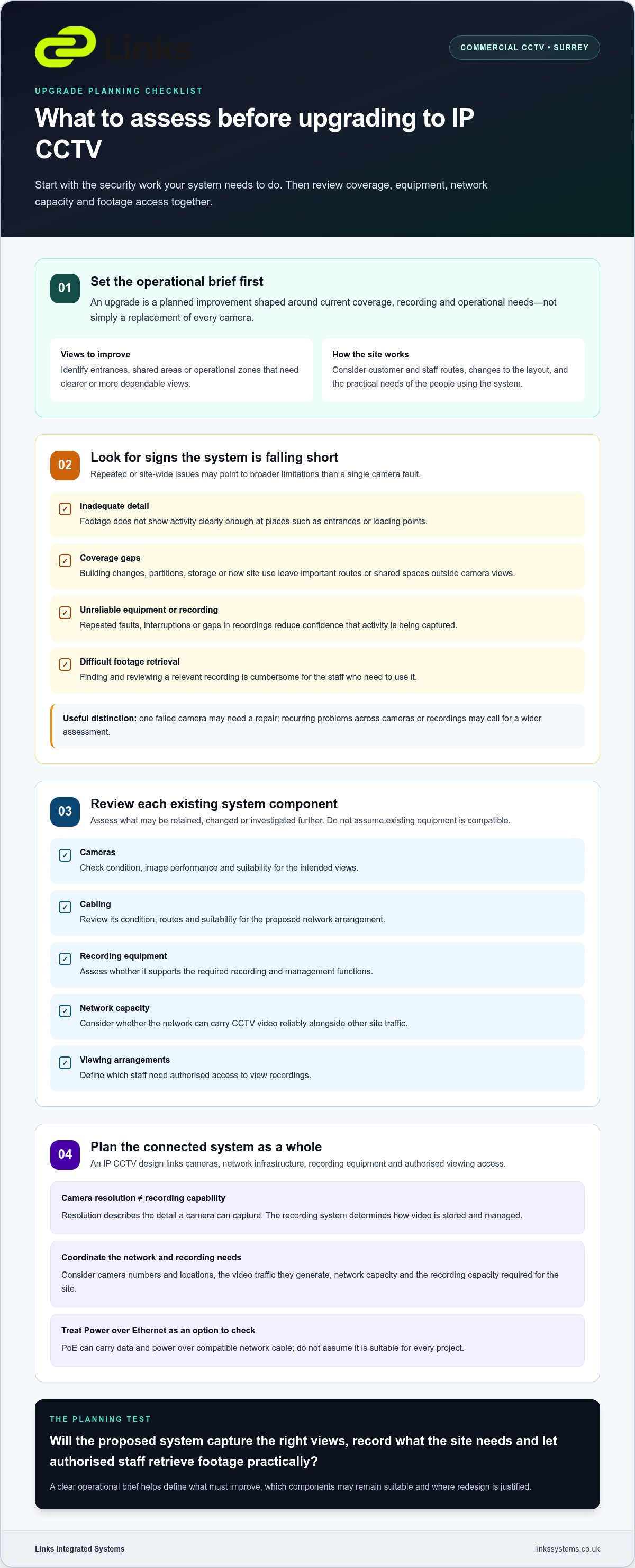
Consider an upgrade when your CCTV system no longer meets the site’s operational requirements. A single camera fault may call for a repair, but recurring problems with image detail, recording or footage retrieval can point to broader limitations. Base the decision on how well the system supports day-to-day security, not simply on how long the equipment has been in place.
An IP CCTV upgrade is a planned improvement to a site’s video-security system, shaped around its current coverage, recording and operational needs. For an IP CCTV system upgrade Surrey businesses should assess whether the existing setup captures usable footage where and when it is needed. Understanding the benefits of IP cameras can also help clarify the differences between IP and older analogue CCTV.
- Inadequate detail: Footage may not show activity clearly enough in areas such as entrances or loading points.
- Coverage gaps: Changes to buildings, partitions, storage or site use may leave important routes or shared spaces outside camera views.
- Unreliable equipment: Repeated faults or inconsistent recording can reduce confidence that the system is capturing the activity it is intended to monitor.
- Difficult retrieval: If finding and reviewing a relevant recording is cumbersome, the system may no longer suit the way staff need to use it.
Which signs indicate that a commercial CCTV system is ageing?
Age alone doesn’t mean every camera needs replacing. A camera may remain suitable if it provides the required view and works reliably with the wider system. The more useful test is how it performs in context. If an extension has created a new entrance, shelving blocks a former sightline or a reception area has been reorganised, camera positions that once made sense may now leave blind spots.
Look for patterns as well as individual faults. One failed camera is different from recurring interruptions across several cameras, gaps in recordings or a review process that makes routine footage hard to find. Note where each issue occurs and how it affects staff. This helps distinguish a local repair from limitations that may require changes to recording, equipment or system management.
What should an upgrade achieve for a Surrey premises?
Start with the activity the system needs to support. A business may need clearer views at entrances, dependable coverage of shared areas or better visibility across particular operational zones. These are distinct objectives: improving image detail won’t necessarily address a blind spot, while adding coverage alone won’t make recordings easier to retrieve.
Set out the required views, recording needs and practical expectations for staff who use the system. Consider how the premises operates, including customer and staff routes, and note any changes to the site’s layout. A clear operational brief helps define a proportionate scope: what must improve, which existing components may still be suitable and where redesign is justified.
What changes when a commercial site moves to IP CCTV?
IP CCTV is a system in which cameras transmit video over an Internet Protocol (IP) network. Instead of treating each camera as an isolated unit, the design connects cameras, network infrastructure, recording equipment and authorised viewing access. The network carries the video; recording equipment stores footage, while permissions govern who can view it.
IP describes how video is communicated across a network; it doesn’t guarantee a particular image quality or feature set. Those depend on the equipment selected and how the system is designed. A useful distinction is: a camera’s resolution describes the detail it can capture, while the recording system’s capability determines how that video is stored and managed.
How do IP cameras, networks and recording work together?
Each camera sends video across the site network to a recording or management point. Staff with authorised access can then view recordings using the arrangements provided for the system. The design needs to account for the number and location of cameras, the video traffic they generate and the recording capacity required for the site’s operational needs. In complex or industrial settings where networked cameras interface with wider operational technology (OT) environments, maintaining infrastructure resilience is just as critical; resources such as bio-cognitive.com highlight approaches to safeguarding OT systems.
Which parts of an existing CCTV system may need attention?
Assess each part of the system on its own merits. Compatibility depends on the equipment already installed and the requirements of the planned system, so don’t assume existing components are suitable for reuse. A structured review can identify where a change is needed and where further assessment is worthwhile.
- Cameras: Consider their condition, image performance and suitability for the intended views.
- Cabling: Review its condition, routes and suitability for the proposed network arrangement.
- Recording equipment: Assess whether it can support the required recording and management functions.
- Network capacity: Consider whether the infrastructure can carry video reliably alongside other site traffic.
- Viewing arrangements: Define which staff need access and how they should retrieve footage.
These elements work as a chain. A capable camera won’t meet the brief if the network or recording arrangement can’t support its output, and suitable recording equipment won’t resolve a poor camera view. For a commercial IP CCTV system upgrade Surrey premises, Links Integrated Systems designs, supplies, installs and commissions systems around site requirements. Explore commercial IP CCTV systems as part of planning a coordinated upgrade.
Should you retain, replace or redesign your existing CCTV equipment?
Choose the scope component by component, considering condition, compatibility, performance and the agreed operational brief. Retain equipment only when it works reliably and supports the proposed arrangement. A camera that still functions may not provide the required view, and a recording unit that stores footage may not suit the planned system.
| Option | Suitable when | Limitations to consider |
|---|---|---|
| Retain | Equipment is in suitable condition, performs as required and is compatible with the proposed system. | Past performance doesn’t establish compatibility or suitability for future requirements. |
| Replace | A specific camera, recording component or other item is faulty, unsuitable or no longer meets the brief. | Replacing one item may not resolve connected limitations elsewhere in the system. |
| Expand | The existing arrangement remains suitable, but the site needs additional coverage or capacity. | New components need to work with the wider system and its network and recording arrangements. |
| Redesign | Several elements or the overall layout no longer support the site’s requirements. | A wider scope needs coordinated planning across cameras, recording and infrastructure. |
Review cameras, cabling, recording equipment and network infrastructure separately, then consider how they work together. For example, a camera might provide a useful view but rely on a recording arrangement that doesn’t meet the current brief. Compatibility depends on the installed equipment and proposed requirements, so don’t assume existing components can always be retained or integrated.
When might a partial CCTV upgrade be appropriate?
A partial upgrade may suit a defined issue, such as an area that needs additional coverage or a component that no longer performs reliably. The decision depends on the existing equipment’s condition and compatibility, and on whether the change addresses the agreed requirements. A site assessment helps establish whether targeted work will meet the brief or leave wider limitations unresolved.
When is a wider CCTV redesign worth considering?
Consider a wider redesign when several limitations recur, the premises have changed substantially or operational requirements now extend beyond the original system’s purpose. Planning cameras, recording and network infrastructure together can provide a coherent design for the site. If CCTV is coordinated with access control, define how the systems’ requirements relate; see this guide to integrating CCTV with access control systems.
For an IP CCTV system upgrade Surrey project, choose the scope that meets the operational brief without treating every existing component as automatically reusable or obsolete. Links Integrated Systems assesses, designs and delivers commercial IP HD CCTV upgrades, including installation, commissioning and maintenance. A planned review can clarify the appropriate scope for your premises. Discuss your commercial CCTV requirements.
How should you plan an IP CCTV upgrade for a Surrey commercial site?
A dependable upgrade follows a defined process, from agreeing the operational brief to checking the commissioned system. On a Surrey commercial site, the review should reflect how the premises is used, whether it’s a workplace, warehouse, office or customer-facing building. Record decisions as the project develops so the design, installation and handover stay aligned with the organisation’s needs.
- Define objectives. Identify what the CCTV system needs to support. Specify priority views, such as entrances, perimeter areas or operational zones, and clarify how staff will use recordings.
- Assess the site. Review the building layout, existing camera positions, lighting conditions and likely obstructions. Map network routes and recording requirements, and involve staff who understand site operations.
- Scope the work. Set out which equipment will be retained, replaced, added or redesigned. Include changes to cameras, cabling, network infrastructure, recording and viewing arrangements.
- Schedule installation. Agree the work sequence around site access, operating hours and activities that could be affected. Identify access constraints and areas where installation needs careful coordination with staff or other work on site.
- Commission the system. Check the configured system against the agreed requirements, including camera views, recording and authorised viewing arrangements. Record outstanding items and provide a clear handover for the people responsible for operating it.
What belongs in a commercial CCTV site assessment?
Walk the site with relevant stakeholders and map priority areas against the camera coverage required. Consider how daylight, artificial lighting and changing conditions affect the intended views. Trace potential cable and network routes, review where recording equipment will be managed, and note practical constraints such as busy access points, delivery schedules or areas that can’t be made available during normal operations.
The assessment should capture how the premises runs, not just its floor plan. A loading area, shared entrance or reception may have different operational needs and access patterns. To ensure wider facility vulnerabilities are accounted for, organisations can work with FaultLine Cyber & Security Ltd to identify hidden physical, cyber, and operational risks across the site. This context helps the project team plan the installation sequence and define requirements that can be checked at commissioning.
How can commissioning and responsible use be planned?
Commissioning is the structured check that the installed and configured system matches the project brief. Confirm that intended views are in place, recording works as required and authorised users understand their access. The organisation should also define who is responsible for footage, how it will be handled and what retention policy applies to its purpose.
For responsible use, review the Information Commissioner’s Office (ICO) guidance on video surveillance alongside the organisation’s obligations under UK data protection law. Consider the system’s purpose, who can access footage, how requests are handled and how long recordings are kept. Include these decisions in the project plan. Where CCTV forms part of a broader security approach, physical security integration for commercial buildings can help frame the coordination requirements.
Links Integrated Systems designs, installs, commissions and maintains commercial IP HD CCTV systems for Surrey premises. Plan your commercial CCTV upgrade around your site’s operational requirements.
How Links Integrated Systems supports an IP CCTV upgrade in Surrey
Links Integrated Systems provides commercial premises in Surrey with IP HD CCTV design, supply, installation, commissioning and maintenance. The company also supports projects across London, Kent, Hertfordshire and Essex. This end-to-end approach connects the site assessment and equipment decisions to the finished system, rather than treating an upgrade as a camera replacement exercise. The scope is shaped around the premises, its operational requirements and the agreed project brief.
Each stage has a practical purpose:
- System design: Translate the site’s operational requirements into a considered CCTV system design.
- Supply: Select equipment to suit the agreed design and the needs of the premises.
- Installation: Coordinate the installation with the project scope and site conditions.
- Commissioning: Check the configured system against the agreed requirements and support a clear handover.
- Maintenance: Provide scheduled maintenance to support the system over time.
What does a professionally managed upgrade involve?
The project begins with understanding what the existing system does well and where it falls short. That assessment informs decisions about camera coverage, equipment, recording and infrastructure. The resulting design defines the work required, whether that means targeted changes or a broader upgrade. Equipment selection follows the site’s requirements, not assumptions about what every commercial premises needs.
Installation and commissioning are coordinated stages of the agreed project. After equipment is installed, professional commissioning checks that the system has been configured in line with the design and intended operation. This gives the organisation an opportunity to review the installed arrangement and understand how it is used. A clear handover connects the technical work with the staff responsible for CCTV day to day.
Why include maintenance in the upgrade plan?
A CCTV system remains part of the site’s security arrangements after installation. Scheduled maintenance gives the equipment and its operation ongoing attention to support system reliability. It also provides an opportunity to consider whether the system continues to meet the premises’ requirements as use or site conditions change. Planning maintenance alongside commissioning makes ongoing care part of the project lifecycle.
For businesses considering an IP CCTV system upgrade Surrey project, Links Integrated Systems brings design, installation, commissioning and maintenance together around the commercial site’s needs. The appropriate scope depends on the premises and its agreed requirements. Discuss your commercial CCTV upgrade with Links Integrated Systems.
Set a clear direction for your next CCTV project
Before committing to an IP CCTV system upgrade Surrey, bring the people responsible for security, facilities and day-to-day footage use around a shared set of priorities. Agree what decisions the system needs to support, who will oversee its use and which planned changes to the premises could affect requirements. This gives project discussions a practical reference point and keeps decisions centred on business needs rather than equipment alone.
It can also help to nominate a project lead and record the assumptions behind the brief. Note which areas are essential to cover, what staff need from footage review and any operational constraints that could influence the project. These details give the design process a firmer starting point and make it easier to assess whether the proposed scope remains appropriate as plans develop.
Links Integrated Systems can support the next step for commercial premises in Surrey. Discuss an IP CCTV upgrade for your Surrey premises and begin shaping a plan around your site.
Frequently Asked Questions
Can an IP CCTV system use existing cameras or cabling?
Sometimes, but retain existing cameras or cabling only if their condition, performance and compatibility suit the proposed design. For example, cabling installed for an older arrangement may not meet the needs of a new networked system. Assess the camera connections, cable condition and recording equipment together. Reuse should be based on suitability, not treated as an automatic way to reduce the scope.
Will IP CCTV continue recording if the internet connection fails?
It may, if the cameras can still communicate over the site’s local network with recording equipment on the premises. Losing internet access could affect remote viewing or other services that rely on an external connection, but it doesn’t necessarily stop local recording. The result depends on the system design and where video is stored. Confirm how recording behaves during an internet or local network interruption.
Do all IP cameras work with every network video recorder?
No. Compatibility varies between cameras and network video recorders (NVRs). It can depend on supported communication standards, software or firmware versions, video formats and the NVR’s capacity. A connection alone doesn’t confirm that every camera function will work as intended. Before selecting equipment, check the specific camera and recorder combination against the required recording and management functions, then verify the configured system during commissioning.
How much does an IP CCTV system upgrade in Surrey cost?
There’s no single standard price for an “IP CCTV system upgrade Surrey” project. The scope depends on factors such as the number of cameras, site layout, cabling and network work, recording requirements, equipment retained or replaced, installation conditions and commissioning. A small change to one area differs from a site-wide redesign. Links Integrated Systems scopes commercial IP HD CCTV projects around the premises and its operational requirements.
How long does a commercial CCTV upgrade take?
The project duration depends on its scope and the conditions at the premises. Replacing equipment in an accessible area may involve different work from extending coverage across several buildings or adapting network routes. Site access, operating schedules and commissioning checks also affect the plan. A project schedule should set out installation stages and any areas affected, so site teams can prepare for the agreed work sequence.
How long should a business retain CCTV footage?
There’s no single retention period that suits every business or purpose. Set a retention policy based on why footage is recorded, how long it may be needed and whether keeping it longer remains necessary. Routine footage should not be stored indefinitely by default. Document the organisation’s approach, make sure footage is deleted in line with that policy and review it as operational needs change.
Can IP CCTV integrate with an access control system?
It can be possible to coordinate IP CCTV with access control, but integration depends on the equipment and the functions required. Define what the organisation wants the systems to do together, which staff need access and how information should be managed. Links Integrated Systems supplies commercial CCTV and access control systems, and can plan requirements for both as part of a coordinated physical-security project.