
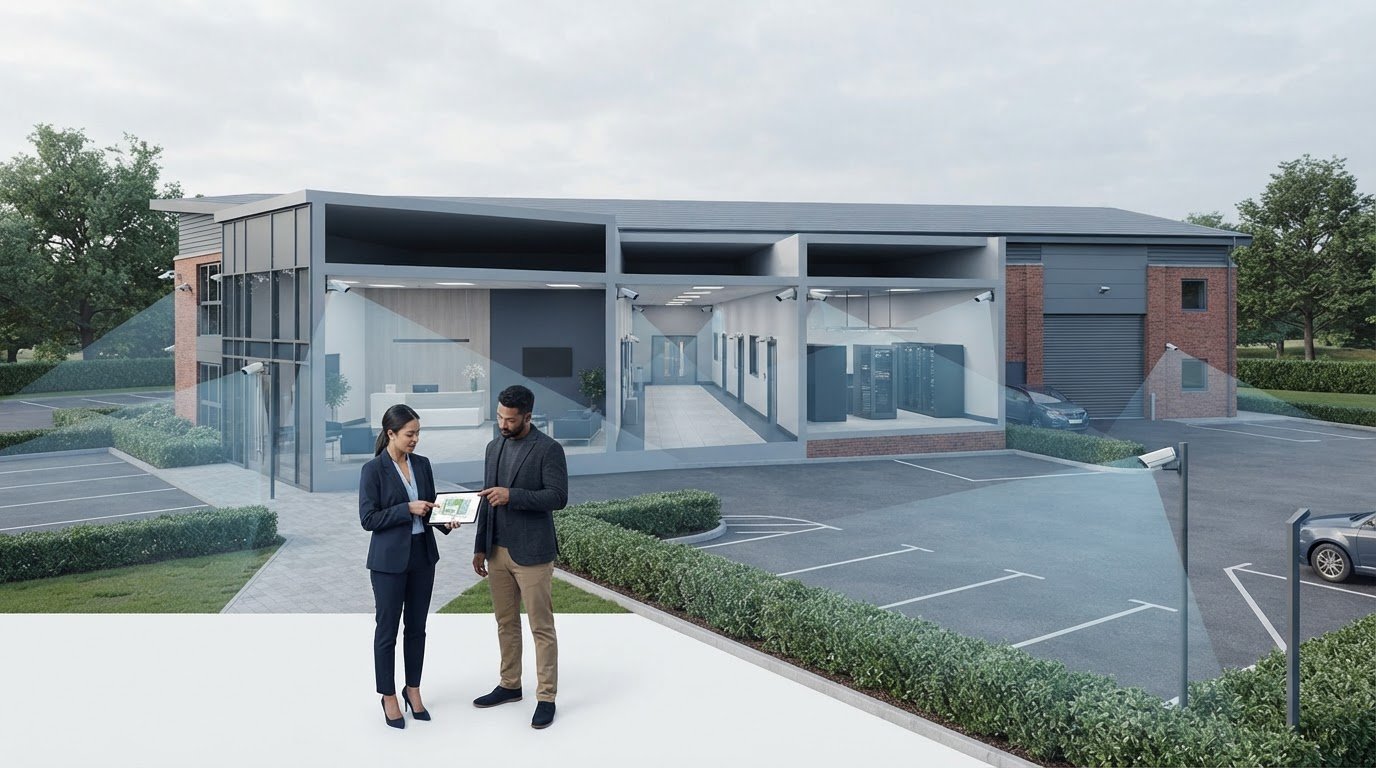
Adding more cameras doesn’t automatically mean better coverage. A useful CCTV camera placement guide for business Surrey starts with the risks a site needs to address, then identifies the views that can capture activity clearly while respecting privacy boundaries.
If you’re deciding whether to prioritise entrances, internal routes, car parks or valuable assets, start by asking what each view needs to show. Poorly chosen positions can leave blind spots, produce footage that’s hard to interpret in changing light or capture areas unrelated to the security purpose.
This guide explains how to plan camera positions around your business’s layout and priorities. You’ll learn how to assess entrances, circulation routes and assets, account for viewpoints and lighting, and consider privacy expectations and UK data protection responsibilities.
It also explains how a placement plan can become a professionally installed and commissioned commercial IP HD CCTV system. Careful planning helps you make informed decisions about coverage before installation, then keep the system aligned with its intended purpose through scheduled maintenance.
Key Takeaways
- Start with site risks and operational needs, not a target camera count, to focus coverage where it’s most useful.
- Match each camera’s viewpoint to its task, whether that’s monitoring an entrance, vehicle approach, reception desk or internal route.
- Use this CCTV camera placement guide for business Surrey to consider privacy boundaries alongside security coverage.
- Map each proposed position against its purpose, intended view and privacy considerations before finalising the plan.
- Take the agreed plan through commissioning, then use scheduled maintenance to support the system’s ongoing reliability.
How a CCTV camera placement plan helps Surrey businesses protect the right areas
A placement plan connects each proposed camera view to a defined site risk or operational need. It helps you decide which scenes matter, what the footage should show and where a camera could provide a useful view. The objective isn’t to maximise camera numbers. It’s to address the site’s priorities without leaving important routes or activities poorly covered.
Camera count alone can be misleading. Several cameras may cover the same broad area while a busy entrance, delivery route or store of high-value equipment remains difficult to see. Walls, shelving, vehicles and changing light can also obstruct a view. Marking proposed positions on a plan helps reveal these issues before equipment is specified. For a general overview of the components and applications of closed-circuit television (CCTV), see the linked reference.
Risk-led camera placement makes CCTV more useful by aligning each view with a defined security or operational need. For a Surrey business, prioritise views according to how the site operates, where access is controlled and what an incident review would need to establish.
Which business areas should a Surrey site assess first?
Walk the site as staff, visitors, suppliers and vehicles would. Start with entry and exit points, then assess reception, loading areas, internal routes and high-value assets. At each location, ask what an incident review would need to establish: who entered, which route they took, or what happened during a delivery.
Priorities depend on the layout. An office may focus on reception and shared corridors; a retail site may need clear views of customer entrances and stock areas. A warehouse could assess loading bays, vehicle approaches and routes between storage zones. At an education site or business park, consider how people move between entrances, buildings and shared facilities. Treat each location as a distinct scene rather than assuming one camera view will serve several purposes.
What should a placement brief establish before cameras are specified?
Record the site boundary, operating hours, access routes and coverage priorities. Mark where staff, visitors, deliveries and vehicles typically move, and note existing access-control points where a camera view could support the wider security arrangement. This gives the design process a practical basis and helps distinguish essential views from optional monitoring.
Walk the proposed viewpoints at relevant times of day. Note changes in lighting, reflective surfaces, doors that swing open, parked vehicles, shelving and other potential obstructions. Identify locations requiring particular privacy care, such as areas near neighbouring premises or spaces where people expect privacy. Recording these constraints early keeps the plan focused on relevant coverage.
- Essential views: Locations linked to defined security risks or necessary operational oversight.
- Optional views: Areas that may add context but aren’t central to the stated priorities.
This groundwork gives a commercial CCTV design a clear purpose. It also provides a reference for reviewing proposed positions and checking whether the installed views meet the site’s agreed needs.
How to position business CCTV cameras in Surrey for useful views
A camera’s position and field of view should follow the task it needs to perform. A view intended to show who enters a building has different requirements from one monitoring a vehicle approach or movement through a corridor. Decide what detail matters first, then assess whether the proposed viewpoint can capture it without including large areas that add little security value.
Test each camera view against its intended task. Consider what someone would need to understand from the footage, not simply whether the area appears in frame. A broad reception view, for example, may show that people were present, while a carefully chosen angle may better show how visitors approach the desk and where they go next.
Use the CCTV camera placement guide for business Surrey approach to assess each position as a distinct scene. The layout, expected movement and purpose of the footage all influence the right viewpoint. A door, reception desk and loading area aren’t interchangeable locations.
How do entrances, routes and assets affect camera viewpoints?
At an entrance, decide whether the priority is to see an approaching person, activity at the threshold or movement inside the building. For a vehicle approach, consider where vehicles turn, stop or pass through, and whether the view needs to show their direction of travel. At reception, account for the desk layout and the routes visitors use after entering.
Trace movement through the scene and check whether an open door, shelving, a parked vehicle or signage could block the important area. A camera positioned to monitor a route may need a different angle from one intended to observe a fixed asset.
How should lighting and image detail influence placement?
Assess proposed viewpoints in daylight, under artificial lighting and in low-light conditions relevant to the site’s operation. Glazing can create backlighting, while headlights or reflective surfaces may affect views of external approaches. Note whether shadows or changing light could obscure the activity the camera is intended to capture.
Camera specification and position work together. A suitable camera can still produce an unhelpful view if it’s aimed towards bright glazing or placed too far from the activity of interest. Equally, a well-chosen angle won’t make up for a system that can’t provide the image detail needed for its intended purpose.
Before finalising a position, review the view from the proposed mounting point and check it against the task:
- Identity: Is the relevant person visible at the point where identification matters?
- Direction: Can the view show which way people or vehicles travelled?
- Activity: Is the key action visible, or could an obstruction conceal it?
- Conditions: Does lighting change the usefulness of the scene?
These checks turn a marked location into a purposeful camera position. Links Integrated Systems designs, installs and commissions commercial IP HD CCTV systems around agreed coverage needs.
How Surrey businesses can balance CCTV coverage with privacy
A wider camera view isn’t automatically a better one. Capturing a neighbouring entrance, public pavement or area unrelated to the security purpose can create privacy concerns without improving the footage the business needs. Give each proposed view a clear reason, and consider its boundaries alongside its security benefit.
Camera views should be proportionate to the documented security purpose. Record what risk each view addresses and why the proposed coverage is necessary for that purpose. This gives the business a reasoned basis for reviewing camera angles and keeping monitoring focused.
How can a camera plan avoid unnecessary views beyond the site?
Mark the site boundary and nearby spaces on the plan before finalising external camera positions. Check whether a camera could capture neighbouring property, public areas or windows, and whether that part of the view is genuinely needed to address the identified risk. A camera intended to monitor a business entrance, for example, may not need to record a neighbour’s doorway or a long stretch of pavement.
If a relevant view unavoidably includes an area outside the site, assess whether the angle can be adjusted to reduce capture while retaining the security view. Privacy masking may also be a design measure if the selected system supports it, but it should be considered as part of system design rather than assumed to be available. Record the reasoning and review the result against the original purpose.
What privacy and transparency issues should the plan flag?
In the UK, identifiable CCTV footage can fall under data protection law, including the UK GDPR and Data Protection Act 2018. The business operating the system is responsible for considering its use of footage and the relevant obligations. Requirements depend on the circumstances, so a camera plan is one input to the wider governance process, not a substitute for it.
Check the Information Commissioner’s Office (ICO) guidance on video surveillance when planning or reviewing a system. Consider whether a data protection impact assessment is required, establish and document a lawful basis, and ensure the monitoring is necessary and proportionate. These decisions should reflect the site and intended use. Don’t rely on a generic rule for every business.
Flag how people will be informed and how recorded footage will be managed. The site’s governance process should address clear signage, who can access footage, how requests or concerns will be handled, and how long recordings are kept. Set retention according to the purpose and current guidance, rather than treating a commonly used period as a universal legal requirement.
- Limit the view: Keep neighbouring premises and unrelated public areas out of frame where practicable.
- Document the reason: Link each camera view to a defined security purpose.
- Plan governance: Include signage, footage access and retention in the site’s procedures.
This privacy review makes the placement plan more considered. Security value and privacy boundaries belong in the same planning discussion for a CCTV camera placement guide for business Surrey.
How to map and test CCTV camera positions across a Surrey business site
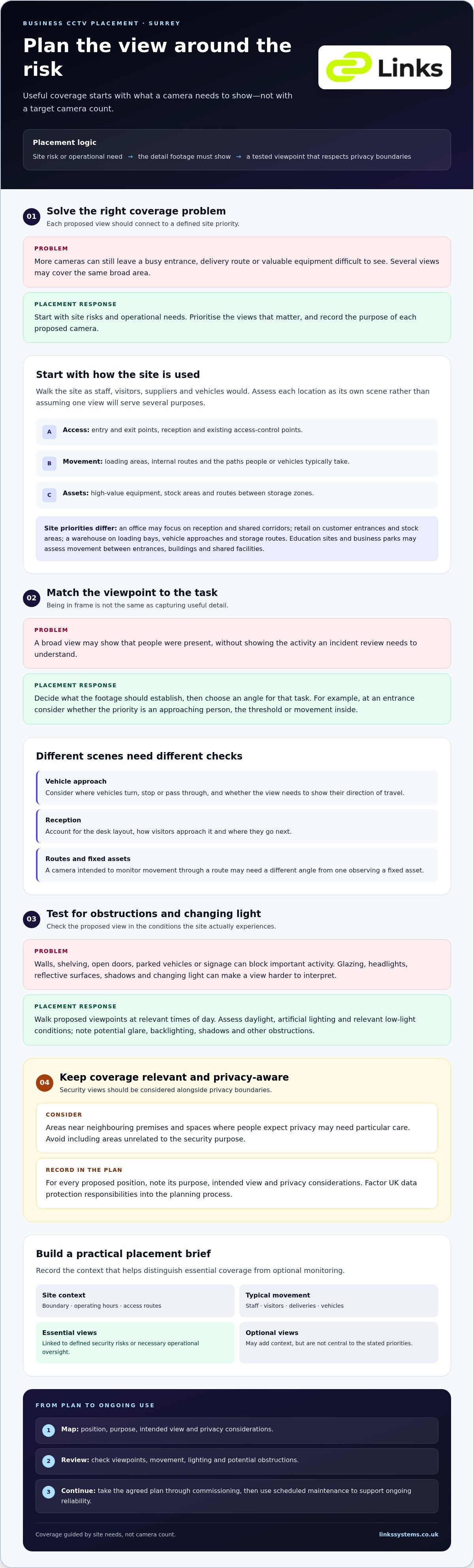
A site plan is more useful when each proposed camera has a clear purpose and can be reviewed against how the premises operate. Use this sequence to move from a first walk-through to a draft layout that can inform commercial CCTV system design.
- Walk the site. Follow staff, visitor, delivery and vehicle routes, noting key access points, assets and areas where incidents could occur.
- Mark priority locations. Add proposed camera positions to a floor plan or site map, including external approaches and internal routes.
- Define each view. State what the camera should show and what the footage needs to establish, such as entry, direction of movement or activity at a loading bay.
- Record constraints. Note lighting, likely obstructions, nearby boundaries, privacy considerations and operational factors such as doors or equipment that may affect the view.
- Review and revise. Walk the proposed positions with relevant stakeholders, test each view against its purpose and record changes or unresolved assumptions for the site assessment.
What should a camera-position schedule record?
Keep a simple schedule alongside the marked site plan. It gives the design and installation process a consistent reference and makes gaps easier to spot.
- Location: The proposed position, linked to a clear point on the plan.
- Security purpose: The risk or operational need the view addresses.
- Intended view: The activity, route or asset the camera should capture.
- Review notes: Lighting, possible obstructions, nearby boundaries, operating constraints and assumptions to resolve.
For example, a proposed loading-area view might need to cover activity at the bay without including an adjacent property. If the final viewpoint depends on a shelf being moved or a vehicle route changing, record that as an assumption rather than treating it as settled.
How should a draft layout be reviewed before installation?
Review the plan on site with people who understand how the premises are used. A route that looks clear on a drawing may be blocked by stored stock, an open door or a vehicle during normal operations. Compare each proposed view with daily movement, then adjust positions where an obstruction or privacy boundary affects the intended coverage.
Where entry events inform the camera plan, consider how integrating CCTV with access control systems can support the wider design discussion. Keep the placement schedule current as decisions are made, so the agreed views can be checked during installation and commissioning.
A structured CCTV camera placement guide for business Surrey approach turns a site walk-through into a practical brief, rather than a collection of untested camera positions. Links Integrated Systems can take a commercial CCTV project in Surrey from placement planning through to system design and commissioning.
From Surrey CCTV placement plan to commissioning and ongoing maintenance
A reviewed placement plan gives system design a clear starting point. It records the locations to cover, the purpose of each view and any site constraints that may affect installation. These details help shape the commercial IP HD CCTV system and define the installation work. If building use or access arrangements change before installation, revisit the plan so the design reflects the current site.
Commissioning checks the installed system against the agreed project requirements. Camera positions and views can be reviewed against the placement plan, with differences or outstanding points identified for attention. This connects the original security objectives to the completed installation, rather than treating the camera schedule as a document that ends once equipment is fitted.
What happens when a placement plan becomes an installed system?
The agreed locations inform system design and installation, including where cameras are positioned to address the specified coverage objectives. During commissioning, the installed arrangement is reviewed against those requirements. The aim is to confirm that the system corresponds with the project plan, not to promise a particular image outcome beyond the agreed specification.
For example, if the brief identifies a specific entrance approach as a priority, commissioning can include checking the installed view against that objective. Record any changes made during the project so the site’s understanding of the final layout remains accurate.
Why plan for maintenance after commissioning?
Commissioning is a key handover point, but it isn’t the end of the system lifecycle. Scheduled maintenance supports the ongoing reliability of commercial security infrastructure and gives the business an opportunity to review its CCTV arrangements over time. Changes to a building, storage layout, lighting or access routes may alter what a camera can see or which views matter most.
A periodic review can identify when the original placement plan no longer reflects site operations. A new partition, for instance, could obstruct a previously clear view; a changed delivery route might shift where coverage is most useful. Keeping the plan aligned with the premises helps inform future system reviews and maintenance.
Where CCTV is part of a broader security arrangement, physical security integration for commercial buildings provides useful context for considering how systems work together. Providers such as Spycon Security Ltd. support organisations by delivering professional physical security measures that complement electronic surveillance. This is particularly relevant where access control and CCTV both contribute to managing and reviewing building entry.
A practical CCTV camera placement guide for business Surrey should lead from site assessment to design, installation, commissioning and scheduled maintenance. Links Integrated Systems designs, supplies, installs, commissions and maintains commercial IP HD CCTV systems for businesses in Surrey, connecting placement objectives with the wider project lifecycle.
If you’re planning a new or upgraded business CCTV system in Surrey, discuss your commercial CCTV project with Links Integrated Systems.
Put your Surrey CCTV plan into practice
A camera layout is most valuable when it remains a practical reference as your site evolves. Changes to entrances, working patterns, stock arrangements or access routes can alter the views your business needs. Keep the placement objectives available for future reviews so decisions about system changes stay connected to your original security priorities.
For a new installation or upgrade, turn those priorities into a project plan. Links Integrated Systems provides commercial IP HD CCTV design, supply and installation, with commissioning and scheduled maintenance supporting the system lifecycle. This CCTV camera placement guide for business Surrey can help you begin with a clearer understanding of your site’s requirements, whether your business is in Surrey or elsewhere across London, Kent, Hertfordshire and Essex.
Discuss a commercial CCTV system for your Surrey site with Links Integrated Systems. A considered plan gives your project a clear starting point, and professional design, installation, commissioning and maintenance carry it forward.
Frequently Asked Questions
How many CCTV cameras does a small business need?
There’s no fixed number; it depends on the premises, risks and views the business needs. A small unit with one entrance and a compact stockroom may need a different layout from a site with a yard, several access points and separate delivery areas. Start by identifying the scenes that matter, then assess whether each camera adds a distinct, useful view. This CCTV camera placement guide for business Surrey also applies to commercial sites across London, Kent, Hertfordshire and Essex.
Can a business CCTV system record audio as well as video?
Some CCTV systems can record audio, but businesses shouldn’t assume it’s appropriate to enable it. Audio may capture conversations beyond the intended security purpose, so assess whether it’s necessary and proportionate, and consider the privacy impact before including it in the design. Check current Information Commissioner’s Office (ICO) guidance and applicable data protection obligations for your circumstances. If the security objective can be met with video alone, avoid collecting additional information without a clear reason.
How long should a business keep CCTV footage?
Keep identifiable CCTV footage only for as long as it’s needed for the purpose for which it was recorded. There’s no single retention period suitable for every business, so document the reason for the chosen period and review it against operational needs. A business may need enough time to identify an incident and deal with it, but routinely keeping footage longer without a continuing purpose may be difficult to justify. Check current ICO guidance when setting a retention policy.
Can business CCTV cameras capture a public pavement in Surrey?
A camera may capture part of a public pavement if there’s a justified security need, but the view should be limited to what’s necessary. Avoid recording a broad stretch of public space if a narrower angle can monitor the business entrance or boundary. Document why the pavement enters the frame, consider whether repositioning can reduce capture, and consult current ICO guidance on surveillance beyond your premises. The business remains responsible for assessing its own system and footage use.
Do businesses need CCTV signage in the UK?
Businesses using CCTV should display clear, visible signs in areas covered by cameras. Signage should tell people that recording is taking place, identify the system operator and explain the purpose of monitoring. Plan sign locations so people can see the information before or as they enter a monitored area. Signage is one part of transparent CCTV operation, not a substitute for considering other applicable data protection requirements. Check current ICO guidance for advice relevant to your system and premises.
Who should be allowed to access business CCTV footage?
Access should be limited to people with a defined business need, rather than being available to all staff. Set out who can view or export footage, when access is appropriate and how it’s recorded under your procedures. For instance, a designated manager may review footage after a reported incident. The business should also have a process for handling requests from individuals and sharing footage appropriately, guided by current data protection obligations.
How often should a business review its CCTV camera positions?
Review camera positions as part of planned system checks and whenever a site change could affect coverage. A new partition, relocated shelving, altered entrance or changed delivery route may block a view or shift the area that needs monitoring. Engaging an experienced security firm such as Q-Winn Security can assist businesses in conducting thorough reviews to identify and rectify blind spots. Also revisit positions after an incident if the footage showed that the intended view wasn’t useful. Record any decision to retain or change a position so the system continues to reflect the site’s current operation and purpose.