

In the high-stakes environment of London’s commercial hubs, a standalone security camera is no longer a sufficient deterrent. You recognise that securing a corporate premises involves more than just mounting hardware. It requires a cohesive strategy that addresses both physical threats and strict regulatory compliance. Many organisations currently struggle with cctv systems london that produce unusable, grainy footage or fail to communicate with existing access control infrastructure. This lack of cohesion often leads to vulnerabilities that only become apparent during a critical incident.
This 2026 guide provides the technical clarity needed to master commercial-grade CCTV specifications, ensuring your investment delivers crystal-clear evidence and seamless integration with speed gates and intercoms. We will examine the essential transition to IP HD technology, the necessity of professional commissioning, and how to maintain a future-proof system that guarantees uptime whilst navigating complex urban privacy laws. By the end of this article, you’ll have a clear roadmap for implementing a security infrastructure that offers genuine peace of mind and the long-term reliability your business demands.
Key Takeaways
- Understand why modern cctv systems london must transition to IP-based infrastructure to handle the complexities of high-density urban environments.
- Learn why IP HD technology is the current industry standard, offering superior scalability and image clarity compared to obsolete analog systems.
- Discover how to integrate visual surveillance with speed gates and access control to create a unified security network.
- Navigate the essential requirements for GDPR compliance and ICO guidelines to ensure your surveillance strategy respects public privacy.
- Recognise the critical distinction between a basic installation and a professionally commissioned system that guarantees long-term uptime.
The Strategic Role of CCTV Systems in London’s Commercial Landscape
In the dense urban environment of the capital, the definition of a professional security system has evolved. By 2026, cctv systems london are no longer viewed as passive recording devices but as active components of a building’s data infrastructure. High-specification IP hardware is essential. London’s high-rise districts present complex light conditions and narrow sightlines that standard cameras cannot handle. Urban density also increases the risk of signal interference, making robust, wired IP infrastructure a necessity for maintaining constant uptime. Standard equipment often fails to capture clear imagery in these settings, rendering it useless for evidential purposes.
Modern facility managers have shifted their focus toward operational intelligence. They use closed-circuit television systems to monitor footfall patterns whilst managing building occupancy and mitigating liability. A professionally commissioned system provides a definitive record of events, protecting corporate assets from fraudulent claims and internal shrinkage. It’s about establishing a stable, reliable environment where security is a silent but robust presence. For complex London sites like high-rises and business hubs, this level of precision is non-negotiable.
Surveillance as a Pillar of Corporate Governance
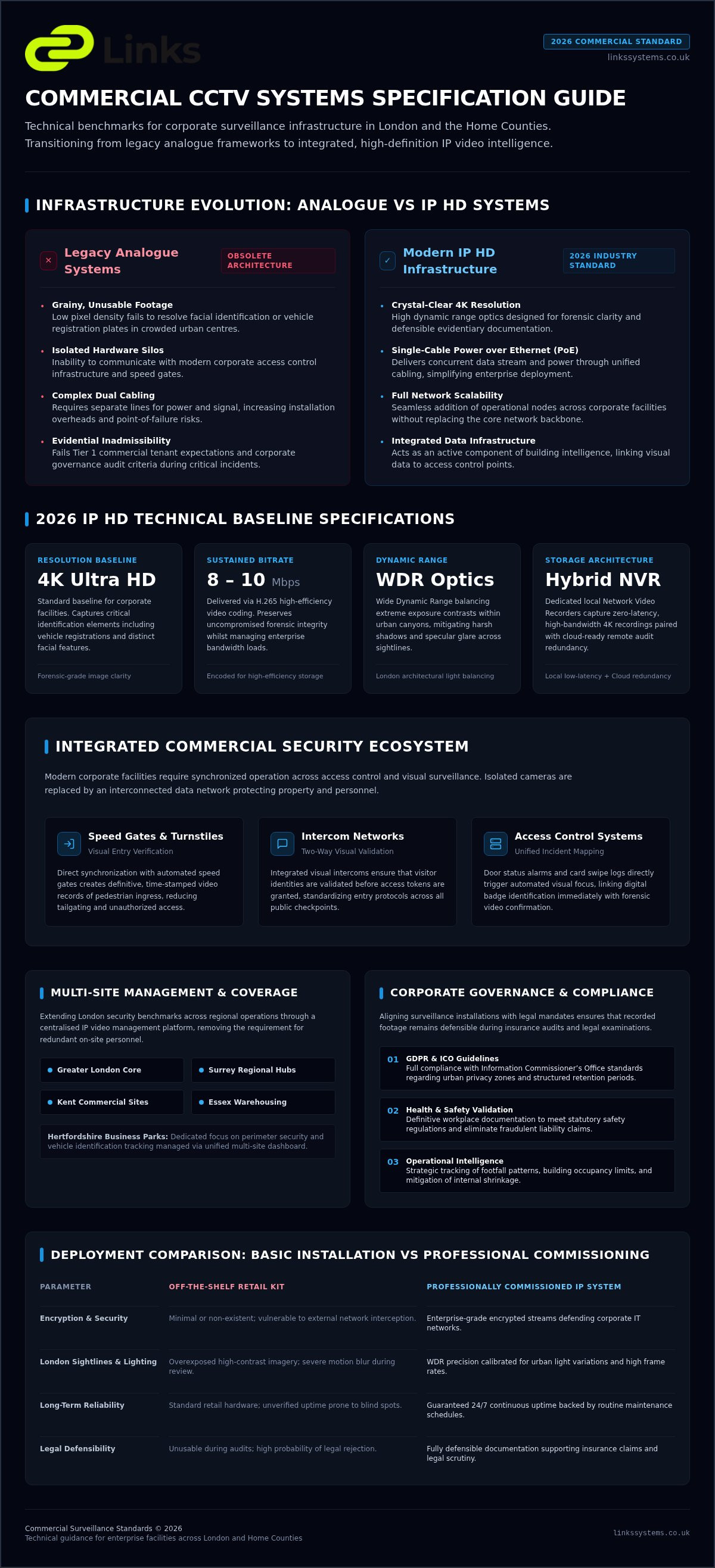
Tier 1 commercial tenants now expect security protocols that align with their own corporate governance standards. High-definition video is a requirement for health and safety compliance, providing clear documentation of workplace incidents. Off-the-shelf kits found in retail outlets simply don’t meet these professional standards. They lack the necessary encryption, durability, and integration capabilities required for a high-value London office or warehouse. Investing in professional-grade IP HD CCTV ensures that your security measures are defensible during legal or insurance audits.
The Evolving Security Needs of the Home Counties
Security requirements extend beyond the M25 into the Home Counties, where the integration of cctv systems london standards ensures consistency across regional offices. Managing multi-site operations across Kent, Surrey, and Essex requires a centralised approach to IP video management, amongst other technical considerations. For regional hubs and Hertfordshire business parks, the focus is often on perimeter protection and vehicle tracking. A unified system allows stakeholders to monitor several locations from a single interface. This ensures consistent security standards across the entire portfolio without the need for redundant on-site personnel.
IP HD CCTV Technology: High-Definition Standards for 2026
The transition from analog to IP-based infrastructure is now complete within the corporate sector. Analog systems are obsolete for modern London commercial sites because they lack the pixel density and dynamic range required to identify individuals in crowded urban environments. For cctv systems london, the shift to IP HD technology provides a foundation of clarity and flexibility. Power over Ethernet (PoE) simplifies installation by delivering data and power through a single cable, whilst the inherent scalability of IP networks allows for the seamless addition of new cameras as your business expands.
Resolution standards have also shifted, with 4K now serving as the baseline for corporate security. High-resolution imagery is vital for capturing fine details, such as vehicle registrations or facial features, which are often lost in lower-quality recordings. Whilst cloud storage offers convenient redundancy, professional London installations typically rely on on-site Network Video Recorders (NVRs). This hybrid approach ensures that high-bandwidth 4K footage is recorded locally without latency, whilst maintaining cloud-ready capabilities for off-site backup and remote viewing.
Analysing Image Quality and Evidential Value
London’s unique architecture creates “urban canyons” where deep shadows and bright reflections coexist. Professional IP cameras must feature Wide Dynamic Range (WDR) to balance these extremes, ensuring that footage remains usable regardless of the time of day. High frame rates are equally important to prevent motion blur during forensic reviews of fast-moving events. To ensure forensic integrity in 2026, 4K security footage typically requires a sustained bitrate of 8Mbps to 10Mbps when utilising H.265 or equivalent high-efficiency video coding. If you are upgrading an older site, reviewing the technical specifications of modern IP HD CCTV systems is a necessary step to ensure your evidence is admissible.
Network Infrastructure and Data Integrity
Deploying high-definition surveillance requires a robust network strategy to prevent bandwidth bottlenecks. Dedicated Virtual Local Area Networks (VLANs) keep security traffic separate from general corporate data, protecting both system speed and data integrity. This infrastructure also supports the integration of an IP video intercom system installation, allowing for unified communication across the premises. Protecting the physical integrity of the security data centre is the final pillar of this approach. Secure cabling and restricted access to NVR racks ensure that the recorded data remains tamper-proof from the moment of capture through to long-term archiving.
Integrating Video Surveillance with Access Control and Speed Gates
The most robust cctv systems london businesses deploy in 2026 are those that move beyond standalone operation. True security efficiency is found in the synergy between visual verification and physical barriers. When cameras are integrated with access control systems, every badge swipe or biometric entry is timestamped and paired with a high-definition video clip. This creates a dual layer of authentication that prevents credential sharing and ensures the person entering is the authorised cardholder. In London’s high-rise lobbies, where footfall is constant, this level of automated oversight is essential for maintaining a secure perimeter without slowing down staff movement.
Speed gates and barriers serve as the first line of physical defence, but their effectiveness increases significantly when paired with intelligent surveillance. Integrated cameras can identify tailgating incidents in real time, triggering an alert to the security desk before the unauthorised individual reaches the lift core. Visitor management also becomes more streamlined through the use of IP video intercom systems. These allow reception teams to visually verify guests and grant access through multiple secure layers from a centralised station, ensuring a professional and controlled entry experience for every visitor.
Visual Verification for Access Events
Linking camera feeds directly to access control logs provides a comprehensive audit trail that is invaluable during internal investigations. If a secure door is forced or left ajar, the system automatically flags the relevant video segment for immediate review. This automation removes the need for security personnel to manually scrub through hours of footage. For a deeper technical breakdown of these requirements, refer to our guide on integrating CCTV with access control systems. By automating alerts for unauthorised tailgating at speed gates, organisations can maintain strict occupancy standards whilst reducing the burden on physical guarding teams.
Unified Management Platforms
Managing disparate security components often leads to operator fatigue and missed incidents. Transitioning to a single-pane-of-glass interface allows your team to monitor cctv systems london, access logs, and intercom calls from one unified dashboard. This approach simplifies response protocols and ensures that data remains synchronised across all security pillars. You can explore the broader benefits of physical security integration for commercial buildings to understand how these systems scale. Professional commissioning is the final, vital step in this process. Without meticulous setup by an experienced specialist, integrated software can become unstable, leading to system lag or communication failures between the cameras and the physical barriers.
Compliance and Operational Planning for London CCTV Installations
Operating cctv systems london requires a rigorous approach to legal frameworks and operational transparency. In a city where private commercial space often borders public thoroughfares, navigating GDPR and the Information Commissioner’s Office (ICO) guidelines is a primary responsibility for any facility manager. Compliance is not merely a box-ticking exercise; it’s a fundamental aspect of corporate risk management. Failure to adhere to the Data Protection Act can lead to significant fines and render your footage inadmissible in legal proceedings. A professional installation prioritises “Privacy by Design,” ensuring that security objectives are met without infringing on the privacy rights of employees or the general public.
Effective planning involves more than technical specifications. It requires a clear data retention policy, typically set at 31 days unless a specific threat justifies a longer period. Visible signage is another legal necessity. These signs must be clearly legible, placed at the perimeter of the monitored area, and contain the contact details of the data controller. Strategic camera placement is the final component of this planning phase. By carefully calculating fields of view, you can ensure maximum coverage of high-value assets whilst utilising privacy masking to black out neighbouring residential windows or sensitive public areas.
GDPR and Data Protection Compliance
Commercial CCTV operators must maintain comprehensive documentation to demonstrate accountability. This includes a Data Protection Impact Assessment (DPIA) for every site, particularly where high-definition recording or biometric integration is used. Managing Subject Access Requests (SARs) is a critical operational task; your system must allow for the efficient extraction and redaction of footage if a member of the public requests to see data held about them. Ensuring your infrastructure meets the latest UK security standards for 2026 provides the assurance that your data handling processes are robust enough to withstand regulatory scrutiny. For businesses seeking to align their security with these high standards, we provide professional CCTV commissioning and maintenance to ensure ongoing compliance.
Strategic Placement and Field of View
London’s architectural diversity, from glass-fronted high-rises to Victorian warehouses, creates unique challenges for camera positioning. Identifying blind spots in alcoves or behind structural columns is essential during the design phase. Wide-angle lenses are typically deployed for general area overwatch, whilst telephoto lenses are reserved for transition points like loading bays or secure lobbies where facial or number plate recognition is required. The “Secured by Design” principle dictates that camera placement should maximise natural surveillance whilst ensuring hardware is positioned to resist tampering and provide clear, unobstructed views of primary transition points. This methodical approach ensures that every camera serves a defined purpose within the broader security strategy.
Professional Commissioning and Maintenance: Ensuring 24/7 Reliability
Commissioning represents the most critical phase of any security project, yet it’s often the most overlooked. There is a fundamental difference between a system that is merely “working” and one that has been professionally commissioned. A system that shows a live feed might appear functional, but without rigorous testing, it may fail at the exact moment an incident occurs. For cctv systems london, commissioning ensures that the underlying IP infrastructure can handle the sustained bitrates of 4K footage whilst maintaining network stability across the entire corporate estate. It’s the process that transforms a collection of hardware into a dependable security asset.
At Links Integrated Systems, our 40 years of industry experience have taught us that long-term reliability is built during the final 10% of the project. We don’t just fit cameras; we establish a stable operational environment. This involves stress-testing failover protocols and ensuring that storage arrays are correctly configured for high-definition data retention. By focusing on IP-based infrastructure, we provide a modern solution that avoids the limitations of legacy equipment. Our role is to act as a steady, experienced guide, ensuring your security investment remains resilient against both physical threats and technical degradation.
The Commissioning Process Explained
The commissioning process starts with a thorough audit of the network’s data throughput. We verify that Power over Ethernet (PoE) switches are providing adequate wattage to every camera, especially during low-light periods when infrared illuminators increase power demand. Fine-tuning camera analytics is another essential step. We calibrate motion detection and tripwire thresholds to eliminate false triggers caused by environmental factors like shadows or light reflections. Finally, we conduct a formal handover, providing facility managers with the training and documentation required to manage the system effectively on a day-to-day basis.
Scheduled Maintenance for Uptime
London’s high-density environment places unique stresses on outdoor hardware. Periodic preventative checks are necessary to ensure 24/7 uptime. These include cleaning lenses to remove urban grime, checking cable integrity at junction points, and applying critical firmware updates to maintain system security. Professional maintenance is equally vital for regional hubs in Kent and Surrey business parks, where remote monitoring relies on consistent connectivity. To understand how to protect every entry point, explore our professional speed gates and barriers guide for insights into maintaining hardware longevity across your entire facility.
Securing Your Corporate Future with Integrated Surveillance
Implementing effective cctv systems london requires a shift from standalone hardware to integrated, data-driven infrastructure. We’ve explored how transitioning to IP HD technology provides the clarity needed for forensic evidence, whilst professional commissioning ensures your system remains stable under the demands of a high-density urban environment. Integration with speed gates and access control systems creates a unified perimeter that protects both your assets and your personnel.
With over 40 years of industry experience, we understand the complexities of London’s commercial landscape. We specialise in integrated IP security infrastructure, providing full lifecycle support from the initial design phase through to scheduled maintenance. This methodical approach ensures that your security measures remain compliant and reliable for the long term. Consult with our specialists at Links Integrated Systems for your bespoke CCTV requirements. We look forward to helping you achieve lasting peace of mind through precision engineering.
Frequently Asked Questions
What are the legal requirements for installing CCTV systems in London offices?
Commercial operators must register with the Information Commissioner’s Office (ICO) and adhere to the Data Protection Act 2018. You’re required to conduct a Data Protection Impact Assessment (DPIA) before installation, especially for high-definition systems. Clear signage must be displayed at entry points to inform the public. You must also ensure that your system follows “Privacy by Design” to avoid capturing footage of private residential areas or unnecessary public space.
Can IP CCTV systems be integrated with my existing access control software?
Modern IP CCTV systems are designed to integrate seamlessly with professional access control software via standard protocols like ONVIF. This allows for visual verification of every badge swipe or biometric entry event. By linking video feeds to your access logs, you create a robust audit trail that simplifies incident investigation. We specialise in commissioning these integrated environments to ensure that your hardware and software communicate reliably without causing network latency.
How long is CCTV footage typically stored for commercial purposes in the UK?
There is no strict legal minimum, but the industry standard for commercial premises in the UK is typically 31 days. This timeframe provides enough time for most incidents to be reported and investigated. Storing data for longer periods requires a specific, documented security justification to remain compliant with GDPR. Your storage infrastructure must be sized correctly to handle the high bitrates of 4K footage whilst maintaining this 31-day retention period.
What is the difference between professional commissioning and basic installation?
A basic installation involves mounting hardware, whereas professional commissioning is an exhaustive testing phase that ensures long-term reliability. During commissioning, we fine-tune motion detection thresholds, verify network failover protocols, and stress-test the data throughput. This process ensures the system performs as specified under real-world conditions. It’s the difference between having a camera that simply “shows a picture” and a cctv systems london solution that provides dependable, high-quality evidence.
Are wireless CCTV systems suitable for large London commercial buildings?
Wireless systems are generally unsuitable for large-scale cctv systems london environments due to signal interference and bandwidth limitations. The dense urban architecture and existing corporate Wi-Fi networks often cause dropouts or reduced image quality. For professional reliability, we recommend a wired IP infrastructure using Power over Ethernet (PoE). This ensures a stable, high-speed connection that can handle the massive data requirements of 4K video whilst providing consistent power to every camera.
How often should a commercial CCTV system undergo professional maintenance?
Commercial systems should undergo professional maintenance at least twice a year to guarantee 24/7 uptime. These visits involve physical checks such as lens cleaning and cable integrity inspections, alongside technical tasks like firmware updates and storage health audits. Regular maintenance is particularly important for sites in Kent and Surrey business parks where environmental factors can impact outdoor hardware. This proactive approach prevents minor issues from escalating into critical system failures during a security incident.
Does a CCTV system in London require a specific data protection officer?
UK law requires a DPO if your organisation is a public authority or if your core activities involve large-scale, systematic monitoring of individuals. Many London businesses operating extensive surveillance networks find that appointing a DPO helps manage complex GDPR obligations and Subject Access Requests. Even if not legally mandated, having a designated person responsible for data oversight ensures that your surveillance strategy remains transparent and compliant with the latest ICO guidelines.
What resolution is required for CCTV footage to be admissible in UK courts?
There isn’t a single resolution required by law, but the footage must be of sufficient quality to prove a fact beyond reasonable doubt. Courts expect clear, recognisable imagery where facial features or vehicle registrations are easily identifiable. Whilst 4K is the modern corporate baseline, the bitrate and frame rate are equally important for preventing motion blur. A professionally commissioned system ensures that the recorded output meets the evidential standards required by the UK legal system.