
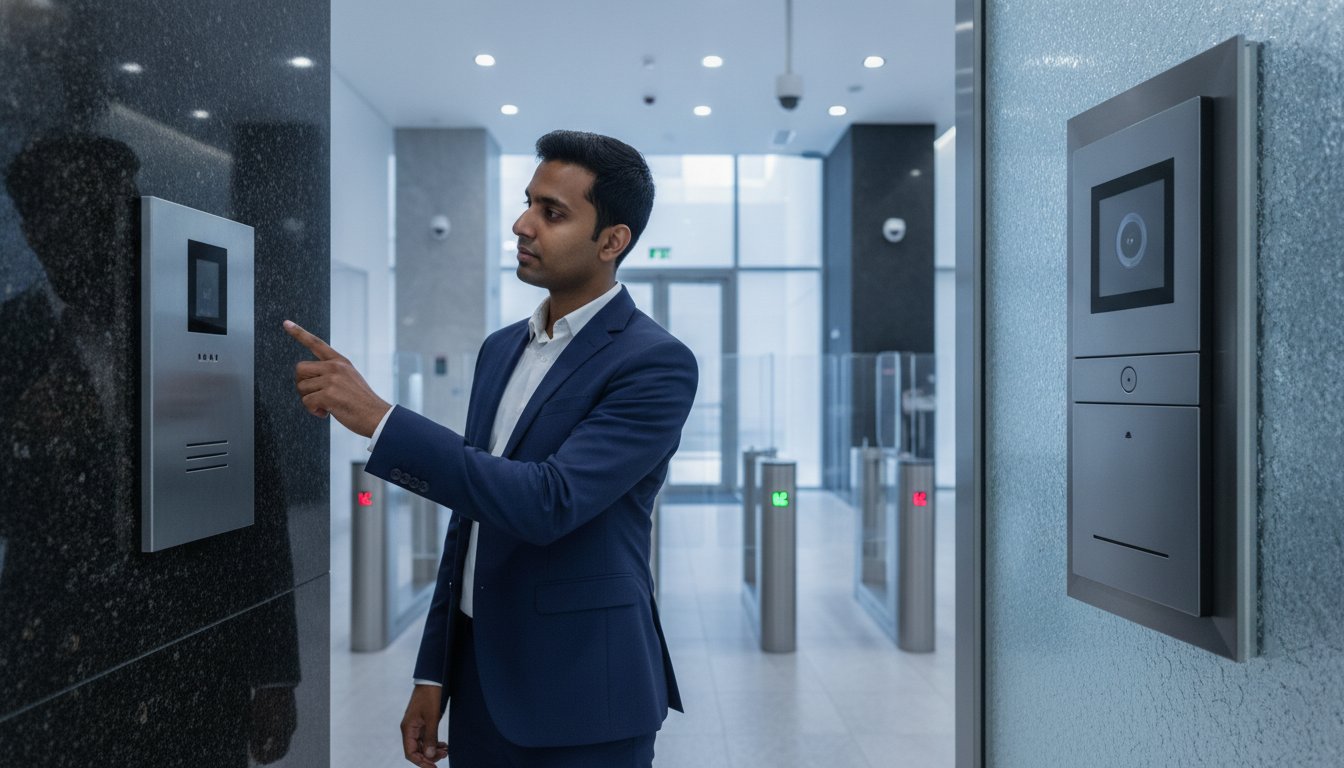
Selecting a high-specification intercom based solely on aesthetics often leads to unforeseen technical debt during the commissioning phase. Whilst the modular design of the new 2N IP Verso 2.0 is visually impressive, the proprietary architecture of the Comelit ViP system offers a level of infrastructure stability that many large-scale commercial hubs require. Choosing between these two industry leaders requires looking beyond the faceplate to understand how they handle data, integration, and long-term maintenance in a professional environment.
You likely want a system that integrates seamlessly with your existing speed gates and CCTV without the headache of complex IP configuration or escalating subscription costs. It’s frustrating when a sophisticated solution becomes a burden on your IT department or a drain on your operational budget. This expert comparison of Comelit VIP vs 2N IP Verso provides the technical clarity needed to specify a reliable, future-proof solution for your commercial project. We’ll examine the hardware capabilities, integration potential, and total cost of ownership to help you decide between 2N’s open-protocol flexibility and Comelit’s robust peer-to-peer reliability.
Key Takeaways
- Understand the fundamental architectural distinction between Comelit’s proprietary peer-to-peer stability and 2N’s modular SIP flexibility.
- Compare the total cost of ownership for Comelit VIP vs 2N IP Verso, weighing Comelit’s lack of recurring software fees against 2N’s advanced licensing options.
- Learn how to synchronise your IP intercom with physical security infrastructure, such as speed gates and access control, for a unified visitor management experience.
- Identify why professional system commissioning and VLAN configuration are vital for preventing network latency and ensuring long-term reliability.
- Assess how to future-proof your investment by choosing hardware that aligns with evolving security standards and mobile credential requirements through 2026.
Defining the Standards: Comelit ViP and 2N IP Verso
In the high-stakes environment of London commercial real estate, the choice of visitor management infrastructure has evolved from a simple intercom into a critical, data-driven asset. By 2026, developers and facility managers have largely abandoned legacy analogue systems in favour of full IP infrastructure. This shift is driven by the need for remote management, high-definition clarity, and seamless integration with wider security stacks. The Comelit VIP vs 2N IP Verso debate sits at the centre of this transition, as both systems represent the current benchmarks for reliability and technical capability in the UK market.
The Comelit ViP Ecosystem
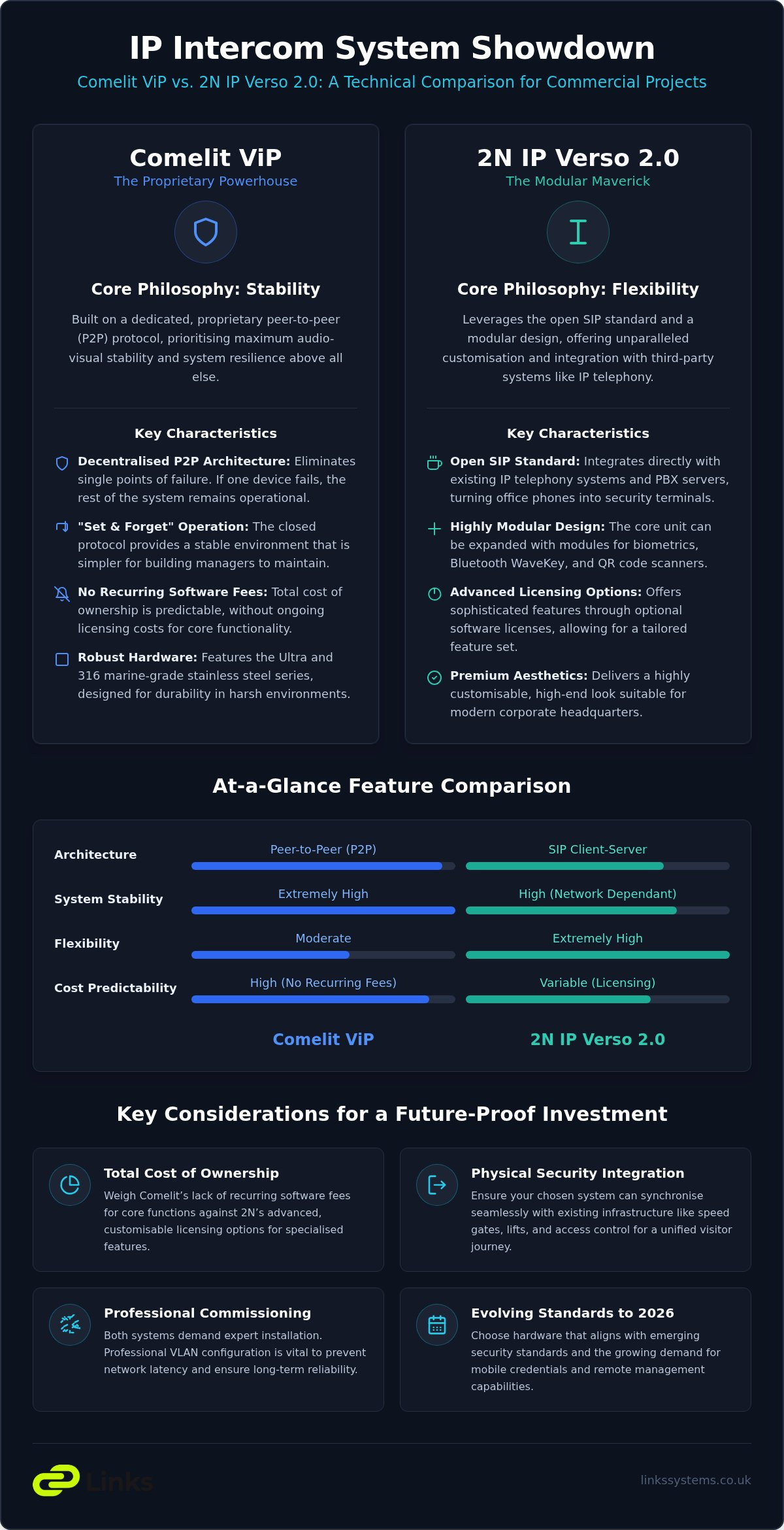
Comelit ViP is built upon a dedicated, proprietary IP protocol designed specifically to maximise audio-visual stability. Whilst some systems rely on generic network standards, the ViP protocol is optimised for the unique demands of real-time video entry. This proprietary nature allows for a peer-to-peer (P2P) architecture, meaning the system functions without the requirement for a vulnerable central server. If a single device on the network encounters an issue, the rest of the ecosystem remains operational, ensuring consistent security for multi-tenant buildings.
The hardware range reflects this focus on durability and professional application:
- Ultra Series: A modular entrance panel that balances modern aesthetics with high-performance internals.
- 316 Series: Constructed from marine-grade stainless steel, these panels are the preferred choice for exposed London sites where environmental resilience is non-negotiable.
This closed-protocol approach provides a layer of stability that is often easier to manage for building managers who prioritise a “set and forget” operational model. By removing the dependency on a central control PC, Comelit reduces the potential for total system failure.
The 2N IP Verso Modular Approach
Where Comelit emphasises protocol stability, the 2N IP Verso 2.0 is defined by its modular flexibility. As part of the Axis family, 2N has engineered a system that adapts to the specific needs of high-end corporate lobbies. The core unit can be expanded with a variety of modules, allowing specifiers to choose exactly which credentials their building will support. This might include biometric fingerprint readers, Bluetooth WaveKey technology, or the latest QR code scanners for temporary visitor access.
A significant advantage of the 2N ecosystem is its adherence to the open SIP standard. This allows the intercom to integrate directly with existing IP telephony systems and PBX servers, turning every office desk phone into a potential security terminal. For many stakeholders, this level of interoperability makes 2N the more flexible choice for complex office environments where communication channels must be unified across different hardware brands. The result is a premium aesthetic combined with a highly customisable user interface that can be tailored to the specific branding and security requirements of a modern corporate headquarters.
Technical Architecture: Proprietary ViP vs Open SIP
The structural integrity of an IP intercom system depends on its underlying communication protocol. When evaluating Comelit VIP vs 2N IP Verso, the most significant technical divergence lies in how data travels across the building’s network. Comelit utilises a decentralised peer-to-peer (P2P) model, whilst 2N adheres to the industry-standard SIP client-server architecture. Both approaches have distinct advantages depending on the project’s IT infrastructure and security requirements.
Both systems require high-quality Cat6 cabling and sufficient PoE (Power over Ethernet) budgets to function at peak performance. However, they manage bandwidth differently. Comelit’s dedicated protocol is engineered to operate alongside other building services without interference. 2N’s SIP model relies on a central server or PBX to route calls, which offers greater flexibility but requires a more robust network backbone to avoid latency. Managing these complex architectures requires more than just basic IT knowledge; it demands a deep understanding of how video packets interact with existing data traffic.
Comelit’s Peer-to-Peer Stability
In large-scale commercial hubs, the P2P architecture of Comelit ViP provides a robust fail-safe. Because every device communicates directly with every other device, there’s no central controller that can bring down the entire system. This decentralised nature eliminates single points of failure, making it ideal for high-density residential blocks or multi-tenant offices. The system maintains high-definition clarity through H.264 compression, which keeps bandwidth consumption low whilst ensuring the video stream remains fluid. It’s a closed ecosystem that prioritises security; by using a dedicated protocol, the video entry traffic is naturally isolated from other network data, reducing the risk of packet loss during peak traffic periods.
2N’s SIP Flexibility and Integration
The 2N IP Verso 2.0 leverages the Session Initiation Protocol (SIP) to act as a native extension of a building’s VoIP network. This allows intercom calls to be handled by existing desk phones or softphone applications, creating a unified communication environment across the entire business. For multi-site deployments, 2N Access Commander serves as a central management tool. This software allows security teams to push firmware updates and manage credentials across hundreds of devices from a single interface. Whilst this requires careful VLAN configuration to ensure voice quality, it offers unparalleled integration with third-party SIP clients and mobile applications. For projects where network reliability is paramount, professional system commissioning ensures that your chosen architecture is configured to meet specific security policies and operational demands.
Commercial Scalability and Total Cost of Ownership
Financial transparency is paramount for M&E contractors and facility managers when specifying visitor management systems. Beyond the initial capital expenditure, the long-term viability of an installation depends on software licensing and hardware resilience. When comparing Comelit VIP vs 2N IP Verso, the total cost of ownership (TCO) over a five or ten-year period often reveals a significant divergence in budgeting requirements. Whilst one system favours a traditional fixed-cost model, the other offers a scalable, feature-rich environment that may involve ongoing investment.
Expanding these systems in the future is a straightforward process for both brands, provided the initial network infrastructure is correctly provisioned. Adding additional monitors or entrance panels involves minimal disruption. However, the commercial implications of these expansions differ. Comelit’s proprietary model generally allows for hardware additions without increasing software overheads. In contrast, the 2N ecosystem often requires additional licenses to unlock advanced functionalities on new devices, making it essential to calculate the full project scope before procurement.
Subscription Fees and Long-Term Budgeting
The “No Recurring Fees” model remains one of the most compelling reasons for choosing Comelit ViP in large-scale commercial developments. Once the system is commissioned, there are typically no mandatory ongoing costs for the core intercom functionality. This predictability is highly valued by developers who wish to hand over a completed building without saddling the management company with escalating software bills.
2N takes a different approach, particularly with the 2N IP Verso 2.0 and its integration with 2N Access Commander 3.7. Whilst basic calling is standard, advanced features like mobile credentials via WaveKey or specific third-party integrations often operate on a licensing structure. For high-end corporate sites that require frequent updates and cloud-based mobile app management, these costs are often viewed as a necessary trade-off for superior flexibility and remote control. Facility managers must decide if the convenience of cloud-based administration justifies the recurring expenditure.
Hardware Durability and Vandal Resistance
London’s urban environment and the unpredictable weather of the Home Counties demand hardware with high IK and IP ratings. Comelit’s 316-grade stainless steel panels offer exceptional resistance to corrosion and physical impact, ensuring the entrance remains professional in appearance for years. This material choice is particularly effective in high-traffic areas where durability is as important as design.
The 2N IP Verso 2.0 utilizes a modular polycarbonate and metal construction that is both robust and aesthetically refined. Whilst the modular nature allows for easy replacement of individual components, it requires regular maintenance to ensure seals remain intact against driving rain. Keeping these high-end finishes looking professional requires a structured maintenance programme, especially for units featuring touchscreens or biometric sensors. Choosing the right materials at the specification stage prevents the need for costly hardware replacements before the system reaches the end of its natural lifecycle.
Integrating Intercoms with Physical Security Infrastructure
The effectiveness of a modern visitor management strategy depends on how well the intercom communicates with physical barriers. In a high-traffic London lobby, the intercom serves as the primary interface for commercial speed gates and barriers. It isn’t merely a communication tool; it’s a critical logic controller. When comparing Comelit VIP vs 2N IP Verso, the focus must extend to how these devices handle secure protocols like OSDP or Wiegand. This ensures the command to open a barrier cannot be intercepted or spoofed by unauthorised parties.
OSDP (Open Supervised Device Protocol) is the preferred standard for 2026 installations due to its bi-directional communication and high-level encryption. Whilst Wiegand remains common in legacy systems, it lacks the security features required for modern skyscrapers. Both Comelit and 2N support these interfaces, but the configuration must be handled with precision to avoid communication errors between the intercom and the barrier controller. Achieving this level of technical synergy is what distinguishes a professional security stack from a basic installation.
Visitor Management and Speed Gate Integration
Streamlining the visitor journey from the external gate to the internal lobby requires a unified approach. The 2N IP Verso 2.0, equipped with its ARTPEC-7 processor, excels at reading QR codes directly from a visitor’s smartphone. This allows a guest to present a pre-authorised code to the intercom, which then triggers the speed gate for immediate entry. Comelit ViP systems offer similar efficiency through their integration with third-party access control. They ensure audio-visual clarity remains high to prevent reception bottlenecks during peak hours. Coordinating the aesthetic of these panels with the architectural finishes of your lobby speed gates is essential for maintaining a premium corporate identity.
Linking with IP CCTV and Building Management
Security professionals increasingly prioritise integrating CCTV with access control systems to create a comprehensive audit trail. Both Comelit and 2N allow for intercom events to be recorded by the building’s NVR, providing a visual record of every person who requests entry. This integration ensures that intercom calls are integrated with access control systems. It allows for automated responses such as triggering lift calls or activating floor-specific lighting upon a successful entry. High-level security audits require this level of granularity to monitor the full lifecycle of a visitor’s presence on-site. For complex projects where these disparate systems must work in unison, our specialist commissioning team ensures every relay and network packet is correctly configured for maximum reliability.
Professional Commissioning and Preventative Maintenance
The successful deployment of a high-end intercom system depends on the distinction between a standard electrical installation and professional system commissioning. Whilst a contractor can physically mount hardware and pull Cat6 cabling, the operational integrity of an IP-based solution requires a specialist to configure the software layer. When evaluating Comelit VIP vs 2N IP Verso, the complexity of the network environment dictates the level of expertise required. Without precise IP addressing and the implementation of dedicated VLANs (Virtual Local Area Networks), video packets may compete with other data traffic, resulting in unacceptable latency or dropped calls.
A methodical approach to commissioning ensures that the intercom doesn’t just function, but excels within the building’s wider ecosystem. This process involves more than just verifying a connection. It’s about optimising the communication pathways between entrance panels, internal monitors, and mobile applications to ensure a seamless user experience. Links Integrated Systems leverages over 40 years of industry heritage to manage these complex technical requirements, providing the steady hand needed for London’s most demanding commercial projects.
The Critical Role of System Commissioning
Commissioning is the phase where a collection of hardware becomes a functional security asset. For multi-tenant offices, this involves configuring extensive user directories and defining specific access levels for different zones. Testing network latency is a non-negotiable step; video entry systems require high-speed packet delivery to maintain audio-visual synchronisation. A professional handover also includes comprehensive training for building security staff and facility managers. This ensures they can manage the system effectively, from updating tenant names to reviewing entry logs, without requiring constant external support.
Preventative Maintenance for Commercial Sites
High-end IP hardware represents a significant capital investment that must be protected through regular preventative maintenance. The Comelit VIP vs 2N IP Verso choice will influence your maintenance schedule. 2N’s open-protocol nature requires frequent firmware updates to patch security vulnerabilities and maintain compatibility with evolving SIP standards. Comelit’s proprietary system requires periodic checks to ensure peer-to-peer communication remains stable across all devices.
Physical inspections are equally vital in the exposed environments of London and the South East. Engineers must check weather seals, tighten fixings, and clean camera lenses to prevent environmental degradation. Remote diagnostics now allow us to identify potential hardware failures or network bottlenecks before they result in system downtime. This proactive service model prioritises long-term reliability over reactive repairs, ensuring that your visitor management system remains a dependable pillar of your building’s security infrastructure for its entire lifecycle.
Selecting a Future-Proof Intercom Specification
Deciding on the right visitor management system requires a balance between the peer-to-peer stability of Comelit and the modular SIP flexibility of 2N. Whilst hardware aesthetics initially catch the eye, the long-term success of the project rests on the technical architecture and its ability to integrate with speed gates and wider access control. This Comelit VIP vs 2N IP Verso comparison highlights that neither system is a universal solution; instead, the choice should be dictated by your building’s specific IT infrastructure and operational goals.
Achieving a seamless, lag-free visitor experience demands more than a basic installation. It requires the precision of expert commissioning and a methodical approach to network configuration. With 40 years of experience in high-security environments, Links Integrated Systems provides specialist commissioning across London and the South East. We ensure your IP hardware is correctly synchronised with physical security barriers to provide a robust audit trail and lasting reliability. Request a professional intercom specification for your commercial project to ensure your building remains secure and efficient for years to come.
Frequently Asked Questions
Does the Comelit ViP system require a monthly subscription fee for mobile app use?
The Comelit ViP system is specifically designed to eliminate hidden recurring costs, meaning there is typically no monthly subscription fee for the MyComelit mobile app. This makes it an attractive option for developers in London and the South East who want to avoid long-term operational overheads. The system utilises your building’s existing internet connection to route calls to smartphones, providing a reliable and cost-effective visitor management solution without the burden of ongoing software licenses.
Can I use existing Cat5e cabling for a 2N IP Verso installation?
Whilst Cat5e cabling is technically capable of handling the data requirements for a 2N IP Verso installation, we generally recommend Cat6 for new commercial projects. Cat6 provides better shielding and higher bandwidth capacity, which is essential for maintaining audio-visual clarity in high-traffic environments. If you are retrofitting an existing building in Surrey or Kent, our commissioning team will test your current cabling for latency and packet loss before finalising the system specification.
Which system is better for a high-rise office building with over 100 tenants?
For high-rise developments with over 100 tenants, the Comelit VIP vs 2N IP Verso debate often leans towards Comelit due to its peer-to-peer stability. This architecture ensures that even in a high-density office block, the failure of one unit doesn’t disrupt the entire network. However, if the building requires deep integration with a complex VoIP phone system, 2N’s SIP-based flexibility might be more appropriate. A professional site assessment is necessary to determine the best fit.
Can Comelit ViP and 2N IP Verso integrate with my existing speed gates?
Both systems are designed to integrate seamlessly with commercial speed gates and barriers. By utilising secure OSDP or Wiegand interfaces, the intercom acts as the primary controller for guest access. For example, a 2N IP Verso can read a visitor’s QR code and immediately trigger the lobby barrier, whilst a Comelit system can manage access through a dedicated relay. Our team specialises in the professional commissioning required to ensure these disparate hardware components communicate without error.
What happens to the intercom system if the building’s local network fails?
If the building’s local network fails, the impact depends on the system architecture. Comelit ViP’s peer-to-peer structure allows internal devices to continue communicating directly with each other, provided the local switches have power. In contrast, a 2N IP Verso system that relies on a central SIP server or PBX may lose functionality until the network is restored. We always recommend installing a robust, redundant network infrastructure with uninterruptible power supplies for critical commercial security systems.
Is it possible to use biometric access modules with the 2N IP Verso?
Yes, the 2N IP Verso 2.0 is highly modular and supports advanced biometric access modules, including fingerprint readers and facial recognition technology. This allows facility managers in high-security environments, such as London financial hubs, to implement multi-factor authentication at the point of entry. These modules are hot-swappable and can be added to the system at any time, providing a future-proof path for buildings that may need to upgrade their security protocols in the future.
Does Comelit ViP support high-definition video for facial recognition?
Comelit ViP supports high-definition video entry, which provides the clarity required for facial recognition software and high-level security auditing. The system uses H.264 compression to deliver fluid, high-resolution imagery without overwhelming the building’s network bandwidth. This makes it suitable for integration with IP HD CCTV systems, allowing security teams to verify the identity of visitors before granting access to sensitive areas. Professional commissioning ensures that the camera settings are optimised for the specific lighting conditions of your lobby.
How often should a commercial IP intercom system undergo professional maintenance?
Commercial IP intercom systems should undergo professional preventative maintenance at least twice a year. High-traffic London sites often face environmental challenges, such as pollution and extreme weather, which can affect hardware longevity. These scheduled visits include firmware updates to patch security vulnerabilities, physical inspections of weather seals, and testing of all integration points with speed gates and access control. Regular maintenance by a specialist contractor is vital for ensuring the system remains compliant and operational throughout its lifecycle.