

Did you know that by March 2027, the long-standing Profile S standard for IP cameras will be retired, making Profile T the essential baseline for any professional specification? For many facility managers, the challenge isn’t just finding a camera; it’s ensuring an ip cctv system for business remains relevant as technology evolves. You’ve likely dealt with the frustration of hardware brands that refuse to communicate or poor image quality that fails when you need it most. It’s a common pain point that undermines the very security you’re trying to build.
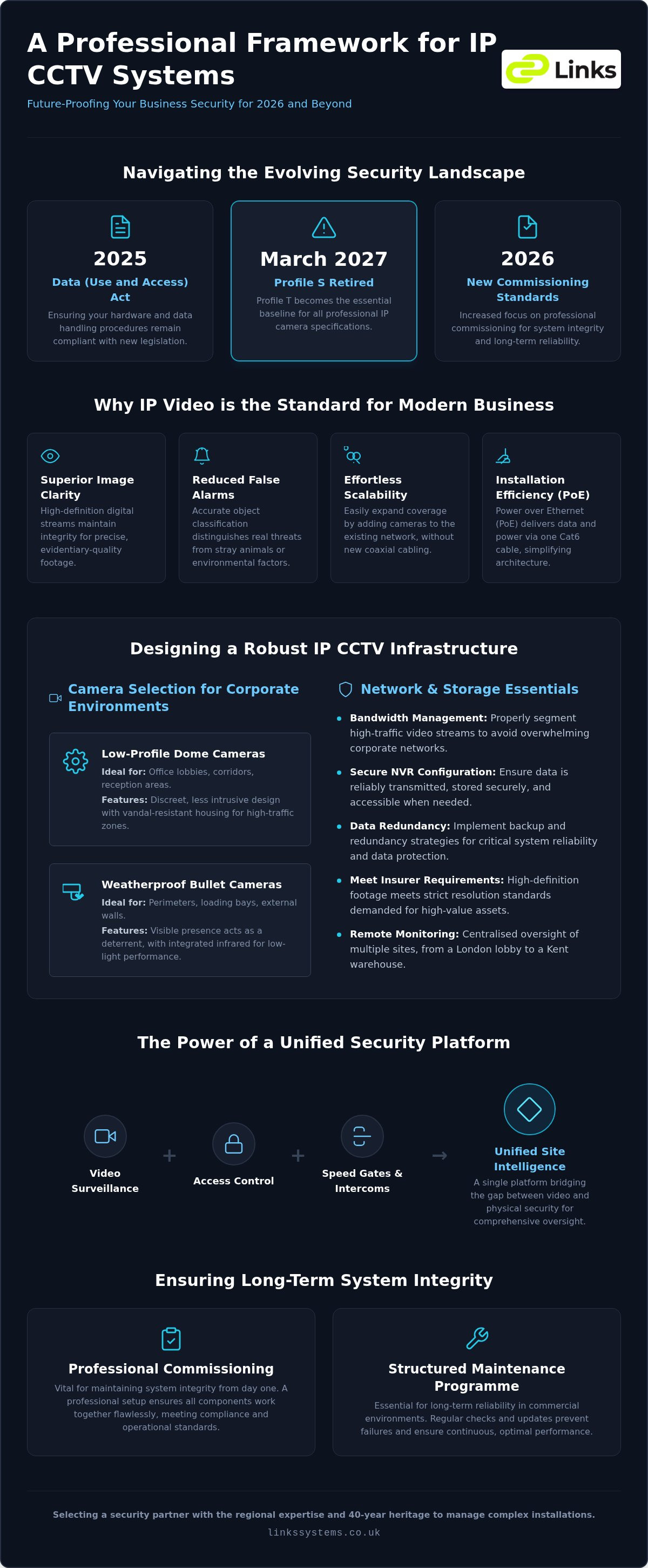
This guide provides a professional specification framework to help you master the complexities of modern IP-based security. We’ll show you how to move beyond standalone silos to create a future-proof infrastructure that integrates seamlessly with access control and speed gates. From navigating the Data (Use and Access) Act 2025 to establishing a rigorous maintenance schedule, we’ll outline the steps needed to achieve long-term reliability and site intelligence. We’ll explore the hardware requirements for high-definition environments and the critical role of professional commissioning in 2026.
Key Takeaways
- Learn how to navigate updated 2026 standards, including the transition to Profile T, ensuring your hardware remains compliant with the Data (Use and Access) Act 2025.
- Understand how to specify an ip cctv system for business that balances high-definition clarity with efficient network storage and secure NVR configurations.
- Discover the operational benefits of a unified platform that bridges the gap between video surveillance and physical access control systems like speed gates and intercoms.
- Identify why professional commissioning and a structured maintenance programme are vital for maintaining system integrity and long-term reliability in commercial environments.
- Gain insights into selecting a security partner with the regional expertise and 40-year heritage required to manage complex installations across London and the South East.
The Evolution of IP CCTV for Business: Beyond Simple Surveillance
Commercial security has moved past the era of grainy, analogue footage stored on local tapes. Today, a professional ip cctv system for business acts as a sophisticated data node within a broader digital ecosystem. It’s no longer just about catching a thief; it’s about site intelligence. Modern video security is an integrated IP network that provides real-time visibility across complex environments. This transition from analogue to High Definition (HD) IP systems has redefined what project managers expect from their infrastructure.
Off-the-shelf surveillance kits often fail to meet the rigorous demands of professional environments. These consumer-grade solutions lack the bandwidth management, low-light performance, and cyber-resilience required for corporate liability protection. In 2026, video security plays a multi-faceted role. It’s a tool for site management, health and safety monitoring, and a robust defence against fraudulent insurance claims. A well-specified system provides the peace of mind that every corner of a facility is accounted for, regardless of the lighting conditions or time of day.
Why IP Video is the Standard for Modern Business
The primary advantage of IP technology is the superior image clarity it offers for evidentiary purposes. Unlike analogue signals that degrade over distance, digital streams maintain their integrity from the lens to the recorder. This ensures that facial features or vehicle registrations are captured with precision. Scalability is another critical factor. Because these systems run on standard network protocols, expanding your coverage is a matter of adding nodes to the existing network rather than laying miles of new coaxial cabling.
Power over Ethernet (PoE) has also revolutionised installation efficiency. By delivering both data and power through a single Cat6 cable, the need for local power outlets at every camera position is eliminated. This reduces the physical footprint of the installation and simplifies the overall system architecture, making it easier to maintain over its lifecycle.
The Business Case for High-Definition Infrastructure
Investing in HD infrastructure is a strategic decision that supports operational efficiency. When specifying an ip cctv system for business, high-resolution sensors significantly reduce false alarms by allowing for more accurate object classification. When your system can distinguish between a person and a stray animal, your security team can focus on genuine threats. This precision is essential for meeting the strict requirements of UK insurers, who often demand specific resolution standards for high-value commercial assets.
Remote monitoring capabilities also allow stakeholders to oversee multiple sites from a central location. Whether you’re managing a corporate lobby in London or a warehouse in Kent, the ability to access high-quality live feeds ensures that operational standards are maintained across the board. This level of oversight is a key component of modern site management and risk mitigation.
Designing a Robust IP CCTV Infrastructure: Cameras, Storage, and Networks
A professional ip cctv system for business is only as reliable as the network backbone supporting it. While high-definition lenses capture the detail, the infrastructure ensures that data is transmitted, stored, and accessible when needed. Designing this environment requires a precise balance of hardware selection, bandwidth management, and data redundancy. In 2026, a robust specification must account for high-traffic video streams that can easily overwhelm standard corporate networks if not properly segmented.
Camera Selection for Corporate Environments
Matching the specific camera form factor to the environment is essential for both operational efficiency and aesthetics. We recommend a tiered approach based on the area of coverage:
- Low-profile dome cameras: These are the preferred choice for office lobbies, corridors, and reception areas. Their discreet design is less intrusive for staff and visitors, whilst the vandal-resistant housing provides protection in high-traffic zones.
- Weatherproof bullet cameras: Designed with a visible presence, these act as a deterrent for perimeters and loading bays. Their integrated infrared (IR) capabilities are vital for maintaining image quality in low-light commercial yards.
- Pan-Tilt-Zoom (PTZ) cameras: For large exterior spaces or car parks, PTZ units allow security teams to actively monitor and track movement across wide areas. Modern PTZ cameras in 2026 often include automated guard tours to ensure comprehensive site coverage.
Storage and Data Management Strategies
Data integrity is the foundation of any security specification. In the UK, whilst there is no single fixed retention period, a 30-day window remains the practical default for most commercial applications. Calculating storage requirements for an ip cctv system for business involves assessing frame rates, resolution, and the number of active streams. A single 4K camera running at 25 frames per second can generate significant data, requiring high-capacity Network Video Recorders (NVRs) with RAID redundancy to protect against drive failure.
Many organisations now favour a hybrid cloud approach. This model keeps primary footage on-site for immediate access whilst backing up critical events to secure, UK-based cloud servers. This ensures that even in the event of hardware theft or damage, the evidence remains secure. For those overseeing complex site requirements, professional system maintenance and commissioning ensures these storage components function as a unified, dependable whole.
The final layer of the infrastructure is the Video Management Software (VMS). This interface allows security professionals to organise feeds, set up motion alerts, and review footage efficiently. When specifying a VMS, ensure it meets ONVIF Profile T standards to guarantee interoperability between different hardware brands. This future-proofs the system, allowing for easier upgrades as newer camera technologies emerge in the coming years.
The Power of Integration: Linking Video Security with Physical Access Control
Integration is the bridge between simple observation and active site management. An ip cctv system for business reaches its full potential when it’s synchronised with physical security layers. By linking video streams to access events, you create a unified platform that provides context to every entry and exit. This prevents the “silo effect” where security teams must cross-reference different logs to understand an incident. In a modern professional environment, a camera should do more than record; it should validate the actions of your access control system.
Streamlining Visitor Access with IP Intercoms
High-definition IP intercoms serve as the digital gatekeeper for modern offices, particularly in high-traffic London commercial centres. Unlike traditional analogue systems, these units provide clear visual verification of visitors before entry is granted. When integrated into the central VMS, the intercom camera becomes part of the wider surveillance grid. This allows reception staff or facility managers to verify identities via mobile apps or desktop consoles, ensuring that only authorised personnel proceed past the primary entry point. It’s a proactive model that combines communication with visual proof.
Video Verification for Physical Barriers
CCTV plays a critical role in monitoring commercial speed gates and barriers. Integrated analytics can now detect tailgating in real-time, triggering an alert if a second individual attempts to follow an authorised user through a gate. This provides a visual audit trail for every barrier activation. If a speed gate is forced or an access denial occurs, the ip cctv system for business can automatically bookmark the relevant video footage. This allows for immediate review by security personnel without the need for manual searching through hours of recordings.
The Benefits of Integrated Systems
Centralising these security layers into a single interface significantly reduces response times during incidents. When an alarm triggers at a secure door, the nearest camera can automatically populate the operator’s monitor, providing instant situational awareness. This level of coordination is essential for maintaining the integrity of professional environments where precision and speed are paramount. Managing multiple security layers from a single pane of glass simplifies training and reduces the risk of human error. For a deeper look at the technical requirements of these setups, see our guide on integrating CCTV with access control systems.
Professional Commissioning and Maintenance: Ensuring Long-Term System Integrity
Professional commissioning is the technical bridge between a physical installation and a high-performance security asset. It’s often the most overlooked stage of a project. Without rigorous technical alignment, even the most expensive hardware will underperform. For an ip cctv system for business, commissioning involves much more than checking if a picture appears on a monitor. It’s about ensuring the network can handle the throughput of multiple high-definition streams without causing latency in other business operations.
A proactive approach to maintenance prevents the slow degradation of image quality and system responsiveness. We view maintenance not as an optional service, but as a technical necessity for hardware longevity. In 2026, the complexity of IP-based security means that a “set and forget” mentality creates significant vulnerabilities, both in physical coverage and network security. Reliability is built through consistent, methodical oversight.
The Commissioning Process for New Installations
The process begins with network optimisation. We ensure that video traffic is segmented from general office data, preventing bandwidth bottlenecks that could lead to dropped frames or stuttering video. Technicians then configure motion detection zones and AI analytics to match the specific environment. This calibration reduces false triggers from shadows or swaying trees, ensuring that alerts are meaningful. A final system stress test simulates peak network load to verify stability before the formal handover to the client.
Planned Preventative Maintenance (PPM)
A reactive approach to security hardware often leads to failure at critical moments. A structured PPM programme is essential for the longevity of an ip cctv system for business. This involves deep-level technical checks rather than a cursory glance at the monitors. Key tasks include:
- Lens Integrity: Cleaning and re-focusing lenses to maintain HD clarity, ensuring that environmental build-up doesn’t compromise evidentiary detail.
- Power Infrastructure: Testing cable integrity and Power over Ethernet (PoE) stability to prevent intermittent camera failures or reboots.
- Storage Health: Reviewing NVR performance and checking for early signs of storage drive degradation, which is vital for meeting data retention requirements.
System security in 2026 also relies heavily on firmware management. Manufacturers regularly release patches to address emerging cyber-vulnerabilities and improve hardware performance. A professional partner ensures these updates are applied systematically, protecting the IP network from unauthorised access. This methodical care maintains the integrity of your data and the physical security of your premises. To ensure your security infrastructure remains dependable, consider our professional system maintenance and commissioning services, tailored for complex commercial environments.
Specifying Your Security Partner in London and the South East
Selecting a partner for an ip cctv system for business requires more than just a review of hardware specifications. It requires a deep understanding of the local environment and a commitment to long-term stability. With 40 years of industry experience, we’ve seen security technology evolve from simple analogue loops to the complex, integrated IP networks of 2026. This heritage isn’t just a number; it’s a foundation of technical knowledge that ensures we can handle the most demanding commercial requirements across London, Kent, Surrey, Hertfordshire, and Essex.
A bespoke design approach is essential because no two commercial buildings are identical. A modern office lobby in Central London presents different challenges compared to a logistics centre in Essex. By prioritising a tailored consultation, we ensure that every camera position, network switch, and storage server is optimised for the specific site. This precision extends to compliance with British Standards and Secured by Design principles, providing the peace of mind that your infrastructure meets the highest professional benchmarks.
Navigating Compliance and Regulations in the UK
Compliance in 2026 is a dynamic field. The Data (Use and Access) Act 2025 has updated the UK’s data protection framework, making it vital for businesses to review their surveillance policies. Adhering to the Information Commissioner’s Office (ICO) guidance and the Surveillance Camera Commissioner’s Code of Practice is a legal necessity, not a suggestion. Every ip cctv system for business must be supported by a Data Protection Impact Assessment (DPIA) and clear, compliant signage to remain on the right side of the law.
We also ensure that your installation aligns with modern building standards. This includes how physical security integration balances safety with operational efficiency. By following these rigorous standards, we protect your organisation from the legal and reputational risks associated with non-compliant video surveillance. It’s about creating a system that is as legally robust as it is technically advanced.
The Links Integrated Systems Difference
Our role as a specialist contractor is to act as a steady, experienced guide through the lifecycle of your project. We specialise in professional environments where the “Link” between video and access control is critical for security integrity. Our team focuses on the South East, providing the local responsiveness that global providers often lack. From the initial site survey to the final commissioning and ongoing maintenance, we provide a proactive service model that prioritises your site’s intelligence.
Whether you’re managing a corporate lobby or a high-security perimeter, our expertise in HD IP video systems ensures a reliable outcome. We invite project managers and stakeholders to contact our team for a tailored consultation. Let’s build a security infrastructure that’s as stable and dependable as our 40-year history in the industry.
Future-Proofing Your Commercial Security Infrastructure
Specifying a modern ip cctv system for business is an investment in long-term site intelligence. The transition to high-definition IP networks allows for seamless integration with physical barriers and intercoms, creating a unified security layer that protects both assets and personnel. By focusing on robust infrastructure and adhering to the latest 2026 compliance standards, project managers can ensure their systems remain relevant as technology continues to evolve.
Reliability isn’t achieved by chance; it’s the result of meticulous planning and professional commissioning. With 40 years of expertise in integrated security, Links Integrated Systems provides the steady hand needed to navigate complex technical requirements across London and the South East. We guarantee that every installation is supported by a rigorous maintenance programme to ensure ongoing system integrity. Discuss your commercial video security requirements with our specialist team today. We look forward to helping you build a secure and dependable environment.
Frequently Asked Questions
What is the difference between analogue and IP video security systems?
IP systems transmit digital data over a network, whilst analogue systems use coaxial cables and DVRs. IP technology offers significantly higher resolution, often exceeding 4K, and allows for Power over Ethernet (PoE) installation. This makes an ip cctv system for business more scalable and capable of advanced analytics at the edge. Analogue systems lack the bandwidth for modern high-definition requirements and the ability to provide integrated site intelligence.
How long is CCTV footage typically stored for commercial businesses?
Most UK commercial businesses adopt a 30-day retention period as a practical default for routine footage. Whilst there isn’t a single law specifying a fixed duration, the Data Protection Act requires that footage is only kept for as long as is necessary for its purpose. You must justify longer retention periods, such as for ongoing legal proceedings or insurance investigations, within your Data Protection Impact Assessment (DPIA) to remain compliant.
Can I integrate my existing access control with a new IP CCTV system?
Yes, modern IP systems are designed for interoperability, particularly those adhering to ONVIF Profile T standards. We can bridge the gap between your video surveillance and physical access control layers, such as speed gates and barriers. This allows your security team to view live video alongside access events. It provides a visual audit trail for every entry or denial, which significantly improves situational awareness across your premises.
What are the legal requirements for commercial CCTV in the UK?
UK businesses must comply with the Data (Use and Access) Act 2025 and the UK GDPR. Key requirements include displaying clear signage, paying the ICO data protection fee, and conducting a Data Protection Impact Assessment (DPIA). You must also ensure your ip cctv system for business respects the privacy of individuals. Footage must be stored securely with restricted access to authorised personnel only to meet professional and legal standards.
How often should a commercial video security system be maintained?
We recommend a professional maintenance visit at least twice a year for commercial environments. These scheduled inspections ensure that lenses remain focused, cable integrity is maintained, and firmware is updated to protect against cyber-vulnerabilities. High-traffic areas, such as London office lobbies or loading bays, may require more frequent checks to clear environmental build-up. This ensures that motion detection zones and AI analytics remain accurately calibrated.
What is professional system commissioning and why do I need it?
Commissioning is the technical process of verifying that every component of your security system is configured to its optimal performance. This involves network segmentation to prevent bandwidth bottlenecks, stress testing the NVR storage, and fine-tuning AI analytics. Professional commissioning ensures the system meets the specific operational requirements of your site before the final handover. It guarantees the long-term reliability and evidentiary quality required in professional commercial environments.
Are wireless security cameras suitable for large commercial buildings?
Wireless cameras are generally unsuitable for large-scale commercial applications due to signal interference and bandwidth limitations. Professional IP systems rely on wired PoE connections to ensure a stable, high-speed data stream that can handle high-definition video without interruption. Wired infrastructure provides the reliability and security required for corporate environments. Wireless signals can be easily jammed or experience latency in complex buildings, making them a less dependable choice.
How does an IP video intercom improve my building security?
An IP video intercom acts as a visual gatekeeper, allowing staff to verify the identity of visitors before granting entry. By integrating the intercom audio and video into your central management software, you create a seamless visitor management process. This prevents unauthorised access at the primary entry point and provides a high-definition recording of every visitor interaction. It’s a critical component for lobby security and maintaining a clear audit trail.