

A sophisticated commercial security strategy is no longer just a collection of cameras and locks; it’s a critical infrastructure project that demands meticulous planning. You’ve likely seen systems that look impressive on paper but fail to communicate when it matters most, leading to hardware conflicts and security lapses during peak operational hours. Achieving a successful integrated physical security system installation requires moving beyond simple hardware procurement and into a realm of expert commissioning and precise technical specification.
We understand that managing complex technical requirements across large-scale developments is a significant undertaking, especially when reliability is non-negotiable. This 2026 guide provides a comprehensive framework for specifying and installing integrated systems that meet current UK building standards and NSI technical codes. We’ll examine the end-to-end process of creating a seamless infrastructure, from initial design to long-term maintenance. This ensures your business remains secure and compliant whilst avoiding the common pitfalls of poor integration between IP HD CCTV, speed gates, and access control hardware.
Key Takeaways
- Understand why transitioning to IP-based hardware is essential for achieving the high-definition surveillance and system scalability required for modern commercial developments.
- Learn how to execute a successful integrated physical security system installation by aligning surveillance, access control, and intercom systems into a unified infrastructure.
- Discover how to manage high-volume pedestrian traffic in London office complexes using high-performance speed gates and barriers without compromising security or flow.
- Explore the critical role of technical commissioning in preventing hardware conflicts and ensuring total compliance with the latest UK commercial building standards.
- Identify the operational advantages of partnering with a specialist who provides end-to-end support, from initial project specification through to long-term system maintenance.
What is Professional Commercial Security System Installation?
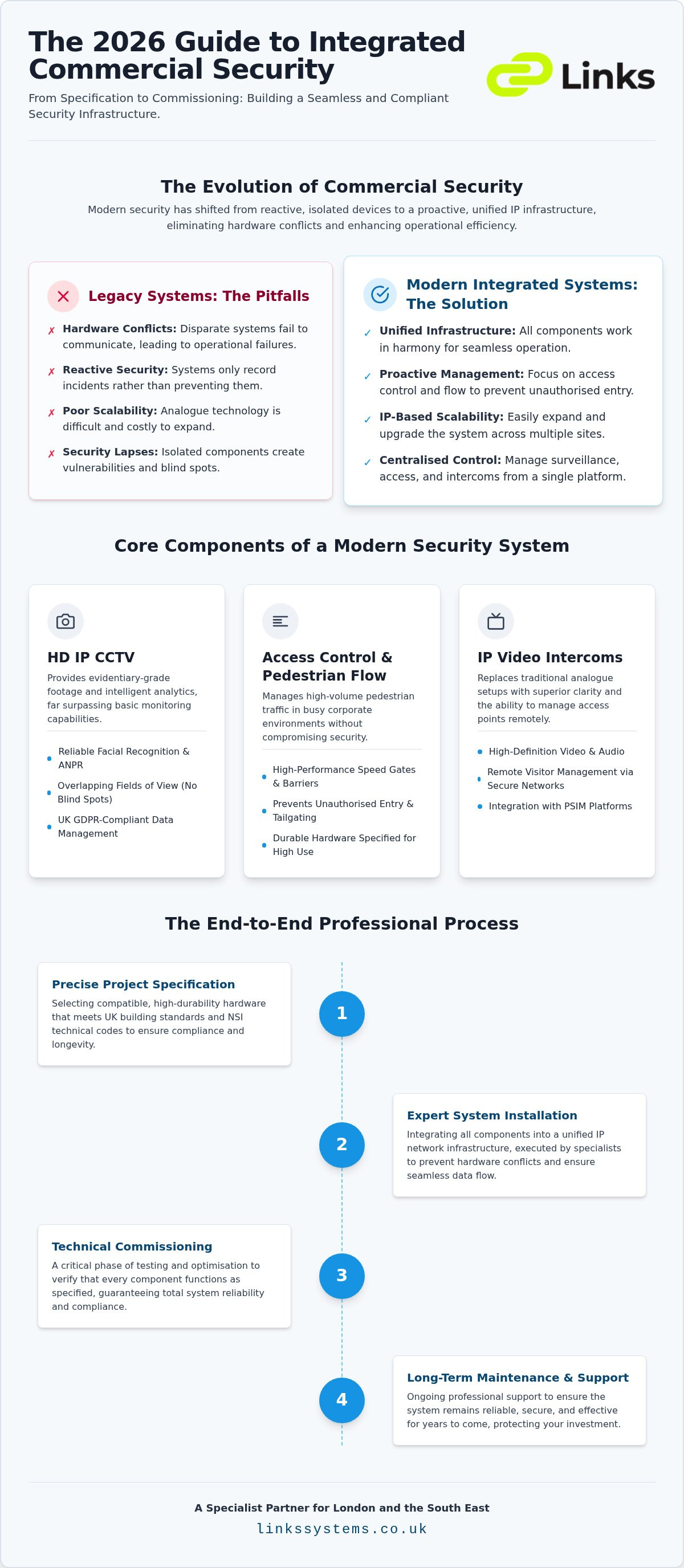
Professional commercial security installation is a sophisticated infrastructure project designed specifically for high-traffic environments. It’s no longer sufficient to view security as a series of standalone devices; instead, it’s a unified network that protects assets and manages the movement of people. For facility managers, developers, and corporate security leads, an integrated physical security system installation is a foundational element of site design. This approach ensures that every component, from surveillance to entry management, works in harmony to provide a reliable environment for staff and visitors alike.
The industry has seen a decisive shift from reactive security to proactive management. Rather than simply recording incidents, modern systems focus on pedestrian flow and access control to prevent unauthorised entry before it occurs. This transition requires a deep understanding of how modern business environments operate, particularly in high-density urban centres where efficiency is as vital as safety.
The Shift Towards Integrated IP Infrastructure
Modern systems must be IP-based to provide the scalability and high-definition output required in 2026. IP video intercom systems have replaced traditional analogue setups because they offer superior clarity and the ability to manage access points remotely via secure networks. In regions like London and Kent, where commercial sites are often spread across multiple buildings, data-driven security allows for centralised control. This level of connectivity supports the use of Physical Security Information Management (PSIM) platforms, which collect and correlate events from different security devices. IP security infrastructure is the backbone of modern site management.
Why Specifying the Right Hardware Matters in 2026
While software provides the intelligence, the longevity of a system depends on the quality of its physical hardware. Components like speed gates and barriers are subject to constant mechanical stress in busy corporate lobbies; they must be specified for durability to ensure a return on investment. It’s essential to choose hardware that meets specific UK commercial standards and building regulations to ensure long-term compliance and insurance validity. Professional installers are vital in this process, as they possess the technical expertise to select compatible components amongst various manufacturers. This avoids the common issue of hardware conflicts that can arise when disparate systems are forced together. By focusing on robust, high-specification hardware, businesses protect their infrastructure and ensure the system remains reliable for years to come.
Core Components of a Modern Commercial Security System
A robust integrated physical security system installation rests on three fundamental pillars: high-definition surveillance, intelligent access control, and IP-based intercoms. In 2026, these are no longer treated as isolated silos; they constitute a unified security posture that protects both physical assets and personnel. High-definition IP systems provide the evidentiary-grade footage necessary for legal and insurance compliance, offering clarity that analogue systems simply cannot deliver. This comprehensive approach aligns with international best practices for infrastructure protection, such as those detailed in CISA Physical Security Resources, which emphasise the importance of layered security in modern commercial environments.
HD IP CCTV: More Than Just Surveillance
Modern HD IP cameras offer technical advantages that go far beyond basic monitoring. They provide the pixel density required for reliable facial recognition and Automatic Number Plate Recognition (ANPR), which are essential for high-security sites. This is particularly vital for commercial buildings in Surrey and Hertfordshire, where larger perimeters often include multiple vehicle access points. Effective placement strategies involve more than just mounting a camera; they require overlapping fields of view to eliminate blind spots and ensure total site coverage. IP-based video storage also allows for more efficient data management and retrieval. It ensures your business remains compliant with UK GDPR whilst providing a clear and accessible audit trail if an incident occurs.
IP Video Intercoms and Visitor Management
IP video intercoms serve as the primary tool for visitor management in modern office lobbies and receptions. They’re often the first point of contact for external contractors and clients, making high-quality hardware essential for maintaining a professional corporate appearance in major business centres. These systems don’t just facilitate communication; they manage pedestrian entry by verifying identities before any access is granted. By integrating CCTV with access control systems, security teams can visually confirm a visitor’s identity and grant entry from a centralised dashboard. This seamless interaction reduces friction for invited guests while keeping the building secure.
Combining these pillars creates a security environment that is both welcoming for staff and formidable against unauthorised access. Professional commissioning ensures that the data from your intercoms triggers the correct cameras and unlocks the right doors without technical lag or hardware conflicts. If you’re looking to upgrade your building’s infrastructure, consulting with specialists in integrated security systems ensures that your hardware is both future-proof and fully compliant with current UK standards.
Optimising Pedestrian Flow with Speed Gates and Barriers
Speed gates have become a standard requirement for skyscrapers and large office complexes across London. The primary challenge for facility managers is balancing high-level security with the need to maintain efficient pedestrian flow during peak hours. Unlike traditional tripod turnstiles, which can appear dated and create a sense of friction, modern speed gates encourage positive user behaviour and reflect a building’s professional status. They offer a more welcoming entrance whilst clearly defining the boundary between public and private space. When planning an integrated physical security system installation, these barriers serve as the physical enforcement of your access control policies, ensuring that only authorised individuals proceed beyond the reception area without hindering the movement of staff.
Selecting the Right Speed Gate for Your Lobby
Choosing the correct hardware involves evaluating the specific needs of your environment. Optical gates provide a sleek, barrier-free look for lower-risk areas, whilst swing-arm and sliding glass models offer a more visible physical deterrent. It’s vital to match the hardware finish to the building’s interior colour palette and architectural style to ensure the security infrastructure complements the design. When specifying speed gates for busy London hubs, consider the following checklist:
- Peak traffic capacity: Can the lane handle 35-40 people per minute to prevent lobby congestion?
- Tailgating detection: Does the system utilise infrared sensors to prevent unauthorised follow-through?
- Safety integration: Is there a fail-safe link to the building’s fire alarm system for emergency egress?
For detailed technical parameters and architectural options, refer to our 2026 specification guide for professional speed gates. Selecting the right model ensures that your security measures remain effective without becoming an operational bottleneck.
Vehicle Barriers for Secure Commercial Perimeters
Securing the perimeter is equally important for sites in Essex and Kent, where car parks and loading bays require managed access. Automated barriers integrated with ANPR-enabled IP CCTV systems allow for a seamless entry process for registered staff and delivery vehicles. This level of coordination follows the Interagency Security Committee best practices for planning and managing physical security resources. The hardware used in these external environments must be exceptionally durable, featuring corrosion-resistant coatings to ensure long-term reliability in the UK climate. A comprehensive integrated physical security system installation should also extend to the perimeter to provide early detection of unauthorised vehicles. By connecting these barriers to a centralised management platform, security teams can monitor vehicle movements in real-time, significantly enhancing the overall security posture of the site.
The Critical Role of Professional Commissioning and Maintenance
Commissioning is the final, rigorous technical verification of the entire integrated physical security system installation. It is the stage where individual components, such as speed gates, HD CCTV, and intercoms, are tested as a unified network to ensure they function as a single, cohesive entity. This process is vital for physical security integration in commercial buildings because it confirms that software triggers and hardware responses align perfectly. Installers who skip this deep-level verification often leave behind systems prone to hardware conflicts or delayed response times. In high-stakes environments, these failures aren’t just inconvenient; they represent a significant breach of site integrity.
What to Expect During the Commissioning Phase
During this phase, technicians follow strict testing protocols to validate IP network stability and hardware response times. They verify failover mechanisms to ensure the system remains operational even during network interruptions. Maintaining data integrity across the entire infrastructure is a priority, ensuring that encrypted signals between readers and servers aren’t compromised. Once completed, a comprehensive commissioning report is issued to the client. This document serves as a formal record of compliance for project managers and facility leads, proving the system meets the specified technical and safety standards. It provides the documentation required for insurance purposes and building handover protocols.
Maintenance Strategies for Long-Term Reliability
Reliability in high-use environments depends on a shift from reactive repairs to proactive maintenance. While reactive fixes address failures after they occur, a structured maintenance contract ensures that mechanical components like speed gates and barriers are serviced before wear leads to downtime. Regular servicing significantly extends the operational life of HD cameras and barriers, protecting the initial capital investment. For modern infrastructure, this includes specific protocols for maintaining cloud-based access control systems for business, such as verifying firmware updates and secure connectivity. These updates often include critical security patches that protect the system from evolving digital threats.
A well-maintained system provides the peace of mind that comes from knowing your security infrastructure is consistently reliable. Scheduled inspections prevent the small technical glitches that can lead to total system failure during peak operational hours. If you require a partner to oversee the technical lifecycle of your security assets, our team provides expert system maintenance and commissioning services across London and the Home Counties.
Choosing a Specialist Security Partner in London and the South East
Selecting the right partner for an integrated physical security system installation is a decision that impacts the long-term stability of your building’s infrastructure. In a sector where technical requirements are increasingly complex, a provider with a 40-year heritage offers a level of professional assurance that newer firms cannot match. This depth of experience is particularly relevant when managing large-scale commercial developments that require precise technical coordination across multiple security layers. Positioning your project with a steady, experienced hand ensures that complex technical requirements are handled with precision from the outset.
Local knowledge of London and the Home Counties, including Kent, Surrey, Hertfordshire, and Essex, is vital for effective logistical planning. Understanding the specific challenges of urban installation, from site access restrictions to local building regulations, ensures that projects remain on schedule. A specialist contractor who focuses exclusively on commercial environments understands the nuances of corporate site management. This ensures that security measures enhance rather than hinder daily operations, providing peace of mind for high-level stakeholders and project managers alike.
Evaluating Security Companies: A Professional Checklist
When reviewing potential partners, project managers should look beyond basic certification and assess specific technical competencies. A professional evaluation should prioritise the following criteria:
- IP System Expertise: Does the team demonstrate a deep understanding of network-based security architecture and data management?
- Speed Gate Track Record: Can they provide evidence of successful installations in high-traffic corporate lobbies?
- Collaborative Approach: Do they work closely with facility managers and architects during the design phase to ensure aesthetic and functional alignment?
- Commercial References: Are they able to provide verified case studies from similar large-scale projects in the South East?
The Links Integrated Systems Approach
Links Integrated Systems projects the image of an authoritative expert and a seasoned guide. Our end-to-end service model covers the full lifecycle of a project, from the initial design and technical specification through to final commissioning and long-term maintenance. By focusing on high-quality hardware and meticulous planning, we ensure that your integrated physical security system installation is delivered with minimal disruption to your business operations.
Our methodology prioritises precision at every stage. We don’t simply install equipment; we create a reliable security infrastructure that meets the highest professional standards. This commitment to quality ensures that your investment is protected and your premises remain secure. We invite you to discuss your specific project requirements with a specialist consultant to explore how our 40 years of expertise can support your commercial security goals.
Securing the Future of Your Commercial Infrastructure
Achieving a seamless and reliable security environment requires a shift from viewing security as a simple purchase to treating it as a critical infrastructure project. By prioritising an integrated physical security system installation, you ensure that high-definition surveillance and access control work in total harmony. This strategic approach doesn’t just meet current UK building standards; it provides the operational efficiency needed for high-traffic developments across London and the Home Counties.
With 40 years of specialist industry experience, Links Integrated Systems acts as a steady hand for complex projects. We understand the technical nuances of speed gate and IP CCTV integration, ensuring that every component is meticulously commissioned for long-term reliability. Our team is dedicated to providing the precision and stability your premises require. Contact Links Integrated Systems for professional security commissioning to discuss your specific site requirements. We look forward to helping you build a secure and resilient foundation for your business.
Frequently Asked Questions
What is the difference between a security installer and a commissioning specialist?
A security installer focuses on the physical mounting and wiring of hardware components. In contrast, a commissioning specialist performs the high-level technical verification to ensure an integrated physical security system installation functions as a unified network. They verify data integrity, software triggers, and failover mechanisms. This process is essential for large-scale commercial developments where hardware conflicts must be avoided to ensure total site reliability and compliance with UK standards.
How long does a commercial speed gate installation typically take in London?
A standard installation for a bank of speed gates typically takes between three to five working days, depending on the site’s logistical complexity. This includes the physical floor mounting, cabling, and the initial technical setup. In busy London hubs, we often plan these works during off-peak hours to minimise disruption to staff. Final commissioning usually adds an extra day to ensure the gates communicate correctly with the building’s central access control server.
Can IP CCTV systems be integrated with existing access control hardware?
IP CCTV systems can often be integrated with existing access control hardware, provided the legacy system supports standard communication protocols like ONVIF or has an available API. This allows for visual verification of access events in real-time. However, if the existing hardware is significantly dated, we may recommend a gradual migration to a modern IP-based infrastructure. This ensures data security and high-definition footage retrieval whilst maintaining a unified security posture across the site.
Do I need a maintenance contract for my commercial barriers?
Regular maintenance is essential for commercial barriers and speed gates because they contain complex mechanical components subject to constant use. A proactive maintenance contract ensures that wear and tear is addressed before it leads to system failure. This extends the life of the hardware and ensures that your integrated physical security system installation remains compliant with UK health and safety standards. Proactive servicing is far more cost-effective than reactive, emergency repairs.
What are the legal requirements for CCTV installation in UK commercial buildings?
UK businesses must comply with the Data Protection Act 2018 and UK GDPR when installing CCTV. This includes displaying clear signage to inform the public they are being recorded and ensuring that footage is only stored for as long as necessary. You must also conduct a Data Protection Impact Assessment (DPIA) if the surveillance is likely to result in a high risk to people’s privacy. All systems should be registered with the Information Commissioner’s Office.
How do speed gates manage pedestrian flow during peak office hours?
Speed gates utilise high-speed infrared sensors to detect authorised users and prevent unauthorised follow-through, known as tailgating. They are designed to handle high-volume traffic, with many models facilitating the passage of up to 40 people per minute per lane. This ensures that even during peak morning or evening periods in large London office complexes, staff can move through the reception area quickly without compromising the building’s secure perimeter or creating bottlenecks.
Are IP video intercoms compatible with mobile devices for remote access?
Modern IP video intercoms are fully compatible with mobile devices, allowing security teams or reception staff to manage access requests remotely via secure applications. This is particularly useful for managing deliveries or contractor access after hours. The system sends a push notification to the designated device, enabling two-way audio and high-definition video communication. This ensures that site managers can maintain control over the premises from any location with a secure internet connection.
Which regions do Links Integrated Systems cover for commercial security projects?
Links Integrated Systems provides comprehensive security solutions across London and the Home Counties. Our primary service areas include Kent, Surrey, Hertfordshire, and Essex. With a 40-year heritage in the South East, we have the local knowledge and logistical expertise required to handle complex installations in both high-density urban centres and large commercial estates. Our team manages the entire process, from initial technical design to long-term maintenance and professional commissioning.