
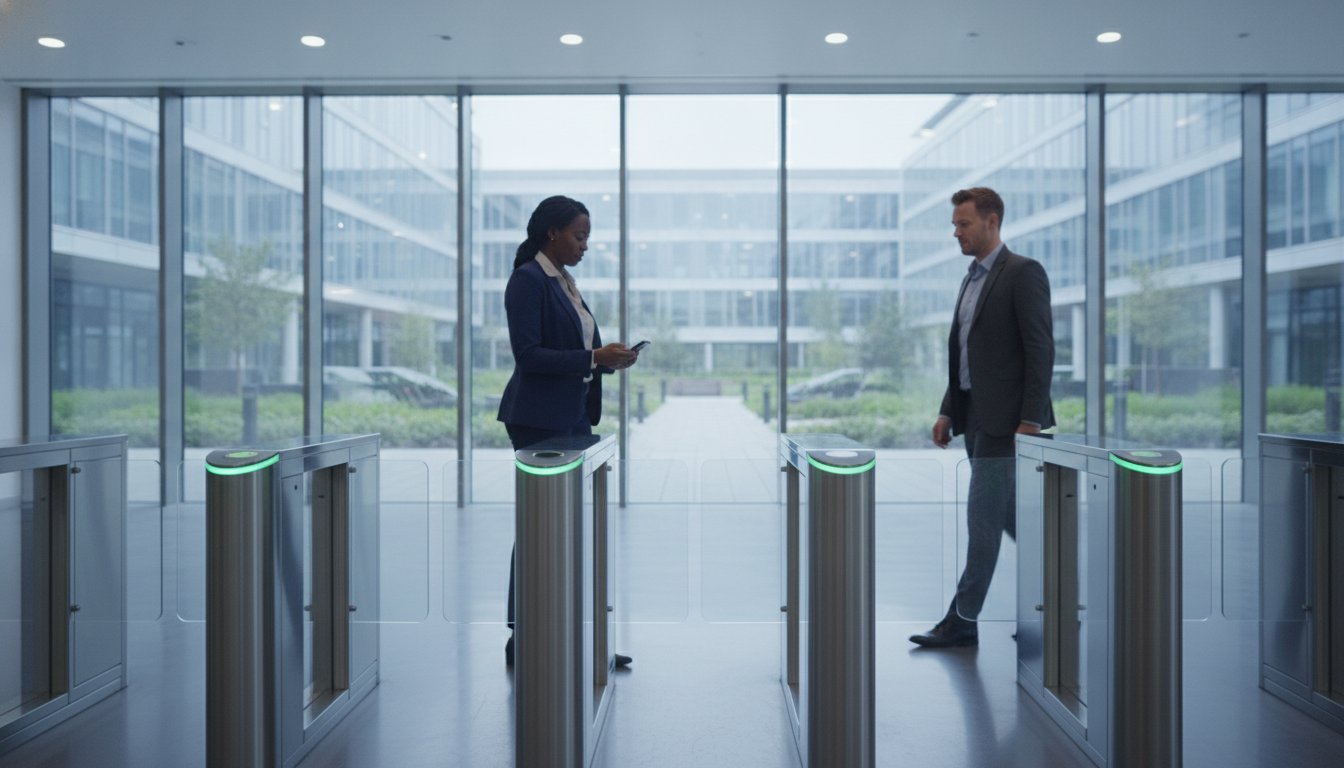
A security turnstile is no longer just a physical barrier; it’s the primary interface between your building’s physical perimeter and its digital intelligence. For many facility managers, the frustration of peak-hour congestion and the persistent risk of unauthorised tailgating are all too familiar. You understand that a security breach or a hardware failure at the main entrance doesn’t just stall traffic; it compromises the safety of everyone inside. Finding reliable security turnstile installers Essex businesses can trust is about more than just bolting hardware to the floor. It’s about ensuring that your access points are as resilient and intelligent as the rest of your infrastructure.
This guide provides a comprehensive framework for procurement in 2026, helping you manage the complexities of high-specification pedestrian gates and speed gates. We’ll explore how to select systems that offer seamless IP access control integration while remaining fully compliant with the latest UK safety standards, including BS EN 16005 and BS 7273-4. From initial site surveys to long-term professional maintenance, you’ll learn how to secure a solution that delivers both operational efficiency and lasting peace of mind.
Key Takeaways
- Understand how modern turnstiles serve as both a physical deterrent and a vital data collection point within an integrated IP security ecosystem.
- Learn to evaluate hardware specifications by balancing peak-hour footfall requirements with the specific security levels required for your Essex facility.
- Discover the operational advantages of linking turnstile hardware with cloud-based access control and IP CCTV to eliminate security silos.
- Identify why partnering with professional security turnstile installers Essex businesses trust is essential for accurate site surveys and structural compliance.
- Recognise the critical role of expert system commissioning and preventative maintenance in ensuring long-term hardware reliability and fail-safe performance.
The Role of Pedestrian Turnstiles in Essex Commercial Security
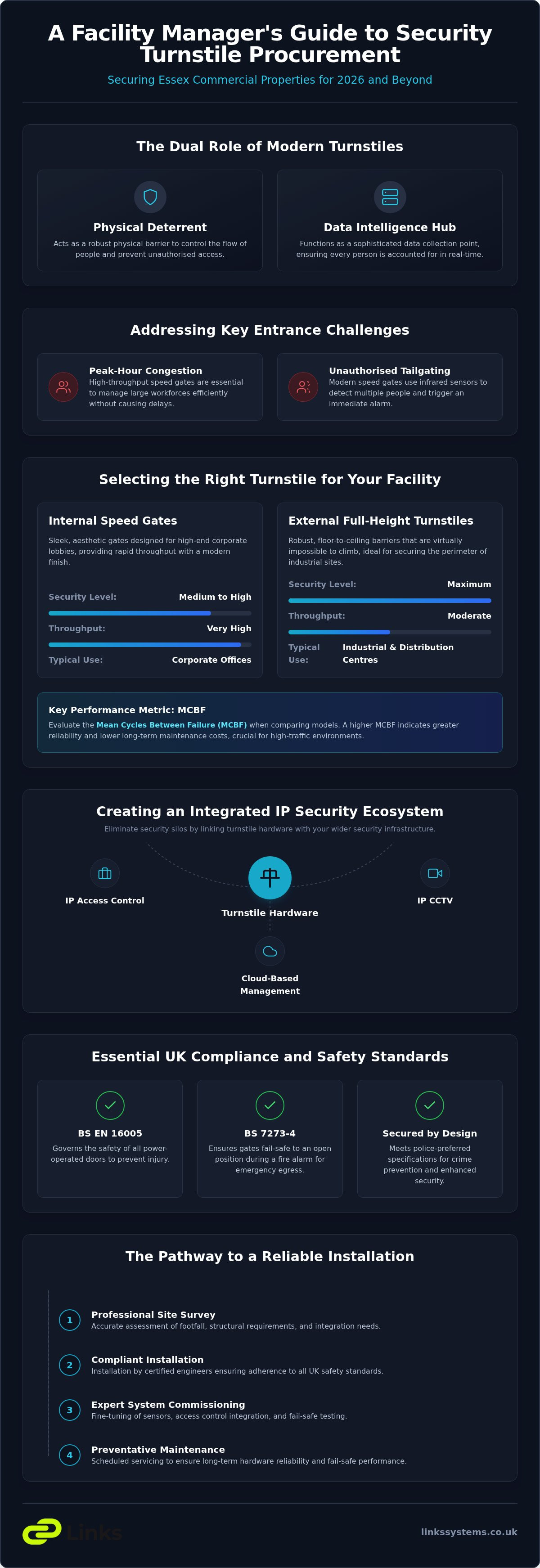
Essex business hubs like Chelmsford, Harlow, and Basildon have seen significant commercial growth, hosting high-value assets and large workforces. In these environments, a simple locked door isn’t enough to manage the flow of people effectively. Understanding The Role of Pedestrian Turnstiles in modern security is essential; they act as both a physical deterrent and a sophisticated data collection point. By requiring a valid credential for entry, they ensure every person on site is accounted for in real-time. This is why many facility managers seek out experienced security turnstile installers Essex based to design systems that handle high throughput without compromising safety.
The primary challenge in any busy lobby is preventing tailgating. This occurs when an unauthorised person follows a legitimate user through a gate before it closes. Traditional barriers often fail to address this, but 2026-standard speed gates use advanced infrared sensors to detect multiple bodies in a single passage. If the system detects a second person, it triggers an immediate alarm or locks the barrier. This shift from passive barriers to intelligent, IP-integrated speed gates allows security teams to respond to breaches instantly rather than reviewing footage after the event.
Securing the Perimeter vs. Internal Lobby Management
The choice of hardware depends on your facility’s specific risk profile. For industrial sites or distribution centres in Harlow, external full-height turnstiles are the standard. They provide a floor-to-ceiling barrier that is virtually impossible to climb. In contrast, corporate offices in Chelmsford favour internal speed gates. These units offer a sleek, aesthetic finish that matches high-end lobby designs whilst providing rapid throughput for staff. Both systems serve to filter traffic, but their physical construction reflects the different threats they’re designed to mitigate.
Compliance and Health and Safety Standards
Compliance isn’t optional. All automated entrance systems in the UK must adhere to strict safety regulations, such as BS EN 16005, which governs the safety of power-operated doors. Professional security turnstile installers Essex must also ensure every gate is correctly integrated with the building’s fire alarm system. Under BS 7273-4, access control systems must fail-safe to an open position during an emergency to allow for immediate egress. Adopting “Secured by Design” principles further ensures your installation meets the highest industry benchmarks for crime prevention and occupant safety.
Selecting the Right Turnstile Specification for Your Facility
Selecting the correct specification for your entrance control is a balance between operational throughput and the security risk profile. While some sites require a hard physical barrier, others need a non-intrusive solution that complements high-end interiors. Working with experienced security turnstile installers Essex professionals ensures that the chosen hardware matches the specific demands of the environment. It’s not just about the initial install; it’s about the long-term performance of the unit under daily pressure.
You must evaluate the Mean Cycles Between Failure (MCBF) when comparing models. For high-traffic environments, a low MCBF leads to frequent downtime and increased maintenance costs. Motorised speed gates offer superior longevity compared to purely mechanical tripod turnstiles because they reduce physical strain on components through controlled, automated movement. Integrating Access Control with motorised units also provides smoother user interaction, as the gate opens before the user reaches it, preventing the “stop-start” friction common with older hardware.
High-Performance Speed Gates for Corporate Lobbies
In modern Essex office developments, first impressions matter. Glass-wing speed gates provide a sleek security presence without making a lobby feel like a restricted zone. These units are highly customisable, with finishes ranging from brushed stainless steel to bespoke powder-coated colours that align with corporate branding. Their silent operation and rapid closing speeds ensure that authorised staff move through the building efficiently whilst unauthorised individuals are effectively deterred. Ensuring these specifications are correctly implemented requires a meticulous approach to system commissioning and maintenance to guarantee 2026-standard reliability.
Full-Height Turnstiles for Industrial and Site Security
Industrial facilities and distribution centres, particularly those in coastal Essex locations like Tilbury or Southend, require hardware capable of withstanding harsh environments. Galvanised steel construction is essential here to prevent corrosion from salt air and moisture. For construction projects, single or double full-height units can be integrated with temporary site access systems to track sub-contractor attendance and ensure only safety-cleared personnel enter the site. These robust barriers provide a clear psychological and physical boundary, making them the preferred choice for unmanned perimeters where high-level security is the priority.
Integrating Access Control and IP CCTV with Turnstile Hardware
Turnstiles that operate in isolation represent a significant vulnerability in a modern security strategy. Without data integration, you lose the ability to track who is on-site or why a specific alarm was triggered. Leading security turnstile installers Essex businesses rely on focus on creating a unified IP ecosystem where every entry event is recorded, verified, and stored. By linking physical hardware with cloud-based access control systems for business, facility managers gain the ability to manage permissions across multiple sites from a single interface. This eliminates the delay of manual updates and ensures that access is revoked instantly when a contract ends or a credential is lost.
Integrating IP video intercoms at the point of entry further strengthens this perimeter. For unmanned entrances or out-of-hours access, an intercom allows for remote visual verification. A security operator can speak with the visitor and view their identification via high-definition video before remotely releasing the speed gate. This transforms the turnstile from a passive barrier into an active, managed gateway that provides a record of every visitor interaction.
Biometric and Smart Credential Integration
The shift towards mobile credentials and facial recognition is rapidly replacing traditional swipe cards. In 2026, the reliance on physical fobs is seen as a security risk due to the ease with which they are lost or shared amongst contractors. Biometric integration ensures that the person passing through the gate is exactly who they claim to be. This level of precision provides facility managers with accurate, real-time reporting on occupancy levels. This data is essential for both fire safety roll calls and optimising building energy use based on actual attendance patterns throughout the day.
Synchronising Video Surveillance for Event Verification
A turnstile alarm is only as useful as the information it provides. By integrating cctv with access control systems, you ensure that every ‘unauthorised entry’ or ‘tailgating’ alert is accompanied by a high-definition video clip of the event. Professional security turnstile installers Essex will position cameras to capture the ‘face zone’ at the point of entry, providing clear evidence for incident response. Automated triggers can be programmed so that if a barrier is forced, the nearest IP HD CCTV camera immediately zooms to the location and alerts the monitoring centre, significantly reducing the time needed to identify a potential intruder.
Planning the Installation: Site Surveys and Technical Requirements
A successful installation begins long before the hardware arrives on site. A meticulous site survey is the foundation of a reliable system, allowing engineers to evaluate floor levels, structural load-bearing capacities, and existing cabling routes. For high-specification speed gates, the floor must be perfectly level to ensure the glass wings align correctly and operate without friction. Specialist security turnstile installers Essex professionals will conduct core drilling tests if necessary, ensuring the substrate can support the static and dynamic loads of heavy motorised units. This level of technical planning prevents the common issue of misaligned barriers that lead to premature motor wear and frequent maintenance calls.
Infrastructure planning for 2026 must account for high-speed data transmission and system resilience. Moving from legacy hardware to IP-integrated solutions requires a robust backbone of Cat6 cabling to handle real-time video and access data. This phase also involves coordinating with your M&E (Mechanical and Electrical) teams to ensure that power and data points are positioned precisely where the turnstile pedestals will sit, avoiding unsightly external trunking in corporate environments. Proper planning ensures that the technical infrastructure is scalable, allowing for future additions like biometric readers or advanced AI analytics without the need for additional structural work.
Cabling and Data Infrastructure
Modern integrated systems rely on Cat6 cabling to maintain low-latency communication between the turnstile sensors and the central access control server. Redundancy is equally important; critical entry points should be equipped with Uninterruptible Power Supplies (UPS) to maintain security during local power outages. In high-traffic corporate lobbies, concealed wiring strategies are used to hide all technical infrastructure within the pedestals or underfloor cavities, preserving the aesthetic integrity of the space. Professional security turnstile installers Essex will ensure all cabling is terminated to industry standards, reducing the risk of signal interference or data loss.
Managing Pedestrian Flow During Works
Operational continuity is a priority for any Essex-based enterprise. We use a phased installation approach for multi-lane entrance points, ensuring that at least one lane remains operational whilst others are being commissioned. Temporary hoarding and clear signage guide staff and visitors safely around the work zone, minimising confusion and maintaining a professional appearance. This process requires close coordination with main contractors and M&E engineers to ensure the project remains on schedule and meets all health and safety requirements. If you’re planning a facility upgrade, you can contact us to discuss your project requirements with our technical team.
System Commissioning and Long-Term Maintenance in Essex
The final handover of a security system is the stage where the difference between a general contractor and specialist security turnstile installers Essex businesses trust becomes most apparent. Commissioning is the technical bridge between physical installation and operational reality. It’s the most critical phase of the project, ensuring that every sensor, motor, and software handshake performs exactly as specified. Without rigorous commissioning, even the highest-specification speed gate can become a source of operational friction, leading to frequent false alarms or, worse, a failure to detect tailgating incidents during peak hours.
Testing fail-safe mechanisms is a non-negotiable part of this process. We verify that every gate responds correctly to fire alarm signals, ensuring they default to an open state as required by BS 7273-4 to allow for immediate emergency egress. We also stress-test the software integration. This involves confirming that the local hardware communicates perfectly with the central access control server, ensuring that a badge swipe in a Harlow or Chelmsford office lobby is logged in the system within milliseconds. This level of precision is what guarantees the 2026-standard reliability expected by high-level stakeholders.
The Commissioning Process
Calibrating infrared sensors is a task that requires meticulous attention to detail. It involves adjusting sensitivity to account for specific lobby lighting and typical pedestrian behaviour, which significantly improves throughput by reducing unnecessary stops. During this stage, we also verify the data flow for all IP-connected devices, ensuring the network is secure and stable. The process concludes with comprehensive staff training and the handover of technical documentation. This ensures your facility management team understands how to monitor the system and interpret diagnostic alerts effectively.
Scheduled Maintenance for Commercial Reliability
Hardware longevity is directly tied to the rigour of your maintenance schedule. In a high-traffic commercial environment, motors and bearings are under constant mechanical stress. Our approach to scheduled maintenance focuses on preventative checks that identify component wear before it leads to system downtime. We also prioritise software updates for all IP-connected devices to protect against evolving cybersecurity threats. Understanding how physical security integration for commercial buildings simplifies the maintenance lifecycle is key; it allows for remote diagnostics and a more proactive service model. By treating maintenance as a routine investment rather than a reactive cost, you ensure your security infrastructure remains a dependable asset for the duration of its lifecycle.
Securing Your Facility’s Future with Integrated Entry Management
The transition to 2026-standard security requires a move away from isolated hardware towards a fully integrated IP ecosystem. The effectiveness of your entrance control depends on the precision of the site survey, the depth of the software integration, and the rigour of the commissioning process. By viewing your turnstiles as a data-driven component of a broader security strategy, you ensure high-traffic efficiency whilst maintaining a robust perimeter against unauthorised access.
Choosing the right partner is essential for navigating these technical complexities. With over 40 years of commercial security expertise, Links Integrated Systems stands as a dependable guide for projects across the region. As specialist security turnstile installers Essex businesses can rely on, we provide a complete end-to-end service, from initial design through to full system commissioning and long-term maintenance. Taking the time to plan your infrastructure today prevents operational friction tomorrow and delivers lasting peace of mind for your stakeholders.
If you’re ready to enhance your site’s security and throughput, Request a Professional Site Survey from Links Integrated Systems. We look forward to helping you build a more secure and efficient commercial environment.
Frequently Asked Questions
Do I need planning permission for external turnstiles in Essex?
Planning permission for external turnstiles in Essex is often required if the structure exceeds two metres in height or is situated near a public highway. Whilst some installations fall under permitted development, industrial sites and distribution centres usually need a formal application to ensure compliance with local planning policies. We recommend consulting with your local authority’s planning department before commencing works on an external perimeter to avoid potential enforcement issues.
How many turnstiles do I need for a high-occupancy office building?
For a high-occupancy office building, you typically require one turnstile lane for every 25 to 30 people passing through per minute during peak periods. A standard three-lane configuration can usually handle a workforce of several hundred employees without causing significant lobby congestion. Our site survey process includes a detailed footfall analysis to ensure the quantity of hardware matches your specific throughput requirements whilst maintaining a professional entrance aesthetic.
Can turnstiles be integrated with existing fire alarm systems?
Turnstiles must be integrated with your building’s fire alarm system to ensure safe egress during an emergency. Under British Standard BS 7273-4, the access control system is programmed to release all barriers to an open position immediately upon alarm activation. This fail-safe mechanism is a critical part of the commissioning process performed by security turnstile installers Essex businesses trust to maintain life safety compliance and insurance standards.
What is the average lifespan of a commercial speed gate?
A high-specification commercial speed gate typically has an operational lifespan of 10 to 15 years when supported by a professional maintenance regime. The longevity of the hardware depends heavily on the Mean Cycles Between Failure (MCBF) rating of the motors and sensors. Regular preventative checks on mechanical components and timely software updates for IP-integrated systems are essential to ensure the gate remains reliable throughout its service life.
Are turnstiles DDA compliant for wheelchair users?
Turnstiles are made DDA compliant through the inclusion of at least one wide-access lane, typically measuring 900mm in width. This ensures that wheelchair users and individuals with mobility aids can pass through the entrance comfortably and safely. These wider lanes are often positioned closest to the reception desk to allow for assisted passage if required, ensuring your facility meets all UK accessibility regulations and Approved Document M requirements.
What happens to the turnstiles during a power failure?
During a power failure, turnstiles can be configured to either ‘fail-safe’ (open) or ‘fail-secure’ (stay locked), depending on your security risk profile. Most commercial buildings utilise a fail-safe configuration to allow for emergency exit. We also recommend installing an Uninterruptible Power Supply (UPS) to provide short-term battery backup, ensuring the system remains operational and the IP access control data continues to sync during local outages.
How do speed gates prevent tailgating in corporate lobbies?
Speed gates prevent tailgating by utilising a sophisticated array of infrared sensors that monitor the passage of each individual. If the sensors detect a second person attempting to follow an authorised user without a valid credential, the system triggers an immediate audible alarm and can be programmed to lock the barriers. This real-time detection allows security turnstile installers Essex to provide systems that alert on-site teams to breaches as they occur.
Can I manage turnstile access remotely via the cloud?
You can manage turnstile access remotely by integrating the hardware with a cloud-based access control platform. This allows facility managers to update user permissions, monitor real-time entry logs, and remotely release gates from any authorised device. We focus on IP-based integration that gives you full visibility of your site’s security status, regardless of your physical location, allowing for instant response to visitor requests or security alerts.