
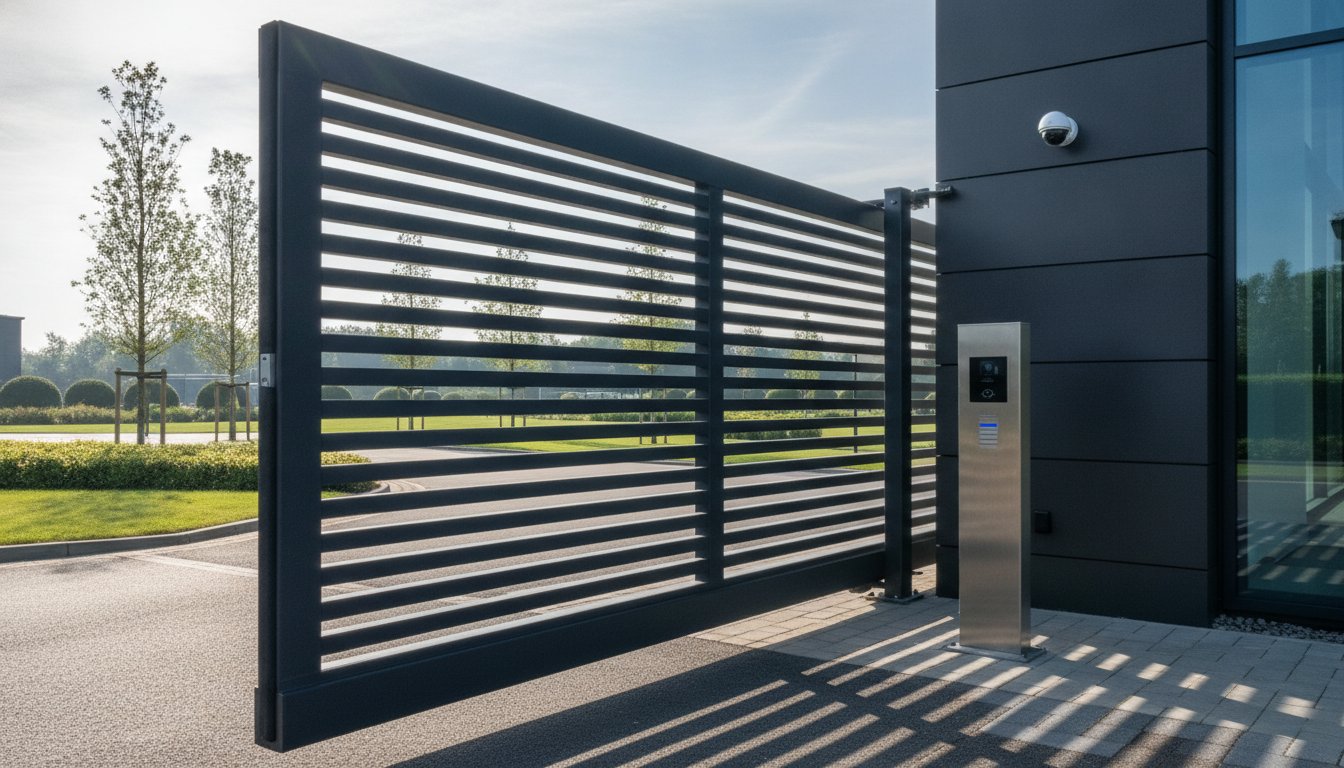
A commercial entrance is often the most neglected piece of critical infrastructure until the moment it fails to open during a Monday morning delivery peak. For facilities managers across the county, the reality of commercial gate automation Hertfordshire projects is that they are complex technical integrations, not simple hardware installations. You likely understand the frustration of intermittent system downtime or the persistent worry that your current setup might not meet the rigorous 2026 safety standards. It’s a common challenge to balance high-duty performance with the strict requirements of the Supply of Machinery (Safety) Regulations 2008.
This guide provides a definitive specification framework to ensure your site remains secure, compliant, and operational. We’ll explore how to achieve full DHF and Gate Safe compliance whilst integrating your physical barriers with modern IP HD CCTV and video intercoms. By the end of this article, you’ll have a clear roadmap for selecting and maintaining a high-duty system that offers genuine peace of mind and long-term reliability for your facility.
Key Takeaways
- Learn how to select the most appropriate hardware, such as speed gates or heavy-duty sliders, based on the specific traffic duty-cycles of Hertfordshire business hubs.
- Understand the latest legal requirements for commercial gate automation Hertfordshire in 2026, ensuring your site meets the Supply of Machinery (Safety) Regulations.
- Discover the technical advantages of integrating automated entrances with IP video intercoms and HD CCTV for centralised, remote visitor management.
- Identify the critical safety components, including force testing and safety edges, necessary to achieve and maintain full DHF and Gate Safe certification.
- Recognise why professional commissioning and structured maintenance plans are essential for transforming a basic gate installation into a reliable security asset.
Securing Hertfordshire’s Commercial Landscape: The Role of Automated Entrances
Hertfordshire’s commercial hubs, from the industrial estates of Hemel Hempstead to the corporate centres of Watford, have seen a significant shift in perimeter management. Relying on manual gates is increasingly viewed as a liability. They require human intervention, which introduces operational delays and clear security vulnerabilities. In a 2026 environment where efficiency is paramount, commercial gate automation Hertfordshire systems provide a controlled, audit-ready entry point that functions without constant manual oversight. This transition allows facilities managers to reallocate personnel to higher-value tasks whilst ensuring the site remains locked and monitored 24/7.
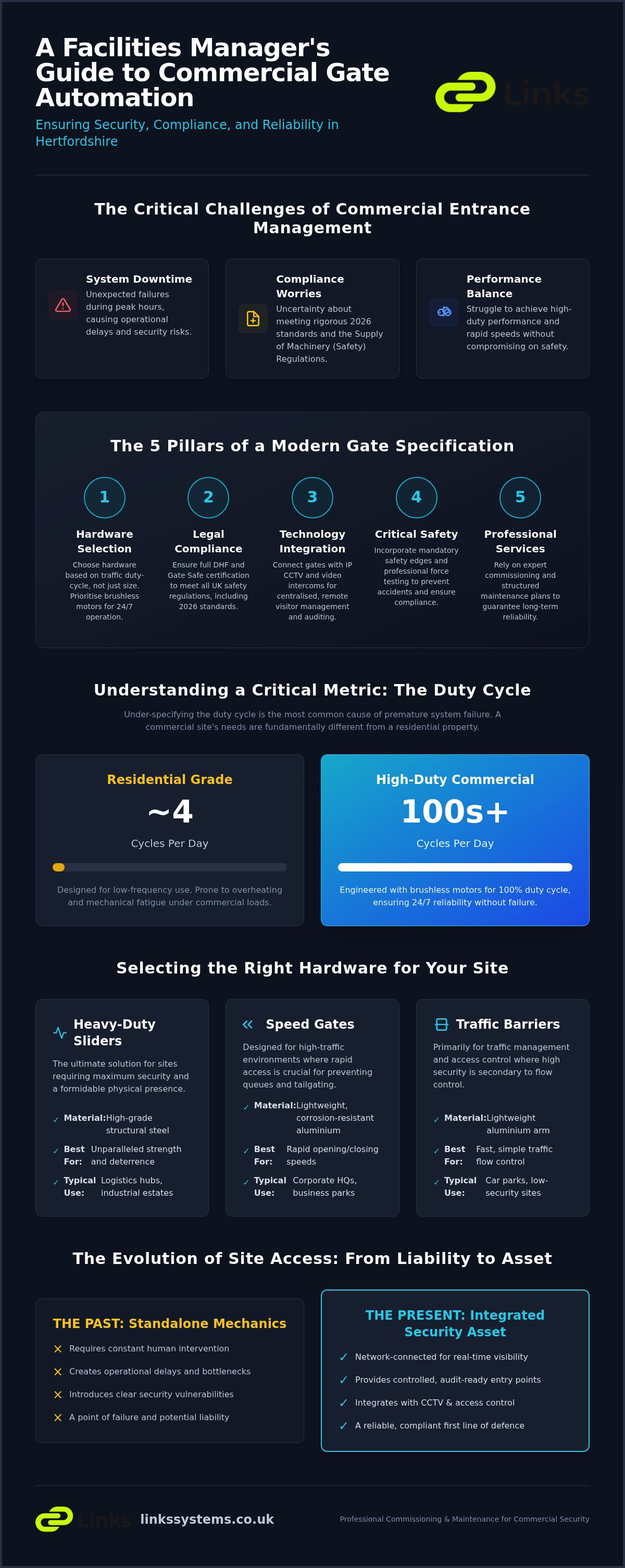
A common mistake in the specification process is underestimating the “duty cycle.” While a residential gate might open four times a day, a logistics hub in Hatfield or a school in St Albans might require hundreds of cycles daily. High-duty systems are engineered for this intensity. They use brushless motors and reinforced components to prevent the overheating and mechanical fatigue common in domestic-grade hardware. For a foundational look at different gate types and their components, this electric gate overview provides useful technical context for those starting a new project.
Hertfordshire Business Park Requirements
Managing traffic flow at peak hours is a primary concern for facilities managers in St Albans and Watford. A slow-moving gate causes tailbacks onto public highways, creating both a safety hazard and a poor first impression for visitors. Modern specifications prioritise rapid opening speeds whilst maintaining a secure perimeter. Aesthetics also play a role for corporate headquarters; a gate must reflect the brand’s professional standing without compromising on the robust physical protection required to deter unauthorised access. It’s about finding the balance between a welcoming entrance for staff and a formidable barrier to intruders.
The Shift to Integrated Physical Security
Automated gates are no longer standalone mechanical items. They serve as the critical first layer in a comprehensive strategy for physical security integration for commercial buildings. By transitioning from simple motors to network-connected assets, site managers gain real-time visibility over every entry and exit event. This evolution has changed the nature of the industry. Professional contractors have replaced general “gate fitters” because modern systems require expertise in data networking, IP protocols, and rigorous safety commissioning. This methodical approach ensures that the entrance is a reliable security asset rather than a point of failure.
Selecting the Right Hardware: Speed Gates, Barriers, and Heavy-Duty Sliders
Selecting the correct physical barrier is a technical decision based on traffic volume, required security level, and environmental conditions. For commercial gate automation Hertfordshire projects, we frequently specify brushless motor technology for its superior longevity. Unlike traditional brushed variants, these motors operate without friction-related heat build-up. This allows for a 100% duty cycle, meaning the system can run 24/7 without the risk of mechanical failure during peak periods. High-grade steel and aluminium remain the materials of choice for Hertfordshire businesses. Steel offers unparalleled structural strength for heavy-duty sliders, whilst aluminium provides a lightweight, corrosion-resistant alternative for speed gates and barriers.
Opening speeds are a critical security metric that facilities managers must evaluate. A slow gate invites “tailgating,” where an unauthorised vehicle follows a legitimate user through the entrance. Professional specifications ensure that the gate speed matches the site’s risk profile without compromising safety. All hardware must be installed and commissioned in accordance with UK gate safety regulations to prevent accidents during these high-speed operations. This methodical approach ensures that the hardware performs reliably under the pressure of constant commercial use.
Speed Gates vs. Traditional Barriers
Speed gates are increasingly specified for high-security perimeters where rapid closure is essential. They combine the speed of a rising barrier with the physical security of a full-height gate, making them ideal for corporate headquarters or sensitive industrial sites. In contrast, rising barriers are the standard for car park management. They are effective for high-throughput areas where the primary goal is traffic control rather than a full security lockdown. When choosing between them, you must weigh the security level against the required vehicles-per-minute throughput to avoid congestion.
Heavy-Duty Cantilever Gates
Cantilever designs are the preferred choice for industrial sites in Hertfordshire with uneven ground or where road debris might obstruct a traditional floor track. Because the gate is suspended over the entrance, it remains unaffected by heavy snow, gravel, or leaves. These systems are typically specified for HGV access, with standard widths reaching up to 12 metres for single leaves. They offer a lower maintenance profile because there is no ground track to clear or repair. If you are planning a site upgrade, reviewing our guide on professional commercial speed gates can help refine your hardware requirements.
Beyond the Gate: Integrating Automation with IP Access Control and CCTV
A physical barrier is only as effective as the logic that controls it. For modern Hertfordshire facilities, a gate is no longer an isolated mechanical component; it’s a data-generating node on the corporate network. Achieving true site security requires integrating CCTV with access control systems to ensure that every vehicle movement is visually verified and recorded. This unified approach transforms commercial gate automation Hertfordshire projects from simple entry points into comprehensive security assets that provide a complete audit trail of site activity.
Automated Number Plate Recognition (ANPR) is now a standard requirement for many business parks in Watford and Borehamwood. It facilitates frictionless entry for authorised staff and regular contractors, reducing tailbacks during morning arrivals. By centralising these functions through a unified security dashboard, facilities managers can monitor gate health, review footage, and manage permissions from a single interface. This level of oversight is essential for maintaining compliance with the UK Gate Safety Regulations, as it allows for real-time monitoring of system performance and safety sensor status.
IP Video Intercoms for Visitor Management
High-definition visual verification is the cornerstone of professional visitor management. Modern IP video intercoms use SIP-based protocols to connect gate stations directly to reception desktops or mobile devices. This allows Hertfordshire reception teams to manage visitors remotely, even if they’re based in a different building or working from a satellite office. These systems support intelligent call routing; if the primary desk is busy, the call automatically transfers to a secondary security station. It ensures no delivery is missed and no unauthorised individual enters the site through a “held open” gate.
Cloud-Based Access Control Integration
Managing permissions across multiple locations is significantly simplified through a cloud-based access control system. Facilities managers can revoke or grant gate access instantly across several Hertfordshire sites without needing to visit each location physically. These systems integrate seamlessly with RFID and biometric readers, ensuring that only verified personnel can trigger the automation. Every event is logged in the cloud, providing an immutable record of entry and exit times. This data is invaluable for health and safety compliance, particularly when managing contractor site hours or investigating security incidents.
Safety Standards and Compliance: Navigating UK Gate Safety Regulations
Legal responsibility for commercial gate automation Hertfordshire rests with the “Person in Control”. Under the Health and Safety at Work etc. Act 1974 and the Workplace (Health, Safety and Welfare) Regulations 1992, facilities managers hold a statutory duty to ensure that powered gates are safe. Compliance isn’t a voluntary choice; it’s a legal requirement that protects both the public and the business from the consequences of mechanical failure. In 2026, UKCA marking remains non-negotiable for all new installations. It serves as a declaration that the system meets the essential health and safety requirements of the Supply of Machinery (Safety) Regulations 2008.
Industry standards set by the Door & Hardware Federation (DHF) and Gate Safe provide the framework for these installations. A compliant system must include active safety features such as force testing and safety edges. Force testing ensures the gate reverses immediately upon encountering an obstruction, whilst safety edges provide a physical buffer to prevent entrapment. These components are critical for mitigating the risks associated with heavy, high-torque commercial motors. To ensure your facility meets these rigorous standards, you can view our full range of system maintenance and commissioning services.
Safety Devices and Redundancy
Commercial environments require layers of safety redundancy. We specify dual-height photocells to detect both standard vehicles and high-sided HGVs, preventing the gate from closing prematurely. Laser scanners are often deployed in high-traffic Hertfordshire business parks to create a “safety curtain” around the gate’s path. Emergency override protocols are equally vital. In the event of a fire alarm or power failure, the system must allow for immediate manual egress without technical intervention. Physical guarding is also installed where necessary to prevent pedestrians from reaching through moving gate leaves or entering “crush zones.”
The Risk Assessment Process
Every Hertfordshire site is unique, which is why a bespoke risk assessment is the first step in any automation project. We identify specific “impact points” and “crush zones” based on the site’s layout and expected user behaviour. A school in Hatfield will have different risk profiles than a distribution centre in Hemel Hempstead. This assessment forms the basis of the technical file, a mandatory document that records all safety tests and component specifications. At the end of the project, this file is handed over to the client as part of the compliance pack, providing a complete record of the system’s safety integrity.
Professional Commissioning and Maintenance in Hertfordshire
Professional commissioning is the most critical phase of any commercial gate automation Hertfordshire project. It is the technical process that transforms a physical installation into a fully operational security asset. Many providers focus solely on “fitting” the hardware, but without a rigorous commissioning phase, the system remains unfinished. A “working” gate might open and close, but a “commissioned” system has been validated against its specific software logic, safety thresholds, and integration requirements. This phase ensures that the high-duty commercial speed gates you’ve invested in perform exactly as the manufacturer intended.
A structured maintenance plan is more than a safety requirement; it’s a financial strategy. For businesses in Hemel Hempstead or Watford, an unexpected gate failure can halt logistics and compromise site security. Regular Planned Preventative Maintenance (PPM) visits reduce the likelihood of these emergency scenarios by addressing component wear in a controlled manner. This proactive approach extends the lifespan of the motor and drive system, ensuring that your initial expenditure provides value for many years. It’s about maintaining a steady state of operational readiness rather than reacting to avoidable breakdowns.
The Commissioning Checklist
Our commissioning process follows a strict protocol to guarantee long-term reliability. We verify motor torque settings to ensure the gate operates smoothly without putting unnecessary strain on mechanical pivots. Software logic is tested to handle complex traffic scenarios, such as multiple vehicles arriving simultaneously or tailgating attempts. We also validate integration points with existing site infrastructure. This includes ensuring that fire alarm overrides function correctly and access control readers communicate seamlessly with the gate controller. The final step is rigorous force testing, providing the documented evidence required for the client’s technical file.
Maintenance for Longevity
Hertfordshire’s climate, with its damp winters and temperature fluctuations, can impact the sensitivity of safety sensors and the lubrication of mechanical components. Regular servicing identifies these minor environmental issues before they lead to system failure. Modern gate systems rely on IP-based infrastructure, which means maintenance now includes software and firmware updates. These updates protect your system from cyber threats and ensure compatibility with newer network protocols. Establishing a Service Level Agreement (SLA) that matches your operational needs ensures that your commercial gate automation Hertfordshire system remains a dependable pillar of your site’s security infrastructure.
Securing Your Hertfordshire Facility for the Long Term
Selecting the right entrance system is a strategic investment in your site’s operational continuity and safety. As we’ve explored, successful commercial gate automation Hertfordshire projects depend on more than just hardware. They require a methodical approach that balances high-duty cycle performance with seamless IP integration and strict regulatory adherence. By prioritising professional commissioning over basic installation, you ensure your perimeter remains a reliable first line of defence rather than a maintenance burden.
Links Integrated Systems brings over 40 years of security engineering expertise to every project. We specialise in high-duty commercial commissioning and maintain full DHF and Gate Safe compliance to guarantee your peace of mind. Our team understands the specific requirements of Hertfordshire’s business parks and educational institutions, providing solutions that are built to last. Consult our Hertfordshire experts for a professional gate automation survey to begin your site upgrade. We’re ready to help you achieve a secure, compliant, and efficient entrance solution that stands the test of time.
Frequently Asked Questions
Do I need planning permission for commercial automated gates in Hertfordshire?
Planning permission is usually required if a new gate exceeds one metre in height when adjacent to a highway or two metres elsewhere. Hertfordshire facilities managers should consult their specific local planning authority, such as St Albans City or Watford Borough Council, before commencing works. While some installations fall under permitted development, commercial sites often require formal applications to ensure the entrance design aligns with local highways safety and environmental standards.
How often should commercial automated gates be serviced to remain compliant?
Commercial automated gates should be serviced at least every six months to remain compliant with UK safety legislation. High-traffic sites in Hertfordshire business parks may require quarterly inspections to account for increased mechanical wear. These professional maintenance visits include force testing and sensor calibration; these are essential for documenting the continued safety of the system in the site’s technical file and ensuring long-term operational reliability.
What happens to my automated gates during a power cut?
Automated systems are equipped with a manual release mechanism or a battery backup to ensure the site remains accessible during a power cut. In a commercial environment, the system is typically configured to fail-safe, meaning the gate can be opened manually with a dedicated key or lever. For high-security perimeters, we often integrate Uninterruptible Power Supplies to maintain full automated functionality until the primary power source is restored.
Can I integrate my existing access control with a new automated gate?
Most modern automated gates can be integrated with your existing access control infrastructure using standard relay outputs or IP-based protocols. This allows your current staff fobs or ID cards to trigger the gate motor directly. During the commissioning of commercial gate automation Hertfordshire projects, we ensure that the communication between the gate controller and your central security management software is seamless, providing a unified audit trail for all entry events.
What is the difference between a sliding gate and a cantilever gate for commercial use?
A sliding gate runs on a floor-mounted track, whereas a cantilever gate is suspended and requires no ground contact across the entrance. Cantilever systems are often superior for Hertfordshire industrial sites where road debris or uneven ground could obstruct a track. While sliding gates require less space to run back, cantilever designs offer reduced maintenance requirements because there are no ground-level components to clear of snow, leaves, or gravel.
Are high-speed gates worth the extra investment for a business park?
High-speed gates are a justifiable investment for business parks that experience high traffic volumes and require strict security. By closing rapidly after each vehicle, these systems effectively eliminate tailgating, where unauthorised cars follow legitimate users through the entrance. This speed also prevents tailbacks onto public Hertfordshire roads during peak morning arrivals, maintaining a professional image and ensuring that the perimeter remains secure at all times.
What safety features are legally required for commercial gate automation in the UK?
Legally required safety features include force-limiting motors, safety edges, and dual-height photocells to detect obstructions. Under the Supply of Machinery (Safety) Regulations 2008, all commercial gate automation Hertfordshire installations must also feature emergency stop buttons and clear warning signage. These components work together to prevent entrapment or crushing injuries, ensuring the system meets the essential health and safety requirements for UKCA marking and DHF compliance.
How long does a typical commercial gate installation take in Hertfordshire?
A typical commercial gate installation in Hertfordshire takes between one and two weeks to complete. This timeline includes the initial civil works, such as pouring concrete foundations and laying ducting, followed by the physical mounting of the gate and the technical commissioning phase. Complex projects involving extensive IP integration or bespoke fabrication may take longer. We provide a detailed project schedule at the outset to minimise disruption to your daily operations.