
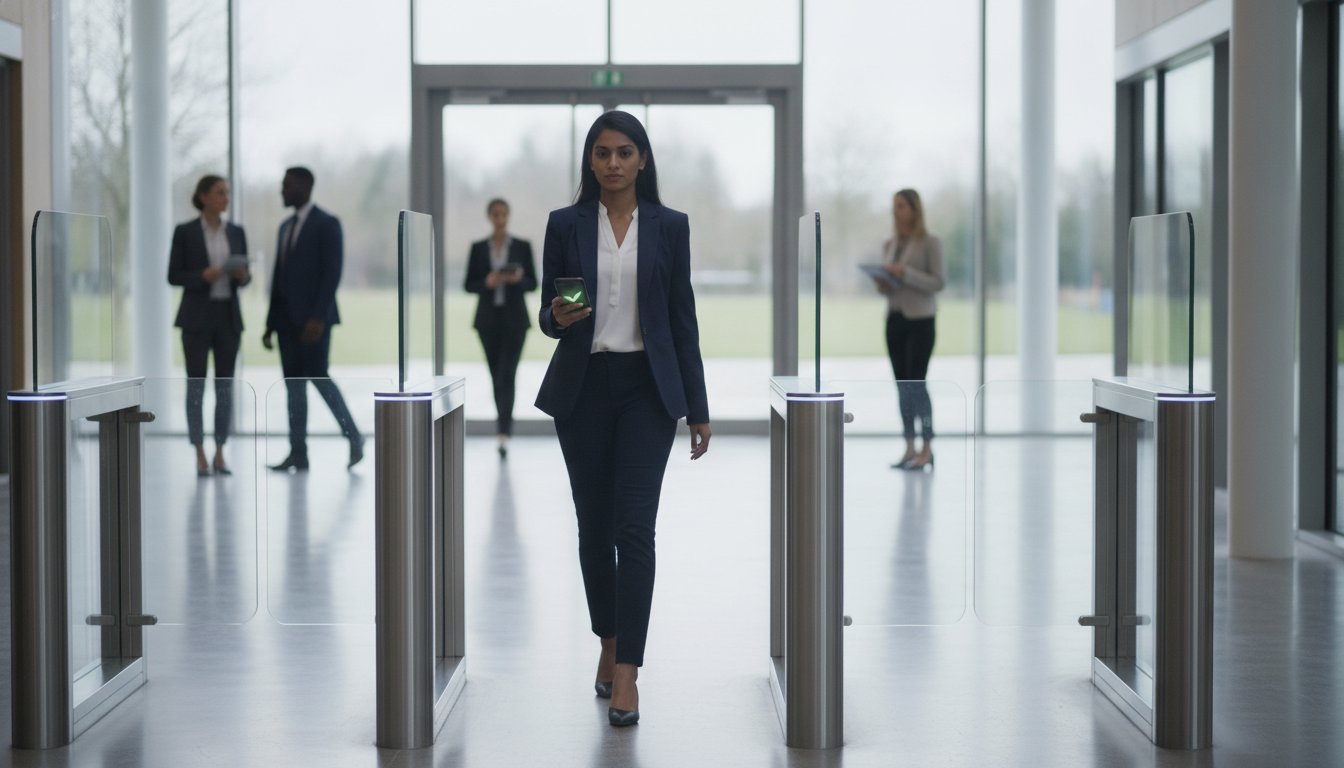
The security of a high-traffic commercial premises depends less on the specific brand of reader on the wall and far more on the precision of its commissioning. In an era where mobile credentials have tripled in adoption, choosing the right office access control solutions Kent businesses can rely on is about more than just hardware; it’s about seamless integration. You likely recognise the frustration of legacy systems causing entry bottlenecks or intercoms that fail to communicate with your perimeter barriers. These faults are rarely about the equipment itself and almost always about a lack of professional foresight during the design phase.
We understand that Kent-based project managers require stability and technical rigour over marketing trends. This guide offers a comprehensive technical specification for those seeking a secure, future-proof environment through 2026 and beyond. We will outline the essential steps for specifying hardware that meets BS EN 60839-11-1 standards, ensuring seamless integration between IP video systems and speed gates, and establishing a reliable maintenance framework with a local partner who understands the regional landscape.
Key Takeaways
- Understand how to transition from traditional locks to scalable, networked IP data systems designed for modern Kent business environments.
- Learn why speed gates and IP video intercoms are essential components of the high-performance office access control solutions Kent professionals specify for 2026.
- Evaluate the balance between the cost-effectiveness of proximity fobs and the enhanced security and convenience of mobile and biometric authentication.
- Identify the critical role of professional commissioning in ensuring that speed gates, intercoms, and fire alarms are correctly integrated for safety and reliability.
- Gain insights into establishing a robust maintenance framework that prioritises system longevity and compliance with the latest British Standards.
Evaluating Access Control Requirements for Kent Business Environments
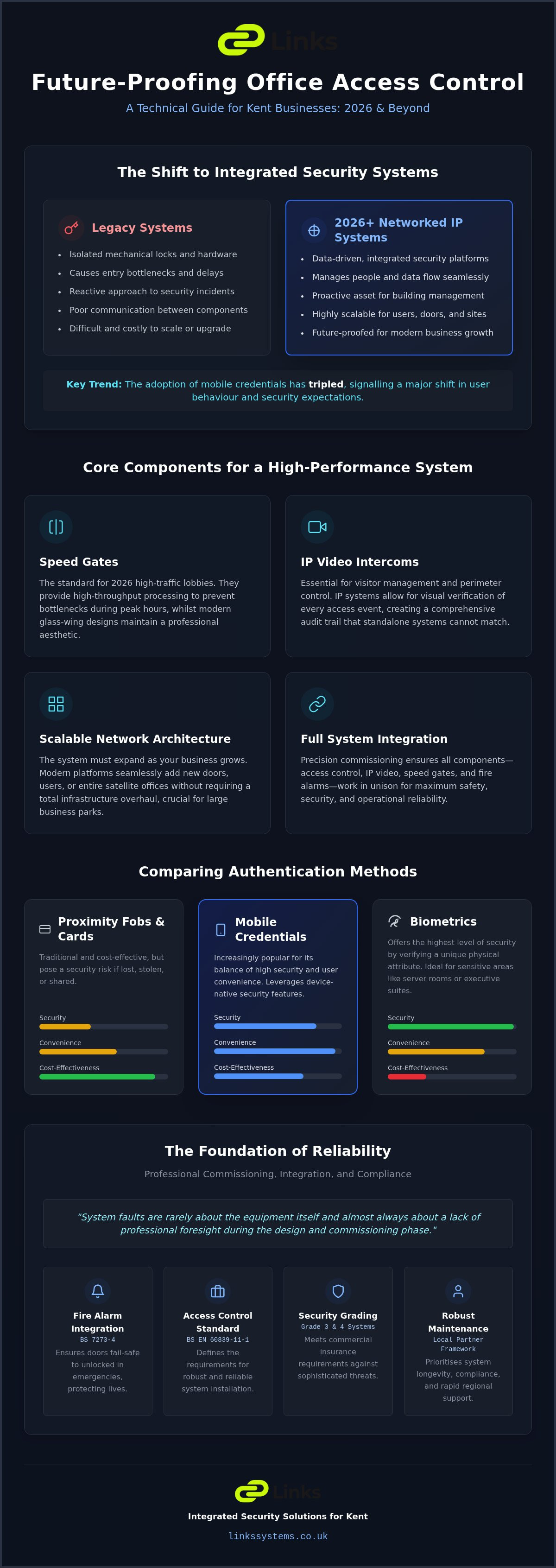
Modern Access control has evolved from simple mechanical locks into sophisticated, data-driven IP systems. For a professional environment, security is no longer just about keeping doors locked; it’s about managing the flow of people and data across a networked ecosystem. When specifying office access control solutions Kent businesses require a transition from isolated hardware to integrated platforms that communicate with wider building management systems. This shift ensures that security remains a proactive asset rather than a reactive hurdle.
Large-scale business parks such as Kings Hill in West Malling or Crossways in Dartford present unique challenges. These multi-tenant environments demand high-level scalability to manage hundreds, or even thousands, of users across various sectors. A system installed in 2026 must be capable of expanding as a business grows, allowing for the seamless addition of new doors, users, and even entire satellite offices without requiring a total infrastructure overhaul. We view the site assessment as a dual-layered process: securing the hard perimeter, such as car park barriers, whilst simultaneously managing internal zones for sensitive areas like server rooms or executive suites.
Compliance with UK building regulations and health and safety standards is the foundation of any professional installation. Systems must adhere to BS EN 60839-11-1 and integrate strictly with fire alarm protocols under BS 7273-4. This ensures that electronically locked doors fail-safe to an unlocked state during an emergency, protecting lives whilst maintaining security during standard operations.
Identifying High-Traffic Pressure Points
The main lobby is often the primary bottleneck in high-occupancy buildings across Maidstone and Dartford. Analysing pedestrian flow during peak morning arrivals is essential to prevent entry delays that frustrate staff and visitors. In these environments, speed gates have become the standard for 2026, providing a high-throughput solution that processes users in seconds. The challenge lies in balancing this robust physical security with the aesthetic requirements of a corporate reception. Modern glass-wing speed gates offer a composed, professional appearance that doesn’t compromise the architectural integrity of the building.
Security Grading and Compliance
Understanding security grades is vital for meeting commercial insurance requirements in the UK. Most Kent office developments require Grade 3 or Grade 4 systems to ensure adequate protection against sophisticated threats. Following a guide on physical security integration for commercial buildings helps project managers align their hardware choices with these rigorous standards. Additionally, adhering to “Secured by Design” principles ensures that new developments are resilient from the outset, reducing the long-term risk of security breaches and potentially lowering insurance premiums.
Specifying High-Performance Hardware: Speed Gates and IP Intercoms
Hardware selection determines the long-term viability of office access control solutions Kent. In 2026, the focus has shifted toward high-performance components that prioritise both security and user experience. It’s no longer sufficient to install a basic reader; the hardware must facilitate a seamless flow of authorised personnel whilst maintaining a rigid barrier against unauthorised entry. Selecting the right physical components is a critical step in building a resilient security posture.
Adhering to the principles of NIST Physical and Environmental Security, we advocate for a multi-layered approach where hardware is chosen for its specific environmental application. This includes integrating IP HD CCTV systems to provide visual verification of every access event. This ensures that the person using the credential matches the authorised user on record, creating a comprehensive audit trail that traditional standalone systems simply cannot provide.
Speed Gates vs. Traditional Barriers
Traditional turnstiles often create bottlenecks during peak hours, leading to frustration and entry delays. Speed gates have become the gold standard for modern Kent office lobbies because they offer significantly higher throughput without compromising safety. These systems utilise advanced infrared sensors and anti-tailgating technology to detect unauthorised followers in real time. For a deeper look at specific dimensions, glass heights, and motor types, you can refer to our professional commercial speed gates guide.
IP Video Intercom Systems
Analogue intercoms are increasingly obsolete in a data-driven commercial landscape. IP video intercoms are now non-negotiable for remote visitor management and delivery handling. These systems provide high-definition visual clarity and integrate seamlessly with mobile devices, allowing reception teams or security personnel to manage entries from anywhere on the premises. In noisy Kent town centre environments, crystal-clear audio and noise-cancelling microphones are essential to ensure communication isn’t compromised by traffic or ambient sound.
For external applications such as car parks or industrial estates in areas like Sittingbourne or Ashford, hardware must be weather-rated to withstand the UK’s varied climate. Robust barriers and IP-rated readers ensure that your perimeter remains secure regardless of environmental conditions. If you are currently designing a new facility or upgrading an existing site, our team can help you specify the correct integrated hardware for your specific requirements.
Comparing Authentication Methods: Fobs, Biometrics, and Mobile
Selecting the most appropriate authentication method is as critical as the hardware itself. For many large Kent workforces, proximity fobs and smart cards remain the cost-effective standard. These physical credentials allow for high-volume issuance and are easily managed through a central database. However, the security of these systems depends heavily on the underlying technology. We advise against non-encrypted legacy fobs, which are susceptible to unauthorised cloning. Instead, 2026 specifications should focus on encrypted smart cards that utilise MIFARE DESFire protocols to ensure credential integrity.
In high-security zones such as server rooms or executive suites, single-factor authentication is often insufficient. Multi-factor authentication (MFA) provides a necessary second layer of protection, typically combining a traditional fob with a PIN or a biometric scan. Biometric solutions, including facial recognition and fingerprint scanning, ensure that the person requesting entry is physically verified. This eliminates the risk of shared or stolen credentials whilst providing a frictionless experience for authorised personnel in sensitive areas.
The Rise of Mobile Access
Mobile credentials represent one of the most significant shifts in how office access control solutions Kent businesses are managed. By utilising Bluetooth or NFC technology, smartphones act as secure digital keys. This approach significantly reduces the administrative burden and costs associated with replacing lost or unreturned physical fobs. Mobile access integrates seamlessly with cloud-based access control systems, allowing facility managers to issue temporary digital keys to contractors and visitors instantly. This ensures that access is revoked automatically once a contract ends, maintaining a tight security perimeter without manual intervention.
Privacy and Data Protection (UK GDPR)
Implementing biometric authentication requires a thorough understanding of UK GDPR obligations. Biometric data is classified as special category data, meaning Kent business owners must conduct a Data Protection Impact Assessment (DPIA) before deployment. It’s essential to store this data as encrypted mathematical templates rather than raw images to protect individual privacy. We ensure that all system communications utilise AES-256 encryption, which is the industry-recognised standard for protecting sensitive data in 2026. Choosing encrypted credentials over standard fobs is a vital step in preventing unauthorised credential cloning and ensuring long-term system resilience.
The Critical Role of Professional Commissioning and Maintenance
Commissioning is the bridge between a collection of hardware and a functioning security ecosystem. It is frequently the most overlooked phase of a project, yet it’s where the technical integrity of the system is established. For high-performance office access control solutions Kent, commissioning ensures that every reader, controller, and software protocol behaves exactly as intended. This stage involves the methodical testing of fail-safe mechanisms, specifically ensuring that speed gates and barriers release instantly upon a fire alarm signal. Without this technical rigour, even the most advanced hardware remains a potential liability.
Modern 2026 IP systems offer the advantage of remote diagnostics, which allows for faster fault resolution. Instead of waiting for a site visit to diagnose a software glitch, engineers can often identify and rectify issues via a secure network connection. This proactive model reduces system downtime and ensures that security remains constant. However, remote support doesn’t replace the need for physical inspections of mechanical components, which are subject to hardware fatigue over time.
The Commissioning Process Explained
The commissioning process begins with precise software configuration. This includes the granular setup of user groups, time zones, and access levels to mirror the operational flow of the business. Beyond the software, hardware stress testing is vital; barriers and speed gates must be tested under heavy load to ensure they operate reliably during peak arrival times. A critical element of this setup is integrating CCTV with access control, which allows for visual verification of every entry event from day one.
Preventative Maintenance in Kent
Preventative maintenance is essential for protecting the long-term investment of a security system. High-traffic environments, such as those found in Maidstone or Ashford, require bi-annual inspections to check for mechanical wear on speed gates and barriers. These visits are also the primary opportunity to perform firmware updates. In 2026, firmware is the frontline of security, protecting IP-based systems from emerging vulnerabilities that could compromise the network.
Utilising local Kent-based engineers provides a distinct advantage in terms of site familiarity and rapid response. A maintenance partner based nearby understands the regional infrastructure and can be on-site quickly if a physical fault occurs. If your current infrastructure requires a professional audit, our team provides specialist system maintenance and commissioning across the county to ensure your facility remains secure and compliant.
Securing Your Kent Office with Links Integrated Systems
Links Integrated Systems brings over 40 years of industry experience to every commercial project. We don’t just supply hardware; we design and commission complex office access control solutions Kent stakeholders can trust for long-term reliability. Our expertise is focused on high-end speed gates and IP-based integrated systems that require technical rigour rather than simple installation. This deep-rooted stability allows us to handle complex technical requirements that individual traders or generalist contractors often lack the capacity to manage effectively.
Our approach is methodical and thorough, reflecting a commitment to precision. It begins with a comprehensive site survey to understand the unique pedestrian flow and security requirements of your facility. From there, we move through the design and installation phases, culminating in the professional commissioning required for 2026 standards. We view our clients as long-term partners, providing ongoing system maintenance and commissioning to ensure hardware remains resilient against fatigue and emerging security threats.
Our Kent and South East Coverage
We serve major business hubs across the county, including Maidstone, Ebbsfleet, and Tunbridge Wells. Whether you’re overseeing a new build or an office refurbishment, we provide dedicated project management to ensure delivery stays on time and within specification. We collaborate closely with main contractors and facility managers, ensuring that our security infrastructure integrates seamlessly with other building services. This collaborative model is essential for large-scale Kent business parks where multi-tenant requirements demand high levels of scalability.
Request a Professional Specification Consultation
Selecting the right speed gates and intercoms requires technical precision and site-specific data. We offer tailored advice based on a detailed analysis of your site’s security gaps and flow requirements. A professional specification consultation provides the roadmap for modernising your Kent office access control. This process ensures your investment meets current British Standards whilst delivering a frictionless experience for employees. If you’re ready to discuss a future-proof security strategy, our team can provide the specialist expertise required for a secure and integrated environment.
Future-Proofing Your Commercial Security Infrastructure
Building a resilient security environment in 2026 requires a shift from isolated hardware to fully integrated ecosystems. As explored in this guide, the most effective office access control solutions Kent businesses can implement rely on the seamless communication between speed gates, IP intercoms, and high-definition CCTV. Selecting the right authentication method, whether encrypted smart cards or mobile credentials, is only the first step. It’s the technical rigour of the initial commissioning and a commitment to preventative maintenance that ensures long-term system success.
With over 40 years of security expertise, we specialise in high-traffic speed gate solutions and complex IP integrations. Our team provides full commissioning and maintenance support to ensure your facility remains secure, compliant, and efficient. If you are ready to upgrade your site’s infrastructure or begin a new specification, contact our Kent-based specialists for a professional access control consultation. We look forward to helping you establish a secure and sophisticated environment for your workforce.
Frequently Asked Questions
How much does a commercial access control system cost in Kent?
The total investment for a commercial system is determined by the number of entry points, the choice of authentication hardware, and ongoing software licensing requirements. Whilst basic standalone readers are available, professional networked systems designed for Kent offices involve more comprehensive infrastructure. Factors such as site cabling, integration with fire safety protocols, and the specific level of security grading required for insurance purposes will influence the final project scope.
What is the difference between a turnstile and a speed gate?
Speed gates utilise motorised glass or plastic wings for faster throughput, whereas traditional turnstiles usually feature mechanical tripod arms. Speed gates are the modern standard for high-traffic lobbies, managing pedestrian flow without creating bottlenecks. They offer superior anti-tailgating technology, detecting unauthorised followers in real time. This makes them a more secure and efficient choice for professional office environments compared to older mechanical alternatives.
Do I need to upgrade my office network for an IP access control system?
Most modern IP-based systems can run on existing structured cabling, but a dedicated Virtual Local Area Network (VLAN) is often recommended for security and stability. Whilst access control data itself requires minimal bandwidth, a stable network environment is essential for reliable operation. If your current infrastructure supports Power over Ethernet (PoE), it can significantly simplify the installation process by powering readers and controllers directly through the data cables.
How long does it take to install speed gates in an office lobby?
A standard installation typically takes between two and five working days, depending on the complexity of the site and ground preparation. The timeline depends heavily on whether the site requires floor cutting for cabling or surface-mounted plinths. For a standard lobby with two lanes, the physical installation and initial commissioning can often be completed quickly. However, complex projects involving extensive integration with existing fire alarms may require additional time for thorough testing.
Can access control systems be integrated with existing CCTV?
Yes, modern office access control solutions Kent businesses specify are designed for seamless integration with IP-based CCTV systems. This allows for visual verification of every access event, linking specific fob swipes or mobile entries to time-stamped video footage. This creates a more robust audit trail and helps identify incidents of tailgating or credential sharing. Most contemporary platforms use open-architecture software, which facilitates the connection between different security layers.
What happens to the access control system during a fire alarm?
In the event of a fire alarm, all electronically locked doors on escape routes must automatically unlock to ensure safe evacuation. Compliance with British Standard BS 7273-4 is mandatory for commercial buildings. The system is hardwired to the fire alarm panel so that a trigger signal breaks the power to the locks, causing them to fail-safe in an open position. During our commissioning phase, we perform rigorous testing to verify this integration works flawlessly.
Are mobile phone entry systems secure for professional offices?
Mobile entry systems are highly secure, often surpassing the security of traditional proximity fobs due to advanced encryption and multi-factor authentication. Mobile credentials utilise industry-standard AES-256 encryption, making them extremely difficult to clone. Because most smartphones require biometric or passcode verification to be unlocked, they provide an inherent layer of security. Facility managers can also revoke digital keys instantly through a central management platform if a device is lost.
How often should commercial speed gates be serviced?
We recommend a professional service at least twice a year for high-traffic commercial environments. Bi-annual maintenance is essential for checking mechanical wear on motorised components and ensuring that infrared sensors remain correctly aligned. Regular servicing prevents hardware fatigue and allows for essential firmware updates that protect the system from emerging digital threats. This proactive approach minimises the risk of unexpected downtime and extends the operational lifespan of your equipment.