
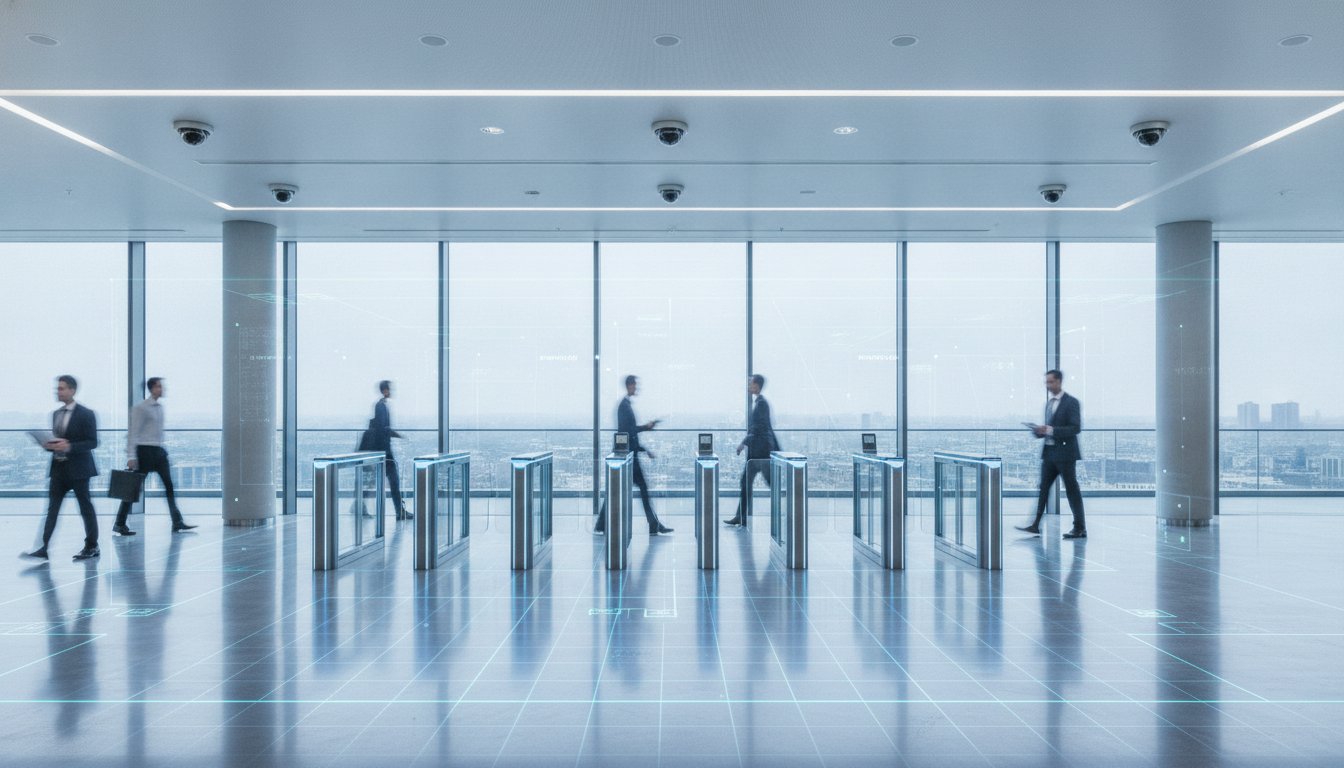
A professional commercial video surveillance system is no longer a standalone security measure, but a sophisticated data asset that requires the same level of architectural planning as your building’s structural foundations. You likely recognise that simply installing cameras is insufficient in an era where hardware must seamlessly communicate with access control and speed gates. The challenge lies in managing this technical complexity whilst navigating the rigorous requirements of the Data (Use and Access) Act 2025.
We understand that for facilities managers and developers, the priority is a reliable infrastructure that eliminates security gaps and avoids the pitfalls of non-compliance. This reference guide provides the technical clarity you need to specify and maintain an integrated security environment. We will explore the latest standards for IP HD CCTV, the importance of professional commissioning, and how a structured maintenance programme ensures your premises remain secure and legally compliant well beyond 2026.
Key Takeaways
- Identify the essential hardware components, from high-definition IP cameras to network video recorders, required to build a future-proofed security foundation.
- Understand how a modern commercial video surveillance system provides visual verification when integrated with speed gates and physical access control barriers.
- Navigate the latest UK compliance requirements, including the Data (Use and Access) Act 2025 and mandatory signage for public and private premises.
- Recognise the critical distinction between basic hardware installation and professional system commissioning for ensuring long-term operational reliability.
- Implement a structured lifecycle maintenance programme to protect your investment and maintain a consistently secure environment.
Understanding Modern Commercial Video Surveillance Systems
A modern commercial video surveillance system is defined as a sophisticated network of IP-based high-definition cameras and centralised storage, engineered specifically for professional asset protection. Whilst the term “CCTV” remains in common use, the industry in 2026 has undergone a fundamental shift from reactive recording to proactive surveillance. This evolution means systems are no longer just repositories of past events; they are active tools for real-time site management and risk mitigation. It’s not just about cameras. It’s about a robust data infrastructure that supports the safety of the entire premises.
Commercial requirements differ significantly from residential setups in scale, bandwidth management, and hardware durability. A business environment demands equipment that can operate 24/7 under varying environmental stresses whilst maintaining high-bitrate data streams across a corporate network. Achieving this requires a deep Understanding Modern Commercial Video Surveillance Systems and how they integrate with existing infrastructure. Professional design is essential to eliminate blind spots amongst complex architectural features, ensuring that every square metre of a facility is accounted for without compromising aesthetics or privacy. Poorly planned systems often lead to security gaps that only become apparent after an incident has occurred.
Analogue vs. IP HD Systems: The 2026 Standard
By 2026, IP-based systems have become the non-negotiable standard for corporate environments. Unlike older analogue technology, IP cameras transmit digital signals that offer superior resolution, often reaching 4K as a baseline. This clarity is vital for identifying faces or vehicle registrations at distance. High-definition surveillance also provides improved frame rates, which are necessary for capturing fluid motion in busy transit areas. The inherent scalability of IP infrastructure allows facilities managers to add cameras to the network as the site expands without the need to replace the core recording engine. This makes it a cost-effective, future-proofed choice for growing businesses.
The Strategic Importance of Surveillance for Business
The utility of a commercial video surveillance system extends far beyond simple theft prevention. It serves as a critical pillar for operational oversight, health and safety monitoring, and liability protection. High-quality video evidence is often the deciding factor in internal investigations or insurance claims, providing an admissible record of events. Visible, modern security hardware also enhances the professional image of a facility. It signals to stakeholders, employees, and visitors that the organisation prioritises safety and maintains rigorous standards of site control. This sense of security is a key component of modern building management, supporting both staff well-being and corporate reputation.
Essential Components of a Professional IP CCTV Infrastructure
Building a professional commercial video surveillance system requires a methodical approach to hardware selection. It begins with the network infrastructure, which serves as the foundational layer for all data transmission. High-performance Power over Ethernet (PoE) switches and dedicated security cabling, such as Cat6 or fibre optics for longer distances, provide the necessary bandwidth and power for High-Definition cameras. This physical layer is the backbone of the entire installation. Without a stable, high-capacity network, even the most advanced cameras will suffer from dropped frames and latency issues that compromise security integrity.
The Network Video Recorder (NVR) acts as the engine of the professional infrastructure. It manages the incoming data streams from multiple IP cameras and handles the heavy lifting of video processing and storage. Alongside the NVR, Video Management Software (VMS) provides the interface for operators to view, search, and export footage effectively. A well-configured VMS allows for seamless navigation across hundreds of cameras. This is essential for large-scale corporate sites where quick retrieval of specific events is a daily requirement. Modern VMS platforms also allow for the integration of smart analytics, enabling the system to flag unusual behaviour automatically.
Camera Form Factors and Applications
Selecting the correct form factor for each zone is a critical design decision that impacts both coverage and aesthetics. Dome cameras are the preferred choice for office lobbies and corridors due to their discreet profile and vandal-resistant housing. Their design makes it difficult for observers to tell which direction the lens is pointing. For car parks and building perimeters, bullet cameras serve as a visible deterrent with their long-range lenses and robust weatherproofing. Large-scale external sites often require PTZ (Pan-Tilt-Zoom) cameras for active monitoring. These allow security teams to track movement across vast areas in real time and zoom in for forensic detail when required.
Storage and Data Management Strategies
Data management is where technical precision meets regulatory adherence. On-premise NVRs offer maximum control over sensitive data, whilst cloud-hybrid storage provides flexible remote access for off-site stakeholders. When calculating retention periods, businesses must align with Compliance, Data Protection, and UK Surveillance Standards. The standard retention period for general commercial footage is typically 30 days unless a specific investigation requires a longer duration. To prevent data loss, we implement redundancy measures such as RAID configurations and dual power supplies. This ensures the system remains operational and your data remains secure even during hardware failure.
If you are currently evaluating your site’s hardware requirements, our team specialises in system maintenance and commissioning to ensure every component performs to its peak specification.
The Role of Video Security in Integrated Physical Access Control
A commercial video surveillance system reaches its full potential when it functions as the visual layer of a wider access control strategy. This synergy is particularly effective when cameras are paired with commercial speed gates. Whilst a barrier provides the physical block, the surveillance system provides the visual verification required to confirm that the individual presenting a credential is the authorised user. This eliminates the risk of “tailgating” or credential sharing, which remain common vulnerabilities in high-traffic corporate environments.
Modern integration allows for event-driven recording, a process that significantly improves the utility of captured data. Instead of recording at a standard resolution around the clock, the system can be configured to trigger high-resolution capture the moment an unauthorised access attempt is detected at a barrier. This ensures that security teams have the clearest possible evidence of an incident without unnecessarily inflating storage requirements for routine activity. It turns your video data into a targeted, actionable resource.
Centralising these functions is key to operational efficiency. By controlling video feeds and access points from a single workstation, security personnel can manage the entire site perimeter without switching between disparate software platforms. This unified approach reduces response times and allows for a more composed, professional management of the facility. It’s a proactive model that replaces the fragmented security protocols of the past with a streamlined, dependable infrastructure.
Video Intercoms and Visitor Management
IP video intercom systems play a vital role in modern reception areas, acting as the first point of contact for guests and contractors. Integrating these intercom feeds directly into the main surveillance record creates a comprehensive visual audit trail of everyone who enters the building. This streamlines visitor entry whilst maintaining a secure record that is easily accessible for later review. It ensures that visitor management is not a separate silo but a fully integrated part of your overall security posture.
Enhancing Perimeter Security with Barriers and Video
Extending surveillance to vehicle barriers and car park entry points provides essential oversight of the site’s outer limits. Using cameras to monitor these zones allows for the identification of potential threats before they reach the main building structure. By 2026, ANPR integration has achieved a level of efficiency where high-speed processing allows for near-instantaneous vehicle identification and barrier activation, removing the friction from traditional gatehouse operations. This level of automation ensures that only authorised vehicles gain entry, maintaining a secure and fluid perimeter for staff and visitors alike.
Compliance, Data Protection, and UK Surveillance Standards
Operating a commercial video surveillance system in 2026 requires strict adherence to the Data (Use and Access) Act 2025. This legislation builds upon the UK GDPR and the Data Protection Act 2018; it necessitates a proactive approach to privacy and data management. For facilities managers, compliance begins with a clearly defined “Purpose of Processing”. You must document exactly why surveillance is necessary for your specific premises, whether for crime prevention or public safety. Clear signage is a legal mandate. These signs must identify the system operator and the purpose of the recording, ensuring that anyone entering the site is fully informed before they are captured on camera.
Equipment selection must align with the BS EN 62676 standard for video surveillance. This BSI standard ensures that the hardware provides the image quality required for its stated purpose, preventing the installation of inadequate technology that fails to provide admissible evidence. Before any new commercial video surveillance system is deployed, a Data Protection Impact Assessment (DPIA) must be conducted. This assessment documents potential risks to individual privacy and the technical measures taken to mitigate them. It’s a foundational document that demonstrates your organisation’s commitment to regulatory standards and protects you from significant ICO fines, which are tiered based on organisation size.
Data Privacy and Subject Access Requests (SARs)
Individuals have the right to request copies of their personal data, including recorded footage. Under current UK law, businesses must respond to these Subject Access Requests within one month. This process involves more than just exporting a video file; it requires the redaction of third-party faces and vehicle registrations to protect the privacy of others. Professional video management software simplifies this task through automated blurring tools. Secure data disposal is equally critical. Most commercial systems are configured with a 30-day retention policy, after which data is automatically overwritten unless it’s required for an ongoing investigation.
CCTV Codes of Practice for Commercial Sites
The Surveillance Camera Commissioner’s Code of Practice outlines 12 guiding principles that every professional installation should follow. These principles focus on transparency, responsibility, and system integrity. Integrity is achieved through professional installation and commissioning, ensuring that the system is secure from both cyber threats and physical tampering. Regular audits are necessary to confirm the system remains fit for its original purpose. If site changes have rendered a camera redundant, it should be adjusted or removed to remain compliant with proportionality rules. Professional oversight ensures your security posture doesn’t drift into non-compliance.
To ensure your infrastructure meets these rigorous legal and technical standards, we provide expert system maintenance and commissioning services across London and the surrounding counties.
Professional Commissioning and Lifecycle Maintenance
The operational success of a commercial video surveillance system depends less on the day of installation and more on the rigour of the commissioning process. Whilst many providers focus on simply ‘fitting a camera’, professional commissioning is a precise engineering phase where the system is stress-tested to ensure it meets its design intent. This stage is particularly vital for physical security integration for commercial buildings, where video feeds must interact flawlessly with access control and speed gates. Without this final verification, a system remains a collection of parts rather than a unified security asset.
A professional commissioning approach considers the full lifecycle of the infrastructure. In 2026, technology refreshes happen more frequently as software capabilities outpace older hardware. A well-designed system includes a roadmap for these updates, ensuring that the core network remains capable of supporting higher bitrates and more advanced analytics. By planning for the long term, facilities managers can avoid the high costs of total system replacement, opting instead for a phased modernisation that maintains continuous protection.
The Commissioning Process: Precision and Performance
During commissioning, engineers conduct exhaustive tests on network throughput and storage reliability under peak load. This ensures that the system won’t fail when multiple cameras trigger high-resolution recording simultaneously. We fine-tune camera angles and focus to ensure every frame provides maximum forensic utility, eliminating the blurry or poorly lit footage often seen in uncommissioned setups. Professional commissioning prevents 90% of mid-term system failures by identifying and rectifying configuration errors before the site is handed over to the client.
Maintenance Contracts for Corporate Peace of Mind
Urban environments present unique challenges for security hardware. High levels of particulate matter and variable weather conditions in the UK can lead to rapid system degradation if left unchecked. This is why we emphasise the importance of commercial CCTV maintenance in London and the surrounding counties. Bi-annual inspections are the standard for maintaining corporate reliability, allowing for the cleaning of lenses, checking of physical connections, and the installation of critical firmware updates.
For sites across Kent, Surrey, and Essex, a structured maintenance programme ensures that your commercial video surveillance system remains a dependable pillar of your security strategy. Regular audits of the system’s performance allow us to spot potential hardware fatigue before it results in a security gap. This proactive service model provides the peace of mind that comes from knowing your premises are protected by a system that is consistently fit for purpose.
Implementing a Future-Proofed Surveillance Strategy
Specifying a modern commercial video surveillance system requires a shift from viewing security as individual components to seeing it as a unified data ecosystem. We’ve examined how high-definition IP infrastructure provides the visual verification necessary for robust access control whilst ensuring full compliance with the Data (Use and Access) Act 2025. The transition from simple hardware installation to professional system commissioning is what ultimately guarantees that your investment remains a dependable asset for years to come.
With 40 years of industry expertise, we understand the specific challenges faced by facilities managers and developers in London and the surrounding counties. Our approach prioritises professional commissioning as standard, ensuring that every camera and network switch is optimised for precision and long-term stability. This methodical process eliminates security gaps and provides the peace of mind that high-level stakeholders expect.
Request a Professional Security Consultation with Links Integrated Systems today to discuss your site requirements. We look forward to helping you establish a secure, compliant, and integrated environment that protects your premises and your people.
Frequently Asked Questions
Do I need a licence to operate a commercial video surveillance system in the UK?
You don’t need a specific personal licence to own or operate the hardware, but your organisation must register with the Information Commissioner’s Office (ICO) and pay the annual data protection fee. This is a mandatory requirement for any business using surveillance for purposes other than domestic use. If you employ external security contractors to monitor your live feeds, those individuals must hold a valid SIA (Security Industry Authority) licence to remain compliant with UK law.
How long should a business keep CCTV footage under UK law?
The standard retention period for general commercial CCTV footage is 30 days. Under UK data protection regulations, you shouldn’t keep personal data for longer than is necessary for its original purpose. If specific footage is required for an ongoing investigation or legal proceeding, you may retain those clips for a longer, documented period. However, your system should be configured to automatically delete all other data once the 30-day window has passed.
What is the difference between an NVR and a DVR for commercial use?
An NVR (Network Video Recorder) processes digital data from IP cameras via network cabling, whilst a DVR (Digital Video Recorder) converts analogue signals from older coaxial systems. For a modern commercial video surveillance system, NVRs are the professional standard because they support 4K resolutions and advanced edge analytics. DVR systems are largely considered legacy technology in 2026 and lack the sophisticated integration capabilities required for complex corporate security environments.
Can video surveillance be integrated with my existing access control system?
Yes, integrating your surveillance with access control is a highly effective way to enhance site security. This connection allows for visual verification at entry points, where a camera feed can automatically trigger on a security workstation when a badge is swiped at a speed gate. This synergy ensures that the individual entering matches the authorised credential, effectively preventing tailgating and unauthorised access at your building’s physical barriers.
What are the common privacy requirements for CCTV in public-facing London offices?
Public-facing offices must prioritise transparency by installing clear, visible signage that identifies the system operator and the specific reason for recording. You’re also required to conduct a Data Protection Impact Assessment (DPIA) to justify the use of cameras in areas where visitors have a reasonable expectation of privacy. Additionally, your system must be capable of redacting or blurring third-party faces if you receive a Subject Access Request (SAR) from a member of the public.
How often should a commercial surveillance system be professionally maintained?
A professional commercial video surveillance system should undergo a full maintenance inspection at least twice a year. Bi-annual visits allow engineers to clean lenses, check for cable degradation, and ensure that all firmware is updated to protect against cybersecurity vulnerabilities. In London’s urban environment, atmospheric pollutants can quickly obscure camera lenses, making regular physical cleaning essential for maintaining the forensic quality of your recorded footage.
Is wireless CCTV suitable for professional commercial environments?
Wireless systems are generally not suitable for high-security commercial environments due to risks of signal interference and bandwidth limitations. For professional-grade reliability, wired IP systems using Cat6 or fibre optic cabling are the preferred choice. Wired connections provide the stable, high-speed data transfer necessary for consistent 4K video streams and ensure that your security infrastructure remains resilient against signal jamming or network dropouts.
What is the benefit of IP HD CCTV over standard analogue cameras?
The primary benefit of IP HD CCTV is superior image resolution, which provides the clarity needed to identify faces or vehicle registrations at a distance. Unlike analogue cameras, IP systems transmit digital data that can include built-in intelligence, such as motion detection or behavioural alerts. They also utilise Power over Ethernet (PoE) technology, which simplifies the installation process by carrying both power and data over a single network cable.