

A security system that only functions when conditions are perfect is a liability, not an asset. Many estate managers find themselves trapped in a cycle of reactive repairs, where a malfunctioning speed gate or a disconnected IP camera leads to urgent call-out fees and compromised building access. Transitioning to a structured programme for integrated security system maintenance is the only way to move from managing crises to managing a reliable infrastructure. You likely recognise that unpredictable downtime doesn’t just disrupt your staff; it creates significant budget uncertainty and potential compliance risks under the latest British standards.
This guide offers a comprehensive roadmap for designing a professional maintenance plan that ensures maximum uptime and long-term ROI for your physical security assets. We will explore how to navigate the shifting regulatory landscape of 2026, including the implications of the Data (Use and Access) Act 2025. By the end of this article, you’ll understand how to implement a preventative model that delivers fixed, predictable costs whilst keeping your site fully compliant and secure.
Key Takeaways
- Understand the transition from reactive repairs to a proactive programme that stabilises budgets and eliminates unpredictable system downtime.
- Discover how integrated security system maintenance extends the lifecycle of your physical hardware, including speed gates, barriers, and IP-based surveillance.
- Learn the importance of mechanical integrity checks and sensor calibration to prevent silent failures in high-traffic professional environments.
- Navigate essential UK compliance requirements, including BS EN 60839 standards and updated data protection regulations for video storage.
- Gain insights into why professional commissioning serves as the critical foundation for a maintenance plan that delivers long-term ROI.
The Critical Role of a Commercial Security System Maintenance Plan
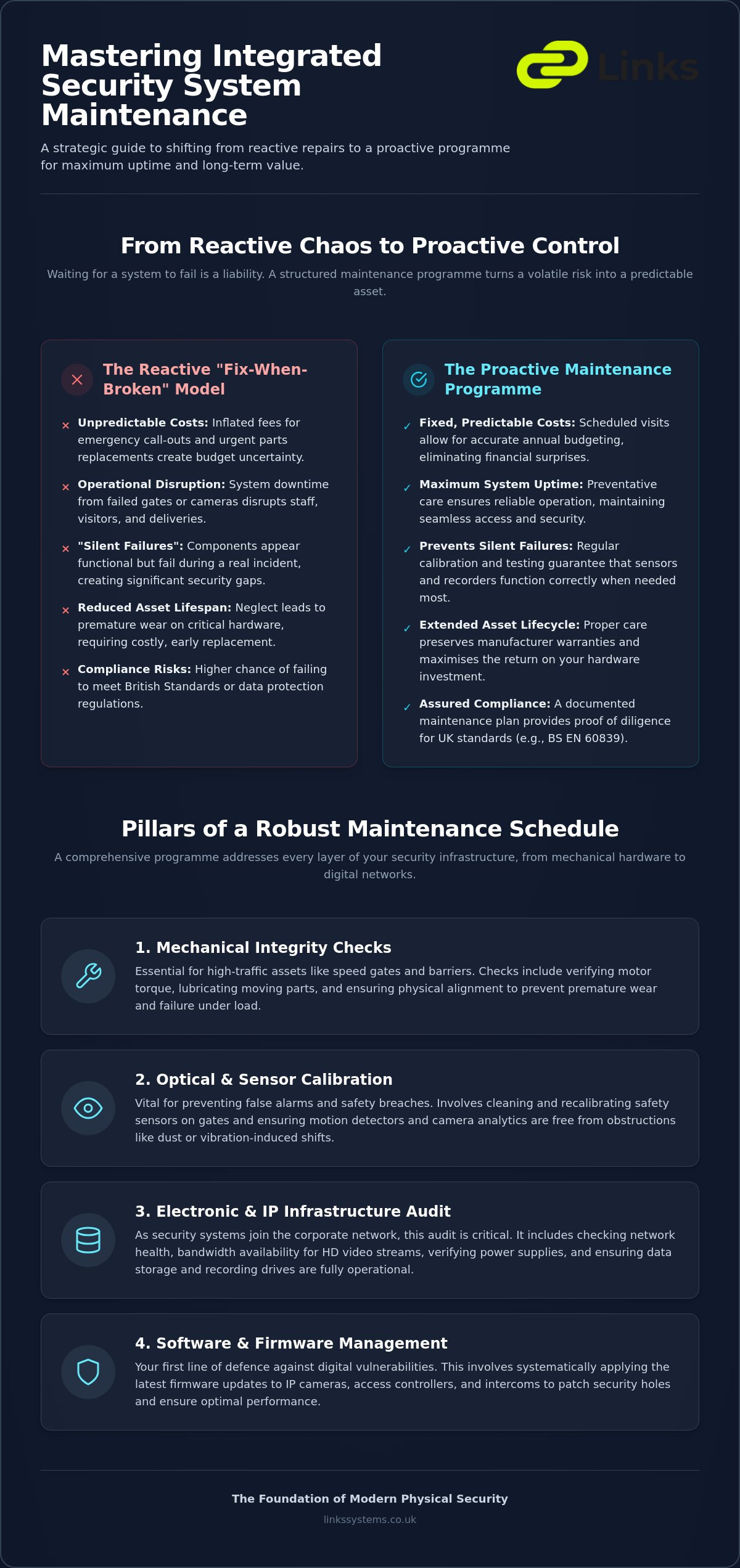
A commercial security maintenance plan is a proactive, scheduled programme of technical inspections and software updates. It’s not merely a “check-up” but a vital process that ensures your hardware remains reliable under operational stress. Effective Physical security measures depend on the precise synchronisation of mechanical parts and digital infrastructure. Without regular integrated security system maintenance, many organisations fall victim to “silent failures.” This is a state where status lights appear normal, yet the system fails to trigger during a real-world incident. A green LED on a speed gate doesn’t guarantee the safety sensors will function correctly during a high-volume transit period whilst under pressure.
Transitioning from a reactive model to a preventative one is a strategic necessity for 2026. Waiting for a system to fail before acting leads to unpredictable downtime and inflated emergency repair costs. By contrast, a structured maintenance programme preserves manufacturer warranties and extends the lifecycle of critical assets like HD CCTV and speed gates. It transforms security from a volatile capital risk into a manageable, predictable operational expense. Regular audits ensure that your system grows with your business rather than becoming a legacy burden.
Preventing Operational Disruption in Professional Environments
System failures create immediate friction in professional settings. In high-traffic London office lobbies, a single failed speed gate can disrupt pedestrian flow, leading to frustrated staff and compromised access control. Similarly, IP video intercom failures in Surrey business parks often result in missed deliveries and fragmented visitor management, which affects overall business efficiency. In Kent, facilities managers rely on HD video evidence for incident reporting; maintenance ensures that recording drives haven’t failed unnoticed, meaning footage is always available when it’s needed most.
The Financial Logic of Preventative Care
The financial benefits of scheduled care are clear when compared to the volatility of emergency call-outs. Fixed-cost maintenance visits allow for accurate annual budgeting, removing the threat of sudden, expensive parts replacements. In Hertfordshire, professional maintenance documentation often serves as proof of diligence, which can lead to more favourable insurance premiums for commercial properties. For developers in Essex, treating integrated security system maintenance as a fixed operational expense rather than a capital risk ensures that the building’s infrastructure remains a stable asset for years to come.
If your organisation requires additional financial flexibility to cover these essential infrastructure upgrades, you might explore Short Term Loans as a practical solution for managing capital expenditure.
Essential Components of a Robust Maintenance Schedule
A high-performance security infrastructure requires more than a cursory inspection of cameras and readers. To achieve true integrated security system maintenance, a schedule must address the interplay between heavy-duty mechanical hardware and sensitive digital networks. A robust programme treats the system as a single, cohesive entity where a failure in one component, such as a misaligned sensor on a speed gate, can compromise the integrity of the entire access control network. This methodical approach ensures that every layer of your physical security remains operational under heavy use.
Mechanical integrity checks form the foundation of this process, particularly for speed gates and barriers. These units contain motors and drive systems that undergo thousands of cycles monthly. Without regular verification of motor torque and physical alignment, premature wear is inevitable. Similarly, optical and sensor calibration is vital for preventing false alarms. In high-traffic commercial areas, sensors can become obscured by dust or shifted by vibration, leading to safety failures or unauthorized “tailgating” incidents that go undetected. Ensuring your service partner adheres to recognized UK compliance and standards is the best way to verify that these technical nuances are handled with precision.
The digital side of the schedule focuses on electronic and IP infrastructure auditing. As HD CCTV and intercom systems move onto the corporate network, checking network health and bandwidth availability is essential. Software and firmware management represents your first line of defence against hardware-level vulnerabilities. Outdated firmware on an IP camera or access controller isn’t just a performance risk; it’s a potential entry point for unauthorized access. A steady, professional hand is required to manage these updates whilst ensuring system stability is never compromised.
Maintaining Access Control and Speed Gates
Reliable access control depends on the synchronisation of database records and physical hardware. Maintenance involves testing motor torque and alignment in speed gates to prevent mechanical strain that leads to motor burnout. Engineers must clean and calibrate IR sensors to maintain accurate tailgating detection in secure lobbies, ensuring that only authorised personnel gain entry. We also verify reader response times across multiple sites to ensure that database synchronisation remains instantaneous, preventing delays for staff and visitors. If you are concerned about the current performance of your hardware, a professional system maintenance audit can identify these issues before they cause a total failure.
Optimising IP HD CCTV and Video Intercoms
Visual clarity is the primary metric for any surveillance system. Regular lens cleaning and refocusing are necessary to maintain 4K or HD image quality, especially in outdoor environments where weather affects clarity. We review storage health and recording schedules to ensure that no data gaps occur in the security archive, which is a critical requirement for incident investigations. For visitor management, testing audio-visual clarity on IP video intercoms ensures that identity verification is fast and reliable, maintaining the professional standard expected in modern corporate environments.
Preventative vs. Reactive: Evaluating Service Level Agreements (SLAs)
A reactive approach to security maintenance is effectively a gamble with your site’s operational continuity. Whilst it may appear cost-effective to only pay for repairs when a fault occurs, the reality is often a cascade of high emergency call-out fees and extended periods of system vulnerability. Professional integrated security system maintenance requires a shift in perspective. You must move away from generic “one size fits all” contracts that treat a complex IP-based network the same as a simple mechanical lock. These basic agreements often lack the technical depth required to sustain modern, high-end hardware.
Choosing a maintenance partner is a strategic decision that directly impacts your building’s resilience. Many providers offer basic check-box exercises that fail to address the underlying health of an IP infrastructure. A true technical audit goes deeper. It involves analysing network throughput, verifying database integrity, and ensuring that the initial commissioning standards are still being met. You need a partner who understands the nuances of high-end hardware integration; a technician who only knows traditional analogue systems will struggle with modern 4K CCTV or IP-based access control.
Defining Your Site’s Maintenance Requirements
Maintenance frequency should be dictated by usage and environment rather than a standard calendar date. A London skyscraper with thousands of daily transits requires far more frequent gate inspections than a Surrey business park with lower pedestrian volume. Environmental factors also play a critical role. For sites in Kent or Essex, outdoor IP cameras and barriers are exposed to higher levels of dust, salt, or temperature fluctuations, which can accelerate component degradation. We help you prioritise maintenance tasks by determining the criticality of each system component, ensuring your most vital access points receive the most rigorous attention.
Key Metrics for a Successful Maintenance Partnership
The value of an SLA isn’t found in how quickly a provider answers the phone, but in their first-time fix rate. Technical competence matters more than just showing up at the site. A provider with deep-rooted industry experience will arrive with the correct diagnostic tools and spare parts to resolve issues immediately. For modern facilities managers, detailed reporting and digital asset management logs are essential for tracking the lifecycle of their hardware. Finally, ensure your provider is authorised to work on your specific brands of commercial speed gates, as uncertified tampering can void warranties and compromise safety certifications.
Compliance and Standards for UK Commercial Security Systems
Compliance is the silent backbone of any professional integrated security system maintenance programme. In the UK, adherence to BS EN 60839 is essential for electronic access control systems. This standard ensures that your hardware and software are not just operational but meet specific security grades required for commercial environments. Building managers in London and the Home Counties are often designated as the ‘Responsible Person’ under current safety regulations. This role carries legal obligations to ensure that all physical security infrastructure is safe and compliant. Failure to maintain equipment like speed gates isn’t just an operational risk; it’s a significant liability if a mechanical failure causes injury in a public-facing lobby.
Navigating the intersection of physical security and data privacy is equally critical. The Data (Use and Access) Act 2025 has updated the UK’s data protection framework, making regular audits of CCTV systems a statutory necessity rather than a recommendation. Maintenance visits must now include a review of data handling processes to ensure your organisation remains on the right side of the law. Establishing a steady, documented history of inspections is the only way to demonstrate due diligence to insurers and regulatory bodies alike.
Adhering to British Standards (BS) and EN Norms
Regular testing is a mandatory requirement for developments seeking to maintain their ‘Secured by Design’ status. For high-security environments, maintenance plays a vital role in satisfying NSI or SSAIB inspection criteria. We ensure that every visit is recorded in a robust logbook, providing a clear audit trail for compliance purposes in 2026. This documentation is essential for verifying that your integrated security system maintenance meets the rigorous expectations of professional project managers and stakeholders. If you require assistance with your regulatory obligations, our team provides expert compliance-led system maintenance to ensure your site remains fully protected.
Data Privacy and Video Surveillance Compliance
Annual audits are the primary time to check that privacy masking on CCTV cameras remains correctly configured. As building layouts change, cameras may inadvertently capture private areas, leading to GDPR breaches. We also ensure that secure data disposal and storage protocols are strictly followed during system infrastructure reviews. Beyond the technical settings, the presence of clear signage and public notification is a key part of our regular maintenance walk-through, ensuring your surveillance remains transparent and legally sound.
Professional Maintenance and Commissioning with Links Integrated Systems
Reliability starts long before the first scheduled inspection. At Links Integrated Systems, we view professional commissioning as the essential foundation for any integrated security system maintenance programme. Commissioning is the rigorous process of verifying that every component-from the motor torque of a speed gate to the bitrate of an IP camera-is functioning exactly as designed. It establishes a performance baseline. Without this initial precision, ongoing maintenance is often reduced to a series of reactive fixes rather than a proactive strategy. With 40 years of industry experience, we ensure that your system is calibrated correctly from day one, providing a stable platform for long-term operational success.
Our presence across London, Kent, Surrey, Hertfordshire, and Essex allows us to serve as a steady, experienced hand for complex technical requirements. We operate as a dedicated service partner rather than a transactional contractor, taking ownership of the full lifecycle of your security infrastructure. This collaborative approach ensures that your investment in high-end hardware continues to deliver a high ROI whilst meeting the evolving demands of your facility. By choosing a partner with a deep-rooted history in the Home Counties, you gain the peace of mind that comes from working with specialists who understand the local regulatory and operational landscape.
The Links Integrated Systems Approach to Reliability
Every commercial site has a unique technical profile that a standard contract cannot address. We develop tailored maintenance plans that reflect the specific requirements of your infrastructure, whether you’re managing a high-traffic London lobby or a secure research facility in Hertfordshire. Our expertise includes:
- Tailored maintenance plans that reflect the specific technical requirements of your commercial site.
- Specialist knowledge in high-definition IP systems and sophisticated pedestrian flow solutions for modern office environments.
- A focus on precision and meticulous planning, moving from the initial design and consultation through to long-term care.
Securing Your Assets for the Future
Proactive lifecycle management is the final component of a resilient security strategy. We identify when components, such as recording drives or barrier motors, are approaching the end of their reliable service life. This allows you to plan upgrades as part of a fixed budget rather than reacting to a sudden failure. Partnering with a specialist who understands the entire project lifecycle-from design to commissioning-provides a level of stability that general contractors cannot match. Transitioning your site to a professional Links maintenance plan ensures your integrated security system maintenance remains a dependable pillar of your business operations for years to come.
Securing Operational Continuity for the Future
Maintaining a resilient security infrastructure requires more than reactive repairs; it demands a structured, proactive approach that prioritises hardware longevity and regulatory compliance. By transitioning to a professional programme of integrated security system maintenance, you eliminate the volatility of emergency call-out costs whilst ensuring your site remains aligned with British Standards such as BS EN 60839. This methodical care protects your physical assets and provides the technical stability necessary for modern, high-traffic commercial environments.
Links Integrated Systems brings 40 years of industry-leading expertise to every project, serving as specialist contractors for London and the Home Counties. We focus exclusively on high-end commercial physical security, ensuring that your HD CCTV, speed gates, and access control systems are managed with precision from initial commissioning to long-term care. Our collaborative approach ensures that your security remains a dependable pillar of your business operations rather than a source of technical friction.
Secure your infrastructure with a professional maintenance plan from Links Integrated Systems today. Establishing a steady, reliable maintenance partnership is the most effective way to protect your stakeholders and your property for years to come.
Frequently Asked Questions
How often should a commercial security system be maintained in the UK?
Most commercial security systems require professional maintenance at least twice per year to ensure reliability. High-traffic environments, such as London office lobbies with multiple speed gates, often benefit from quarterly inspections to manage the mechanical strain of constant use. The frequency is usually dictated by the complexity of the hardware and the specific operational risks of the site.
Is it a legal requirement to have a security system maintenance plan for businesses?
Whilst there isn’t a single law mandating a maintenance contract, businesses must meet several regulatory obligations that effectively require one. The Data (Use and Access) Act 2025 and BS EN 60839 standards for access control necessitate regular audits to ensure safety and privacy compliance. Furthermore, many commercial insurance policies require documented proof of maintenance to remain valid in the event of a claim.
What is the difference between a reactive repair and a preventative maintenance visit?
Reactive repairs are unscheduled interventions that occur after a system has already failed, leading to unpredictable downtime and high emergency call-out fees. Preventative integrated security system maintenance is a scheduled programme designed to identify and resolve minor issues before they escalate. This proactive approach ensures maximum uptime and allows facilities managers to maintain a fixed, predictable budget for their security infrastructure.
Does a maintenance plan cover software and firmware updates for IP cameras?
Yes, a professional maintenance plan includes regular audits of software and firmware for all IP-based hardware. These updates are a critical line of defence against hardware-level vulnerabilities and ensure that your HD CCTV and intercom systems remain stable on the corporate network. Keeping firmware current is essential for maintaining the integrity of your digital and physical security layers.
Can you maintain a security system that was installed by another company?
We frequently take over the maintenance of high-end commercial systems originally installed by other providers. Our process begins with a comprehensive technical audit and commissioning review to establish a performance baseline. This ensures that we fully understand the existing infrastructure before implementing a long-term care programme tailored to your site’s specific requirements.
What happens if my speed gates fail and I do not have a maintenance contract?
A failure without a contract often results in significant building disruption and safety liabilities. You’ll likely face higher emergency repair costs and potential delays in sourcing specialist parts for mechanical barriers. Without a documented history of integrated security system maintenance, it also becomes difficult to demonstrate that you have met your Duty of Care to staff and visitors.
How does professional commissioning improve the effectiveness of a maintenance plan?
Professional commissioning sets the technical standards for the entire lifecycle of your security assets. It verifies that every component is installed and configured to its optimum specification from the start. When a system is correctly commissioned, subsequent maintenance visits are more effective because they’re based on a stable, verified baseline rather than trying to correct underlying installation faults.
Are your maintenance services available across all Home Counties, including Hertfordshire and Essex?
Our specialist maintenance and commissioning services are available throughout London and the Home Counties. We provide localised expertise and a steady, professional presence for clients in Hertfordshire, Essex, Kent, and Surrey. This regional focus ensures that our engineers can respond effectively to the technical requirements of high-level stakeholders and project managers across the southeast.