
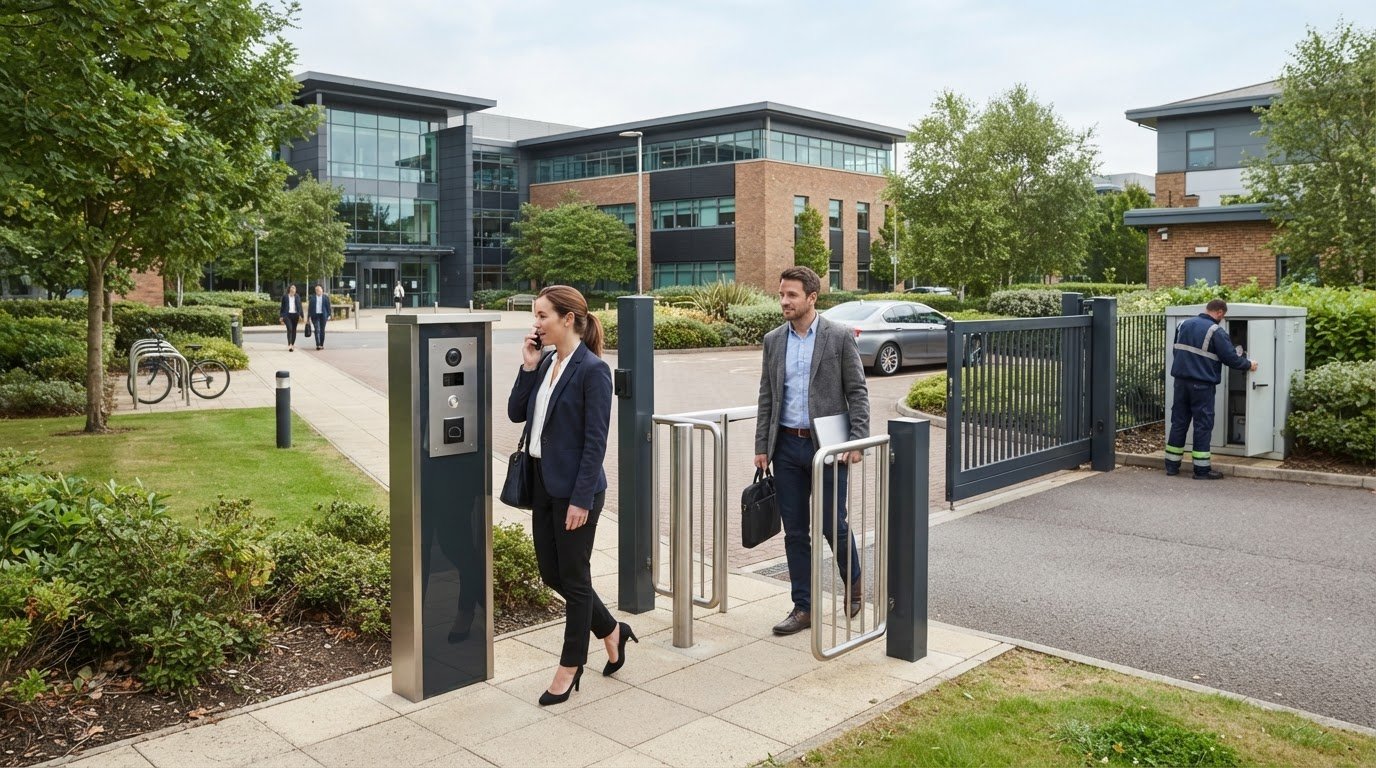
What if replacing an ageing entry system made arrival at your business park harder, rather than easier? A video intercom upgrade for business park Hertfordshire sites should improve visitor handling while keeping everyday access moving for occupiers, guests and delivery teams.
That balance takes planning. Shared entrances may serve businesses with different procedures, and existing access control or site infrastructure can affect the design. Replacing equipment without reviewing these connections can create avoidable disruption. A clear plan helps coordinate work around an occupied site and gives visitors a consistent way to request entry.
This guide explains how to plan a commercial video intercom upgrade around access, integration and continuity. It covers assessing current equipment and entry arrangements, considering how the new system can work with wider access control, and managing installation while the business park remains operational. It also explains the role of professional commissioning and ongoing maintenance. Links Integrated Systems designs, installs, commissions and maintains commercial IP video intercom systems for businesses in Hertfordshire, London, Kent, Surrey and Essex.
Key Takeaways
- Ageing equipment, changing occupier needs and unclear visitor procedures can all prompt an intercom upgrade.
- Document entrances, user groups and current equipment before deciding what to replace or improve.
- Compare like-for-like replacement, targeted improvements and wider integration to find an approach suited to the site.
- A video intercom upgrade for business park Hertfordshire sites should be planned around access continuity, with work sequenced for an occupied, multi-user environment.
- Professional installation, commissioning and maintenance support the project from initial requirements through to ongoing system care.
Why Hertfordshire business parks upgrade video intercom systems
A video intercom upgrade replaces or improves the equipment and functions used to communicate with visitors at an entrance. The aim is to make entry arrangements fit the way the site operates now, rather than simply install newer equipment. Depending on the layout, this could mean improving a shared entrance, reception point or access to separate occupier areas. A video door-phone system generally combines two-way communication with a camera and display, allowing someone inside to see and speak with a visitor at the entrance.
The need for an upgrade often starts with a mismatch between the entry process and how people use the site. Equipment may be ageing, unreliable or difficult for staff to operate. Occupiers may have changed, a building may serve a different purpose, or visitor procedures may no longer be effective. Reviewing the intercom helps clarify who receives calls, how visitors identify their destination and how entry is authorised.
Plan around operational continuity: define how people will enter and get assistance before replacing equipment. Consider site-wide requirements, such as a shared entrance or agreed visitor route, separately from individual tenant preferences. This helps avoid a design that works for one occupier but creates confusion for others.
Which business-park access problems can an upgrade address?
Consider a delivery driver who reaches a shared gate but cannot tell which business to call, or a visitor who selects the wrong occupier at a reception point. Staff also need a clear way to identify callers before granting entry. If call routing, instructions or responsibilities are unclear, reception and facilities teams may spend time redirecting visitors, answering avoidable questions or coordinating access between occupiers.
Start by separating the entrance process that must work across the site from preferences that apply only within a tenant’s area. A shared entrance may need consistent directions and a defined response process; an individual business may have its own visitor arrangements beyond that point. Mapping these needs shows where an intercom change could make entry clearer without imposing one occupier’s procedure on the whole park.
When should a business consider replacing its video intercom?
Recurring faults, unreliable communication, unclear images or controls that staff find difficult to use are practical reasons to review the system. A single fault may not require full replacement, but repeated problems can make day-to-day entry less predictable. Record where issues occur, who is affected and whether they interrupt visitor, delivery or staff access. This gives the review a practical basis instead of relying on equipment age alone.
Changes in occupancy, building use or access procedures are also useful review points, even if the equipment still works. A new mix of occupiers may change who needs to receive calls, while a revised visitor route may make existing instructions confusing. A video intercom upgrade for business park Hertfordshire sites should address these operating needs, taking the condition and role of existing equipment into account.
What to assess before upgrading a business-park video intercom
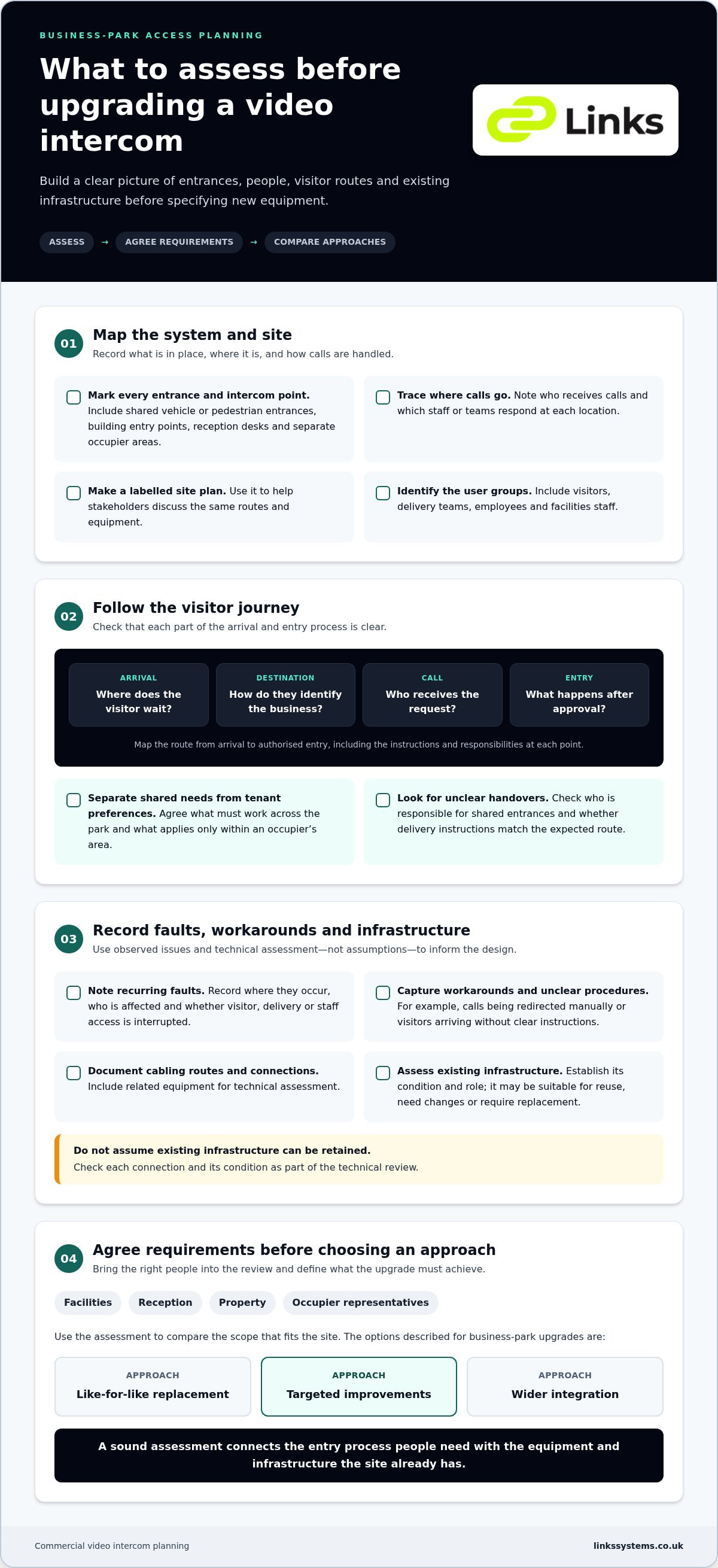
Before specifying new equipment, record how entry works across the site. A business park may have a shared vehicle or pedestrian entrance, individual building entry points, reception desks and separate occupier areas. Distinguish what is already in place from what each location needs, so the design responds to actual use rather than assumptions.
Build an accurate picture of the existing system
Map every entrance and intercom point, noting where calls are received and which staff or teams respond. Record the user groups involved, including visitors, delivery teams, employees and facilities staff. A simple site plan with labelled entry points helps stakeholders discuss the same routes and equipment.
Capture recurring faults, workarounds and unclear procedures, such as calls being redirected manually or visitors arriving at an entrance without clear instructions. Also document cabling routes, connections and related equipment for technical assessment. Existing infrastructure may be suitable for reuse, need changes or require replacement. Assess its condition and role rather than assuming it can be retained.
Set requirements for tenants, visitors and site teams
Separate requirements shared across the park from requests specific to individual occupiers. A common entrance may need a consistent way to identify a visitor’s destination, while a tenant may have separate arrangements for receiving guests at its building. Agreeing these boundaries helps create a coherent site-wide process without overlooking different operating needs.
Map the visitor journey from arrival to authorised entry. Note where a visitor waits, how they identify the business they are visiting, who receives the call and what happens after access is approved. Include facilities, reception, property and occupier representatives. Their input can reveal practical gaps, such as unclear responsibility for a shared entrance or delivery instructions that do not match the expected visitor route.
Use the assessment to define what the upgrade must achieve before choosing an approach. Useful records include:
- Entrance locations, intercom points and call-receiving locations.
- Current users, visitor routes and entry procedures.
- Observed faults, manual workarounds and unclear responsibilities.
- Existing cabling and connected equipment requiring technical review.
- Any relationship with access control or other site systems.
Where the project involves connected security systems, consider how the intercom fits within the wider site design. This guide to physical security integration for commercial buildings explains why system relationships matter during planning. Assess compatibility for the specific equipment and site; do not assume existing connections will support a new system without review.
A thorough assessment gives a video intercom upgrade for business park Hertfordshire project a sound basis for design, sequencing and commissioning. Links Integrated Systems plans and installs commercial IP video intercom systems. Explore commercial video intercom systems as part of your project planning.
Compare video intercom upgrade approaches for Hertfordshire business parks
There is no single scope that suits every business park. A focused replacement may address a limited entrance requirement, while a wider project may be more appropriate if visitor handling needs to work alongside access control or other site systems. The right choice depends on survey findings, user workflows and the condition of existing equipment, not a fixed package.
Use the comparison below to frame project discussions. Operational impact and coordination will depend on the site layout and how its entrances are used.
| Approach | Operational impact | Infrastructure review | Coordination needs |
|---|---|---|---|
| Like-for-like replacement | Primarily focused on restoring or updating the intercom function at a defined entrance. | Review the existing cabling and connected equipment; suitability for reuse needs technical assessment. | Coordinate access to the affected entrance and agree how calls will be handled during the work. |
| Targeted improvement | Addresses specific gaps, such as call handling at selected entry points or clearer arrangements for a particular occupier. | Assess the components and connections related to the areas being changed, including dependencies on the wider system. | Align the work with the occupiers and teams who use the affected entrances. |
| Wider system integration | Considers coordinated workflows across the intercom, access control and other connected systems. | Review interfaces, existing equipment and system relationships before developing the design. | Involve relevant site, property and occupier stakeholders to agree how processes should work across shared areas. |
Like-for-like replacement or broader system improvement?
A like-for-like approach can suit a limited requirement, such as replacing an intercom at one entrance where the visitor process still works. Targeted improvement may be more appropriate if only certain entry points or occupier arrangements need to change. Consider broader integration when the site needs the intercom and access control to support a coordinated entry workflow. Recommendations should follow the site assessment, not an assumption that a larger or smaller scope is always preferable.
How do existing infrastructure and occupancy affect scope?
Business parks remain in use during upgrade planning, so consider how staff, visitors and delivery teams use shared areas throughout the working day. Tenant access needs may differ, and a change at a shared entrance can affect several occupiers. Existing cabling and connected equipment also shape the technical design, but their presence alone does not mean they can be retained. Assess dependencies for the specific site before agreeing the final specification.
Where CCTV forms part of the wider design, guidance on integrating CCTV with access control systems can help frame the discussion about connected equipment. A video intercom upgrade for business park Hertfordshire project benefits from clear scope boundaries, agreed user workflows and coordination between affected teams. Links Integrated Systems can develop a commercial upgrade from assessment through installation and commissioning. Explore IP video intercom system support as part of your planning.
How to plan a low-disruption video intercom upgrade
Keeping an occupied business park operating during an intercom upgrade depends on a coordinated project plan. The aim is not to promise uninterrupted access, but to identify where work could affect entry and agree practical arrangements before installation begins. A clear sequence also gives property teams and occupiers a shared understanding of what will happen and who is responsible at each stage.
Use an ordered process to move from assessment to operational handover:
- Survey: Review entrances, existing equipment and site conditions. Note where installation activity could affect staff, visitors or deliveries.
- Confirm requirements: Agree how calls should be received, how authorised entry is managed and which shared or occupier-specific procedures the design must support.
- Develop the design: Set out the proposed equipment and relevant connections to access control, based on the survey and agreed requirements.
- Plan installation: Confirm work areas, access arrangements, responsibilities and the sequence for each affected entrance.
- Commission: Check the installed system against the agreed project requirements and address issues identified during testing.
- Handover: Provide user guidance and relevant system documentation, and agree how ongoing maintenance will be planned.
Coordinate the work around business-park operations
Identify busy entrances, operating patterns and site-specific access constraints during planning. A pedestrian entrance used heavily at the start of the working day may need a different work sequence from a less-used entrance. Agree who will communicate with tenants, how temporary access arrangements will be shared and which site contact will coordinate operational questions. Where the survey and site conditions support it, phase work by entrance or area.
For a video intercom upgrade for business park Hertfordshire site, responsibilities should be clear before work starts. Property or facilities teams can coordinate site-wide information, while occupiers brief their staff on agreed changes to entry procedures. Set out how to direct visitors and deliveries if an entrance is temporarily affected, and make sure relevant teams understand the arrangements.
Commission the system and prepare users
Commissioning checks that the installed system has been set up against the project requirements. Review the intended call and entry processes at the locations within scope, rather than treating installation completion alone as handover. Record any findings and resolve them as part of project close-out.
Give users clear guidance on receiving calls and following the agreed access procedure. Provide operational handover information and relevant system documentation to the people responsible for day-to-day use. Maintenance planning supports continued attention to the system after commissioning, without assuming a particular performance outcome is guaranteed.
Links Integrated Systems installs, commissions and maintains commercial IP video intercom systems. Plan your video intercom upgrade around site operations from the outset.
Upgrade your Hertfordshire business-park intercom with Links Integrated Systems
Links Integrated Systems designs, supplies, installs, commissions and maintains commercial IP video intercom and physical access-control systems. For a business park, an upgrade needs to account for more than the equipment at the entrance. It should reflect how property teams, facilities staff, occupiers, visitors and delivery teams use the site, and how access responsibilities are shared.
The project starts with the site’s requirements and the role of each entrance. The scope can then be shaped around existing conditions, user workflows and wider access-control arrangements where relevant. This keeps the proposed work specific to the site rather than relying on a standard package. It also gives facilities and property teams a clear basis for coordinating decisions with occupiers.
A project approach suited to commercial sites
Planning brings the right stakeholders into the process early. Property and facilities teams can outline site-wide needs, while business occupiers explain how calls are received and entry is managed in their areas. Links Integrated Systems uses this information to develop a project scope that reflects shared requirements and relevant differences between users.
Professional installation and commissioning are connected stages of the work. Installation puts the agreed design in place; commissioning checks the completed system against project requirements. Where the scope calls for it, the intercom can be considered alongside physical access control. Coordination is built into the project rather than left until after the design is agreed.
Plan for long-term system operation
Handover should make clear how the intercom is used and who manages user administration. Agreeing ownership of these tasks helps avoid uncertainty when occupiers or staff change. Operational guidance and relevant system documentation give site teams a reference after installation.
Scheduled maintenance can form part of the system’s ongoing care. It provides a planned basis for reviewing and maintaining the installed equipment, alongside commissioning at project completion. The arrangements should reflect the system and site requirements.
A video intercom upgrade for business park Hertfordshire teams can be planned as a complete commercial project, from understanding entry needs through design, installation and commissioning to ongoing maintenance. Links Integrated Systems supports commercial sites in Hertfordshire, London, Kent, Surrey and Essex with IP video intercom and access-control systems.
To discuss your site’s requirements and plan an upgrade suited to its users and operating arrangements, discuss a video intercom upgrade with Links Integrated Systems.
Set your next upgrade in motion
Turn the site assessment into a concise project brief. Set out which entrances matter most, how visitors should be directed, who will manage access decisions and what occupiers need from the process. This gives property and facilities teams a practical starting point for agreeing priorities, responsibilities and scope before detailed planning begins.
For a video intercom upgrade for business park Hertfordshire project, clarity at this stage helps keep decisions grounded in how the site operates. It also gives stakeholders a shared reference as the design develops, especially where common entrances serve several businesses. Links Integrated Systems can shape the project around these requirements, with commercial IP video intercom installation, commissioning and scheduled maintenance as part of the service.
Bring your site priorities and access requirements into the first conversation, then develop a plan suited to your occupiers and operating arrangements. Discuss a video intercom upgrade for your Hertfordshire site with Links Integrated Systems.
Frequently Asked Questions
Can a business-park video intercom be upgraded without replacing the whole access-control system?
Yes, an intercom can sometimes be upgraded independently if the existing access-control equipment and connections suit the proposed design. A technical assessment should establish how the intercom communicates with door controls and whether those interfaces can be retained. For example, replacing equipment at one visitor entrance may have a narrower scope than changing how several buildings manage entry. Verify compatibility before finalising the system design.
How can a video intercom upgrade minimise disruption to tenants?
Give tenants practical notice of which entrances may be affected, when work is planned and what temporary arrangements apply. A named site contact and a clear way to report access issues can reduce confusion during installation. Where a shared entrance serves several occupiers, issue consistent instructions to all affected businesses. Account for deliveries and visitors as well as staff, so temporary directions make sense to people unfamiliar with the site.
How long does it take to upgrade a commercial video intercom?
There is no reliable fixed duration without understanding the site and agreed scope. Work involving one entrance may differ substantially from an upgrade across several buildings or one that includes connected access-control equipment. Cable routes, site access arrangements and the sequence of work also affect the programme. A survey helps identify these factors and plan the work stages and coordination with occupiers.
Can one video intercom system serve multiple businesses on a business park?
Yes, a system can be designed for multiple businesses where its functions and configuration suit the site’s requirements. Planning should establish how visitors select the business they are visiting, who receives each call and who is authorised to manage relevant user details. For a video intercom upgrade for business park Hertfordshire sites, clearly distinguish shared entrances from tenant-controlled areas. The system design must reflect the agreed responsibilities.
What should a business park assess before replacing an old video intercom?
Alongside the equipment, review who holds system records, how user permissions are managed and what information is available about previous changes or faults. Check whether current procedures match actual visitor routes, including entrances used by contractors and delivery drivers. These operational details can reveal issues that are not obvious from inspecting the intercom unit alone. A concise record helps the project team decide what needs to change and what should remain in scope.
Does a commercial video intercom upgrade need to consider data protection?
Yes, particularly if the system captures or records identifiable images or audio. The organisation responsible for the site should consider what information is collected, why it is needed, who can access it and how long it is retained. Live viewing and recorded footage can raise different operational questions. Involve the organisation’s data protection lead when setting requirements, and refer to current Information Commissioner’s Office guidance for relevant UK data-protection considerations.
Can an IP video intercom integrate with CCTV and access control?
It may be possible, depending on the equipment, interfaces and intended workflow. A project might consider how staff use intercom calls alongside CCTV images, or how an approved entry decision relates to access control. These functions do not automatically become one system simply because they are installed at the same site. Define the practical outcome first, then assess the existing and proposed equipment to determine an appropriate design.
What happens during video intercom commissioning?
Commissioning checks the installed system against the requirements agreed for the project. Practical checks may include placing calls from relevant entrances, confirming that they reach the intended users and reviewing audio and video at both ends. If door release or access-control functions are included, test their agreed operation as well. Record the outcome, provide relevant operating information and identify issues that need resolving before handover.